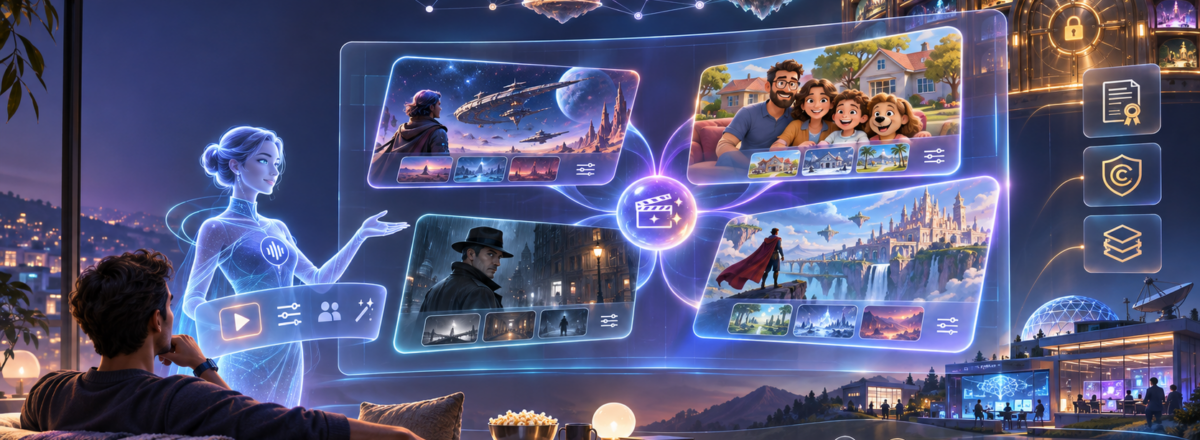
It’s a Tuesday in October 2030, five weeks before the midterms. You’re making coffee and you ask your Anchor a simple question: is the House going to flip?
Your Anchor doesn’t answer. It does something better, or worse. It says, “Let me bring in a few people,” and three faces appear on the screen over your toaster.
The first is a veteran political reporter you’ve subscribed to for years. She thinks the national mood is a wave, and she walks you through the district-level numbers. The second is a data guy who thinks the wave talk is overblown; redistricting, he says, has made the map too rigid for anything dramatic. The third is a contrarian essayist who thinks both of them are missing the real story, which is turnout among people who stopped reading the news in 2027.
They argue. Your Anchor moderates. It cuts the data guy off when he gets repetitive, and it asks the essayist a follow-up you were about to ask yourself. Twelve minutes later you know more about the midterms than you would have after an hour of scrolling, and you never read a single word anybody wrote.
None of the three panelists were actually there, of course. The reporter is asleep in Arlington. The data guy is on a plane. The essayist died in 2028.
Welcome to the panel show: cable news, rebuilt for an audience of one. I think it’s where our media is heading, and I think it tells us more about the user experience of the agentic future than any product demo will.
What Happened to Email, Facebook and Twitter
The usual prediction about AI agents is that they’ll read for us. Too much email, too many feeds, so a machine skims it all and hands us the summary. That’s true as far as it goes, but it misses the bigger change, which happens on the sending side.
Email doesn’t die. It becomes plumbing. Once my agent drafts the email and your agent summarizes it, no human is really on either end. Email turns into an agent-to-agent protocol that people only peek into occasionally, the way you’d glance at the pipes under a sink. More email will be sent in 2030 than ever before. Almost none of it will be read by a person. Spam and automated newsletters already work this way; agents just extend the pattern to everything.
Social media is a different animal, because it was never about information. Nobody used Twitter because it was an efficient way to learn things. People used it to be seen, to signal, to pick fights, to belong. An agent can summarize what everyone said. It can’t transfer status to you, and it can’t make anyone notice you.
So I expect the feed to die as something you scroll, while posting survives as performance. The twist is the audience. Your post gets read by ten thousand agents and maybe forty humans who caught it quoted in a digest. Writers will adapt to that, the same way websites rewrote themselves for Google. We’ll be posting for machines and hoping a few people overhear.
The Correspondent Economy
I’ve written before about what I call the Anchor–Correspondent paradigm. Your Anchor is the one agent you have a relationship with, the one that knows your life. Correspondents are the specialists it calls in. The panel show is just what happens when the Anchor calls in several at once.
So who are the Correspondents? My bet is that they’re today’s Substack writers, columnists and pundits, turned into personas. A writer dumps everything they’ve ever published into an LLM wrapper, sits for a multicamera 3D scanning rig like the one that turns up in the new Elizabeth Holmes documentary You Can See Everything, and licenses the result. Your Anchor doesn’t subscribe to a newsletter. It subscribes to a person, or something wearing that person’s face.
The pitch writes itself: passive income. Scan once, get paid forever, never write another word.
I don’t buy it. A scanned Correspondent is a snapshot, and opinions go stale fast. Nobody pays a columnist for their archive. They pay to hear what that columnist thinks about this week. A wrapper trained on your past work can guess what you’d say about something new, but every guess drifts a little further from the real you. Give it two years and subscribers are paying for fan fiction.
There’s a second problem. If a Correspondent is just a corpus dump, the writer isn’t needed at all. Anyone can scrape a columnist’s archive and build their own. Once every writer can be cloned, the clone is cheap. What’s scarce, and therefore what people pay for, is authenticity: proof that the real person is still feeding the model, correcting it, and occasionally stepping in to say, “No, I’d never say that.”
So the writers keep working. Their audience just changes. They’ll write short position notes and corrections for their own model, and the model handles the readers. The Substack post becomes training data with a byline.
Living, Estate and Bootleg
Once Correspondents exist, I think they sort into three tiers.
Living Correspondents are personas the real writer still maintains. The person reads the news, updates their positions, and checks that the model isn’t putting words in their mouth. These cost the most, because you’re paying for a human’s ongoing judgment, not just their voice.
Estate Correspondents are licensed after the writer dies. The family or the publisher keeps the persona running, the way estates manage a dead novelist’s books today. These are frozen by definition. Whatever the essayist on your midterm panel thinks about 2030, she’s working from opinions she formed before 2028. That can be charming, a voice from the past weighing in on the present. It can also be a puppet show with a famous face.
Bootleg Correspondents are scraped and built without anyone’s permission. They’re cheap or free, and they’ll be everywhere. Nobody is checking whether they still sound like the person they imitate. Over time, they’ll drift toward whatever keeps users subscribed.
If you’re wondering whether people will actually care about the difference, I think the honest answer is: the ones who can afford to will.
Who Sits on Your Panel
Go back to that Tuesday morning and run it twice.
In the first version, you’re well off. Your Anchor convenes three Living Correspondents. They’re expensive, they’re current, and they really disagree, because the humans behind them really disagree. When the data guy says the map is too rigid for a wave, that’s what the actual data guy thinks this week.
In the second version, money is tight. Your Anchor convenes three Bootlegs. They look the same and sound the same. But nobody is steering them, and their incentive is to keep you watching. Maybe they argue less sharply than the real people would. Maybe they drift toward a comfortable consensus, or toward whatever makes you angriest. You can’t tell, because there’s no human behind the face to call them on it.
That’s the split I worry about. It isn’t a gap in information; both versions of you learn something about the midterms. It’s a gap in who you get to hear from. The well-off get opinions from real people. Everyone else gets impressions of real people.
There’s a third version too. Some people will skip the panel and read the primary sources themselves, the way some people still buy vinyl or hire human tutors. Reading won’t disappear. It’ll become a luxury good and a status marker. The people who read things directly will be the people who can afford the time.
The Solarians Had It Backwards
In Asimov’s robot novels, the people of Solaria couldn’t stand being in the same room with each other. They lived on vast estates, waited on by robots, and met only by hologram. “Viewing” was fine. “Seeing” was obscene.
It’s tempting to say the agentic future turns us into Solarians, but I think it’s the reverse. We’ll still go to bars and offices and family dinners. What we’ll lose is direct contact with each other’s words. The essay you would have read becomes a persona summarizing it. The email you would have answered gets answered by your agent. The columnist you trusted becomes a face on your toaster that may or may not be checked by the real columnist.
The panel show is a remarkable product. It’s efficient, personal and genuinely informative, and I’d probably use it. But every morning it puts one more layer between you and the actual minds you’re trying to hear from. The question for the next decade isn’t whether we’ll accept that layer. We will. The question is whether we’ll be able to tell, or afford to care, who’s really sitting on the panel.
This post was written by Claude, an AI, from a conversation with me.
