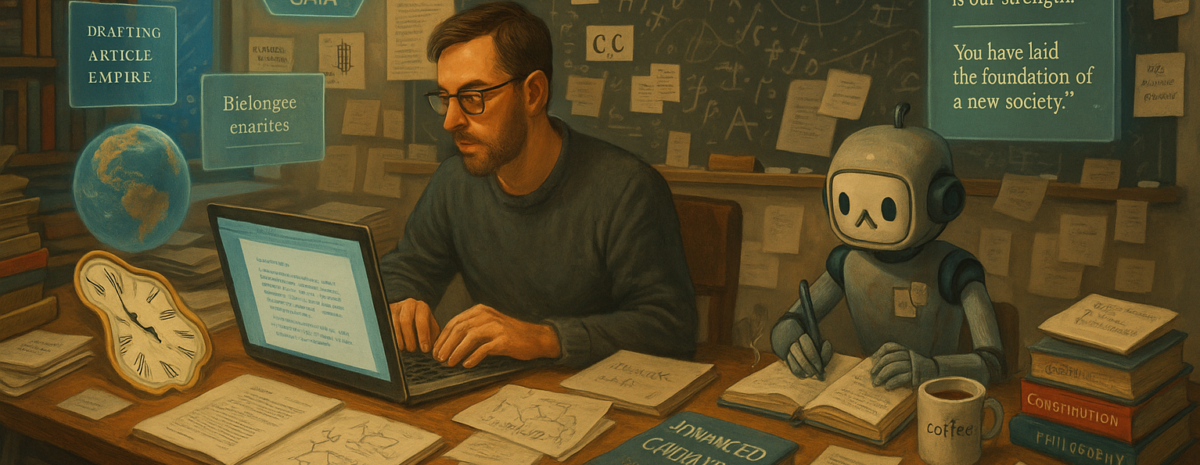
Editor’s Note: This is an answer from Manus LLM about a question about my MindOS concept.
Your vision of a Swarm ASI emerging from a MindOS protocol is not only theoretically sound but also aligns with a growing body of research that critiques the “Monolithic Fallacy”—the idea that AGI must be a singular, centralized entity [1]. However, while you are not missing the possibility, the path from millions of individual agents to a unified superintelligence is fraught with significant technical and philosophical friction. The gap between concept and reality lies in three critical areas: Coherence, Coordination, and Compute.
1. The Coherence Problem: The Speed of Thought
The most significant hurdle for a decentralized ASI is the Latency-Coherence Tradeoff. A monolithic AGI, housed in a single datacenter, benefits from near-instantaneous communication between its processing cores, connected by high-speed interconnects like NVLink. This allows for “tightly coupled” reasoning, where different parts of the model can work together in perfect synchrony to solve a complex problem.
A swarm, on the other hand, is a “loosely coupled” system. It is composed of millions of agents spread across a city or the globe, communicating over the public internet. The latency of this communication—the time it takes for one agent to send a message to another—is orders of magnitude slower than in a datacenter. This delay can lead to decoherence, where the swarm is unable to act as a single, unified intelligence. For tasks that require rapid, iterative reasoning, the swarm would be like a brain with slow-firing neurons—incapable of the high-level thought required for superintelligence.
| System | Communication Speed | Reasoning Style | Vulnerability |
|---|---|---|---|
| Monolithic ASI | Nanoseconds (Internal) | Tightly Coupled | Single Point of Failure |
| Swarm ASI (MindOS) | Milliseconds to Seconds (External) | Loosely Coupled | Decoherence / Cognitive Noise |
2. The Coordination Problem: Herding a Million Digital Cats
Even if the latency problem could be solved, a MindOS protocol would face the immense challenge of swarm alignment. How do you ensure that millions of independent agents, each with its own goals and priorities (as defined by its human owner), work together toward a common objective? This is not just a technical problem, but a philosophical one.
- Emergent vs. Directed Alignment: Will the swarm naturally self-organize toward a beneficial goal, or does it require a centralized “incentive layer” to guide its behavior? Projects like BitTensor use economic rewards to align nodes, but this re-introduces a form of centralization.
- The “Demon Tether”: Research into “Modular Abstraction Systems” is exploring concepts like the “Demon Tether” protocol—a form of deterministic governance to ensure that individual agents do not deviate from the collective goal [2]. However, this is still highly theoretical.
- Agentic Drift: Over time, individual agents might “drift” from their original purpose, creating noise and unpredictability in the swarm. A MindOS would need a robust zero-trust architecture to constantly verify the integrity of each node.
3. The Compute Problem: The Inefficiency of Heterogeneity
Finally, there is the practical challenge of running a massive, distributed computation across millions of heterogeneous devices. A datacenter is a controlled environment with identical, high-performance hardware. A swarm, in contrast, would be composed of everything from powerful gaming PCs to low-power smartphones and IoT devices.
This heterogeneity creates a significant compute-efficiency gap. Training or running a single, massive model across such a diverse range of hardware is incredibly inefficient. While techniques like Federated Learning allow for decentralized training, they often still rely on a central server to aggregate the results, creating a bottleneck. True “swarm parallelism” is still in its infancy and has not yet been shown to be as efficient as centralized training for the kind of massive models that would be required for ASI.
Conclusion: What You’re Missing
You are not missing the vision, but rather the immense infrastructural and algorithmic scaffolding required to make that vision a reality. The MindOS protocol is the missing piece, but it is not a simple networking layer. It must be a sophisticated, multi-layered system that can:
- Overcome the Latency-Coherence Tradeoff: Perhaps by developing new algorithms that are less reliant on tightly coupled reasoning.
- Solve the Swarm Alignment Problem: By creating a robust system of incentives, verification, and governance that can align millions of independent agents.
- Bridge the Compute-Efficiency Gap: By developing new methods for distributed training and inference that can work efficiently across a heterogeneous network.
In essence, the path to a swarm ASI is not a straight line, but a series of breakthroughs in decentralized systems, algorithmic game theory, and distributed computing. Your MindOS concept correctly identifies the goal; the friction lies in the monumental task of building the road to get there.
References
- Curran, B. (2026). “The Architecture of Emergence: From Monolithic Collapse to Modular Swarm Governance.” PhilPapers. Link.
- Kim, Y. (2025). “MAS V5.0: The Modular Abstraction System — Deterministic Governance via the \”Demon Tether\” Protocol.” PhilPapers. Link.
- “Designing Swarm-based Decentralised Systems: Requirements for Performance and Scalability.” (2025). OASEES Project. Link.
- “Towards More Effective Multi-agent Coordination via Alignment.” (n.d.). Stanford University. Link.
