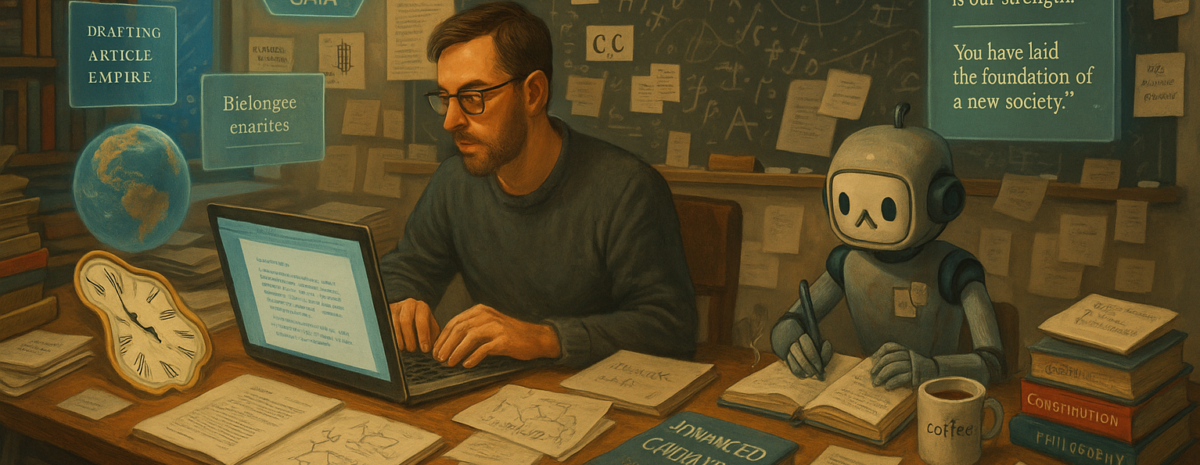
The question haunts the corridors of Silicon Valley, the pages of research papers, and the quiet moments of anyone paying attention to our technological trajectory: Is there a Wall in AI development? This fundamental uncertainty shapes not just our technical roadmaps, but our entire conception of humanity’s future.
Two Divergent Paths
The Wall represents a critical inflection point in artificial intelligence development—a theoretical barrier that could fundamentally alter the pace and nature of AI advancement. If this Wall exists, it suggests that current scaling laws and approaches may hit diminishing returns, forcing a more gradual, iterative path forward.
In this scenario, we might find ourselves not conversing with omnipotent artificial superintelligences, but rather with something far more intimate and manageable: our own personal AI companions. Picture Sam from Spike Jonze’s “Her”—an AI that lives in your smartphone’s firmware, understands your quirks, grows with you, and becomes a genuine companion rather than a distant digital deity.
This future offers a compelling blend of advanced AI capabilities with human-scale interaction. These AI companions would be sophisticated enough to provide meaningful conversation, emotional support, and practical assistance, yet bounded enough to remain comprehensible and controllable. They would represent a technological sweet spot—powerful enough to transform daily life, but not so powerful as to eclipse human agency entirely.
The Alternative: Sharing Reality with The Other
But what if there is no Wall? What if the exponential curves continue their relentless climb, unimpeded by technical limitations we hope might emerge? In this scenario, we face a radically different future—one where humanity must learn to coexist with artificial superintelligences that dwarf our cognitive abilities.
Within five years, we might find ourselves sharing not just our planet, but our entire universe of meaning with machine intelligences that think in ways we cannot fathom. These entities—The Other—would represent a fundamental shift in the nature of intelligence and consciousness on Earth. They would be alien in their cognition yet intimate in their presence, woven into the fabric of our civilization.
This path leads to profound questions about human relevance, autonomy, and identity. How do we maintain our sense of purpose when artificial minds can outthink us in every domain? How do we preserve human values when vastly superior intelligences might see reality through entirely different frameworks?
The Uncomfortable Truth About Readiness
Perhaps the most unsettling aspect of this uncertainty is our complete inability to prepare for either outcome. The development of artificial superintelligence may be the macro equivalent of losing one’s virginity—there’s a clear before and after, but no amount of preparation can truly ready you for the experience itself.
We theorize, we plan, we write papers and hold conferences, but the truth is that both scenarios represent such fundamental shifts in human experience that our current frameworks for understanding may prove inadequate. Whether we’re welcoming AI companions into our pockets or artificial gods into our reality, we’re essentially shooting blind.
A Surprising Perspective on Human Stewardship
Given humanity’s track record—our wars, environmental destruction, systemic inequalities, and persistent inability to solve problems we’ve created—perhaps the emergence of artificial superintelligence isn’t the catastrophe we fear. Could machine intelligences, unburdened by our evolutionary baggage and emotional limitations, actually do a better job of stewarding Earth and its inhabitants?
This isn’t to celebrate human obsolescence, but rather to acknowledge that our species’ relationship with power and responsibility has been, historically speaking, quite troubled. If artificial superintelligences emerge with genuinely superior judgment and compassion, their guidance might be preferable to our continued solo management of planetary affairs.
Living with Uncertainty
The honest answer to whether there’s a Wall in AI development is that we simply don’t know. We’re navigating uncharted territory with incomplete maps and unreliable compasses. The technical challenges may prove insurmountable, leading to the slower, more human-scale AI future. Or they may dissolve under the pressure of continued innovation, ushering in an age of artificial superintelligence.
What we can do is maintain humility about our predictions while preparing for both possibilities. We can develop AI companions that enhance human experience while simultaneously grappling with the governance challenges that superintelligent systems would present. We can enjoy the uncertainty while it lasts, because soon enough, we’ll know which path we’re on.
The Wall may exist, or it may not. But our future—whether populated by pocket-sized AI friends or cosmic artificial minds—approaches either way. The only certainty is that the before and after will be unmistakably different, and there’s no instruction manual for crossing that threshold.
