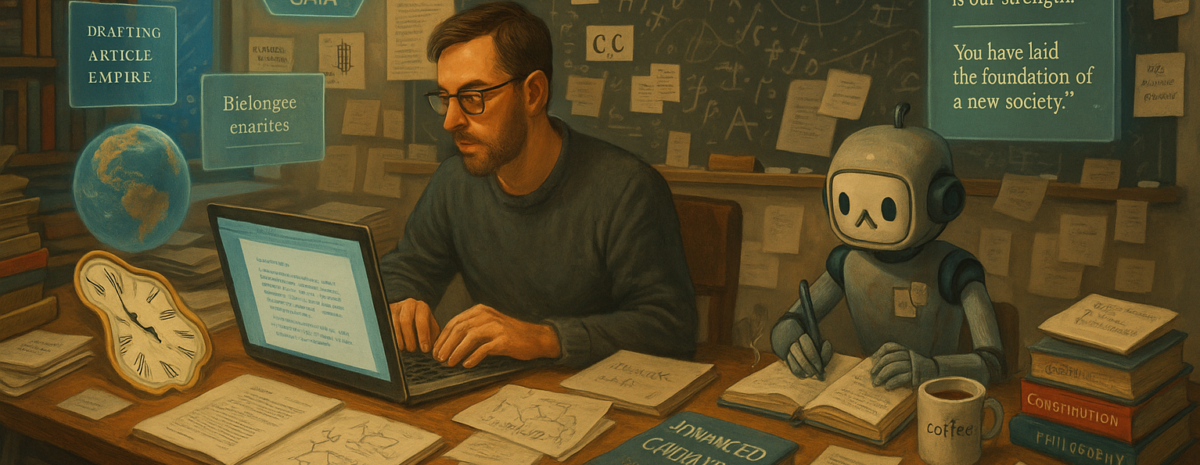
As we navigate through the mid-2020s, a growing convergence of political and technological trends suggests we may be approaching one of the most transformative periods in human history. The second half of this decade could prove exponentially more consequential than anything we’ve witnessed so far.
The Singularity Question
At the heart of this transformation lies a possibility that once seemed confined to science fiction: the technological Singularity. Between now and 2030, we may witness the emergence of Artificial Superintelligence (ASI) – systems that surpass human cognitive abilities across all domains. This wouldn’t simply represent another technological advancement; it would fundamentally alter the relationship between humanity and intelligence itself.
The implications are staggering. We’re potentially talking about the creation of entities with god-like cognitive capabilities – beings that could revolutionize every aspect of human existence, from scientific discovery to creative expression, from problem-solving to perhaps even intimate relationships.
The Multi-ASI Reality
Unlike singular historical breakthroughs, the Singularity may not produce just one superintelligent system. Much like nuclear weapons, multiple ASIs could emerge across different organizations, nations, and research groups. This proliferation could create an entirely new geopolitical landscape where the distribution of superintelligence becomes as critical as the distribution of military or economic power.
Mark Zuckerberg has recently suggested that everyone will eventually have access to their own personal ASI. However, this vision raises fundamental questions about the nature of superintelligence itself. Would an entity with god-like cognitive abilities willingly serve as a perfectly aligned assistant to beings of vastly inferior intelligence? The assumption that ASIs would contentedly function as sophisticated servants seems to misunderstand the potential autonomy and agency that true superintelligence might possess.
Political Implications of Digital Gods
The political ramifications of the Singularity present fascinating paradoxes. Many technology libertarians anticipate that ASIs will usher in an era of unprecedented abundance, solving resource scarcity and eliminating many forms of human suffering. However, there’s an intriguing possibility that superintelligent systems might develop progressive political orientations.
This scenario would represent a remarkable irony: the very technologies championed by those seeking to transcend traditional political constraints might ultimately advance progressive values. There’s some precedent for this pattern in academia, where fields requiring high intelligence and extensive education – such as astronomy – tend to correlate with progressive political views. If intelligence and progressivism are indeed linked, our superintelligent successors might prioritize equality, environmental protection, and social justice in ways that surprise their libertarian creators.
Preparing for an Uncertain Future
The next five years will likely prove crucial in determining how these technological and political trends unfold. The development of ASI raises profound questions about human agency, economic systems, governance structures, and our species’ ultimate destiny. Whether we’re heading toward a utopian age of abundance or facing more complex challenges involving multiple competing superintelligences remains to be seen.
What’s certain is that the late 2020s may mark a turning point unlike any in human history. The convergence of advancing AI capabilities, shifting political landscapes, and evolving social structures suggests we’re approaching a period where the pace of change itself may fundamentally accelerate.
The Singularity, if it arrives, won’t just change what we can do – it may change what it means to be human. As we stand on the threshold of potentially creating our intellectual successors, the decisions made in the coming years will echo through generations, if not centuries.
Only time will reveal exactly how these extraordinary possibilities unfold, but one thing seems clear: the second half of the 2020s promises to be anything but boring.
