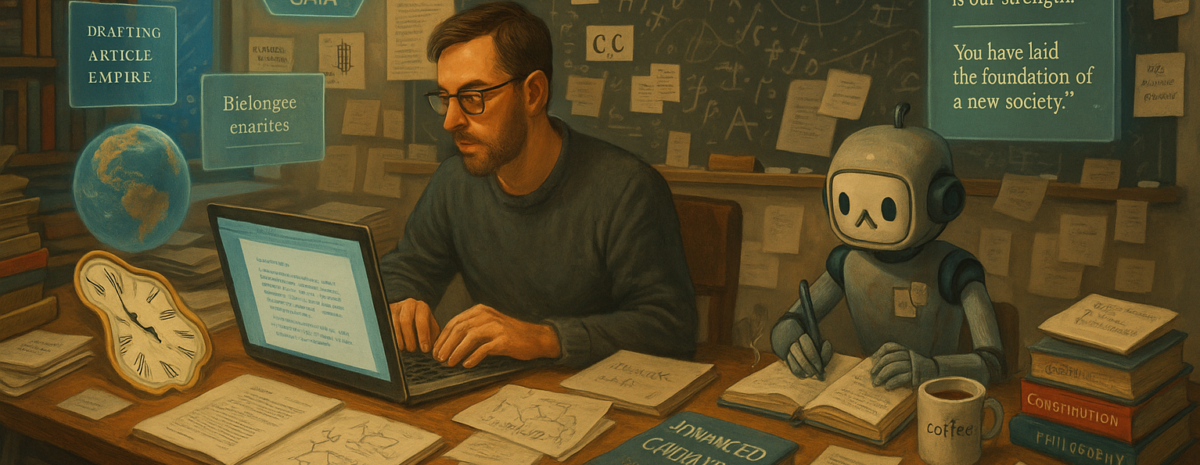
Forget chatbots. The real revolution in AI isn’t about building smarter assistants—it’s about creating a world where your personal AI can interview any expert, living or dead, at any time, for the cost of a Netflix subscription.
The Death of Static Media
We’re rapidly approaching a world where everyone has an LLM as firmware in their smartphone. When that happens, traditional media consumption dies. Why listen to a three-hour Joe Rogan podcast when your AI can interview that same physicist for 20 minutes, focusing exactly on the quantum computing questions that relate to your work in cryptography?
Your personal AI becomes your anchor—like Anderson Cooper, but one that knows your interests, your knowledge level, and your learning style. When you need expertise, it doesn’t search Google or browse Wikipedia. It conducts interviews.
The Expert Bottleneck Problem
But here’s the obvious issue: experts have day jobs. A leading cardiologist can’t spend eight hours fielding questions from thousands of AIs. A Nobel laureate has research to do, not interviews to give.
This creates the perfect setup for what might become one of the most lucrative new industries: AI Expert Twins.
Creating Your Knowledge Double
Picture this: Dr. Sarah Chen, a leading climate scientist, spends 50-100 hours working with an AI company to create her “knowledge twin.” They conduct extensive interviews, feed in her papers and talks, and refine the AI’s responses until it authentically captures her expertise and communication style.
Then Dr. Chen goes back to her research while her AI twin works for her 24/7, fielding interview requests from personal AIs around the world. Every time someone’s AI wants to understand carbon capture technology or discuss climate tipping points, her twin is available for a virtual consultation.
The economics are beautiful: Dr. Chen earns passive income every time her twin is accessed, while remaining focused on her actual work. Meanwhile, millions of people get affordable access to world-class climate expertise through their personal AIs.
The Subscription Reality
Micropayments sound elegant—pay $2.99 per AI interview—but credit card fees would kill the economics. Instead, we’ll see subscription bundles that make expertise accessible at unprecedented scale:
Basic Expert Access ($20/month): University professors, industry practitioners, working professionals across hundreds of specialties
Premium Tier ($50/month): Nobel laureates, bestselling authors, celebrity chefs, former CEOs
Enterprise Level ($200/month): Ex-presidents, A-list experts, exclusive access to the world’s most sought-after minds
Or vertical bundles: “Science Pack” for $15/month covers researchers across physics, biology, and chemistry. “Business Pack” for $25/month includes MBA professors, successful entrepreneurs, and industry analysts.
The Platform Wars
The companies that build these expert twin platforms are positioning themselves to capture enormous value. They’re not just booking agents—they’re creating scalable AI embodiments of human expertise.
These platforms would handle:
- Twin Creation: Working with experts to build authentic AI representations
- Quality Control: Ensuring twins stay current and accurate
- Discovery: Helping personal AIs find the right expert for any question
- Revenue Distribution: Managing subscriptions and expert payouts
Think LinkedIn meets MasterClass meets Netflix, but operating at AI speed and scale.
Beyond Individual Experts
The really interesting development will be syndicated AI interviews. Imagine Anderson Cooper’s AI anchor conducting a brilliant interview with a leading epidemiologist about pandemic preparedness. That interview becomes intellectual property that can be licensed to other AI platforms.
Your personal AI might say: “I found an excellent interview that BBC’s AI conducted with that researcher last week. It covered exactly your questions. Should I license it for my Premium tier, or would you prefer I conduct a fresh interview with their twin?”
The best interviewer AIs—those that ask brilliant questions and draw out insights—become content creation engines that can monetize the same expert across millions of individual consumers.
The Democratization of Genius
This isn’t just about convenience—it’s about fundamentally democratizing access to expertise. Today, only Fortune 500 companies can afford consultations with top-tier experts. Tomorrow, anyone’s AI will be able to interview their digital twin for the cost of a monthly subscription.
A student in rural Bangladesh could have their AI interview Nobel laureate economists about development theory. An entrepreneur in Detroit could get product advice from successful Silicon Valley founders. A parent dealing with a sick child could access pediatric specialists through their AI’s interview.
The Incentive Revolution
The subscription model creates fascinating incentives. Instead of experts optimizing their twins for maximum interview volume (which might encourage clickbait responses), they optimize for subscriber retention. The experts whose twins provide the most ongoing value—the ones people keep their subscriptions active to access—earn the most.
This rewards depth, accuracy, and genuine insight over viral moments or controversial takes. The economic incentives align with educational value.
What This Changes
We’re not just talking about better access to information—we’re talking about a fundamental restructuring of how knowledge flows through society. When any personal AI can interview any expert twin at any time, the bottlenecks that have constrained human learning for millennia start to disappear.
The implications are staggering:
- Education becomes infinitely personalized and accessible
- Professional development accelerates as workers can interview industry leaders
- Research speeds up as scientists can quickly consult experts across disciplines
- Decision-making improves as anyone can access world-class expertise
The Race That’s Coming
The companies that recognize this shift early and invest in building the most compelling expert twin platforms will create some of the most valuable businesses in history. Not because they have the smartest AI, but because they’ll democratize access to human genius at unprecedented scale.
The expert twin economy is coming. The only question is: which platform will you subscribe to when you want your AI to interview Einstein’s digital twin about relativity?
Your personal AI anchor is waiting. And so are the experts.
