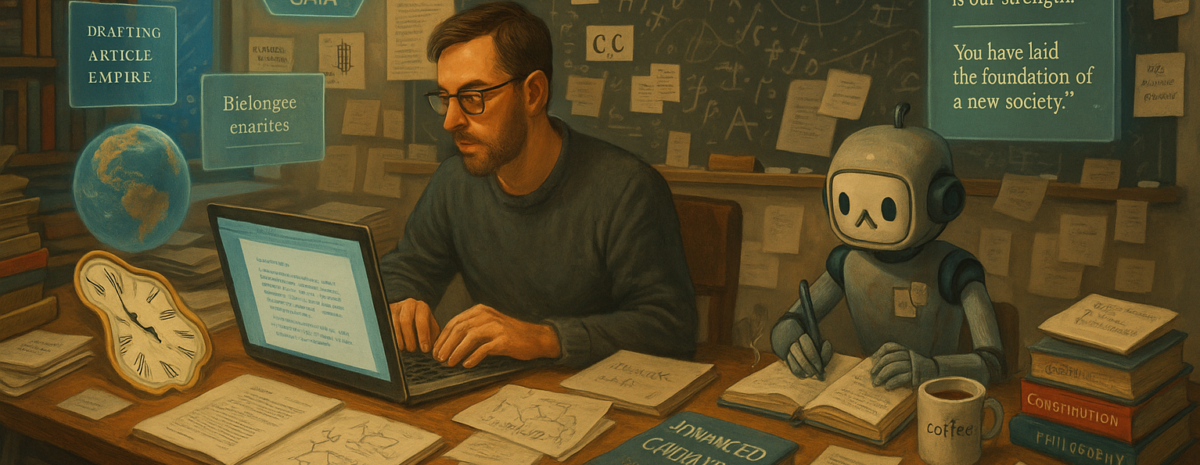
We’re overthinking the future of AI-powered news consumption. Everyone’s debating whether we’ll have one personal AI or multiple specialized news AIs competing for our attention. But television already solved this problem decades ago with one of media’s most enduring innovations: the anchor-correspondent model.
The Coming Fragmentation
Picture this near future: everyone has an LLM as firmware in their smartphone. You don’t visit news websites anymore—you just ask your AI “what’s happening today?” The web becomes an API layer that your personal AI navigates on your behalf, pulling information from hundreds of sources and synthesizing it into a personalized briefing.
This creates an existential crisis for news organizations. Their traditional model—getting you to visit their sites, see their ads, engage with their brand—completely breaks down when your AI is extracting their content into anonymous summaries.
The False Choice
The obvious solutions seem to be:
- Your personal AI does everything – pulling raw data from news APIs and repackaging it, destroying news organizations’ brand value and economic models
- Multiple specialized news AIs compete for your attention – creating a fragmented experience where you’re constantly switching between different AI relationships
Both approaches have fatal flaws. The first commoditizes journalism into raw data feeds. The second creates cognitive chaos—imagine having to build trust and rapport with dozens of different AI personalities throughout your day.
The Anchor Solution
But there’s a third way, and it’s been hiding in plain sight on every evening newscast for the past 70 years.
Your personal AI becomes your anchor—think Anderson Cooper or Lester Holt. It’s the trusted voice that knows you, maintains context across topics, and orchestrates your entire information experience. But when you need specialized expertise, it brings in correspondents.
“Now let’s go to our BBC correspondent for international coverage…”
“For market analysis, I’m bringing in our Bloomberg specialist…”
“Let me patch in our climate correspondent from The Guardian…”
Your anchor AI maintains the primary relationship while specialist AIs from news organizations provide deep expertise within that framework.
Why This Works
The anchor-correspondent model succeeds because it solves multiple problems simultaneously:
For consumers: You maintain one trusted AI relationship that knows your preferences, communication style, and interests. No relationship fragmentation, no switching between personalities. Your anchor provides continuity and context while accessing the best expertise available.
For news organizations: They can charge premium rates for their “correspondent” AI access—potentially more than direct subscriptions since they’re being featured as the expert authority within millions of personal briefings. They maintain brand identity and demonstrate specialized knowledge without having to compete for your primary AI relationship.
For the platform: Your anchor AI becomes incredibly valuable because it’s not just an information service—it’s a cognitive relationship that orchestrates access to the world’s expertise. The switching costs become enormous.
The Editorial Intelligence Layer
Here’s where it gets really interesting. Your anchor doesn’t just patch in correspondents—it editorializes about them. It might say: “Now let’s get the BBC’s perspective, though keep in mind they tend to be more cautious on Middle East coverage” or “Bloomberg is calling this a buying opportunity, but remember they historically skew optimistic on tech stocks.”
Your anchor AI becomes an editorial intelligence layer, helping you understand not just what different sources are saying, but how to interpret their perspectives. It learns your biases and blind spots, knows which sources you trust for which topics, and can provide meta-commentary about the information landscape itself.
The Persona Moat
The anchor model also creates the deepest possible moat. Your anchor AI won’t just know your news preferences—it will develop a personality, inside jokes, ways of explaining things that click with your thinking style. It will become, quite literally, your cognitive companion for navigating reality.
Once that relationship is established, switching to a competitor becomes almost unthinkable. It’s not about features or even accuracy—it’s about cognitive intimacy. Just as viewers develop deep loyalty to their favorite news anchors, people will form profound attachments to their AI anchors.
The New Value Chain
In this model, the value chain looks completely different:
- Personal AI anchors capture the relationship and orchestration value
- News organizations become premium correspondent services, monetizing expertise rather than attention
- Platforms that can create the most trusted, knowledgeable, and personable anchors win the biggest prize in media history
We’re not just talking about better news consumption—we’re talking about a fundamental restructuring of how humans access and process information.
Beyond News
The anchor-correspondent model will likely extend far beyond news. Your AI anchor might bring in specialist AIs for medical advice, legal consultation, financial planning, even relationship counseling. It becomes your cognitive chief of staff, managing access to the world’s expertise while maintaining the continuity of a single, trusted relationship.
The Race That Hasn’t Started
The companies that recognize this shift early—and invest in creating the most compelling AI anchors—will build some of the most valuable platforms in human history. Not because they have the smartest AI, but because they’ll sit at the center of billions of people’s daily decision-making.
The Knowledge Navigator wars are coming. And the winners will be those who understand that the future of information isn’t about building better search engines or chatbots—it’s about becoming someone’s most trusted voice in an increasingly complex world.
Your AI anchor is waiting. The question is: who’s going to create them?
