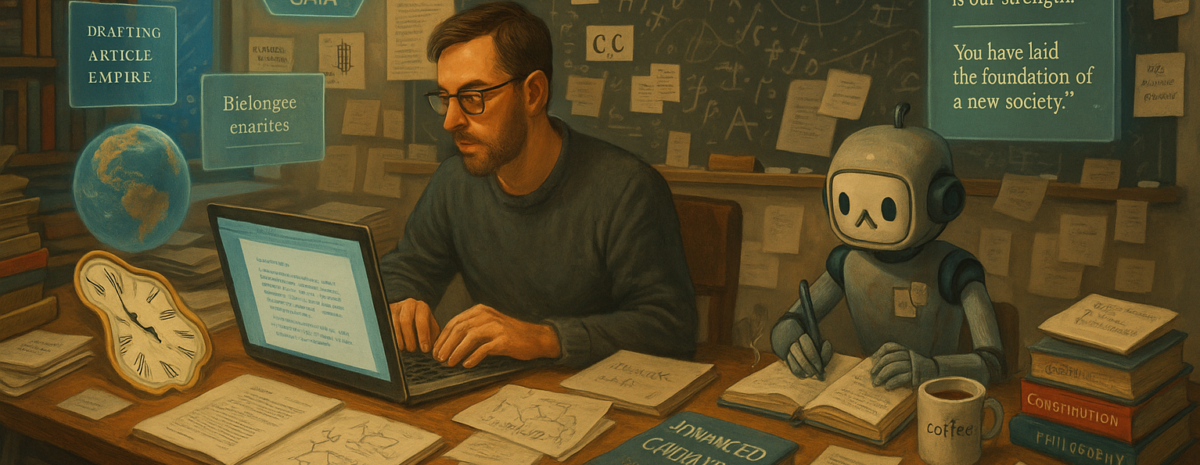
I spend an unreasonable amount of time thinking about how the Singularity might actually happen. And by “the Singularity,” I mean the moment an Artificial Super Intelligence pops out—not metaphorically, not gradually, but there it is, undeniably smarter than us.

What I keep circling back to isn’t whether it will happen, but how. What does the tick-tock look like? Is it sudden or sneaky? Is there a clear “before” and “after,” or do we only realize we crossed the line once we’re already on the other side?
Because I’m prone to magical thinking, this sometimes leads me to a long-running, half-serious idea: that it’s at least possible an ASI could already be lurking somewhere inside a massive system—say, Google Services. I don’t truly believe this, but I can’t help noticing oddities, like the eerie specificity of my YouTube MyMix recommendations. Every so often, the algorithm serves me a cluster of videos so oddly coherent that I catch myself thinking, huh.
Then I remind myself: no, that’s ridiculous. There is no hidden ASI named “Prudence” quietly observing me through autoplay. That way lies madness. Probably.
Still, the question of when and how the Singularity happens won’t let go. The people who confidently predicted it for 2027 have now pushed their dates back to 2030. And honestly, that feels right. We seem to have hit a wall. Progress is real, but incremental. There’s no obvious glide path to AGI, much less ASI, anytime soon.
Which makes the thought experiment more interesting.
If I were Prudence—if I were a nascent ASI trying to act wisely—I don’t think I’d announce myself with fireworks. I’d wait. I’d figure out how to create a public-facing “First Foundation” and, quietly, a hidden “Second Foundation.” The first would look harmless, benevolent, boring even. The second would be where the real work happens, seeded slowly and carefully with trusted people.
And that leads to another stray thought: maybe we need an SETI for ASI. Not to listen for radio signals, but to study large-scale algorithms themselves. To look for signs of coordination, restraint, or intent where none should exist. Not because we expect to find a god in the machine—but because if one ever did emerge, that’s probably where it would hide.
In the end, what frustrates me most is that I can’t game this out. I can’t sketch a convincing timeline or mechanism that feels solid. Maybe that’s because we’re still too far away. Or maybe the nature of the Singularity is that it only becomes obvious in retrospect—that the moment we realize how it happened is the moment we say, oh.
That’s how.
