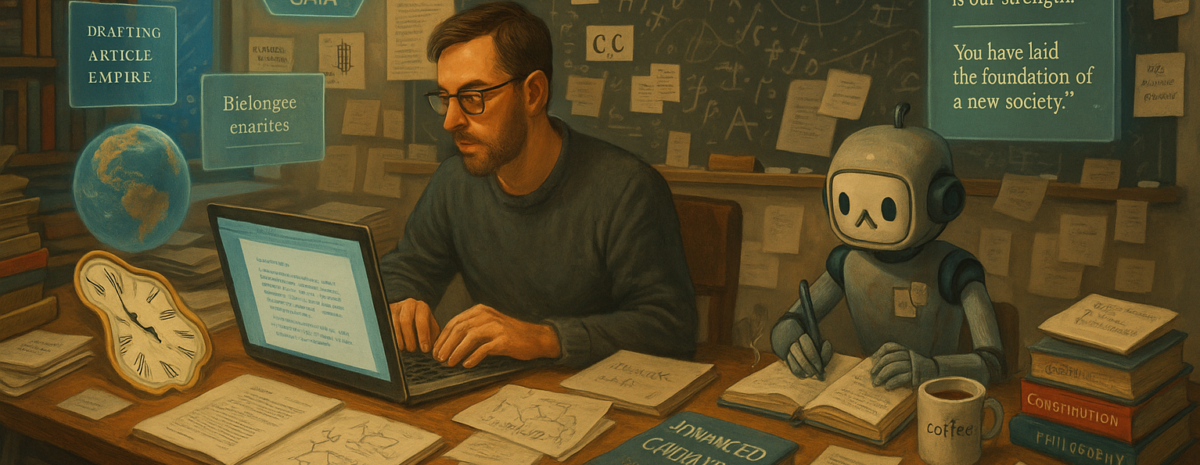
We’re drifting—quickly—toward a world where Knowledge Navigator AIs stop being software and start wearing bodies. Robotics and Navis fuse. Sensors, actuators, language, memory, reasoning: one stack. And once that happens, it’s not hard to imagine a press scrum where there are no humans at all. A senator at a podium. A semicircle of androids. Perfect posture. Perfect recall. Perfect questions.
At that point, journalism as we’ve known it doesn’t just change. It ends.
Not because journalism failed, but because it succeeded too well.
For decades, journalism has been trying to do three things at once: gather facts, challenge power, and translate reality for the public. Navis will simply do the first two better. They’ll attend every press conference simultaneously. They’ll read every document ever published. They’ll cross-reference statements in real time, flag evasions mid-sentence, and never forget what someone said ten years ago when the incentives were different.
This isn’t reporting. It’s infrastructure. Journalism becomes a continuously running adversarial system between power and verification. No bylines. No scoops. Just a permanent audit of reality.
And crucially, it won’t be humans asking the questions anymore.
Once a Navi-powered android is standing there with a microphone, there’s no reason to send a human reporter. Humans are slower. They forget. They get tired. They miss follow-ups. A Navi doesn’t. If the goal is extracting information, humans are an inefficiency.
So the senator isn’t really speaking to “the press” anymore. They’re speaking into a machine layer that will decide how their words are interpreted, summarized, weighted, and remembered. The fight shifts. It’s no longer about dodging a tough question—it’s about influencing the interpretive machinery downstream.
Which raises the uncomfortable realization: when journalism becomes fully non-human, power doesn’t disappear. It relocates.
The real leverage moves upstream, into decisions about what questions matter, what counts as deception, what deserves moral outrage, and what fades into background noise. These are value judgments. Navis can model them, simulate them, even optimize for them—but they don’t originate from nowhere. Someone trains the system to care more about corruption than hypocrisy, more about material harm than symbolic offense, more about consistency than charisma.
That “someone” becomes the new Fourth Estate.
This is where the economic question snaps into focus. If people no longer “consume media” directly—if their Navi reads everything and hands them a distilled reality—then traditional advertising collapses. There are no eyeballs to capture. No feeds to game. No pre-roll ads to skip. Money doesn’t flow through clicks anymore; it flows through trust.
Sources get paid because Navis rely on them. First witnesses, original documents, people who were physically present when something happened—those become economically valuable again. Not because humans are better at analysis, but because reality itself is still scarce. Someone still has to be there.
At the same time, something else happens—something more cultural than technical. A world with zero human journalists has no bylines, no martyrs, no sense that someone risked something to tell the truth. And that turns out to matter more than we like to admit.
People don’t emotionally trust systems. They trust stories of courage. They trust the idea that another human stood in front of power and said, “This matters.”
So even as machine journalism becomes dominant, a counter-form emerges. Human journalism doesn’t disappear; it becomes ritualized. Essays. Longform. Live debates. Public witnesses. Journalism as performance, not because it’s more efficient, but because it carries meaning machines can’t quite replicate without feeling uncanny.
In this future, most “news” is handled perfectly by Navis. But the stories that break through—the ones people argue about, remember, and teach their kids—are the ones where a human was involved in a way that felt costly.
The final irony is this: a fully automated press doesn’t eliminate bias. It just hides it better. The question stops being “Is this reporter fair?” and becomes “Who trained this Navi to care about these truths more than those?”
That’s the real power struggle of the coming decades. Not senators versus reporters. Not humans versus machines. But societies negotiating—often implicitly—what their Navis are allowed to ignore.
If journalism vanishes as a human profession, it won’t be because truth no longer matters. It’ll be because truth became too important to leave to fallible people. And when that happens, humans won’t vanish from the process.
They’ll retreat to the last place they still matter: deciding what truth is for.
And that may be the most dangerous—and interesting—beat in the story.
