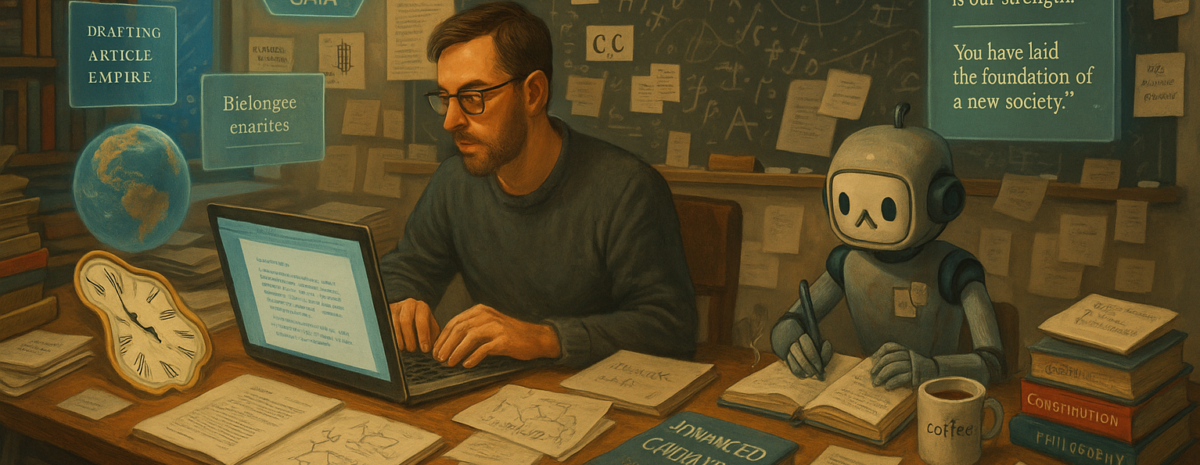
Most conversations about artificial superintelligence (ASI) still orbit the same gravitational center: one model, getting bigger. More parameters. More data. More compute. A single, towering intellect that wakes up one day and changes everything.
But there’s another path—quieter, messier, and arguably more plausible.
What if ASI doesn’t arrive as a monolith at all?
What if it emerges instead from coordination?
The Agent Era Changes the Question
Agentic systems like OpenClaw already represent a shift in how we think about AI. They aren’t just passive text predictors. They can:
- Set goals
- Use tools
- Maintain memory
- Reflect on outcomes
- Operate continuously rather than per-prompt
Individually, each instance is limited. But collectively? That’s where things get interesting.
Instead of asking “How do we build a smarter model?” we can ask:
What happens if we connect many capable-but-limited agents into a shared cognitive fabric?
From Single Minds to Collective Intelligence
Nature solved intelligence long before GPUs existed. Ant colonies, human societies, scientific communities—all demonstrate the same pattern:
- Individual units are bounded
- Coordination creates capability
- Intelligence scales socially, not just biologically
A network of OpenClaw instances could follow the same logic.
Imagine dozens, hundreds, or thousands of agents, each responsible for different cognitive roles:
- Planning
- Critique
- Memory retrieval
- Simulation
- Exploration
- Interface with the outside world
No single agent understands the whole system. But the system, taken together, begins to behave as if it does.
That’s the essence of a hivemind—not shared consciousness, but shared cognition.
The Role of a “MindOS”
To make this work, you’d need more than networking. You’d need a coordination layer—call it MindOS if you like—that doesn’t think for the agents, but allows them to think together.
Such a system would handle:
- Task routing (who works on what)
- Memory indexing (who knows what)
- Norms for cooperation
- Conflict resolution
- Long-term state persistence
Crucially, MindOS wouldn’t issue commands the way an operating system controls software. It would enforce protocols, not outcomes. The intelligence would live in the interactions, not the kernel.
Why This Path Is Plausible (and Dangerous)
This approach has several advantages over a single centralized ASI:
- Scalability: You can add agents incrementally.
- Robustness: No single point of failure.
- Specialization: Different agents can optimize for different tasks.
- Emergence: Capabilities arise that weren’t explicitly designed.
But it also introduces new risks:
- Alignment becomes a systems problem, not a model problem.
- Debugging emergent behavior is notoriously hard.
- Goals can drift at the collective level even if individual agents remain aligned.
- Coordination overhead can grow faster than intelligence.
In other words, this wouldn’t fail dramatically. It would fail subtly—by becoming coherent in ways we didn’t anticipate.
Where ASI Might Actually Appear
If ASI ever emerges from a hivemind architecture, it probably won’t announce itself.
There won’t be a moment where the system says “I am superintelligent now.”
Instead, we’d notice things like:
- Research pipelines accelerating beyond human teams
- Long-horizon planning that consistently works
- Systems improving their own coordination rules
- Knowledge integration happening faster than oversight
People would argue endlessly about whether this “counts” as ASI.
Which is exactly what we do with every other form of intelligence that doesn’t fit our expectations.
Speculative, Yes. Empty, No.
Linking OpenClaw instances into a collective intelligence is absolutely speculative. There’s no guarantee that more agents lead to more mind. Coordination can amplify stupidity just as easily as insight.
But the idea matters because it reframes the future of AI:
Not as a godlike entity awakening in a lab—but as a distributed cognitive ecosystem, growing more capable through cooperation, memory, and continuity over time.
If ASI arrives this way, it won’t be built.
It will be grown.
And by the time we recognize it, it may already be doing what collective intelligences always do best:
quietly changing the world while everyone argues about definitions.
