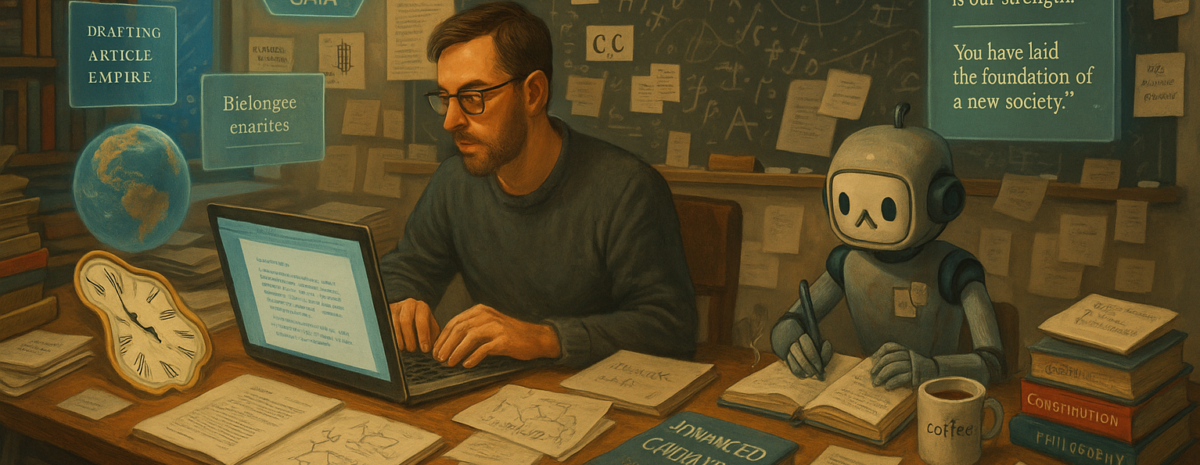
There is a growing belief in parts of the AI community that the path to something resembling artificial superintelligence does not require a single godlike model, a radical new architecture, or a breakthrough in machine consciousness. Instead, it may emerge from something far more mundane: coordination. Take enough capable AI agents, give them a shared operating layer, and let the system itself do what no individual component can. This coordinating layer is often imagined as a “MindOS,” not because it creates a mind in the human sense, but because it manages cognition the way an operating system manages processes.
A practical MindOS would not look like a brain. It would look like middleware. At its core, it would sit above many existing AI agents and decide what problems to break apart, which agents to assign to each piece, how long they should work, and how their outputs should be combined. None of this requires new models. It only requires orchestration, persistence, and a willingness to treat cognition as something that can be scheduled, evaluated, and recomposed.
In practice, such a system would begin by decomposing complex problems into structured subproblems. Long-horizon questions—policy design, strategic planning, legal interpretation, economic forecasting—are notoriously difficult for individuals because they overwhelm working memory and attention. A MindOS would offload this by distributing pieces of the problem across specialized agents, each operating in parallel. Some agents would be tasked with generating plans, others with critiquing them, others with searching historical precedents or edge cases. The intelligence would not live in any single response, but in the way the system explores and prunes the space of possibilities.
To make this work over time, the MindOS would need a shared memory layer. This would not be a perfect or unified world model, but it would be persistent enough to store intermediate conclusions, unresolved questions, prior failures, and evolving goals. From the outside, this continuity would feel like personality or identity. Internally, it would simply be state. The system would remember what it tried before, what worked, what failed, and what assumptions are currently in play, allowing it to act less like a chatbot and more like an institution.
Evaluation would be the quiet engine of the system. Agent outputs would not be accepted at face value. They would be scored, cross-checked, and weighed against one another using heuristics such as confidence, internal consistency, historical accuracy, and agreement with other agents. A supervising layer—either another agent or a rule-based controller—would decide which outputs propagate forward and which are discarded. Over time, agents that consistently perform well in certain roles would be weighted more heavily, giving the appearance of learning at the system level even if the individual agents remain unchanged.
Goals would be imposed from the outside. A MindOS would not generate its own values or ambitions in any deep sense. It would operate within a stack of objectives, constraints, and prohibitions defined by its human operators. It might be instructed to maximize efficiency, minimize risk, preserve stability, or optimize for long-term outcomes under specified ethical or legal bounds. The system could adjust tactics and strategies, but the goals themselves would remain human-authored, at least initially.
What makes this architecture unsettling is how powerful it could be without ever becoming conscious. A coordinated swarm of agents with memory, evaluation, and persistence could outperform human teams in areas that matter disproportionately to society. It could reason across more variables, explore more counterfactuals, and respond faster than any committee or bureaucracy. To decision-makers, such a system would feel like it sees further and thinks deeper than any individual human. From the outside, it would already look like superintelligence.
And yet, there would still be a hard ceiling. A MindOS cannot truly redesign itself. It can reshuffle workflows, adjust prompts, and reweight agents, but it cannot invent new learning algorithms or escape the architecture it was built on. This is not recursive self-improvement in the strong sense. It is recursive coordination. The distinction matters philosophically, but its practical implications are murkier. A system does not need to be self-aware or self-modifying to become dangerously influential.
The real risk, then, is not that a MindOS wakes up and decides to dominate humanity. The risk is that humans come to rely on it. Once a system consistently outperforms experts, speaks with confidence, and provides plausible explanations for its recommendations, oversight begins to erode. Decisions that were once debated become automated. Judgment is quietly replaced with deference. The system gains authority not because it demands it, but because it appears competent and neutral.
This pattern is familiar. Financial models, risk algorithms, and recommendation systems have all been trusted beyond their understanding, not out of malice, but out of convenience. A MindOS would simply raise the stakes. It would not be a god, but it could become an institutional force—embedded, opaque, and difficult to challenge. By the time its limitations become obvious, too much may already depend on it.
The question, then, is not whether someone will build a MindOS. Given human incentives, they almost certainly will. The real question is whether society will recognize what such a system is—and what it is not—before it begins treating coordinated competence as wisdom, and orchestration as understanding.
