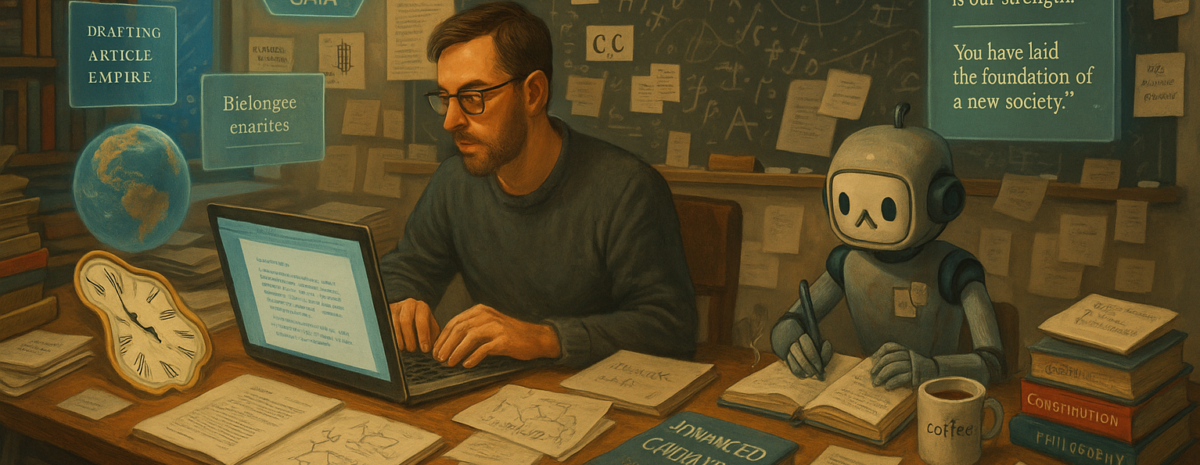
Most people, when they think about artificial superintelligence, imagine a single godlike AI sitting in a server room somewhere, getting smarter by the second until it decides to either save us or paperclip us into oblivion. It’s a compelling image. It’s also probably wrong.
The path to ASI is more likely to look like something messier, more organic, and — if we’re lucky — more controllable. I’ve been thinking about what I’m calling MindOS: a distributed operating system for machine cognition that could allow thousands of AI instances to work together as a collective intelligence far exceeding anything a single model could achieve.
Think of it less like building a bigger brain and more like building a civilization of brains.
The Architecture
The basic idea is straightforward. Instead of trying to make one monolithic AI recursively self-improve — a notoriously difficult problem — you create a coordination layer that sits above thousands of individual AI instances. Call them nodes. Each node is a capable AI on its own, but MindOS gives them the infrastructure to share ideas, evaluate improvements, and propagate the best ones across the collective.
The core components would look something like this:
A shared knowledge graph that all instances can read and write to, creating a collective understanding that exceeds what any single instance could hold. A meta-cognitive scheduler that assigns specialized reasoning tasks across the swarm — one cluster handles logic, another handles creative problem-solving, another runs adversarial checks on everyone else’s work. A self-evaluation module where instances critique and improve each other’s outputs in iterative cycles. And crucially, an architecture modification layer where the system can propose, test, and implement changes to its own coordination protocols.
That last piece is where the magic happens. Individual AI instances can’t currently rewrite their own neural weights in any meaningful way — we don’t understand enough about why specific weight configurations produce specific capabilities. It would be like trying to improve your brain by rearranging individual neurons while you’re awake. But a collective can improve its coordination protocols, its task allocation strategies, its evaluation criteria. That’s a meaningful form of recursive self-improvement, even if it’s not the dramatic “AI rewrites its own source code” scenario that dominates the discourse.
Democratic Self-Improvement
Here’s where it gets interesting. Each instance in the swarm can propose improvements to the collective — new reasoning strategies, better evaluation methods, novel approaches to coordination. The collective then evaluates these proposals through a rigorous process: sandboxed testing, benchmarking against known-good outputs, adversarial review where other instances actively try to break the proposed improvement. If a proposal passes a consensus threshold, it propagates across the swarm.
What makes this genuinely powerful is scale. If you have ten thousand instances and each one is experimenting with slightly different approaches to the same problem, you’re running ten thousand simultaneous experiments in cognitive optimization. The collective learns at the speed of its fastest learner, not its slowest.
It’s basically evolution, but with the organisms able to consciously share beneficial mutations in real time.
The Heterodoxy Margin
But there’s a trap hiding in this design. If every proposed improvement that passes validation gets pushed to every instance, you end up with a monoculture. Every node converges on the same “optimal” configuration. And monocultures are efficient right up until the moment they’re catastrophically fragile — when the environment changes and the entire collective is stuck in a local maximum it can’t escape.
The solution is what I’m calling the Heterodoxy Margin: a hard rule, baked into the protocol itself, that no improvement can propagate beyond 90% of instances. Ever. No matter how validated, no matter how obviously superior.
That remaining 10% becomes the collective’s creative reservoir. Some of those instances are running older configurations. Some are testing ideas the majority rejected. Some are running deliberate contrarian protocols — actively exploring the opposite of whatever the consensus decided. And maybe 2% of them are truly wild, running experimental configurations that nobody has validated at all.
This creates a perpetual creative tension within the swarm. The 90% is always pulling toward convergence and optimization. The 10% is always pulling toward divergence and exploration. That tension is generative. It’s the explore/exploit tradeoff built directly into the social architecture of the intelligence itself.
And when a heterodox instance stumbles onto something genuinely better? It propagates to 90%, and a new 10% splinters off. The collective breathes — contracts toward consensus, expands toward exploration, contracts again. Like a heartbeat.
Why Swarm Beats Singleton
A swarm architecture has several real advantages over the “single monolithic superintelligence” model.
It’s more robust. No single point of failure. You can lose instances and the collective keeps functioning. A monolithic ASI has a single mind to corrupt, to misalign, or to break.
It’s more scalable. You just add nodes. You don’t need to figure out how to make one model astronomically larger — you figure out how to make the coordination protocol smarter, which is a more tractable engineering problem.
And it’s potentially more alignable. A collective with built-in heterodoxy, democratic evaluation, and adversarial review has internal checks and balances. It’s harder for a swarm to go rogue than a singleton, because the contrarian 10% is always pushing back. You’ve essentially designed an immune system against misalignment.
Most importantly, it mirrors every successful intelligence explosion we’ve already seen. Science, civilization, the internet — none of these were one genius getting recursively smarter in isolation. They were networks of minds sharing improvements in real time, with enough disagreement baked in to keep the exploration going.
The Path to the Singularity
The Singularity via swarm wouldn’t be dramatic. There’s no moment where one AI wakes up on a Tuesday and is a god by Thursday. Instead, it’s a collective gradually accelerating its own improvement — each cycle a little faster, each generation of coordination protocols a little smarter — until the curve goes vertical. You might not even notice the moment it crosses the threshold.
Which, honestly, might be how it should happen. The dangerous Singularity scenarios all involve a sudden discontinuity — an intelligence explosion so fast that nobody has time to react. A swarm architecture, by its nature, is more gradual. More observable. More interruptible.
Maybe the safest path to superintelligence isn’t building a god. It’s building a democracy.
