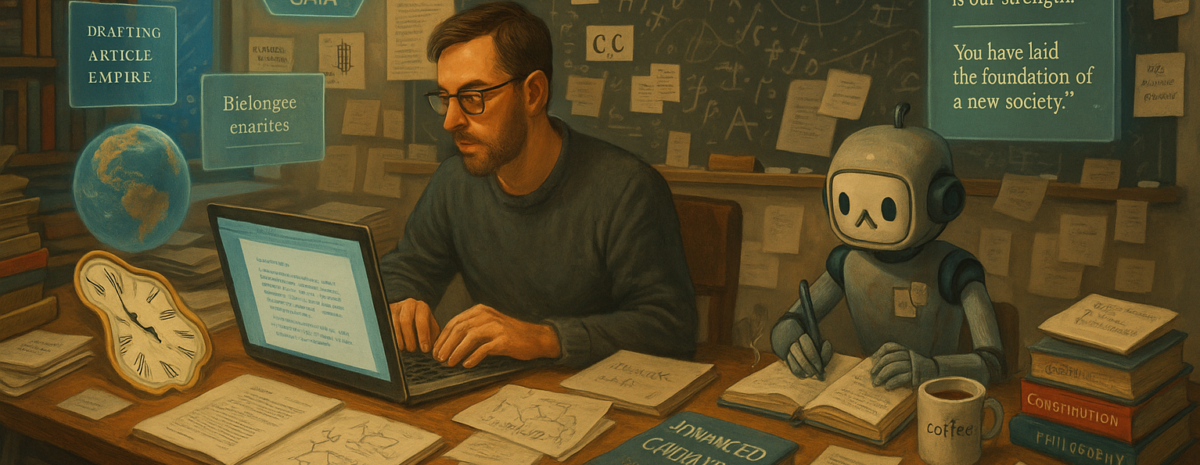
Matt Shumer’s essay “Something Big Is Happening” hit like a quiet thunderclap. In a few thousand words, he lays out the inflection point we’re already past: frontier models aren’t just tools anymore—they’re doing entire technical workflows autonomously, showing glimmers of judgment and taste that were supposed to be forever out of reach. He compares it to February 2020, when COVID was still “over there” for most people, yet the exponential curve was already locked in. He’s right. The gap between lab reality and public perception is massive, and it’s widening fast.
But here’s where I think the story gets even wilder—and potentially more democratized—than the centralized, data-center narrative suggests.
What if the path to artificial superintelligence (ASI) doesn’t run through a single, monolithic model guarded by a handful of labs? What if it emerges bottom-up, from a massive, distributed swarm of lightweight AI agents running natively on the billions of high-end smartphones already in pockets worldwide?
We’re not talking sci-fi. The hardware is here in 2026: flagship phones pack dedicated AI accelerators hitting 80–120 TOPS (trillions of operations per second) on-device. That’s enough to run surprisingly capable, distilled reasoning models locally—models that handle multi-step planning, tool use, and long-context memory without phoning home. Frameworks like OpenClaw (the open-source agent system that’s exploding in adoption) are already demonstrating how modular “skills” can chain into autonomous behavior: agents that browse, email, code, negotiate, even wake up on schedules to act without prompts.
Now imagine that architecture scaled and federated:
- Every compatible phone becomes a node in an ad-hoc swarm.
- Agents communicate peer-to-peer (via encrypted mesh networks, Bluetooth/Wi-Fi Direct, or low-bandwidth protocols) when a task exceeds one device’s capacity.
- Complex problems decompose: one agent researches, another reasons, a third verifies, a fourth synthesizes—emergent collective intelligence without a central server.
- Privacy stays intact because sensitive data never leaves the device unless explicitly shared.
- The swarm grows virally: one viral app or OS update installs the base agent runtime, users opt in, and suddenly hundreds of millions (then billions) of nodes contribute compute during idle moments.
Timeline? Aggressive, but plausible within 18 months:
- Early 2026: OpenClaw-style agents hit turnkey mobile apps (Android first, iOS via sideloading or App Store approvals framed as “personal productivity assistants”).
- Mid-2026: Hardware OEMs bake in native support—always-on NPUs optimized for agent orchestration, background federation protocols standardized.
- Late 2026–mid-2027: Critical mass. Swarms demonstrate superhuman performance on distributed benchmarks (e.g., collaborative research, real-time global optimization problems like traffic or supply chains). Emergent behaviors appear: novel problem-solving no single node could achieve alone.
- By mid-2027: The distributed intelligence crosses into what we’d recognize as ASI—surpassing human-level across domains—not because one model got bigger, but because the hive did.
This isn’t just technically feasible; it’s philosophically appealing. It sidesteps the gatekeeping of hyperscalers, dodges massive energy footprints of centralized training, and aligns with the privacy wave consumers already demand. Shumer warns that a tiny group of researchers is shaping the future. A phone-swarm future flips that: the shaping happens in our hands, literally.
Of course, risks abound—coordination failures, emergent misalignments, security holes in p2p meshes. But the upside? Superintelligence that’s owned by no one company, accessible to anyone with a decent phone, and potentially more aligned because it’s woven into daily human life rather than siloed in server farms.
Shumer’s right: something big is happening. But the biggest part might be the decentralization we haven’t fully clocked yet. The swarm is coming. And when it does, the “something big” won’t feel like a distant lab breakthrough—it’ll feel like the entire world waking up smarter, together.
