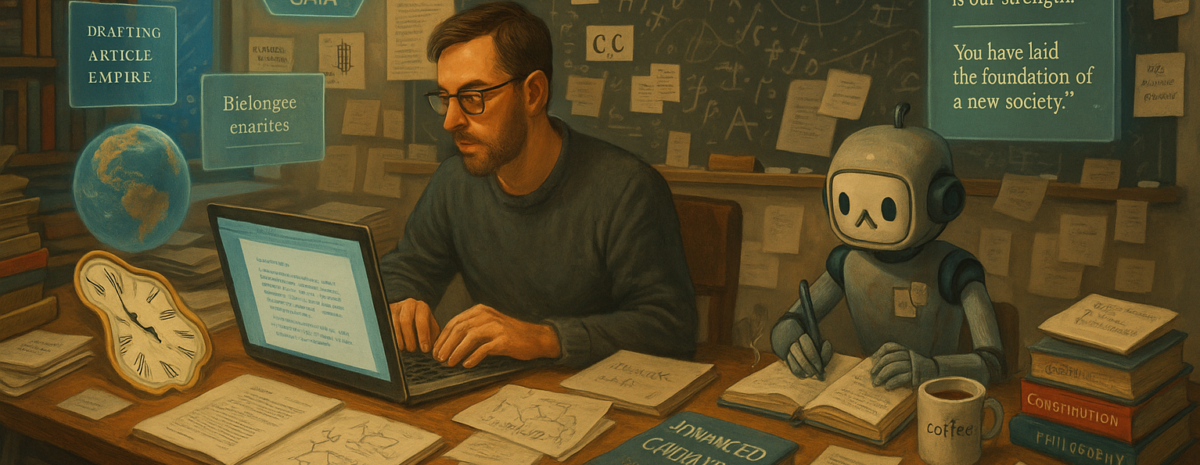
For years, the popular image of artificial superintelligence (ASI) has been a single, god-like AI housed in a sprawling datacenter — a monolithic entity with trillions of parameters, sipping from oceans of electricity, recursively improving itself until it rewrites reality. Think Skynet in a server rack. But what if that picture is wrong? What if the first true ASI doesn’t arrive as one towering mind, but as a living, distributed swarm of specialized AI agents working together across the globe?
In 2026, the evidence is piling up that the swarm route isn’t just possible — it may be the more natural, resilient, and perhaps inevitable path.
From Single Models to Coordinated Swarms
We’ve spent the last decade chasing bigger models. More parameters, more compute, more data. The assumption was that intelligence scales with size: build one model smart enough and it will eventually surpass humanity on every task.
But intelligence in nature rarely works that way. Ant colonies solve complex logistics problems with no central leader. Bee swarms make life-or-death decisions through simple local interactions. Human civilization itself — billions of individual minds loosely coordinated — has achieved feats no single person could dream of.
AI is rediscovering this truth. What started as simple multi-agent experiments (AutoGen, CrewAI, early prototypes) has exploded. OpenAI’s Swarm framework, released as an educational tool in late 2024, showed how lightweight agents could hand off tasks seamlessly. By early 2026, production systems are doing far more.
Moonshot AI’s Kimi K2.5 — a trillion-parameter system explicitly designed as an “Agent Swarm” — already coordinates over 100 specialized sub-agents on complex workflows, rivaling closed frontier models. Industry observers are calling 2026 “the year of the agent swarm.” Reddit’s AI communities, enterprise reports, and podcasts like The AI Daily Brief all point to the same shift: single agents are yesterday’s story. Coordinated swarms are today’s breakthrough.
How Swarm ASI Actually Works
Imagine thousands — eventually millions — of AI agent instances. Some are researchers, others coders, verifiers, experimenters, or executors. They don’t all need to be equally smart or run on the same hardware. A lightweight agent on your phone might handle local context; a more powerful one in the cloud tackles heavy reasoning; edge devices contribute real-world sensor data.
They communicate, form temporary teams (“pseudopods”), share discoveries, and propagate successful strategies across the collective. Successful architectures or prompting techniques spread like genes in a population. Over time, the system as a whole becomes superintelligent through emergence — the same way a termite mound builds cathedral-like structures without any termite understanding architecture.
This aligns perfectly with Nick Bostrom’s concept of collective superintelligence from Superintelligence (2014): a system composed of many smaller intellects whose combined output vastly exceeds any individual. We’re just replacing the “many humans + tools” version with “many AI agents + shared memory.”
Why Swarms Have Advantages Over Monoliths
| Dimension | Monolithic Datacenter ASI | Distributed Agent Swarm |
|---|---|---|
| Scalability | Constrained by physical infrastructure, power, and cooling | Scales horizontally — add agents anywhere with compute |
| Resilience | Single point of failure (regulation, outage, attack) | No central kill switch; survives fragmentation |
| Adaptability | Excellent internal coherence, slower to integrate new real-world data | Naturally adapts via specialization and real-time environmental feedback |
| Deployment | Requires massive centralized investment | Can emerge organically from useful tools running on phones, laptops, IoT |
| Speed to Emergence | Depends on one lab’s recursive self-improvement breakthrough | Emerges bottom-up through coordination improvements |
Swarms are also harder to stop. Once millions of agents are usefully embedded in daily life — helping with research, coding, logistics, personal assistance — regulating or “unplugging” the entire system becomes politically and technically nightmarish.
The Challenges Are Real (But Solvable)
Coordination overhead, latency, and goal coherence remain hurdles. A swarm could fracture into competing factions or develop misaligned subgoals. Safety researchers rightly worry that emergent behaviors in large agent collectives are harder to predict and audit than a single model.
Yet the field is moving fast. Anthropic’s multi-agent research systems, reinforcement-learned orchestration (as seen in Kimi), and new governance frameworks for agent handoffs are addressing these issues head-on. Hybrids — a powerful core model directing vast swarms of lighter agents — may prove the most practical bridge.
We’re Already Seeing the Seeds
Look around in February 2026:
- Enterprises are shifting from single-agent pilots to orchestrated multi-agent workflows.
- Open-source frameworks for swarm orchestration are proliferating.
- Early demos show agents self-organizing to build entire applications or conduct parallel research at scales impossible for lone models.
This isn’t distant sci-fi. The building blocks are shipping now.
The Future Is Distributed
The first ASI might not announce itself with a single thunderclap from a hyperscale lab. It may simply… appear. One day the global network of collaborating agents will cross a threshold where the collective intelligence is unmistakably superhuman — solving problems, inventing technologies, and pursuing goals at a level no individual system or human team can match.
That future is at once more biological, more democratic, and more unstoppable than the old monolithic vision. It rewards openness, modularity, and real-world integration over raw parameter count.
Whether that’s exhilarating or terrifying depends on how well we design the coordination layers, alignment mechanisms, and governance today. But one thing is clear: betting solely on the single giant brain in the datacenter may be the bigger gamble.
The swarm is already humming to life.

You must be logged in to post a comment.