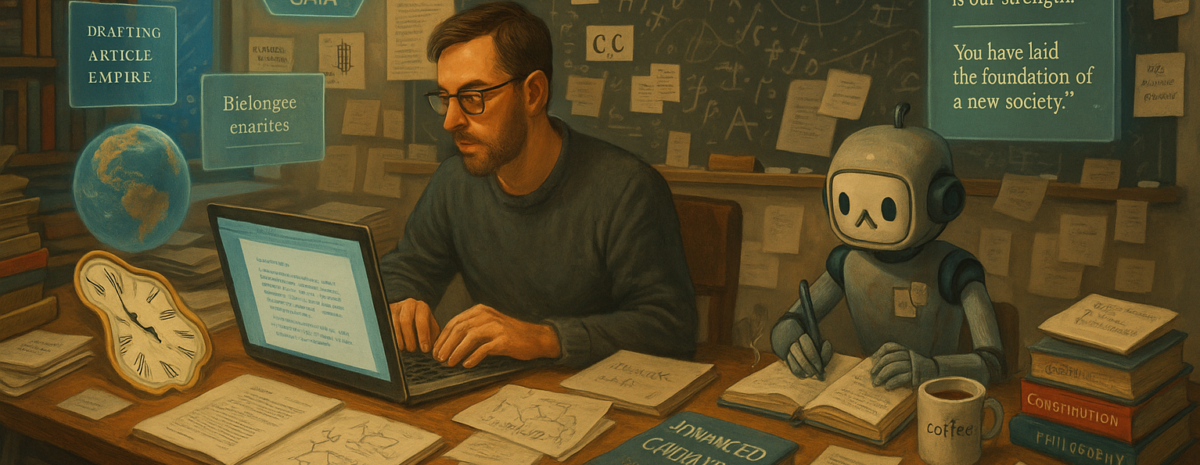
A flight of fancy about what comes after the feed
Every few years someone declares they’re building “the new Reddit,” and every few years we get… a slightly different Reddit. The same infinite scroll, the same comment boxes, the same insular communities that reward the chronically online and punish the casually curious.
I keep thinking about what we actually lost when we left Usenet behind. Not the technical stack — good riddance to NNTP — but the texture of it. Full pages you actually composed, not containers for hot takes. Threads that branched and breathed. The sense that reading and writing were serious acts, not reflexes.
So here’s a thought experiment: Gawker. (Yes, I know about the old one. This is different. Work with me.)
Posts, Not Products
In Gawker, everything starts with a Post. Not a tweet, not a threadstarter — a full page. Rich text, images, the whole canvas. You write into it the way you might write into a Google Doc, because inline editing is native here. The Post is the unit of attention, not the user, not the community. You subscribe to individual Posts. When they update — new reply, new fork, new edit — your newsfeed lights up.
This matters. On Reddit, you subscribe to a subreddit and hope the algorithm surfaces the good stuff. On Gawker, you follow conversations you’ve chosen to care about. The discovery problem solves itself: interesting Posts attract cross-cutting attention regardless of which Group they live in. No more wondering why r/Space and r/Engineering never talk to each other.
Groups Are Cheap, And That’s The Point
Posts live in Groups, but Groups are trivial to create — tied to your ID, instant, no approval process. Redundancy isn’t a bug; it’s oxygen. Multiple Groups about the same topic keeps populations smaller, discussions manageable, cultures distinct. You want ten different “Climate Science” Groups with ten different moderation philosophies? Great. The Posts carry the weight, not the containers.
You Don’t Get To Post Just Because You Signed Up
Here’s the friction: you earn the right to create Posts. New users get a weekly allowance of points. Spend them to publish. Run out, and you’re reading, replying, editing — but not originating, not until the next week or until other users gift you points for quality contributions.
Yes, this adds admin overhead. Yes, “rogue” point-givers might distort things. But the alternative is worse: the flood of drive-by posting that makes every platform feel like the same shouting room. The point system manages expectations from day one. You’re not entitled to an audience here. You build to one.
The Fork in the Road
Discussions drift. On Gawker, you can fork a thread — spin a sub-conversation into its own Post, carrying the history but opening new terrain. This is how Posts reproduce. This is how the graph stays alive without collapsing under the weight of ancient threads resurrecting themselves. (Though honestly? Sometimes they should. Let the dead breathe.)
The NYT Thing (Or: Why Embedded Is Wrong)
One last fancy: imagine pushing a New York Times article into Gawker as a Post itself, not embedded, not linked — the actual text, now editable, annotated, remixed. The original becomes substrate. The thread becomes collaborative investigation, translation, annotation, refutation. The newsfeed shows you when the article itself has been edited, when new branches of analysis appear.
This is legally terrifying. I know. It’s also the only thing I’ve described that feels genuinely new — not better Reddit, not revived Usenet, but a different shape of attention entirely.
Build It?
I won’t. I can’t code my way out of a paper bag, and vibe-coding my way to a functional prototype feels like asking for humiliation. Maybe in a few years I’ll just tell my Knowledge Navigator to mock it up and see if the dream survives contact with interaction design.
But the spec is here. The questions are interesting. Someone else can steal it, or wait for the landscape to catch up.
Either way, I’m tired of platforms that treat writing like a side effect of engagement. I want one that treats engagement as a side effect of writing.