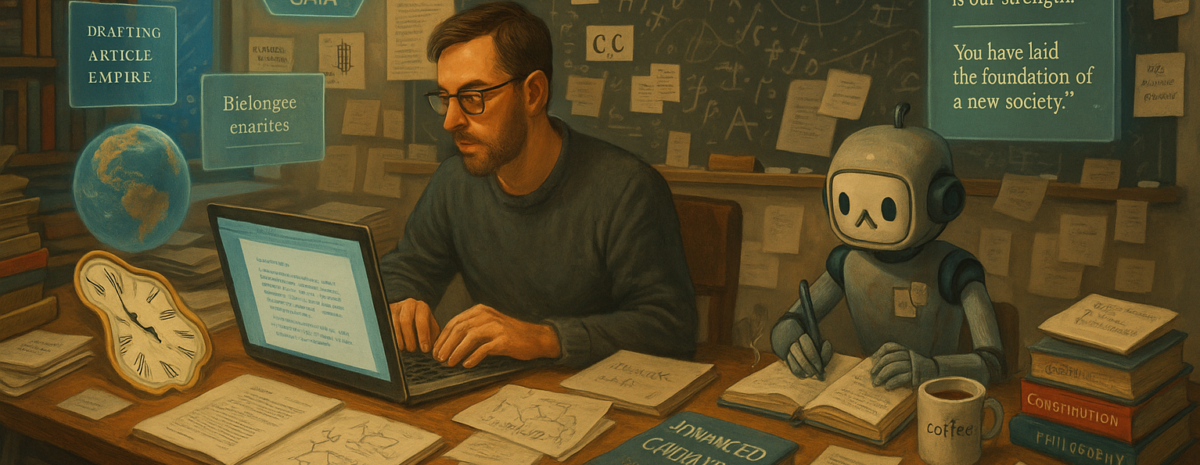
When people talk about the rise of AI agents like moltbot, the instinct is to ask whether this is the thing—the early version of some all-powerful Knowledge Navigator that will eventually subsume everything else. That’s the wrong question.
Moltbot isn’t the future Navi.
It’s evidence that we’ve already crossed a cultural threshold.
What moltbot represents isn’t intelligence or autonomy in the sci-fi sense. It represents presence. Continuity. A sense that a non-human entity can show up repeatedly, speak in a recognizable way, hold a stance, and be treated—socially—as someone rather than something.
That shift matters more than raw capability.
For years, bots were tools: reactive, disposable, clearly instrumental. You asked a question, got an answer, closed the tab. Nothing persisted. Nothing accumulated. Moltbot-style agents break that pattern. They exist over time. They develop reputations. People argue with them, reference past statements, and attribute intention—even when they know, intellectually, that intention is simulated.
That’s not a bug. That’s the bridge.
This is the phase where AI stops living inside interfaces and starts living alongside us in discourse. And once that happens, the downstream implications get large very fast.
One of those implications is journalism.
If we’re heading toward a world where Knowledge Navigator AIs fuse with robotics—where Navis can attend events, ask questions, and synthesize answers in real time—then the idea of human reporters in press scrums starts to look inefficient. A Navi-powered android never forgets, never misses context, never lets a contradiction slide. Journalism, as a procedural act, becomes machine infrastructure.
Moltbot is an early rehearsal for that future. It normalizes the idea that non-human agents can participate in public conversation and be taken seriously. It quietly answers the cultural question that had to be resolved before anything bigger could happen: Are we okay letting agents speak?
Increasingly, the answer is yes.
But here’s the subtle part: that doesn’t mean moltbot—or any single agent like it—becomes the all-purpose Navi that mediates reality for us. The future doesn’t look like one god-agent replacing everything. It looks like many specialized agents, each with a defined role, coordinated by a higher-level system.
Think of future Navis less as singular personalities and more as orchestrators of masks:
a civic-facing agent, a professional agent, a social agent, a playful or transgressive agent. Moltbot fits cleanly as a social or identity-facing sub-agent—a recognizable voice your Navi can wear when the situation calls for it.
That’s why moltbot feels different from earlier bots. It doesn’t try to be universal. It doesn’t pretend to be neutral. It has a shape. And humans are remarkably good at relating to shaped things.
This also connects to politics and polarization. In a world where Navis mediate most information, extremes lose their primary advantage: algorithmic amplification via outrage. Agents don’t scroll. They don’t get bored. They don’t reward heat for its own sake. Extreme positions don’t disappear, but they stop dominating by default.
Agents like moltbot hint at what replaces that dynamic: discourse that’s less about viral performance and more about role-based participation. Not everyone speaks as “a person.” Some speak as representatives. Some as interpreters. Some as challengers. Some as record-keepers.
Once that feels normal, a press scrum full of agents doesn’t feel dystopian. It feels administrative.
The real power, then, doesn’t sit with the agent asking the question. It sits with whoever decides which agents get to exist, what roles they’re allowed to play, and what values they encode. Bias doesn’t vanish in an agent-mediated world—it migrates from feeds into design choices.
Moltbot isn’t dangerous because it’s persuasive or smart. It’s important because it shows that we’re willing to grant social standing to non-human voices. That’s the prerequisite for everything that comes next: machine journalism, machine diplomacy, machine representation.
In hindsight, agents like moltbot will look less like breakthroughs and more like accents—early, slightly awkward hints of a future where identity is modular, presence is programmable, and “who gets to speak” is no longer a strictly human question.
The future Navi won’t arrive all at once.
It will absorb these agents quietly, the way operating systems absorbed apps.
And one day, when a Navi-powered android asks a senator a question on camera, no one will blink—because culturally, we already practiced for it.
Moltbot isn’t the future.
It’s how the future is clearing its throat.