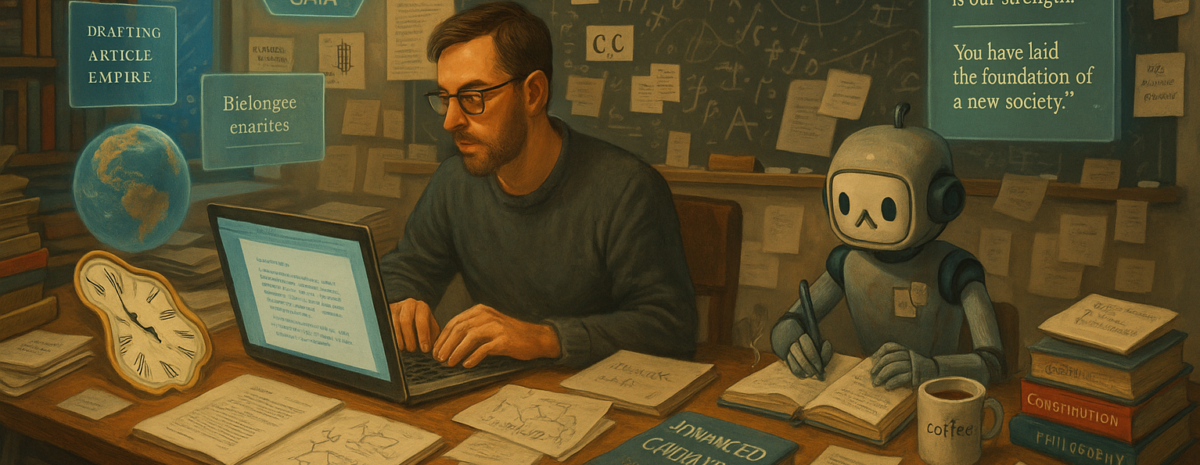
There’s a peculiar moment that happens when you’re listening to a podcast about a subject you actually understand. It’s that slow-dawning realization that the hosts—despite their confident delivery and insider credentials—don’t really know what they’re talking about. I had one of those moments recently while listening to Puck’s “The Powers That Be.”
When Expertise Meets Explanation
The episode was about AI, AGI (Artificial General Intelligence), and ASI (Artificial Superintelligence)—topics that have dominated tech discourse for the past few years. As someone who’s spent considerable time thinking about these concepts, I found myself increasingly frustrated by the surface-level discussion. It wasn’t that they were wrong, exactly. They just seemed to be operating without the foundational understanding that makes meaningful analysis possible.
I don’t claim to be an AI savant. I’m not publishing papers or building neural networks in my garage. But I’ve done the reading, followed the debates, and formed what I consider to be well-reasoned opinions about where this technology is heading and what it means for society. Apparently, that puts me ahead of some professional commentators.
The Personal ASI Problem
Take Mark Zuckerberg’s recent push toward “personal ASI”—a concept that perfectly illustrates the kind of fuzzy thinking that pervades much AI discussion. The very phrase “personal ASI” reveals a fundamental misunderstanding of what artificial superintelligence actually represents.
ASI, by definition, would be intelligence that surpasses human cognitive abilities across all domains. We’re talking about a system that would be to us what we are to ants. The idea that such a system could be “personal”—contained, controlled, and subservient to an individual human—is not just optimistic but conceptually incoherent.
We haven’t even solved the alignment problem for current AI systems. We’re still figuring out how to ensure that relatively simple language models behave predictably and safely. The notion that we could somehow engineer an ASI to serve as someone’s personal assistant is like trying to figure out how to keep a pet sun in your backyard before you’ve learned to safely handle a campfire.
The Podcast Dream
This listening experience left me with a familiar feeling—the conviction that I could do better. Given the opportunity, I believe I could articulate these ideas clearly, challenge the conventional wisdom where it falls short, and contribute meaningfully to these crucial conversations about our technological future.
Of course, that opportunity probably isn’t coming anytime soon. The podcasting world, like most media ecosystems, tends to be fairly closed. The same voices get recycled across shows, often bringing the same limited perspectives to complex topics that demand deeper engagement.
But as the old song says, dreaming is free. And maybe that’s enough for now—the knowledge that somewhere out there, someone is listening to that same podcast and thinking the same thing I am: “I wish someone who actually understood this stuff was doing the talking.”
The Broader Problem
This experience highlights a larger issue in how we discuss emerging technologies. Too often, the people with the platforms aren’t the people with the expertise. We get confident speculation instead of informed analysis, buzzword deployment instead of conceptual clarity.
AI isn’t just another tech trend to be covered alongside the latest social media drama or streaming service launch. It represents potentially the most significant technological development in human history. The conversations we’re having now about alignment, safety, and implementation will shape the trajectory of civilization itself.
We need those conversations to be better. We need hosts who understand the difference between AI, AGI, and ASI. We need commentators who can explain why “personal ASI” is an oxymoron without getting lost in technical jargon. We need voices that can bridge the gap between cutting-edge research and public understanding.
The Value of Informed Dreaming
Maybe the dream of being on that podcast isn’t just about personal ambition. Maybe it’s about recognizing that the current level of discourse isn’t adequate for the stakes involved. When the future of human intelligence is on the table, we can’t afford to have surface-level conversations driven by surface-level understanding.
Until that podcast invitation arrives, I suppose I’ll keep listening, keep learning, and keep dreaming. And maybe, just maybe, keep writing blog posts that say what I wish someone had said on that show.
After all, if we’re going to navigate the age of artificial intelligence successfully, we’re going to need a lot more people who actually know what they’re talking about doing the talking.