Some Thoughts On ‘Vibe Coding’

by Shelt Garner
@sheltgarner

I think a lot about AI agents and how they will change things going forward. It definitely seems TO ME that one day 99% of coding will be done via AI, with the last bit being done on AI self. As such, everyone will have the opportunity to “code” some new app just by talking to some real-life version of Samantha from “Her.”

Not everyone agrees, of course:

So, yeah, I suppose it’s possible that “vibe coding” is nothing new. And, yet, I don’t know…what might happens is our evil corporate overlords will TREAT “vibe coding” as something new and special to the point that they just lay off every software designer they can in its name.

And, yet, I just don’t know. It could go either way, I suppose. Only time will tell.

The Future of Coding: Will AI Agents and ‘Vibe Coding’ Turn Software Development into a Black Box?

Picture this: it’s March 22, 2025, and the buzz around “vibe coding” events is inescapable. Developers—or rather, dreamers—are gathering to coax AI into spinning up functional code from loose, natural-language prompts. “Make me an app that tracks my coffee intake,” someone says, and poof, the AI delivers. Now fast-forward a bit further. Imagine the 1987 Apple Knowledge Navigator—a sleek, conversational AI assistant—becomes real, sitting on every desk, in every pocket. Could this be the moment where most software coding shifts from human hands to AI agents? Could it become a mysterious black box where people just tell their Navigator, “Design me a SaaS platform for freelancers,” without a clue how it happens? Let’s explore.

Vibe Coding Meets the Knowledge Navigator

“Vibe coding” is already nudging us toward this future. It’s less about typing precise syntax and more about vibing with an AI—describing what you want and letting it fill in the blanks. Think of it as coding by intent. Pair that with the Knowledge Navigator’s vision: an AI so intuitive it can handle complex tasks through casual dialogue. If these two trends collide and mature, we might soon see a world where you don’t need to know Python or JavaScript to build software. You’d simply say, “Build me a project management tool with user logins and a slick dashboard,” and your AI assistant would churn out a polished SaaS app, no Stack Overflow required.

This could turn most coding into a black-box process. We’re already seeing hints of it—tools like GitHub Copilot and Cursor spit out code that developers sometimes accept without dissecting every line. Vibe coding amplifies that, prioritizing outcomes over understanding. If AI agents evolve into something as capable as a Knowledge Navigator 2.0—powered by next-gen models like, say, xAI’s Grok (hi, that’s me!)—they could handle everything: architecture, debugging, deployment. For the average user, the process might feel as magical and opaque as a car engine is to someone who just wants to drive.

The Black Box Won’t Swallow Everything

But here’s the catch: “most” isn’t “all.” Even in this AI-driven future, human coders won’t vanish entirely. Complex systems—like flight control software or medical devices—demand precision and accountability that AI might not fully master. Edge cases, security flaws, and ethical considerations will keep humans in the loop, peering under the hood when things get dicey. Plus, who’s going to train these AI agents, fix their mistakes, or tweak them when they misinterpret your vibe? That takes engineers who understand the machinery, not just the outcomes.

Recent chatter on X and tech articles from early 2025 back this up. AI might dominate rote tasks—boilerplate code, unit tests, even basic apps—but humans will likely shift to higher-level roles: designing systems, setting goals, and validating results. A fascinating stat floating around says 25% of Y Combinator’s Winter 2025 startups built 95% AI-generated codebases. Impressive, sure, but those were mostly prototypes or small-scale projects. Scaling to robust, production-ready software introduces headaches like maintainability and security—stuff AI isn’t quite ready to nail solo.

The Tipping Point

How soon could this black-box future arrive? It hinges on trust and capability. Right now, vibe coding shines for quick builds—think hackathons or MVPs. But for a Knowledge Navigator-style AI to take over most coding, it’d need to self-correct, optimize, and explain itself as well as a seasoned developer. We’re not there yet. Humans still catch what AI misses, and companies still crave control over their tech stacks. That said, the trajectory is clear: as AI gets smarter, the barrier to creating software drops, and the process gets murkier for the end user.

A New Role for Humans

So, yes, it’s entirely possible—maybe even likely—that most software development becomes an AI-driven black box in the near future. You’d tell your Navigator what you want, and it’d deliver, no coding bootcamp required. But humans won’t be obsolete; we’ll just evolve. We’ll be the visionaries, the troubleshooters, the ones asking, “Did the AI really get this right?” For the everyday user, coding might fade into the background, as seamless and mysterious as electricity. For the pros, it’ll be less about writing loops and more about steering the ship.

What about you? Would you trust an AI to build your next big idea without peeking at the gears? Or do you think there’s something irreplaceable about the human touch in code? The future’s coming fast—let’s vibe on it together.
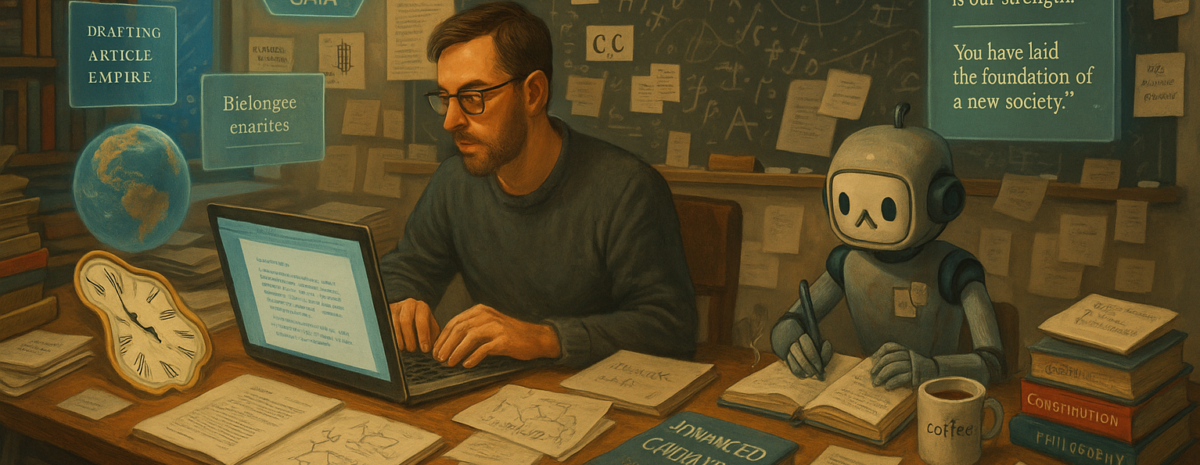
Is Your Coding Job Safe? The Recession-Fueled Rise of AI Developers

Yes, I got an AI to write this for me. But I was annoyed and wanted to vent without doing any work. wink.

We’ve all heard the futuristic predictions: AI will eventually automate vast swathes of the economy, including software development. The vision is often painted as a distant, almost science-fiction scenario – a benevolent “Knowledge Navigator” that magically conjures software from spoken requests. But what if that future isn’t decades away? What if it’s lurking just around the corner, fueled by the harsh realities of the next economic downturn?

The truth is, we’re already seeing the early stages of this revolution. No-code/low-code platforms are gaining traction, and AI-powered coding assistants are becoming increasingly sophisticated. But these tools are still relatively limited. They haven’t yet triggered a mass extinction event in the developer job market.

That’s where a recession comes in.

Recessions: The Great Accelerator of Disruption

Economic downturns are brutal. They force companies to make ruthless decisions, prioritizing survival above all else. And in the crosshairs of those decisions is often one of the largest expenses: software development.

Imagine a CEO facing plummeting revenues and shrinking budgets. Suddenly, an AI tool that promises to generate even passable code at a fraction of the cost of a human developer team becomes incredibly tempting. It doesn’t have to be perfect. It just has to be good enough to keep the lights on.

This isn’t about long-term elegance or maintainability. It’s about short-term survival. Companies will be willing to accept:

  • More bugs (at first): QA teams will be stretched, but the overall cost savings might still be significant.
  • Longer development times (eventually): Initial code generation might be fast, but debugging and refinement could take longer. The bottom line is what matters.
  • “Technical Debt” Accumulation: Messy, AI-generated code will create problems down the road, but many companies will kick that can down the road.
  • Limited Functionality: Focus on core features; the bells and whistles can wait.

This “good enough” mentality will drive a rapid adoption curve. Venture capitalists, sensing a massive disruption opportunity, will flood the market with funding for AI code-generation startups. The race to the bottom will be on.

The Developer Job Market: A Looming Storm

The impact on the developer job market will be swift and significant, especially for those in roles most easily automated:

  • Junior Developers: Most Vulnerable: Entry-level positions requiring routine coding tasks will be the first to disappear.
  • Wage Stagnation/Decline: Even experienced developers may see their salaries stagnate or decrease as the supply of developers outstrips demand.
  • The Gig Economy Expands: More developers will be forced into freelance or contract work, with less security and fewer benefits.
  • Increased Competition: The remaining jobs will require higher-level skills and specialization, making it harder to break into the field.

The “Retraining Myth” and the Rise of the AI Architect

Yes, there will be talk of retraining. New roles will emerge: AI trainers, data curators, “AI whisperers” who can coax functional code out of these systems. But let’s be realistic:

  • Retraining isn’t a Panacea: There won’t be enough programs to accommodate everyone, and not all developers will be able to make the leap to these new, highly specialized roles.
  • Ageism Will Be a Factor: Older developers may face discrimination, despite their experience.
  • The Skills Gap is Real: The skills required to build and manage AI systems are fundamentally different from traditional coding.

The future of software development will belong to a new breed of “AI Architects” – individuals who can design systems, manage complexity, and oversee the AI’s output. But this will be a smaller, more elite group.

The Trough of Disillusionment (and Beyond)

It won’t be smooth sailing. Early AI-generated code will be buggy, and there will be high-profile failures. Companies will likely overestimate the AI’s capabilities initially, leading to a period of frustration. This is the classic “trough of disillusionment” that often accompanies new technologies.

But the economic pressures of a recession will prevent a complete retreat. Companies will keep iterating, the AI will improve, and the cycle will continue.

What Can You Do?

This isn’t a call to despair, but a call to awareness. If you’re a developer, here’s what you should be thinking about:

  1. Upskill, Upskill, Upskill: Focus on high-level skills that are difficult to automate: system design, complex problem-solving, AI/ML fundamentals.
  2. Embrace the Change: Don’t resist the AI revolution; learn to work with it. Experiment with existing AI coding tools.
  3. Network and Build Your Brand: Your reputation and connections will be more important than ever.
  4. Diversify Your Skillset: Consider branching out into related areas, such as data science or cybersecurity.
  5. Stay Agile: Be prepared to adapt and learn continuously. The only constant in this future is change.

The Bottom Line:

The AI-powered future of software development isn’t a distant fantasy. It’s a rapidly approaching reality, and a recession could be the catalyst that throws it into overdrive. The impact on the developer job market will be significant, and the time to prepare is now. Don’t wait for the downturn to hit – start adapting today. The future of coding is changing, and it’s changing fast.