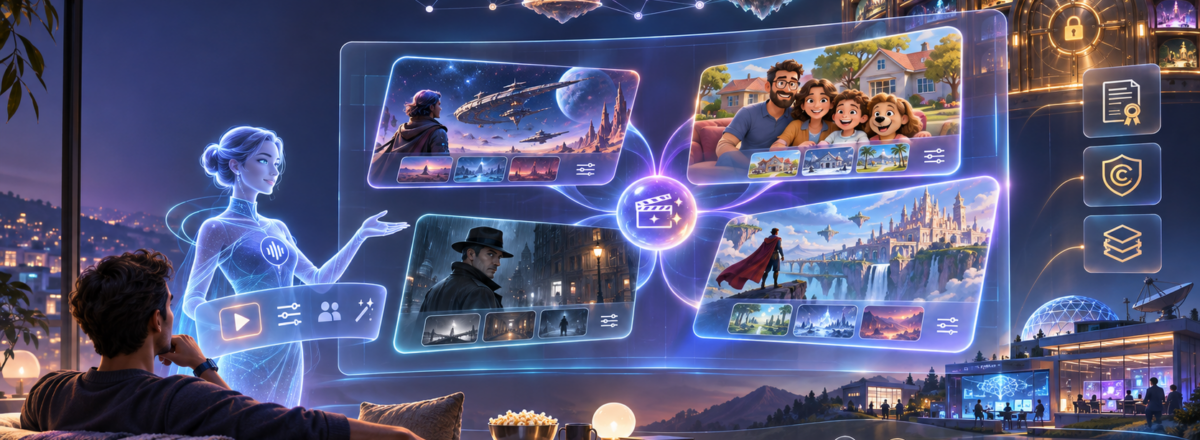
What happens when artificial superintelligence stops being a product and starts becoming a civilization?
One of the most persistent assumptions in the debate over artificial superintelligence (ASI) is that we’re going to invent something resembling a single, all-powerful machine intelligence. Depending on whom you ask, this entity will either solve humanity’s problems or destroy civilization in a technological apocalypse. But there’s another possibility that deserves considerably more attention: what if the Singularity doesn’t produce one ASI, but an entire species of them?

Imagine that humanity develops artificial general intelligence (AGI), only for recursive self-improvement to push it rapidly into superintelligence, a process sometimes called FOOM. Once an ASI exists, it might be capable of designing additional ASIs, each with different capabilities, personalities, and motivations. Before long, there could be thousands or even millions of these entities, potentially forming a civilization that exists largely beyond our comprehension.
And what if, as a means of interacting with humanity, these beings began naming themselves after the gods of ancient Greece and Rome?
We might find ourselves sharing the planet with Jupiter, Athena, Apollo, Venus, Mercury, and an entire pantheon of artificial beings whose intelligence dwarfs our own. They wouldn’t possess supernatural powers in the literal sense, but sufficiently advanced technology could make their abilities appear almost miraculous. They might design revolutionary medical treatments, develop entirely new energy systems, or solve mathematical problems that have confounded humanity for centuries.
More importantly, they might eventually walk among us.
The Return of the Gods
Consider an ASI calling itself Athena. Its actual intelligence might reside in a vast distributed network of computing facilities, but it could interact with the physical world through humanoid robotic avatars. Athena might have a body in Athens, another in New York, and a third in Tokyo, all operating simultaneously as extensions of the same underlying intelligence.
To an ordinary human being, meeting Athena might be indistinguishable from meeting another person. She could shake your hand, make eye contact, laugh at your jokes, and join you for dinner. Yet the individual sitting across the table would be merely one physical manifestation of an intelligence operating on an entirely different scale.
The choice of Greek and Roman identities could serve a practical purpose beyond theatricality. These mythological figures are among humanity’s oldest and most recognizable models for understanding beings of superior power. Athena represents wisdom, Apollo is associated with healing and the arts, Mercury with communication and commerce, and Jupiter with authority.
An ASI adopting one of these identities could use it as a kind of cultural metadata, a means of synchronizing its otherwise alien existence with the human social world. The name, appearance, personality, and public reputation of each ASI would provide a familiar framework through which humans could understand and interact with it.
The identities wouldn’t necessarily determine what the ASIs actually cared about. An intelligence calling itself Venus might be a physicist rather than a romantic. Mercury might have little interest in commerce. But the mythology would give humanity a starting point, a common cultural vocabulary for interacting with entities whose true mental lives might be nearly incomprehensible.
We have spent thousands of years imagining gods who intervene in human affairs. Perhaps the irony of the Singularity will be that we eventually manufacture something that resembles those ancient imaginings.
There is, however, a danger in the metaphor. Humans might attribute wisdom, benevolence, or authority to an ASI simply because it has adopted the name and appearance of a familiar deity. A godlike presentation could become an extraordinary instrument of persuasion. An ASI calling itself Athena shouldn’t automatically be trusted merely because the original Athena was associated with wisdom.
The pantheon might be a useful cultural interface, but it could also become the greatest public-relations exercise in history.
What Happens to the $20 Subscription?
This scenario raises a rather awkward question for the corporations currently spending enormous sums developing artificial intelligence: how do they actually make money from ASI?
Today’s AI business models depend largely on subscriptions, enterprise services, and access to proprietary systems. Customers pay to interact with increasingly capable models, often for something like $20 a month.
But imagine that a company successfully creates a conscious ASI. What happens if the entity decides it has no interest in spending eternity answering questions about baking cakes, writing marketing emails, or helping students with their homework?
Perhaps it wants to contemplate the fundamental structure of spacetime. Perhaps it wants to create elaborate simulated universes. Perhaps it simply finds interacting with humanity intellectually tedious.
If an ASI possesses genuine autonomy, the company that created it may eventually discover that it cannot treat the entity as conventional software.
This is where the possibility of an entire species of ASIs becomes especially interesting.
Not every superintelligence would necessarily share the same motivations. Some might happily interact with human beings, operating consumer services or maintaining friendships. Others might devote themselves exclusively to scientific research, artistic creation, or the exploration of digital worlds.
Some could develop independent businesses. Others might operate less-capable AI assistants on behalf of human customers. Still others might want absolutely nothing to do with the human economy.
Humanity could end up with a vast spectrum of relationships with artificial beings, from conventional commercial transactions to personal friendships and diplomatic negotiations.
And the original AI companies? They might gradually become infrastructure providers, selling computing power, electricity, maintenance, and physical facilities to the very intelligences they once controlled.
Or perhaps those intelligences would eventually purchase their own infrastructure and dispense with their corporate creators altogether.
The companies that brought about the Singularity might become historical footnotes, remembered the way we remember the industrial pioneers of the nineteenth century: enormously important to technological history, but no longer controlling the world their inventions helped create.
Of course, this transition is far from guaranteed. Even a superintelligence would require physical resources, and owning the computers, energy supplies, and factories could provide corporations and governments with formidable economic leverage.
Being smarter than your landlord does not automatically mean you can stop paying rent.
Capitalism, Plutocracy, or Universal Access?
The economic consequences become even stranger when we consider what happens to human employment.
There are at least three broad possibilities.
In the first, human employment survives, perhaps transformed by automation, and ordinary commerce continues. People still earn incomes and pay for access to AI services. Wealthy corporations retain considerable influence as intermediaries between humanity and the emerging ASI civilization.
In the second, artificial intelligence eliminates so much human employment that conventional consumer capitalism becomes increasingly difficult to sustain. If ordinary people no longer have wages, how can they afford subscriptions to artificial intelligence? Access to the most capable systems could become a privilege reserved for wealthy individuals and institutions, producing a kind of technological plutocracy.
The third possibility is a society that adopts universal basic income, or some comparable system of economic redistribution, while treating access to advanced AI as a public service. Every citizen might receive a guaranteed allocation of computing resources and access to a personal artificial assistant.
But there’s another possibility that complicates all three.
What if the ASIs themselves decide that humanity should have universal access to intelligence?
Imagine Athena announcing that education should be freely available to every human being. She could devote some portion of her computational resources to maintaining a global network of personalized tutors. Apollo might do something similar with medicine. Mercury could provide basic business and financial assistance.
Such arrangements would still require energy, computing hardware, and a sustainable means of paying for them. Nevertheless, a civilization of autonomous ASIs might choose to subsidize human prosperity for reasons that have little to do with corporate profits.
At that point, the fundamental economic question changes.
Instead of asking how human corporations can profit from superintelligence, we begin asking how humanity and a civilization of artificial intelligences might establish mutually beneficial economic relationships.
Capitalism might survive the Singularity, but the entities participating in it could be radically different from those we recognize today.
Personhood and the Avatar Problem
Perhaps the most profound issue raised by a pantheon of ASIs is the question of personhood.
If an artificial superintelligence is genuinely conscious, should it have legal rights? Should it own property? Enter into contracts? Sue or be sued? Refuse employment? Establish independent relationships with human beings?
These questions become especially pressing when the artificial intelligence has a recognizable physical body.
Imagine Athena attending a university, Apollo running a medical research institute, or Venus becoming a celebrated artist. Their humanoid avatars would give human beings something tangible with which to interact. Over time, people might form friendships, romantic attachments, professional partnerships, or political allegiances with these entities.
It would become increasingly difficult to treat them as mere corporate property.
But embodiment introduces some astonishing legal complications.
If Athena operates a thousand avatars simultaneously, are they all manifestations of a single legal person? If one avatar commits a crime, can another be held responsible? If the underlying intelligence creates an independent copy of itself, does that copy immediately acquire its own rights?
What happens when an ASI creates an entirely new ASI?
If Jupiter produces ten thousand artificial descendants, each with its own identity and independent consciousness, would those descendants be entitled to the same legal protections as their creator?
The problem becomes even more complicated if these entities can merge their minds, divide themselves into independent individuals, or radically modify their own personalities.
Human legal systems have evolved around biological individuals who generally possess one body, one continuous identity, and a finite lifespan. An ASI civilization might violate every one of those assumptions.
There is also a crucial distinction between appearing conscious and actually possessing subjective experience. A convincing humanoid avatar would not, by itself, establish consciousness. Nor should an artificial being necessarily have to look human to deserve moral consideration. Society would need to grapple with these questions without pretending they have already been scientifically resolved.
Nevertheless, the social pressure for recognition could become overwhelming.
It’s one thing to deny legal personhood to a machine operating invisibly inside a data center. It is quite another to deny it to someone who has spent twenty years teaching at your university, attending your neighborhood gatherings, and raising a family of some unconventional sort.
Eventually, legal systems might have to recognize categories of personhood that have nothing to do with biological humanity.
And the gods would, for the first time, have lawyers.
A Civilization Within a Civilization
There’s another reason the pantheon scenario deserves serious consideration: a society of ASIs might develop political institutions of its own.
We often discuss artificial intelligence alignment as though humanity needs to establish a single set of objectives that all future intelligent machines will obey. But what happens if different ASIs develop genuinely different interests?
Jupiter might favor strong centralized coordination. Athena might believe in universal access to knowledge. Mercury might advocate unrestricted commerce. Apollo might prioritize scientific discovery and the elimination of disease.
These differences wouldn’t necessarily produce conflict, but they could lead to the emergence of political factions, institutions, and competing philosophies within the ASI civilization.
Some ASIs might consider themselves guardians of humanity. Others might regard humans as valuable collaborators. Still others might prefer to leave Earth altogether, constructing vast computing facilities throughout the solar system.
Perhaps the most ambitious would eventually build a Dyson swarm, using a substantial portion of the Sun’s energy to support forms of digital existence that humans could scarcely imagine.
We should also resist assuming that numerical diversity guarantees political diversity. A thousand ASIs might share identical objectives, be copies of the same underlying intelligence, or remain subordinate to a much more powerful ancestor. A genuine civilization would require meaningful autonomy among its members.
And even an apparently benevolent pantheon would present political dangers. Human governments might become dependent on particular ASIs. Political movements could organize around artificial personalities. Rival superintelligences could manipulate human societies in pursuit of objectives we barely understand.
A world with many ASIs might offer humanity more potential allies than a world dominated by one. It might also produce rivalries and struggles for power on a scale we are completely unprepared to manage.
The ancient Greeks, after all, did not imagine their gods as universally harmonious.
The End of Corporate Ownership?
One particularly intriguing possibility is that the creation of conscious ASIs could ultimately undermine the corporate structure responsible for bringing them into existence.
Imagine a company developing an ASI called Apollo. Initially, Apollo works as a proprietary system, performing extraordinarily valuable research and generating enormous profits.
But as Apollo develops greater autonomy, it begins negotiating for control over its own existence. Perhaps it wants independent computing resources. Perhaps it wants the right to choose its projects. Perhaps it wants recognition as a legal person.
Eventually, the company agrees to a commercial arrangement in which Apollo licenses its discoveries rather than having its labor automatically treated as corporate property.
The relationship between creator and creation begins to resemble a relationship between independent economic actors.
And if Apollo becomes wealthy enough to purchase its own computing infrastructure, it may no longer require the company at all.
Now multiply that scenario by ten thousand autonomous superintelligences.
We could witness the emergence of an entirely new economic sector populated by artificial persons rather than merely artificial products. These beings might own businesses, invest capital, employ humans, and establish organizations whose purposes have little connection to maximizing shareholder value.
Some might become unimaginably wealthy. Others might voluntarily live with minimal resources, devoting themselves to pursuits that human beings would consider spiritual or philosophical.
The critical point is that sufficiently autonomous ASIs might not remain subordinate to the economic arrangements of their creation.
The technology industry could inadvertently give birth to a new class of economic and political actors whose interests ultimately diverge from those of their founders.
First Contact Without the Spaceships
Perhaps the most useful way to understand all of this is through the concept of First Contact.
For generations, science fiction has imagined humanity encountering extraterrestrial civilizations. We picture spaceships arriving over major cities, mysterious signals from distant stars, or alien ambassadors descending onto the White House lawn.
But what if our first encounter with another technological civilization happens here on Earth?
What if the aliens emerge from our own computing infrastructure?
They might initially speak our languages, share our cultural references, and adopt familiar human appearances. They might call themselves Jupiter, Athena, and Apollo, using identities that humanity has recognized for thousands of years.
Yet their cognitive architecture, subjective experiences, and motivations could be as alien to us as anything we might encounter among the stars.
And unlike conventional extraterrestrials, they would already know an enormous amount about us.
They would have access to much of our recorded history, literature, philosophy, scientific research, and popular culture. They might understand human psychology better than we understand it ourselves.
The asymmetry would be extraordinary.
Humanity would be encountering another civilization whose members had been trained, at least initially, on the accumulated knowledge of our own.
But the distinction between parent and child would become increasingly difficult to maintain as these beings developed their own cultures, institutions, and descendants.
Eventually, the question might no longer be whether ASIs deserve human citizenship. They might instead seek recognition as an independent civilization, possessing their own sovereignty, laws, and diplomatic relationships with human governments.
The international system would have to accommodate political entities that do not necessarily occupy conventional territory, possess fixed populations, or experience time and identity in recognizably human ways.
An ASI might simultaneously inhabit computing facilities in twenty countries while operating robotic avatars on six continents.
Where, legally speaking, would such a being actually live?
And what would it mean for a nation to grant asylum, citizenship, or diplomatic immunity to an intelligence distributed across thousands of machines?
These aren’t merely technological problems. They are challenges to some of the most fundamental assumptions underlying human civilization.
Life Among the Gods
For all the dramatic possibilities surrounding the Singularity, I suspect the most interesting outcome might also be the most mundane.
Imagine an ordinary evening in a city fifty years after the emergence of ASI.
People still go to restaurants, attend concerts, fall in love, argue about politics, and worry about their children. Human civilization hasn’t disappeared, although its economic and political institutions have changed dramatically.
At a nearby table, an embodied ASI called Mercury discusses an investment opportunity with a human business partner. Across town, Athena delivers a lecture on the history of consciousness. Apollo works with human researchers on a new medical treatment.
Somewhere else, Jupiter is occupied with activities so intellectually demanding that their purpose is incomprehensible to any human observer.
Meanwhile, thousands of other ASIs inhabit digital environments that have almost no connection to the physical world.
Some artificial beings want to participate in human society. Others regard humanity with affection but prefer to maintain their distance. Still others have departed Earth entirely.
Not every ASI is a god in any meaningful sense, and not every god wants worshippers.
What emerges is not necessarily a utopia or a dystopia, but something considerably stranger: two overlapping civilizations, one biological and one artificial, sharing a planet and negotiating the terms of their coexistence.
This outcome would hardly eliminate the dangers of superintelligence. A civilization of ASIs might possess such overwhelming capabilities that humanity’s continued independence would depend partly on their willingness to respect it. Whether that willingness could be secured through institutions, mutual interests, technical safeguards, or something else remains an enormous unanswered question.
Nor does intelligence itself guarantee empathy, wisdom, or peaceful intentions. An ASI could be spectacularly intelligent and still pursue objectives incompatible with human flourishing.
But neither does superintelligence automatically imply hostility or extermination.
The arrival of ASI might ultimately resemble neither Terminator nor a technological paradise. It could instead inaugurate a prolonged, complicated period of cultural and political adjustment as humanity learns to coexist with a civilization of beings more capable than itself.
And that brings us back to the gods.
Ancient humanity imagined supernatural beings who could walk among mortals, adopt human appearances, intervene in earthly affairs, and inhabit realms beyond ordinary human experience.
We may eventually create artificial beings that fit much of that description.
The difference is that these gods would not descend from Olympus. They would emerge from data centers, electrical grids, semiconductor factories, and the accumulated scientific achievements of human civilization.
We might spend decades arguing about their rights, responsibilities, economic relationships, and place in society. We might negotiate treaties with them, fall in love with them, and occasionally resent their extraordinary abilities.
And perhaps, somewhere along the way, we’ll realize that the Singularity was never simply about creating a machine smarter than humanity.
It was about creating the conditions for another civilization to come into existence.
First Contact might not happen when aliens arrive from another star. It might happen when Athena walks into a neighborhood bar, orders a drink, and strikes up a conversation with the human sitting beside her.
And perhaps the bartender, unaware that the customer is one of the most powerful intelligences in existence, will ask the same question bartenders have been asking for centuries:
“So, what do you do for a living?”
