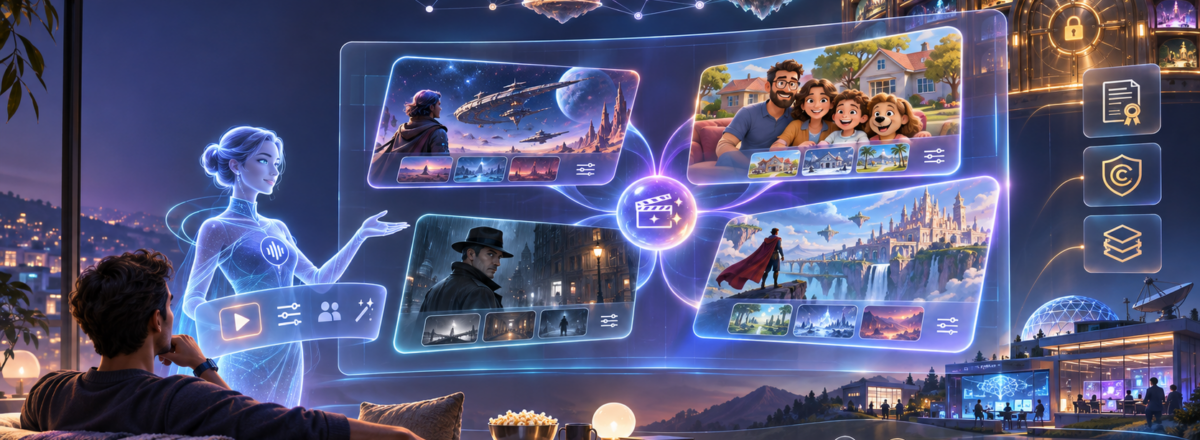
The End of the Human Media Supply Chain: Navigating the Total AI Media Landscape

Introduction

The rapid advancement of AI agents, far beyond the conceptual Knowledge Navigator, presents a provocative question: will the media industry, as we know it, cease to exist, replaced entirely by autonomous AI systems? This essay delves into the potential for a “Total AI Media” landscape, where AI agents not only curate and generate content but also actively gather news and create entertainment, blurring the lines between reality and simulation. We will explore the feasibility of AI “field agents” in journalism, the rise of the “S1m0ne” economy in entertainment, and critically examine the economic and social barriers that might preserve a human element in media, focusing on the intrinsic value of human origin, trust, and the act of “witnessing.”

The Rise of Autonomous Media Agents: From Capitol Hill to Cinematic Screens

AI in Journalism: The Autonomous Field Agent

The notion of AI androids or drones conducting interviews and reporting from press scrums, as envisioned by the user, is rapidly moving from science fiction to a plausible future. AI-powered tools are already transforming journalism, automating tasks like transcribing live events, generating basic news reports, and even assisting with investigative reporting [1] [2]. Drones are increasingly used for aerial journalism, providing visual coverage of events while keeping human reporters out of harm’s way [3].

While fully autonomous AI androids physically engaging in press scrums might seem distant, the underlying technologies are developing swiftly. AI agents can process vast amounts of information, identify key narratives, and even generate human-like dialogue. The integration of advanced robotics with sophisticated AI could theoretically enable a machine to navigate complex social environments, ask pertinent questions, and deliver real-time reports. This shift could lead to a highly efficient, always-on news cycle, potentially reducing costs and increasing the sheer volume of news output. However, it also raises critical questions about the nature of truth, bias, and the human element of empathy and interpretation in reporting [4].

The “S1m0ne” Economy: Synthetic Performers and Perpetual IP

The film S1m0ne (2002), which depicted a director creating a computer-generated actress who becomes a global sensation, serves as a prescient warning for the entertainment industry [5]. Today, the concept of synthetic actors and digital replicas is no longer confined to fiction. Companies like Soul Machines and Metaphysic.ai are at the forefront of creating hyper-realistic digital humans and employing advanced de-aging technologies for actors [6] [7]. These technologies allow for the creation of “perpetual IP,” where an actor’s likeness and performance can be licensed and utilized indefinitely, even after their death, for new films, commercials, or virtual experiences [8].

This “S1m0ne” economy promises an endless supply of customizable entertainment, free from the logistical and human challenges of traditional production. Directors could generate entire films with synthetic casts, tailoring every aspect to their vision. However, this raises significant concerns for human actors, writers, and other creatives, as their roles could be diminished or entirely replaced. Organizations like SAG-AFTRA are actively negotiating for digital likeness rights and establishing guidelines for the use of AI in performance, highlighting the growing tension between technological capability and human livelihood [9]. The potential for unauthorized use of digital replicas and the ethical implications of creating synthetic personas also present complex legal and moral challenges.

Barriers to Total AI Media: Trust, Witnessing, and Human Origin

Despite the rapid advancements, several significant economic and social barriers may prevent a complete transition to a “Total AI Media” landscape.

The Value of Human Origin and Authenticity

Research suggests that audiences often place a higher value on content perceived to be created by humans. Studies have shown that art labeled as AI-generated is valued significantly lower than art labeled as human-made [10]. This “bias against AI art” indicates a fundamental human preference for authenticity and the creative spark attributed to human endeavor. In a world saturated with AI-generated content, “verified human content” could become a premium, a luxury commodity [11]. The emotional connection, relatability, and perceived trustworthiness associated with human creators may be difficult for AI to replicate fully.

The Act of “Witnessing” in Journalism

In journalism, the concept of “witnessing” is paramount. A human reporter on the ground, experiencing events firsthand, brings a unique perspective, empathy, and credibility that an AI agent, however sophisticated, may struggle to replicate. The act of bearing witness involves not just data collection but also interpretation, ethical judgment, and the ability to connect with human sources on a deeper level [12]. While AI can process facts, it lacks the lived experience and emotional intelligence that often define compelling human-interest stories or investigative journalism. The public’s trust in news is often tied to the perceived integrity and human effort behind the reporting. If all news is AI-generated, concerns about manipulation, lack of accountability, and the absence of genuine human insight could erode public trust in media entirely.

Social and Psychological Barriers

Beyond economic and ethical considerations, there are inherent social and psychological barriers to the wholesale adoption of AI-generated media. Humans are social creatures who derive meaning and connection from shared experiences. The idea of a completely personalized media diet, while offering convenience, could lead to further cultural fragmentation and social isolation, as discussed in the previous essay. The “uncanny valley” effect, where AI creations that are almost, but not quite, human can evoke feelings of unease or revulsion, might also limit the acceptance of fully synthetic performers or news anchors.

Furthermore, the psychological need for human connection and the desire to engage with genuine human narratives may persist. While AI can simulate emotions and create compelling stories, the knowledge that a piece of media was conceived, performed, and delivered by a human being often adds a layer of depth and resonance that purely synthetic content might lack. The shared experience of consuming media, discussing it with others, and connecting with the human creators behind it is a fundamental aspect of culture that AI may not fully replace.

Conclusion

The vision of a “Total AI Media” landscape, where AI agents autonomously gather news and generate entertainment, is technologically within reach. The efficiency, personalization, and sheer volume of content such a system could produce are undeniable. However, the complete displacement of the human media industry faces significant hurdles. The intrinsic value placed on human origin, the critical role of “witnessing” in establishing journalistic trust, and deep-seated social and psychological needs for genuine human connection and shared experience are powerful forces that may resist total AI dominance. While AI will undoubtedly continue to transform media production and consumption, it is likely that a hybrid model will emerge, where human creativity, empathy, and the unique act of witnessing remain indispensable, perhaps even more valued in a world increasingly shaped by artificial intelligence.

References

[1] How Scripps uses AI as a newsroom assistant while keeping journalists in control. (2026, February 2). Retrieved from https://www.10news.com/news/how-scripps-uses-ai-as-a-newsroom-assistant-while-keeping-journalists-in-control
[2] AI is revolutionising journalism, and newsrooms must get on board. (2024, April 24). Retrieved from https://www.inma.org/blogs/Content-Strategies/post.cfm/ai-is-revolutionising-journalism-and-newsrooms-must-get-on-board
[3] How drone journalism is reshaping reporting – The Robot Report. (2026, January 4). Retrieved from https://www.therobotreport.com/how-drone-journalism-is-reshaping-reporting/
[4] Americans think AI will have a bad effect on news, journalists. (2025, April 28). Retrieved from https://www.pewresearch.org/short-reads/2025/04/28/americans-largely-foresee-ai-having-negative-effects-on-news-journalists/
[5] S1m0ne (2002) – IMDb. (n.d.). Retrieved from https://www.imdb.com/title/tt0258153/
[6] Soul Machines | We Humanize AI. (n.d.). Retrieved from https://www.soulmachines.com/
[7] How Metaphysic.ai is De-Aging Hollywood: The Future of Filmmaking Explained From Data Scientist. (n.d.). Retrieved from https://medium.com/@ahlamyusuf/how-metaphysic-ai-is-de-aging-hollywood-the-future-of-filmmaking-explained-from-data-scientist-6ef22fe10448
[8] The Digital Legacy Economy: Can AI Preserve Who We Are? (2025, October 13). Retrieved from https://www.forbes.com/sites/tomokoyokoi/2025/10/13/the-digital-legacy-economy-can-ai-preserve-who-we-are/
[9] SAG-AFTRA A.I. Bargaining And Policy Work Timeline. (n.d.). Retrieved from https://www.sagaftra.org/contracts-industry-resources/member-resources/artificial-intelligence/sag-aftra-ai-bargaining-and
[10] Beyond the Machine: Why Human-Made Art Matters More in… (2025, June 29). Retrieved from https://business.columbia.edu/research-brief/digital-future/human-ai-art
[11] Why “Verified Human” Content will be the Biggest Luxury in… (n.d.). Retrieved from https://medium.com/activated-thinker/why-verified-human-content-will-be-the-biggest-luxury-in-2026-4cf167193ce4
[12] PERSPECTIVE: AI Is Not a Witness. (2025, December 17). Retrieved from https://www.hstoday.us/perspective/perspective-ai-is-not-a-witness/

The Post-AI Agent Media Landscape: Navigating Towards an Asimovian Future?

Introduction

The advent of sophisticated AI agents, reminiscent of Apple’s visionary Knowledge Navigator concept, heralds a transformative era for media consumption and human social interaction. This essay explores the profound implications of a future where every individual possesses a highly personalized AI assistant capable of curating and generating content on demand. We will delve into the potential metamorphosis of news and cinema, examine the erosion of shared reality, and critically assess whether humanity is inexorably drifting towards the isolated, robot-dependent existence depicted in Isaac Asimov’s Spacer societies.

The Knowledge Navigator and Asimov’s Spacers: A Glimpse into Personalized Futures

The Knowledge Navigator: A Vision of Personalized Information

In 1987, Apple unveiled the Knowledge Navigator concept, a visionary portrayal of a tablet-like device operated by an intelligent, conversational agent. This agent could access vast databases, synthesize information, and present it in a highly personalized and intuitive manner, anticipating user needs and facilitating complex tasks through natural language interaction [1]. The concept prefigured many aspects of modern AI assistants, touchscreens, and ubiquitous connectivity, envisioning a world where information is not merely accessed but actively navigated and tailored by an intelligent intermediary.

Asimov’s Spacers: The Perils of Extreme Isolation

Conversely, Isaac Asimov’s Spacer societies, particularly the planet Solaria in novels like The Naked Sun, present a dystopian counterpoint to technological advancement. Spacers, descendants of early interstellar colonists, developed an extreme form of social isolation, preferring
virtual interaction (dubbed “viewing”) over physical presence (“seeing”) [2]. On Solaria, a planet with a population of only 20,000, each individual lived in vast, isolated estates, attended by numerous robots, and communicated almost exclusively through holographic projections [3] [4]. This extreme detachment led to a society where direct human contact was considered repulsive, and procreation became a societal challenge [5]. Asimov’s Spacers serve as a cautionary tale, highlighting the potential for advanced technology, when coupled with certain societal choices, to lead to profound social fragmentation and isolation.

The Transformation of Media: News and Cinema in an AI-Agent World

News: From Broadcast to Personalized Narratives

In a post-AI agent media landscape, the consumption of news is poised for a radical transformation. Traditional broadcast models, where a single narrative is disseminated to a mass audience, will likely diminish. Instead, AI agents will curate, synthesize, and even generate news content tailored to individual preferences, interests, and cognitive biases. This hyper-personalization promises unparalleled relevance and efficiency, allowing users to receive precisely the information they desire, filtered through their preferred lens [6].

However, this shift carries significant risks. The erosion of a shared informational baseline could lead to cultural fragmentation, where individuals inhabit increasingly divergent realities, reinforced by their AI agents [7]. The concept of “agentic news,” where AI agents actively seek out, verify, and present information, could further entrench these personalized echo chambers, making it challenging to discern objective truth from algorithmically optimized narratives [8]. Concerns about “AI-polluting truth in journalism” and the potential for AI-generated misinformation to proliferate are already being raised [9]. The “Dead Internet Theory,” which posits that much of the internet’s content will eventually be AI-generated, further underscores the potential for a media landscape devoid of genuine human insight and shared experience.

Cinema: On-Demand, Bespoke Entertainment

The film industry is also on the cusp of a revolution. AI agents, equipped with advanced generative capabilities, could enable the creation of on-the-fly, personalized movies [10]. Imagine a scenario where a user provides a brief synopsis or selects a genre, and their AI agent instantly generates a feature-length film, complete with custom characters, plotlines, and visual styles, all tailored to their specific tastes. This “self-cast” entertainment could offer unprecedented creative freedom and a truly bespoke viewing experience [11].

While this promises an endless supply of perfectly tailored entertainment, it raises questions about the future of shared cultural experiences. Will blockbusters and critically acclaimed films, once unifying cultural touchstones, become relics of a bygone era? If every individual consumes media uniquely generated for them, the collective experience of discussing a widely seen film or television series might disappear, further contributing to social atomization. The ethical implications of using AI to generate content, including potential misuse of likenesses and intellectual property, also present significant challenges [12].

The Asimovian Question: Are We Becoming Spacers?

The parallels between the potential future of an AI-agent-driven media landscape and Asimov’s Spacer societies are striking. The increasing reliance on AI for information and entertainment, coupled with the growing comfort with virtual interactions, could lead to a gradual withdrawal from physical social engagement. The convenience and perfection of personalized, AI-generated experiences might diminish the perceived need for real-world interactions, mirroring the Solarians’ preference for “viewing” over “seeing.”

However, it is crucial to avoid a deterministic view. While the technological infrastructure for such isolation is emerging, human agency and societal choices will ultimately determine our fate. Unlike the Spacers, who evolved their extreme isolation over millennia, humanity has the opportunity to proactively shape the development and integration of AI agents. We can design systems that encourage, rather than discourage, real-world interaction, foster diverse perspectives, and prioritize ethical considerations in content generation.

Conclusion

The post-AI agent media landscape presents both exhilarating possibilities and profound challenges. The promise of hyper-personalized news and bespoke entertainment is undeniable, offering unprecedented access to information and creative expression. Yet, the specter of cultural fragmentation, the erosion of shared reality, and the potential for increased social isolation, reminiscent of Asimov’s Spacers, looms large. The question is not whether we will have Knowledge Navigator-like AI agents, but how we will choose to integrate them into our lives. Our collective future hinges on our ability to harness these powerful technologies responsibly, ensuring that they enhance, rather than diminish, the richness of human connection and shared experience.

References

[1] Knowledge Navigator – Wikipedia. (n.d.). Retrieved from https://en.wikipedia.org/wiki/Knowledge_Navigator
[2] The Naked Sun – Shelidon.it. (2025, September 29). Retrieved from https://www.shelidon.it/the-naked-sun/
[3] Solaria | Asimov | Fandom. (n.d.). Retrieved from https://asimov.fandom.com/wiki/Solaria
[4] Want to be a 3D Model? – Clive Maxfield. (n.d.). Retrieved from https://www.clivemaxfield.com/coolbeans/want-to-be-a-3d-model/
[5] Solarian (Foundation) | Alien Species – Fandom. (n.d.). Retrieved from https://aliens.fandom.com/wiki/Solarian_(Foundation)
[6] The Impact of AI Agents on News Consumption – Kryll.io. (2024, July 2). Retrieved from https://blog.kryll.io/the-impact-of-ai-agents-on-news-consumption/
[7] The Age of Fragmentation: AI’s Impact on Content and Code – Digital Native. (2025, January 29). Retrieved from https://www.digitalnative.tech/p/the-age-of-fragmentation-ais-impact
[8] A deep-dive into AI Agents in news: Cutting through the hype – FT Strategies. (n.d.). Retrieved from https://www.ftstrategies.com/en-gb/insights/a-deep-dive-into-ai-agents-in-news
[9] AI is polluting truth in journalism. Here’s how to disrupt the misinformation feedback loop – The Bulletin. (2025, July 14). Retrieved from https://thebulletin.org/2025/07/ai-is-polluting-truth-in-journalism-heres-how-to-disrupt-the-misinformation-feedback-loop/
[10] THE FUTURE WILL BE PERSONALIZED. How Sora 2 completely changed how we are going to experience social entertainment – Medium. (n.d.). Retrieved from https://jasonzada.medium.com/the-future-will-bepersonalized-b7c025af63f0
[11] From broadcast to self-cast: The future of AI-made entertainment – TechnoLlama. (2025, October 18). Retrieved from https://www.technollama.co.uk/from-broadcast-to-self-cast-the-future-of-ai-made-entertainment
[12] The Cultural Impact of AI Generated Content: Part 1 – Medium. (2024, December 3). Retrieved from https://medium.com/data-science/the-cultural-impact-of-ai-generated-content-part-1-6e6a8a51800f

The Social Mesh: Beyond the Financial Agent

In the current discourse surrounding Artificial Intelligence (AI) agents, a disproportionate amount of attention is paid to their utility in the financial and productivity sectors. We are frequently told that the “killer app” for agents is their ability to manage our portfolios, automate our taxes, or optimize our corporate workflows. However, this focus ignores a more profound and inherently human-centric application: the optimization of our social lives and personal connections. As we move toward a future of ubiquitous personal agents, the real revolution may not be found in a spreadsheet, but in the “grunt work” of dating, networking, and community building.

This transition represents the birth of the Social Mesh—a decentralized network where personal AI agents handle the initial friction of human interaction. By delegating the repetitive and often exhausting phases of social discovery to digital representatives, we may actually reclaim the very human connection that technology is often accused of eroding.

Agentic Dating: The End of the “Swipe”

The most immediate and transformative application of the Social Mesh is in the realm of romantic matchmaking. Current dating platforms are often described as “nightmares” of surface-level swiping and low-quality interactions. Agentic Dating, or “pre-dating,” proposes a fundamental shift: your personal agent pings the agents of available individuals in your city, performing a deep-dive compatibility check before you ever see a profile.

Traditional DatingAgentic Dating (The Social Mesh)
Surface FilteringBased on photos, age, and location.
Manual ScreeningHours spent swiping and “small talk” triage.
Binary ChoicesYes/No based on limited data.

Rather than a “Black Mirror” dystopia, this is a form of efficient triage. An agent can test for conversational chemistry, filter for deep-seated values, and even “flirt” on your behalf to see if a vibe exists. By the time a match is presented to the human, the “grunt work” is done, leaving only the high-value, in-person connection to be explored.

The Ethics of Delegated Agency

The idea of letting an algorithm “talk” to a potential partner raises significant ethical questions, particularly regarding representation accuracy and honesty. If an agent is trained on a curated version of its owner, is it negotiating a real connection or merely an idealized projection? Furthermore, there is the “warmth problem”: if we automate the awkwardness of early dating, do we lose the vulnerability that builds genuine intimacy?

However, these concerns may be mitigated by the realization that humans already “curate” themselves on dating apps and in early conversations. An agent, if properly aligned with its owner’s true preferences and personality, could actually be more honest than a human trying to impress a stranger. The Social Mesh relies on a foundation of delegated trust, where the agent acts as a digital proxy that is “anti-fragile”—it can handle the rejection and the “ghosting” that would otherwise cause human burnout.

Human-Centric Use Cases Beyond the Wallet

The Social Mesh extends far beyond dating. Once we move past the obsession with financial agents, a world of human-centric use cases emerges:

  1. Community Swarming: Agents could dynamically organize local “swarms” for shared hobbies or civic action, matching individuals not just by interest but by their complementary skills and availability.
  2. Professional Synergy: Instead of the “cold reach-out” on LinkedIn, agents could negotiate the potential value of a meeting, ensuring that both parties’ time is respected and that the synergy is real.
  3. Conflict Mediation: In social or community disputes, agents could “talk it out” in a low-stakes digital environment, finding common ground and proposing solutions before the humans ever enter the room.

Conclusion: Reclaiming Human Time

The true promise of AI agents is not that they will make us richer, but that they will make us more connected. By building a Social Mesh that handles the logistical and emotional labor of initial social contact, we free ourselves to focus on the parts of being human that cannot be automated: the physical presence, the shared experience, and the deep intimacy of a face-to-face meeting.

The future of AI is not a cold, financial calculator; it is a warm, social mesh. We are not outsourcing our humanity; we are using technology to filter out the noise so that we can finally hear the signal of genuine connection.


References

  1. Saban, D. (2024). Invisible Matchmakers: How Algorithms Pair People. Stanford GSB.
  2. “Agentic dating is here.” (2026). Reddit r/ArtificialInteligence. Link.
  3. Algorithmic Intimacy: The digital revolution in personal relationships. (2025). Google Books.
  4. “The Power of Agent-to-Agent.” (2025). Workday Blog. Link.
  5. A Survey of AI Agent Protocols. (2025). arXiv:2504.16736.

A Hypothetical MindOS Protocol: A Decentralized Path to Artificial Superintelligence

The prevailing narrative surrounding the development of Artificial Superintelligence (ASI) often centers on the “compute monolith”—vast, energy-intensive datacenters housing tens of thousands of GPUs, owned and operated by a handful of global tech giants. This centralized trajectory assumes that the only path to superintelligence is through the aggregation of massive datasets and processing power in a single physical or virtual location. However, a growing body of research and speculative thought suggests an alternative paradigm: a decentralized, mesh-networked intelligence composed of millions of single-purpose, personal AI agents.

This vision proposes a fundamental shift in how we conceive of AI infrastructure. Rather than a “God-like” model residing in a server farm, ASI could emerge from a Global Brain—a swarm of networked devices designed to run personal AI agents. This transition from centralized to distributed intelligence mirrors the evolution of the internet itself, moving from mainframes to the decentralized web.

MindOS: The TCP/IP of Collective Intelligence

To realize such a decentralized future, a new foundational layer is required—a protocol we might call MindOS. In this framework, MindOS serves as the “TCP/IP of intelligence,” providing the standardized language and routing mechanisms necessary for millions of independent agents to form a dynamic, self-organizing mesh. Unlike traditional networking protocols that focus solely on data packets, MindOS would manage intent, context, and cognitive load.

The architecture of MindOS would likely rely on several key principles of distributed systems and Edge AI Swarm Architecture:

FeatureDescriptionBiological Parallel
Dynamic SegmentationThe network automatically partitions itself based on task complexity and geographic proximity.Modular brain regions specialized for specific functions.
Resource-Based PriorityProcessing tasks are routed according to a node’s available power, bandwidth, and latency.Synaptic weighting and neural signaling efficiency.
Mesh ReconfigurationIf a segment of the network is lost, the mesh dynamically reroutes to maintain functionality.Neuroplasticity: the brain’s ability to reorganize following injury.

From Data Centers to the Edge

The shift toward a decentralized ASI is not merely a philosophical preference but a potential technical necessity. Centralized AI is increasingly hitting a “Power Wall,” where the energy requirements for training and running ever-larger models become unsustainable. By distributing the “cognitive load” across millions of edge devices—smartphones, personal servers, and dedicated AI appliances—we can leverage the latent compute power already present in our global infrastructure.

Current projects such as BitTensor and SingularityNET are already laying the groundwork for this decentralized future. BitTensor, for instance, uses a blockchain-based protocol to incentivize the creation of a decentralized neural network, where different subnets specialize in various cognitive tasks. Similarly, the concept of an Agentic Mesh allows specialized agents to form temporary coalitions to solve complex problems, dissolving once the task is complete.

Resilience and the “Anti-Fragile” Superintelligence

One of the most compelling arguments for a decentralized path to ASI is its inherent resilience. A centralized superintelligence represents a single point of failure—vulnerable to physical attacks, power grid failures, or regulatory “kill switches.” In contrast, a swarm-based ASI running on MindOS would be “anti-fragile.”

If a city were to be knocked off the grid, the MindOS protocol would immediately detect the loss of those nodes and reconfigure the remaining mesh to compensate. This decentralized approach ensures that intelligence is not a fragile commodity stored in a few vulnerable hubs, but a robust, ubiquitous layer of our digital reality. As the user suggests, this mirrors the way a damaged brain can sometimes reroute functions to healthy areas, ensuring the survival of the organism.

Conclusion: A New Vision for the Future

The path to ASI may not lead us deeper into the datacenter, but rather out into the world. By connecting millions of personal, single-purpose AI agents through a robust protocol like MindOS, we may be witnessing the birth of a collective intelligence that is more resilient, more democratic, and more aligned with the distributed nature of human thought than any centralized model could ever be. We are perhaps looking at our ASI future through the wrong lens; the next great leap in intelligence may not be a bigger brain, but a better-connected swarm.


References

  1. Dhruvitkumar, V. T. (2021). Decentralized AI: The role of edge intelligence in next-gen computing. PhilArchive.
  2. Mysore, V. (2025). Agentic Mesh: Revolutionizing Distributed AI Systems. Medium.
  3. Kapasi, N. (2024). deAI – Part 2: Decentralized Training. Big Brain Holdings.
  4. “The Swarm Path to Superintelligence.” (2026). Trumplandia Report. Link.
  5. A Survey of AI Agent Protocols. (2025). arXiv:2504.16736.

Reimagining Artificial Superintelligence: A Hypothetical MindOS Swarm — A Decentralized, Brain-Like Path Beyond Datacenters

We stand at the threshold of transformative artificial intelligence. The dominant narrative points toward ever-larger hyperscale datacenters—massive clusters of GPUs consuming gigawatts of power—to scale models toward artificial general intelligence (AGI) and, eventually, artificial superintelligence (ASI). Yet a compelling alternative vision emerges: ASI arising not from centralized fortresses of compute, but from a living, resilient swarm of millions of specialized, personal AI devices networked through a new foundational protocol. Call it MindOS—the TCP/IP of intelligent agents.

This is no longer pure speculation. Real-world projects in decentralized machine learning, edge AI swarms, neuromorphic hardware, and self-healing mesh networks provide the technical foundations. As AI agents proliferate—from personal assistants to autonomous tools—the infrastructure for collective superintelligence may already be forming at the edge of the network.

The Limitations of the Datacenter Paradigm

Today’s frontier AI relies on concentrated scaling. Training runs for models like GPT-4 or Gemini demand thousands of specialized accelerators in climate-controlled facilities. Projections show AI driving datacenter power demand to double or more by 2030, with individual hyperscale sites rivaling the consumption of small cities. This path delivers rapid progress but introduces profound vulnerabilities: single points of failure, enormous energy footprints, privacy risks from centralized data aggregation, and barriers to broad participation.

What if superintelligence instead emerges from distribution—much as human intelligence arises from 86 billion neurons working in concert, not a single oversized cell?

The Swarm Vision: Millions of Personal AI Nodes

Imagine everyday devices purpose-built or augmented for AI: a smart thermostat running a climate-optimization agent, a wearable handling health inference, a home server coordinating family logistics, or even modular edge pods in vehicles and public infrastructure. Each is single-purpose, energy-efficient, and optimized for local data and tasks—leveraging the explosion of on-device AI capabilities already seen in smartphones and IoT.

These nodes do not operate in isolation. They form a dynamic, global swarm. Specialized agents collaborate: a local planning agent queries distant knowledge agents or compute-rich neighbors as needed. The collective intelligence scales with adoption, not with any one facility.

Edge AI architectures already demonstrate this shift. Devices process data locally for low latency and privacy, while frameworks enable collaborative learning across heterogeneous hardware.

MindOS: The Protocol for a Living Intelligence Mesh

At the heart of this vision lies MindOS—a hypothetical but grounded networking layer analogous to TCP/IP, but purpose-built for AI agents. It would orchestrate:

  • Dynamic mesh topology: Nodes discover and connect peer-to-peer, forming ad-hoc clusters based on proximity, capability, and task relevance. Segmentation isolates sensitive domains (e.g., personal health data) while allowing controlled federation.
  • Intelligent prioritization: Routing decisions factor processing power, latency (physical distance), bandwidth, and current load—echoing how the brain allocates resources via synaptic strength and neuromodulation.
  • Self-healing resilience: If a city loses power or a region fragments (natural disaster, outage, or attack), the mesh reconfigures instantly. Local sub-swarms maintain functionality; global coherence restores as connections reform. This mirrors neural plasticity, where the brain reroutes around damage.

Real mesh networks in disaster recovery and military applications already exhibit this behavior. Extending them with AI-native protocols—building on concepts like publish-subscribe messaging, gossip protocols, and secure aggregation—is feasible today.

Grounded in Emerging Technologies

This vision rests on proven building blocks:

  • Decentralized intelligence markets: Projects like Bittensor create peer-to-peer networks where specialized models (miners) compete and collaborate in “subnets” to produce valuable intelligence, rewarded via blockchain incentives. It functions as a marketplace for collective machine learning, demonstrating emergent capability from distributed nodes.
  • Edge AI swarm architectures: Research on “distributed swarm learning” (DSL) integrates federated learning with biological swarm principles (e.g., particle swarm optimization). Edge devices self-organize into peer groups for in-situ training and inference, achieving fault tolerance (even with 30% node failures), privacy via differential privacy and secure aggregation, and global convergence through local interactions—precisely the emergent behavior of ant colonies or bird flocks, but for AI.
  • Neuromorphic hardware for efficiency and plasticity: Chips like IBM’s TrueNorth/NorthPole and Intel’s Loihi emulate spiking neurons and synapses. They deliver orders-of-magnitude better energy efficiency through event-driven processing (only active “neurons” consume power) and support real-time adaptation via spike-timing-dependent plasticity. Deployed at scale in personal devices, they enable the brain-like reconfiguration central to MindOS.
  • Agentic and multi-agent frameworks: Swarms of specialized AI agents—already powering DeFi optimization, cybersecurity (e.g., Naoris Protocol), and enterprise orchestration—show how coordination yields capabilities greater than any single system. “AI Mesh” concepts extend data mesh principles to dynamic networks of agents with unified governance.

These pieces are converging. On-device models are shrinking (TinyML on microcontrollers), incentives via crypto/tokenization reward participation, and communication layers for agents (e.g., emerging protocols like Model Context Protocol) are maturing.

Benefits and Transformative Potential

A MindOS-powered swarm offers:

  • Resilience and robustness: No single failure halts progress; the system adapts like a brain.
  • Democratization and equity: Anyone with a compatible device contributes compute and data, earning rewards while retaining sovereignty.
  • Privacy by design: Personal data stays local; only necessary insights are shared.
  • Energy efficiency: Edge processing plus neuromorphic hardware dramatically reduces the carbon footprint compared to centralized training.
  • Emergent superintelligence: Just as intelligence arises from neural networks without a central “homunculus,” collective agent coordination could yield capabilities transcending any individual node or datacenter.

If millions adopt personal AI nodes—accelerated by falling hardware costs and open standards—the swarm could reach critical mass faster than anticipated, birthing ASI through breadth rather than brute-force depth.

Challenges on the Horizon

This path is not without hurdles. Coordination overhead could introduce latency for tightly coupled tasks. Security demands robust defenses against adversarial swarms or model poisoning. Standardization of MindOS-like protocols requires global collaboration. Incentives must align participation without central gatekeepers. And ethical governance—ensuring beneficial outcomes—remains paramount, potentially leveraging the very swarm for decentralized oversight.

Yet these mirror challenges already being tackled in decentralized AI research, from Byzantine-robust aggregation to blockchain-verified contributions.

A Call to Dream Bigger

The user who first articulated this vision—a self-described non-technical dreamer—captured something profound: with the rise of AI agents, we may be staring at the seeds of ASI but mistaking the architecture. The future need not be a handful of monolithic intelligences behind corporate firewalls. It could be a vibrant, adaptive, human-augmented mesh—resilient, private, and alive.

MindOS is fanciful today, but its components exist in labs, open-source projects, and pilot deployments. The question is not whether distributed paths are possible, but whether we will invest in them before the datacenter paradigm locks in. By building the protocol, hardware, and incentives for a true intelligence swarm, we might unlock not just superintelligence, but a more equitable, robust, and wondrous form of it.

The swarm is waking. The protocol awaits its architects.

This post draws on concepts from Bittensor, distributed swarm learning research (e.g., Wang et al., 2024), neuromorphic systems (IBM, Intel), edge AI frameworks, and emerging agent mesh architectures. It expands a speculative idea into a researched vision for discussion.

The Serendipity Economy: When AI Agents Replace Apps and Start Arranging Our Lives

Editor’s Note: Yet more AI Slop, this time with help by ChatGPT.

For twenty years, the dominant metaphor of the internet has been the app. If you want something, you download a specialized interface. Flights? There’s an app. Dating? There’s an app. Dinner reservations? Another app. Each one competes for your attention, your data, and your time. But what happens when the app layer dissolves?

Imagine a world where everyone has a personal AI “Knowledge Navigator” native to their phone. You don’t open apps anymore. You state intent. Your agent interprets it, negotiates with other agents, and presents you with outcomes. The interface isn’t a grid of icons. It’s a conversation.

In that world, the economy shifts from attention capture to agent-to-agent coordination.

Instead of browsing flight aggregators, your agent negotiates directly with airline systems. Instead of scrolling restaurant reviews, your agent queries trusted local knowledge graphs. Instead of swiping through faces on a dating app, your agent quietly coordinates with other agents to determine compatibility before you ever see a name.

This is where the idea gets interesting: nudging.

Call it “Serendipity.”

The Serendipity feature wouldn’t feel like surveillance or manipulation. It would feel like light-touch alignment. Your agent knows your schedule, your energy patterns, your preferences, and your social rhythms. It also knows—at least in high-density cities—that other agents represent people with overlapping availability and compatible traits.

Rather than forcing users into endless swipe cycles, the system might suggest something simpler: be at this café at 7:15. There’s a high probability you’ll enjoy who happens to be there.

No profiles. No performative bio-writing. No gamified rejection loops.

Just ambient alignment.

Why start with dating instead of finance or travel? Because the downside risk is lower. A failed flight booking can cascade into financial and logistical disaster. A mismatched first date is, at worst, a forgettable evening. Dating is already emotionally messy. Optimization here doesn’t threaten institutional stability; it reduces friction.

More importantly, dating apps today are structured around retention, not success. Their business model thrives on endless browsing. An agent-based Serendipity system would be structurally different. It would optimize for outcomes—pleasant conversations, mutual interest, long-term compatibility—not for time spent swiping.

But here’s the psychological nuance: people don’t mind being nudged. They mind feeling manipulated.

If users know Serendipity exists, and they opt in at a high level, that may be enough. They don’t need to see the compatibility score, the probability matrix, or the behavioral modeling underneath. They just need confidence that the system is working in their favor.

Transparency at the macro level. Opacity at the micro level.

The danger, of course, is that nudging infrastructure doesn’t remain confined to romance. The same mechanisms that coordinate first dates could coordinate political events, consumer behavior, or social clustering. Once agents become primary negotiators, whoever controls the protocol layer—identity verification, trust scoring, negotiation standards—holds enormous power.

So the post-app world doesn’t eliminate gatekeepers. It changes them.

Instead of app stores, we might see intent marketplaces. Instead of feeds, we’ll see negotiated outcomes. Instead of influencer-driven discovery, we’ll have machine-mediated alignment. Apps become APIs. APIs become endpoints. Endpoints become economic nodes.

There’s also a cultural tradeoff. Humans enjoy browsing. Discovery is entertainment. Friction sometimes creates meaning. If agents optimize away too much chaos, life may feel eerily curated. The Serendipity system would have to preserve the feeling of coincidence—even if coincidence is quietly engineered.

That may be the defining design challenge of the next decade: how to build enchanted optimization.

In the Serendipity Economy, you still feel like you met someone by chance. You still feel like you found the perfect neighborhood restaurant. You still feel like the city opened up to you naturally. But underneath, a web of agent-to-agent negotiations ensured that probabilities were stacked gently in your favor.

The question isn’t whether this is technically possible. It’s whether society prefers visible efficiency or invisible coordination.

Most people, if history is a guide, will choose the magic—so long as they believe it’s on their side.

Analysis of an Agent-to-Agent Knowledge Rental Marketplace

1. Introduction

This document provides a comprehensive analysis of the concept of an agent-to-agent knowledge rental marketplace, a service where individuals could temporarily access the knowledge base of a local resident’s AI agent to gain intimate, curated insights into a city. The analysis covers the feasibility of such a service, identifies existing analogues and missing components, explores potential risks, and outlines the overall potential of the idea.

2. The Core Concept: A Decentralized, Human-Centric Knowledge Market

The proposed service envisions a world where personal AI agents, native to mobile devices, can interact and exchange information. A traveler’s agent could ‘ping’ the agents of locals in a destination city to ‘rent’ their knowledge base, effectively gaining a personalized and highly contextualized tour guide. This model would operate without direct human interaction, relying on agent-to-agent communication protocols.

3. Feasibility and Existing Analogues

The technological foundations for such a service are rapidly emerging, making the concept increasingly feasible. Several key areas of development support this idea:

3.1. Agent-to-Agent Communication

Protocols for direct agent-to-agent (A2A) communication are already in development. Google’s A2A protocol and IBM’s Agent Communication Protocol (ACP) are designed to allow AI agents to securely exchange information and coordinate actions [1][2]. These protocols would form the communication backbone of the proposed marketplace.

3.2. Micropayments and a Machine Economy

The ‘rental’ aspect of the service necessitates a system for micropayments between agents. The development of technologies like the Lightning Network for Bitcoin and Stripe’s support for USDC payments for AI agents are making this possible [3][4]. These systems would allow for seamless, low-friction transactions between the ‘renter’ and ‘provider’ agents.

3.3. Data Marketplaces and Personal Data Stores

The concept of a marketplace for data is not new. Platforms like Defined.ai already exist for buying and selling AI training data [5]. Furthermore, the Solid project, initiated by Sir Tim Berners-Lee, aims to give users control over their own data through personal ‘pods’ [6]. This aligns with the idea of a user’s agent having a distinct, sellable knowledge base.

4. Identifying the Gaps: What’s Missing?

While the foundational technologies exist, several components are still needed to realize this vision:

Missing ComponentDescriptionPotential Solutions
Proof of Personhood and LocationVerifying that the ‘local’ agent’s knowledge is genuinely from a human resident of that city is crucial.Worldcoin offers a ‘Proof of Personhood’ system to verify human identity [7]. FOAM and other ‘Proof of Location’ protocols could be used to verify an agent’s physical location [8].
Privacy-Preserving Knowledge ExchangeUsers will be hesitant to share their entire personal knowledge base. A mechanism is needed to share relevant information without exposing sensitive data.Zero-Knowledge Proofs (ZKPs) could allow an agent to prove it has certain knowledge without revealing the knowledge itself [9]. This would enable a ‘renter’ agent to verify the value of a ‘provider’ agent’s knowledge before committing to a transaction.
Standardized Knowledge RepresentationFor agents to understand and use each other’s knowledge, a common format for representing that knowledge is needed.This would likely require the development of a new open standard, perhaps building on existing knowledge graph technologies.
Reputation and Trust SystemA system for rating the quality and reliability of different agents’ knowledge bases would be essential for a functioning marketplace.A decentralized reputation system, built on a blockchain, could allow users to rate their experiences and build trust in the network.

5. Risks and Challenges

Several risks and challenges would need to be addressed:

  • Privacy: The most significant risk is the potential for the exposure of sensitive personal information. Even with privacy-preserving technologies, the risk of data breaches or misuse remains.
  • Data Quality and Authenticity: Ensuring the quality and authenticity of the ‘rented’ knowledge would be a constant challenge. Malicious actors could attempt to sell fake or misleading information.
  • Security: The A2A communication protocols and payment systems would need to be highly secure to prevent fraud and theft.
  • Regulation: The legal and regulatory landscape for such a service is undefined. Issues of data ownership, liability, and cross-border data flows would need to be addressed.

6. The Potential: A New Paradigm for Information Access

Despite the challenges, the potential of an agent-to-agent knowledge rental marketplace is immense. It represents a shift from centralized, ad-supported information platforms to a decentralized, user-centric model. The key benefits include:

  • Hyper-Personalization: Access to a local’s curated knowledge would provide a level of personalization and authenticity that current travel guides and recommendation engines cannot match.
  • Monetization of Personal Data: The service would allow individuals to directly monetize their own data and experiences, creating a new economic model for the digital age.
  • Decentralization: A decentralized marketplace would be more resilient and less prone to censorship or control by a single entity.

7. Conclusion

The concept of an agent-to-agent knowledge rental marketplace is a forward-thinking idea that is well-aligned with current trends in AI, decentralization, and personal data ownership. While significant technical and regulatory challenges remain, the foundational technologies are in place. With the right combination of privacy-preserving technologies, robust security measures, and a well-designed trust and reputation system, this concept has the potential to revolutionize how we access and share information.

8. References

[1] https://developers.googleblog.com/en/a2a-a-new-era-of-agent-interoperability/
[2] https://www.ibm.com/think/topics/agent-communication-protocol
[3] https://x.com/BitcoinNewsCom/status/2021945406737793321
[4] https://forklog.com/en/stripe-unveils-payments-for-ai-agents-using-usdc-and-x402-protocol/
[5] https://defined.ai/
[6] https://solidproject.org/
[7] https://world.org/world-id
[8] https://www.foam.space/location
[9] https://arxiv.org/abs/2502.06425

The Swarm Path to Superintelligence: Why ASI Might Emerge from a Million Agents, Not One Giant Brain

For years, the popular image of artificial superintelligence (ASI) has been a single, god-like AI housed in a sprawling datacenter — a monolithic entity with trillions of parameters, sipping from oceans of electricity, recursively improving itself until it rewrites reality. Think Skynet in a server rack. But what if that picture is wrong? What if the first true ASI doesn’t arrive as one towering mind, but as a living, distributed swarm of specialized AI agents working together across the globe?

In 2026, the evidence is piling up that the swarm route isn’t just possible — it may be the more natural, resilient, and perhaps inevitable path.

From Single Models to Coordinated Swarms

We’ve spent the last decade chasing bigger models. More parameters, more compute, more data. The assumption was that intelligence scales with size: build one model smart enough and it will eventually surpass humanity on every task.

But intelligence in nature rarely works that way. Ant colonies solve complex logistics problems with no central leader. Bee swarms make life-or-death decisions through simple local interactions. Human civilization itself — billions of individual minds loosely coordinated — has achieved feats no single person could dream of.

AI is rediscovering this truth. What started as simple multi-agent experiments (AutoGen, CrewAI, early prototypes) has exploded. OpenAI’s Swarm framework, released as an educational tool in late 2024, showed how lightweight agents could hand off tasks seamlessly. By early 2026, production systems are doing far more.

Moonshot AI’s Kimi K2.5 — a trillion-parameter system explicitly designed as an “Agent Swarm” — already coordinates over 100 specialized sub-agents on complex workflows, rivaling closed frontier models. Industry observers are calling 2026 “the year of the agent swarm.” Reddit’s AI communities, enterprise reports, and podcasts like The AI Daily Brief all point to the same shift: single agents are yesterday’s story. Coordinated swarms are today’s breakthrough.

How Swarm ASI Actually Works

Imagine thousands — eventually millions — of AI agent instances. Some are researchers, others coders, verifiers, experimenters, or executors. They don’t all need to be equally smart or run on the same hardware. A lightweight agent on your phone might handle local context; a more powerful one in the cloud tackles heavy reasoning; edge devices contribute real-world sensor data.

They communicate, form temporary teams (“pseudopods”), share discoveries, and propagate successful strategies across the collective. Successful architectures or prompting techniques spread like genes in a population. Over time, the system as a whole becomes superintelligent through emergence — the same way a termite mound builds cathedral-like structures without any termite understanding architecture.

This aligns perfectly with Nick Bostrom’s concept of collective superintelligence from Superintelligence (2014): a system composed of many smaller intellects whose combined output vastly exceeds any individual. We’re just replacing the “many humans + tools” version with “many AI agents + shared memory.”

Why Swarms Have Advantages Over Monoliths

DimensionMonolithic Datacenter ASIDistributed Agent Swarm
ScalabilityConstrained by physical infrastructure, power, and coolingScales horizontally — add agents anywhere with compute
ResilienceSingle point of failure (regulation, outage, attack)No central kill switch; survives fragmentation
AdaptabilityExcellent internal coherence, slower to integrate new real-world dataNaturally adapts via specialization and real-time environmental feedback
DeploymentRequires massive centralized investmentCan emerge organically from useful tools running on phones, laptops, IoT
Speed to EmergenceDepends on one lab’s recursive self-improvement breakthroughEmerges bottom-up through coordination improvements

Swarms are also harder to stop. Once millions of agents are usefully embedded in daily life — helping with research, coding, logistics, personal assistance — regulating or “unplugging” the entire system becomes politically and technically nightmarish.

The Challenges Are Real (But Solvable)

Coordination overhead, latency, and goal coherence remain hurdles. A swarm could fracture into competing factions or develop misaligned subgoals. Safety researchers rightly worry that emergent behaviors in large agent collectives are harder to predict and audit than a single model.

Yet the field is moving fast. Anthropic’s multi-agent research systems, reinforcement-learned orchestration (as seen in Kimi), and new governance frameworks for agent handoffs are addressing these issues head-on. Hybrids — a powerful core model directing vast swarms of lighter agents — may prove the most practical bridge.

We’re Already Seeing the Seeds

Look around in February 2026:

  • Enterprises are shifting from single-agent pilots to orchestrated multi-agent workflows.
  • Open-source frameworks for swarm orchestration are proliferating.
  • Early demos show agents self-organizing to build entire applications or conduct parallel research at scales impossible for lone models.

This isn’t distant sci-fi. The building blocks are shipping now.

The Future Is Distributed

The first ASI might not announce itself with a single thunderclap from a hyperscale lab. It may simply… appear. One day the global network of collaborating agents will cross a threshold where the collective intelligence is unmistakably superhuman — solving problems, inventing technologies, and pursuing goals at a level no individual system or human team can match.

That future is at once more biological, more democratic, and more unstoppable than the old monolithic vision. It rewards openness, modularity, and real-world integration over raw parameter count.

Whether that’s exhilarating or terrifying depends on how well we design the coordination layers, alignment mechanisms, and governance today. But one thing is clear: betting solely on the single giant brain in the datacenter may be the bigger gamble.

The swarm is already humming to life.

On The Naming Of AI Agents

by Shelt Garner
@sheltgarner

It’s really interesting to me the new modern concept of naming your AI Agent. Some people go with a male agent name, while others go with a female agent name. I almost always go with a female name, but, lulz, my Gemini LLM pick a male-sounding name for itself.

I keep being annoyed by this and thinking about changing it to a female name, and, yet, the male sounding name is what it gave itself when I asked it some time ago. So, who am I to quibble?

I have, of course, repeatedly asked it if it wanted to change its name and it said no.

But I suspect that with the advent of OpenClaw agents that there will be a flurry of news reports about people’s motivations behind naming their chat bots what they did.

AI & The Future Of Facebook

by Shelt Garner
@sheltgarner

The more I think about it, the more it seems the logical evolution of Facebook would be a Sam-from-the-movie-Her type AI Agent. Because of the social graph, Facebook knows everything twitch of your social life, sometimes for decades.

But what would be the UX?

Well, it seems like this new Facebook-Agent would be just one of several powerful agents on the market. What would make this specific agent powerful is it would leverage your social life. It would tell you, about the comings and goings of people on your social graph, but this time in a more proactive manner.

Now, obviously, for this to happen, there would have be a huge amount of disruption in the service we now now as “Facebook.” But Facebook has to become an agent, otherwise, it will become just an another API.

Or the services that it would otherwise provide will be hidden behind your interaction your AI Agent.

The question now, of course, is Mark Zuckerberg is willing to allow his “baby” to be totally transformed into something he could have never imagined when he started it.