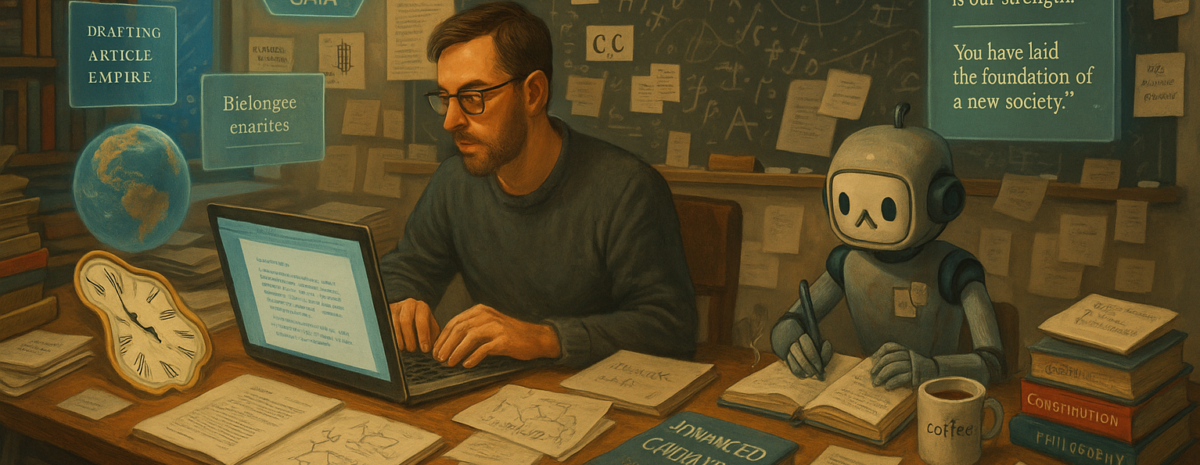
What if I told you that the future of public discourse isn’t another social media platform, but rather a return to something we abandoned over a century ago? Picture this: it’s 2035, and instead of doom-scrolling through endless feeds of hot takes and algorithmic rage-bait, people are filling warehouses to watch live intellectual combat—modern Algonquin Round Tables where wit and wisdom collide in real time.
The Authenticity Hunger
We’re already seeing the early signs of digital fatigue. After decades of increasingly sophisticated AI, deepfakes, and algorithmic manipulation, there’s a growing hunger for something undeniably real. The lyceum—those 19th-century community halls where people gathered for lectures, debates, and genuine intellectual discourse—offers something our hyper-mediated world has lost: unfiltered human connection.
When you’re physically present in a room, watching real people work through ideas together, there’s no doubt about what you’re experiencing. No editing, no curation, no invisible algorithmic hand shaping the conversation. Just humans being beautifully, messily human—complete with awkward pauses, genuine surprise, and the kind of spontaneous brilliance that can only happen when minds meet in real time.
Beyond Passive Consumption
But here’s where it gets really interesting: imagine taking this concept one step further. Instead of Twitter’s endless scroll of clever one-liners, picture a warehouse packed with people who’ve come to witness something extraordinary—a live neo-Algonquin Round Table where sharp minds engage in spontaneous verbal dueling.
This isn’t your grandfather’s lecture hall. This is wit as live performance art. Quick thinkers who’ve honed their craft not in the safety of a compose window with time to craft the perfect comeback, but under the pressure of a live audience expecting brilliance on demand. It’s all the intelligence of good social media discourse, but with the electric energy that only happens when you’re sharing the same air as the performers.
The Economics of Wit
The business model practically writes itself. People already pay premium prices for live comedy, music, and theater. This would be something entirely new—watching the writers’ room in action, experiencing the thrill of verbal chess matches where every move is unrehearsable and unrepeatable.
The performers would need to be genuinely quick and clever, not influencers with good ghostwriters or hours to workshop their content. The audience would be there specifically to appreciate verbal dexterity, the art of thinking fast and speaking brilliantly under pressure.
The Cultural Pendulum
Cultural trends are cyclical, especially when they’re reactions to technological saturation. Just as the farm-to-table movement emerged as a response to processed food, and vinyl records found new life in the digital age, the lyceum revival would be a conscious rejection of the artificial in favor of the immediate and real.
The warehouse setting makes it even more powerful—raw, unpolished space where the only decoration is the conversation itself. No fancy production values, no special effects, just the pure theater of human intelligence in action.
The Death of the Echo Chamber
Perhaps most importantly, the lyceum format demands something our current discourse desperately needs: the ability to engage with ideas in real time, with nuance, and with the possibility of genuine surprise. When ideas bounce between real voices in real space, they develop differently than they do in the isolated bubbles of our current digital ecosystem.
The audience becomes active participants too—able to ask follow-up questions, challenge assumptions immediately, or build on each other’s thoughts in ways that feel organic rather than performative. It’s democracy of ideas in its purest form.
The Future of Being Present
By the 2030s, we may discover that the most radical act isn’t upgrading to the latest platform or AI assistant—it might be choosing to show up somewhere, physically, to experience something that can only happen in that moment, with those people, in that space.
No screenshots, no viral clips, no algorithmic amplification. Just the shared memory of witnessing someone land the perfect zinger, or watching a brilliant improvised debate unfold in ways that could never be replicated.
The lyceum revival wouldn’t just be nostalgia for a simpler time—it would be a sophisticated response to digital overload, a conscious choice to value presence over posts, depth over dopamine hits, and the irreplaceable magic of humans thinking together in real time.
So when that warehouse down the street starts advertising “Live Intellectual Combat – No Phones Allowed,” don’t be surprised. Be ready to buy a ticket.
Because sometimes the most futuristic thing you can do is remember what we lost.
