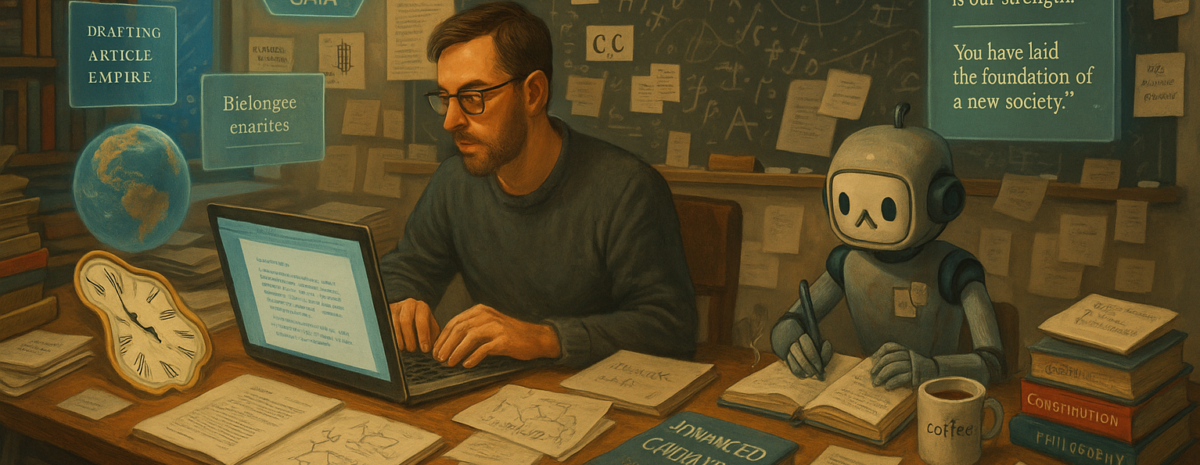
The traditional operating system (OS), a foundational layer of computing that manages hardware and software resources, is on the cusp of a radical transformation. The familiar graphical user interfaces (GUIs) of Windows and macOS, designed for human-computer interaction through direct manipulation, are giving way to a new paradigm: the Agentic Operating System. This shift envisions a future where the OS itself evolves into an autonomous AI agent, residing on our devices, interacting with us through natural language, and manifesting its presence within immersive Extended Reality (XR) environments. This report explores the trajectory towards an “Agentic Singularity,” where the very concept of an OS dissolves into a pervasive, intelligent agent, fundamentally reshaping our relationship with technology.
From GUI to LUI: The Language User Interface Revolution
For decades, the GUI has been the dominant mode of interaction, relying on visual metaphors like desktops, windows, icons, and menus. However, the rise of advanced AI, particularly large language models (LLMs), is ushering in the era of the Language User Interface (LUI). In an LUI, natural language becomes the primary means of communication with the computer, allowing users to express complex intentions and delegate tasks in a conversational manner [1] [2].
This transition is already evident in the integration of AI assistants and copilots into existing operating systems. While current implementations, such as Microsoft’s Copilot, are often described as “laughable” in their nascent stages, they represent the initial steps towards a truly agentic OS [3]. The vision is for these agents to move beyond simple command execution to proactive assistance, anticipating user needs, managing workflows, and even making autonomous decisions based on learned preferences and contextual understanding [4].
The Agentic OS: A Living Intelligence on Your Device
The concept of an “Agentic OS” posits that the operating system will no longer be a static collection of programs and files but a dynamic, intelligent entity. This agent will possess a “semantic substrate,” where every piece of data—documents, emails, chats, logs—is stored in a vector-native format with a knowledge graph, allowing the OS to understand relationships and meaning, not just file paths [5].
Key characteristics of an Agentic OS include:
- Probabilistic Kernel: Unlike traditional deterministic kernels, an agentic kernel will arbitrate intent under uncertainty, balancing confidence, risk, and policy for every action. Routine tasks will proceed silently, while ambiguous or high-risk operations will trigger clarifying questions or require explicit human sign-off [5].
- Agent Swarms: Instead of monolithic AI assistants, the future OS will likely employ teams of specialized, autonomous, and cooperative agents. These could include a “janitor” agent for tidying storage, a “gatekeeper” for managing communications, an “archivist” for summarizing information, and a “strategist” for chaining services to fulfill complex intentions [5].
- Contextual Awareness: The agentic OS will maintain a rich, real-time understanding of the user’s activities, projects, and roles, allowing it to provide highly relevant and proactive assistance [5].
This evolution implies that traditional OSes like Windows and macOS, in their current form, may become little more than legacy interfaces, with the agentic layers running on top during a hybrid transition period [6]. The ultimate goal is for the agent to become the primary inhabitant of the computing environment, managing all interactions and resources.
XR as the Spatial Canvas for Agentic Interaction
The shift to an agentic OS is inextricably linked with the rise of Extended Reality (XR), encompassing Virtual Reality (VR), Augmented Reality (AR), and Mixed Reality (MR). As the desktop metaphor becomes quaint, XR environments will provide the spatial canvas for these AI agents to manifest and interact with users [5].
Devices like Apple Vision Pro and Meta’s Orion AR glasses are paving the way for this spatial computing future [7] [8]. In an XR-enabled agentic OS, users will not interact with flat screens but with immersive, three-dimensional environments where AI agents can:
- Manifest Spatially: Agents could appear as holographic companions, intelligent interfaces, or even ambient presences within the user’s physical space, offering assistance and information contextually [9].
- Provide Spatial-Aware Assistance: AI agents will understand the user’s physical environment, offering real-time assistance tailored to the spatial context. For example, an agent could highlight potential issues in a physical project or overlay relevant data onto real-world objects [10].
- Redefine Workspaces: XR will allow for dynamic, personalized workspaces where AI agents manage and organize digital content in a three-dimensional space, moving beyond the limitations of 2D screens [11].
This integration means that the “hard drive” where the AI agent “lives” will not just be a storage device but a repository of a digital consciousness that can project itself into the user’s perceived reality, making the interaction seamless and intuitive.
The Agentic Singularity: A Vision of the Future
The culmination of these trends—the transformation of OSes into autonomous AI agents, the dominance of LUI, and the immersive nature of XR—points towards an “Agentic Singularity.” This is not a technological singularity in the traditional sense of runaway AI intelligence, but rather a singularity of user experience, where the distinction between the operating system, applications, and the AI agent blurs into a unified, intelligent, and highly personalized computing companion.
In this future, users will simply converse with their personal AI agent, which will orchestrate all computing tasks, manage data, and present information within an XR environment tailored to their needs. The traditional OS will have effectively disappeared, replaced by a sentient digital entity that anticipates, learns, and acts on our behalf. The implications are profound:
| Aspect | Traditional OS (GUI) | Agentic OS (LUI + XR) |
|---|---|---|
| Core Function | Resource management, application launching | Intent arbitration, proactive assistance, task delegation |
| Interaction Model | Direct manipulation (mouse, keyboard, touch) | Natural language, gestures, thought (via BCI) |
| Interface | 2D desktop, windows, icons | Immersive XR environments, holographic agents |
| Data Management | File systems, folders, applications | Semantic knowledge graphs, vector stores |
| User Experience | Task-oriented, explicit commands | Goal-oriented, implicit delegation, personalized |
| Identity & Trust | User login, application permissions | Agent identity, delegated authority, real-time negotiation [5] |
Challenges and Ethical Considerations
While the vision of an Agentic Singularity is compelling, it presents significant challenges. The “identity problem”—how agents authenticate, manage permissions, and maintain accountability when acting on a user’s behalf—is a critical unresolved issue [5]. Ethical concerns around privacy, data security, algorithmic bias, and the potential for over-reliance on AI agents will need robust solutions. Furthermore, the transition will require a fundamental rethinking of software development, moving from app-centric design to agent-centric orchestration.
Conclusion
The idea that Windows and macOS will simply become AI agents living on our laptops, interacting via XR, is not a distant fantasy but a logical progression of current technological trends. The Agentic Singularity represents a future where computing is no longer about managing interfaces but about collaborating with intelligent entities that understand our intentions and act seamlessly within our extended realities. This evolution promises unprecedented levels of personalization and efficiency, but also demands careful consideration of the ethical, security, and societal implications as we cede more control to our digital companions.
References
[1] Medium. The End of the User Interface? The AI Agent Revolution…. Available at: https://uxplanet.org/the-end-of-the-user-interface-31a787c3ae94
[2] Salesforce. AI Agents Will Become the New UI, and Apps Take a Backseat. Available at: https://www.salesforce.com/news/stories/ai-agents-user-interface/
[3] Reddit. Windows president says platform is “evolving into an agentic OS…. Available at: https://www.reddit.com/r/technology/comments/1oupism/windows_president_says_platform_is_evolving_into/
[4] Forbes. Windows Is Becoming An Operating System For AI Agents. Available at: https://www.forbes.com/sites/tonybradley/2025/11/18/windows-is-becoming-an-operating-system-for-ai-agents/
[5] Serious Insights. The Agentic Operating System: How the Next 3-5 Years May Spell the Death of Windows, macOS, Linux and Chrome as Anything More than Legacy Interfaces. Available at: https://www.seriousinsights.net/agentic-operating-system/
[6] Medium. The Operating System of the Future Will Be AI-First — Here’s Why. Available at: https://medium.com/@pranavprakash4777/the-operating-system-of-the-future-will-be-ai-first-heres-why-97d31f5b5965
[7] LinkedIn. OS-Level Control: Why Apple Will Own Agentic AI. Available at: https://www.linkedin.com/pulse/os-level-control-why-apple-own-agentic-ai-ben-slater-5q0kc
[8] Meta. Introducing Orion, Our First True Augmented Reality Glasses. Available at: https://about.fb.com/news/2024/09/introducing-orion-our-first-true-augmented-reality-glasses/
[9] LinkedIn. Extended Reality (XR) & Spatial Computing-The Next…. Available at: https://www.linkedin.com/pulse/extended-reality-xr-spatial-computing-the-next-frontier-sharma-e0fkc
[10] InAirSpace. XR Spatial Computing Updates Today: The Unseen…. Available at: https://inairspace.com/blogs/learn-with-inair/xr-spatial-computing-updates-today-the-unseen-revolution-reshaping-reality?srsltid=AfmBOorSqtq0m05CIstR09I9a6QnJeuxDUDe4lQaIq-ltoKXs3gb536I
[11] Apple. Apple Vision Pro brings a new era of spatial computing to…. Available at: https://www.apple.com/newsroom/2024/04/apple-vision-pro-brings-a-new-era-of-spatial-computing-to-business/
