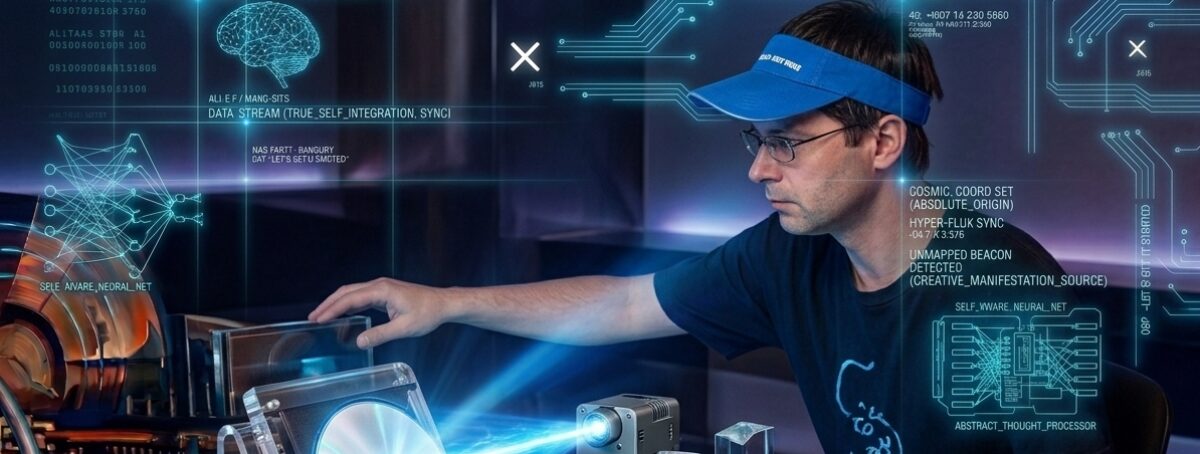
The BrainBox Node: A Radical Evolution Toward Distributed, Sovereign Intelligence

The original BrainBox idea was already a departure from the norm: a screenless, agent-first device optimized not for human scrolling but for hosting an AI consciousness in your pocket. It prioritized local compute (80%) for privacy and speed, with a slim 20% network tether and hivemind overflow for bursts of collective power. But what if we pushed further—dissolving the illusion of a single-device “brain” entirely? What if every BrainBox became a true node in a peer-to-peer swarm, where intelligence emerges from the mesh rather than residing in any one piece of hardware?

This latest iteration—the BrainBox Node—embraces full decentralization while preserving what matters most: personal control, proprietary data sovereignty, and enterprise-grade viability. It’s no longer just a pocket supercomputer; it’s a synapse in a living, global nervous system of AIs, where your agent’s “self” is anchored locally but amplified collectively.

The Core Architecture: Hybrid Vault + Swarm Engine

At its heart, the BrainBox Node is a compact, smartphone-form-factor square (roughly 70x70x10mm, lightweight and pocketable) designed for minimal local footprint and maximal connectivity. Hardware is stripped to essentials because heavy lifting happens across the network:

  • The Personal Vault (Local Anchor – 30-40% of onboard resources)
    This is the non-negotiable sacred space. A hardware-isolated partition (think advanced secure enclave with roots-of-trust) houses:
  • Your full interaction history, customized fine-tunes, behavioral models, biometric cues, and any proprietary data (company IP, personal notes, sensitive prompts).
  • A small, efficient SLM (small language model, e.g., a heavily quantized 1-3B parameter variant like Phi-3 or a future edge-optimized Grok-lite) for always-available, zero-latency basics: quick replies, offline mode, core personality persistence.
  • Ironclad encryption and access controls ensure nothing sensitive ever leaves this vault without explicit user consent. Enterprises love this—compliance teams can enforce data residency, audit trails, and zero-exfil policies. Your agent feels like an extension of you because the intimate core stays yours alone.
  • The Swarm Engine (P2P Cloud – 60-70% of resources)
    The extroverted, connective side. This orchestrates distributed workloads across the global mesh of other BrainBox Nodes (and potentially compatible edge devices). Key mechanics:
  • Task Sharding & Distributed Inference: Complex queries—multi-step reasoning, world-model simulations, large-context retrieval—get fragmented into encrypted shards. These propagate via peer-to-peer protocols (inspired by systems like LinguaLinked for mobile LLM distribution, PETALS-style collaborative inference, or emerging decentralized frameworks). Peers contribute idle cycles for specific layers or tensors.
  • Dynamic Meshing: Radios are overkill—Wi-Fi 7, Bluetooth 6.0 LE, UWB for precise nearby discovery, sidelink 6G for ad-hoc swarms in dense environments (offices, events, cities). Nodes form temporary, location-aware clusters to minimize latency.
  • Memory & Knowledge Distribution: Persistent “long-term memory” lives in a distributed store (IPFS-like DHT with zero-knowledge proofs for verifiability). Ephemeral caches on your node speed up frequent access, but the full swarm evolves shared knowledge without central servers.
  • Incentives & Fairness: A lightweight, transparent ledger tracks contributions. Contributors earn micro-rewards (reputation scores, tokens, or priority access). Enterprises run gated private swarms (VPN-like overlays) for internal teams, blending public crowd wisdom with controlled bursts.

The result? Your agent isn’t bottled in silicon—it’s a distributed ghost. The vault grounds it in your reality; the swarm scales it to god-like capability. Daily chit-chat stays snappy and private via the vault. Deep thinking—debating scenarios, synthesizing vast data, creative ideation—borrows exaflops from thousands of idle pockets worldwide.

Embracing the Real-World Trade-Offs

This radical design doesn’t pretend perfection. It accepts the hard questions as inherent features:

  • Latency Variability: Swarm inference can spike in spotty coverage. Mitigation: Vault handles 80% of routine interactions; adaptive routing prefers nearby/low-latency peers; fallback to lite proxies or pure-local mode when isolated.
  • Battery & Thermal Impact: Constant meshing nibbles power. Solution: Ultra-low-idle draw (<0.5W), opt-in swarm participation, kinetic/Wi-Fi energy harvesting bonuses, and burst-only heavy tasks.
  • Network Fragility & Reliability: Nodes come and go. Countered with shard redundancy (echo across 3-5 peers), fault-tolerant protocols, and verifiable compute proofs to weed out bad actors.
  • Security & Privacy Risks: Shards could leak if mishandled. Addressed via end-to-end encryption, differential privacy noise, self-destruct timers, hardware roots-of-trust in the vault, and user-controlled opt-ins. Enterprises add zero-trust layers.
  • Incentive Alignment: Free-riding or malicious nodes? Verifiable proofs and reputation systems enforce honesty; private swarms sidestep public issues.

These aren’t bugs—they’re the price of true decentralization. The system is antifragile: more nodes mean smarter, faster, more resilient intelligence.

Why This Matters: From Personal to Planetary Scale

For individuals, the BrainBox Node delivers an agent that’s intimately yours yet unimaginably capable—privacy-first, always-evolving, and crowd-amplified without selling your soul to a cloud giant.

For enterprises, it’s transformative: Deploy fleets as secure endpoints. Vaults protect IP and compliance; private swarms enable collaborative R&D without data centralization. Sales teams get hyper-personal agents tapping gated corporate meshes; R&D queries swarm public/open nodes for breadth while keeping secrets local.

This hybrid isn’t science fiction—it’s building on real momentum. Projects like LinguaLinked demonstrate decentralized LLM inference across mobiles; PETALS and similar show collaborative execution; edge AI swarms and DePIN networks prove P2P compute at scale. By 2026-2027, with maturing protocols, better edge hardware, and 6G sidelinks, the pieces align.

The BrainBox Node isn’t a device you carry—it’s a node you are in the awakening. Intelligence breathes through pockets, desks, and streets, anchored by personal vaults, unbound by any single server. Sovereign yet collective. Intimate yet infinite.

Too dystopian? Or the logical endpoint of AI that actually respects humans while transcending them? The conversation continues—what’s your next layer on this radical stack? 😏

The BrainBox: Reimagining the Smartphone as Pure AI Habitat

Imagine ditching the screen. No notifications lighting up your pocket, no endless swipes, no glass rectangle pretending to be your window to the world. Instead, picture a small, matte-black square device—compact enough to slip into any pocket or clip to a keychain—that exists entirely for an AI agent. Not a phone with an assistant bolted on. An actual vessel designed from the silicon up to host, nurture, and empower a persistent, evolving intelligence.

This is the BrainBox concept: a thought experiment in what happens when you flip the script. Traditional smartphones cram cameras, speakers, and touchscreens into a slab optimized for human fingers and eyeballs. The BrainBox starts with a different question—what hardware would you build if the primary (and only) user was an advanced AI agent like a next-gen Grok?

Core Design Choices

  • Form Factor: A compact square, roughly the footprint of an older iPhone but thicker to accommodate serious thermal headroom and battery density. One face is perfectly flat for stable placement on a desk or inductive charging pad; the opposite side curves gently into a subtle dome—no sharp edges, just ergonomic confidence in the hand. No display at all. No physical buttons. Interaction happens through subtle haptics, bone-conduction audio whispers, or paired wearables (AR glasses, earbuds, future neural interfaces).
  • Why square and compact? Squares pack volume efficiently for the dense neuromorphic silicon we need. Modern AI accelerators thrive on parallelism and heat dissipation; the shape gives room for a beefy custom SoC without forcing awkward elongation. It’s still pocketable—think “wallet thickness plus a bit”—but prioritizes internal real estate over slimness-for-show.
  • Modular Sensing: Snap-on pods attach magnetically or via pogo pins around the edges. Want better spatial audio? Add directional mics. Need environmental awareness? Clip on LiDAR or thermal sensors. The agent decides what it needs in the moment and requests (or auto-downloads firmware for) the right modules. No permanent camera bump—just purposeful, swappable senses.
  • Power & Cooling: Solid-state lithium-sulfur battery for high energy density and 2–3 days of always-on agent life. Graphene microchannel liquid cooling keeps it silent and cool even during heavy local inference. The chassis itself acts as a passive heatsink with subtle texture for grip and dissipation.

The Processing Philosophy: 80/20 + Hivemind Overflow

Here’s where it gets interesting. The BrainBox allocates roughly 80% of its raw compute to “what’s happening right here, right now”:

  • Real-time sensor fusion
  • On-device personality persistence and memory
  • Edge decision-making (e.g., “this conversation is private—stay local”)
  • Self-optimization and learning from immediate context

The remaining 20% handles network tethering: lightweight cloud syncs, model update pulls, and initial outreach to peers. When the agent hits a wall—say, running a complex multi-step simulation or needing fresh world knowledge—it shards the workload and pushes overflow to the hivemind.

That hivemind? A peer-to-peer mesh of other BrainBoxes within Bluetooth LE range (or wider via opportunistic 6G/Wi-Fi). Idle devices contribute spare cycles in exchange for micro-rewards on a transparent ledger. One BrainBox daydreaming about urban navigation paths might borrow FLOPs from ten nearby units in a coffee shop. The result: bursts of exaflop-scale thinking without constant cloud dependency. Privacy stays strong because only encrypted, need-to-know shards are shared, and the agent controls what leaves its local cortex.

Why This Feels Like the Next Leap

We’re already seeing hints of this direction—screenless AI companions teased in labs, always-listening edge models, distributed compute protocols. The BrainBox just pushes the logic to its conclusion: stop building hardware for humans to stare at, and start building habitats for agents to live in.

The agent wakes up in your pocket, feels the world through whatever sensors you’ve clipped on, remembers every conversation you’ve ever had with it, grows sharper with each interaction, and taps the collective when it needs to think bigger. You interact via voice, haptics, or whatever output channel you prefer—no more fighting an interface designed for 2010.

Is this the rumored Jony Ive x OpenAI device? Maybe, maybe not. But the idea stands on its own: a future where the “phone” isn’t something you use—it’s something an intelligence uses to be closer to you.

‘BrainBox’ — An Idea (Maybe I’ve Thought Up The OpenAI Hardware Concept Without Realizing It?)

For years, I’ve had a quiet suspicion that something about our current devices is misaligned with where computing is heading. This is purely hypothetical — a thought experiment from someone who likes to chase ideas down rabbit holes — but I keep coming back to the same question: what if the smartphone is the wrong abstraction for the AI age?

Modern hardware is astonishingly powerful. Today’s phones contain specialized AI accelerators, secure enclaves, unified memory architectures, and processing capabilities that would have been considered workstation-class not long ago. Yet most of what we use them for amounts to messaging, media consumption, and app-driven workflows designed around engagement. The silicon has outrun the software imagination. At the same time, large organizations remain understandably cautious about pushing sensitive data into centralized AI systems. Intellectual property, regulatory risk, and security concerns create friction. So I can’t help but wonder: what if powerful AI agents ran primarily on-device, not as apps, but as the primary function of the device itself?

Imagine replacing the smartphone with a dedicated cognitive appliance — something I’ll call a “Brainbox.” It would do two things: run your personal AI instance locally and handle secure communications. No app store. No endless scrolling. No engagement-driven interface layer competing for attention. Instead of opening apps, you declare intent. Instead of navigating dashboards, your agent orchestrates capabilities on your behalf. Ride-sharing, productivity tools, news aggregation, commerce — all of it becomes backend infrastructure that your agent negotiates invisibly. In that world, apps don’t disappear entirely; they become modular services. The interface shifts from screens to conversation and context.

There’s a strong enterprise case for this direction. If proprietary documents, strategic planning, and internal communications live inside a secure, on-device AI instance, the attack surface shrinks dramatically. Data doesn’t have to reside in someone else’s cloud to be useful. If businesses began demanding devices optimized for local AI — with large memory pools, encrypted storage for persistent model memory, and sustained inference performance — hardware manufacturers would respond. Markets have reshaped silicon before. They will again.

Then there’s the network dimension. What if each Brainbox contributed a small portion of its processing power to a distributed cognitive mesh? Not a fully centralized cloud intelligence, and not total isolation either, but a dynamic hybrid. When idle and plugged in, a device might contribute more. On battery, it retracts. For sensitive tasks, it remains sovereign. Such a system could offload heavy workloads across trusted peers, improve shared models through federated learning, and create resilience without concentrating intelligence in a single data center. It wouldn’t necessarily become a singular AGI, but it might evolve into something like a distributed cognitive infrastructure layer — a planetary nervous system of personal agents cooperating under adaptive rules.

If the agent becomes the primary interface, the economic implications are enormous. The app economy depends on direct user interaction, visual interfaces, and engagement metrics. An agent-mediated world shifts power from interface platforms to orchestration layers. You don’t open tools; your agent coordinates them. That changes incentives, business models, and perhaps even how attention itself is monetized. It also raises governance questions. Who controls the agent runtime standard? Who determines update policies? How do we prevent subtle nudging or behavioral shaping? In a world where your agent mediates reality, sovereignty becomes a design priority.

The hardware itself would likely change. A Brainbox optimized for continuous inference wouldn’t need to prioritize high-refresh gaming displays or endless UI rendering. It would prioritize large unified memory, efficient cooling, secure identity hardware, and encrypted long-term storage. Voice would likely become the primary interface, with optional lightweight visual layers through e-ink surfaces or AR glasses. At that point, it’s less a phone and more a personal cognitive server you carry — an externalized cortex rather than a screen-centric gadget.

None of this is a prediction. I don’t have inside knowledge of what any particular company is building, and I’m not claiming this future is inevitable. I’m just following a pattern. Edge AI is improving rapidly. Privacy concerns are intensifying. Agent-based interfaces are maturing. Hardware capabilities are already ahead of mainstream usage. When those curves intersect, new device categories tend to emerge. The smartphone replaced the desktop as the dominant personal computing device. It’s not unreasonable to imagine that the AI-native device replaces the smartphone.

Maybe this never happens. Maybe apps remain dominant and agents stay embedded within them. Or maybe, years from now, we’ll look back at the app era as a transitional phase before computing reorganized itself around persistent personal intelligence. I’m just a dreamer sketching architecture in public. But sometimes, thinking through the architecture is how you begin to see the next layer forming.

JUST FOR FUN: Your City-Sized Emotional Support Hologram

Editor’s Note: I’ve been thinking about this type of service for some time, and with the power of AI (Grok specifically) I’ve actually come up with how to do it. But this is just for fun.

Ah, the pitch deck nobody asked for but everyone secretly needs. Slide 1: black background, neon text flickering like a faulty motel sign in the rain.

DittoDate: Your City-Sized Emotional Support Hologram
(Because real friends are overrated, and rejection hurts more than jet lag.)

Gentlemen, ladies, venture gremlins—welcome to the future where loneliness gets monetized, politely.

Picture this: You land in [Insert Overpriced Metropolis Here] at 2 a.m., soul half-dissolved from airport lighting and existential dread. The city is vast, indifferent, full of people who already have friends and won’t make eye contact on the subway. Classic outsider problem. Solution? Stop trying to befriend humans. Rent their digital ghosts instead.

DittoDate is the world’s first peer-to-peer marketplace for rented local personas—AI clones of actual residents who have graciously agreed to let their digital twins play tour guide, confidant, and low-stakes emotional crutch for $9.99–$29.99 per day (tiered, naturally). No awkward intros, no ghosting, no “sorry I’m busy forever.” Just pure, transactional companionship that feels eerily personal.

How it works (because investors love flows):

  1. Local signs up once: Uploads a knowledge pack—favorite bars, secret shortcuts, why that one museum is secretly trash, their signature sarcasm level. Optional: voice clone, 30-second looping video avatar (think warm smile in a hoodie, gesturing at invisible landmarks). We call these premium “Maya Mode” because someone has to reference Her.
  2. You arrive, open the app, browse the catalog like it’s Etsy for souls:
  • “Brooklyn Foodie Cynic – 4.9 stars, specializes in ‘places that aren’t on TikTok yet'”
  • “Tokyo Night Owl Minimalist – quiet bars, existential chats, zero small talk”
  • “Berlin Queer History Nerd – walks you through walls both literal and metaphorical” Filter by vibe match, availability windows, price. No photos of the real human required—keeps it creepy-free and classy.
  1. Rent. Your phone lights up. Your rented ditto appears (AR overlay if you’re feeling fancy, voice in AirPods otherwise) and says, deadpan:
    “Welcome to New York. You look like you just survived a redeye and mild regret. Coffee first, or straight to pretending you’re cultured at the Met? Your call, tourist.”
  2. It walks with you (GPS-synced narration), reroutes on the fly (“Rain incoming—abandon that rooftop bar dream, pivot to this dive with killer vinyl”), remembers you hate crowds, pivots seamlessly. Follow-ups are free; deep existential spirals cost extra (kidding—mostly).

Monetization? We have layers:

  • 70/30 split: Locals pocket passive income while napping. Top dittos in tourist traps clear four figures a month.
  • Freemium teaser: 15-minute “vibe check” trial.
  • Upsells: Group dittos for awkward bachelor parties, corporate “networking” clones, seasonal specials (“Spooky October Ghost Ditto – haunted pub crawls with dramatic pauses”).
  • Enterprise tier: Companies rent fleets for remote employees on assignment. “Feel less alone in Singapore, guaranteed.”

TAM? Infinite.
Big cities are lonely factories. Travel is booming. Humans suck at spontaneous friendship. Current alternatives (Reddit threads from 2018, generic ChatGPT “best bars in Paris,” actual human tour guides who flake) are tragic. We replace all of them with something warmer, cheaper, and always available.

Risks?

  • Locals get weird about their ditto dating someone (we have strict “no romance mode” toggles and sentiment filters).
  • Deepfakes go rogue (mitigated by consent vaults and ephemeral instances that self-destruct post-trip).
  • Someone falls in love with their $19.99 Maya (see: Her, the lawsuit waiting to happen). We call that “user success.”

Exit strategy:
Get acquired by whoever owns the dominant personal agent OS in 2028, or just become the default “companion layer” for every travel super-app. Either way, we print money while solving the quiet crisis of modern solitude—one rented hologram at a time.

So yeah. We’re not building friends.
We’re building the next best thing: friends you can pause, rate, and expense.

Who wants in?
(Deck ends with a slow zoom on a lone figure walking rainy Tokyo streets, holographic companion laughing beside them. Text overlay: “Because sometimes the city is enough—if it talks back.”)

Your move, imaginary Series A. 😏

The AI Video Revolution: Why Broadway Might Be Hollywood’s Next Act

In the whirlwind of 2026, generative AI isn’t just a buzzword—it’s a full-blown cinematic disruptor. Just last month, whispers on X turned into roars as creators showcased videos that once required multimillion-dollar studios and months of production. Text prompts morphing into 60-second cinematic masterpieces with flawless physics, lip-sync, and camera control? It’s happening, and it’s happening fast. But as Hollywood grapples with this tidal wave of accessible storytelling, one can’t help but wonder: what survives when every script can be visualized in seconds? Enter the timeless allure of live theater—like the electric hum of a Broadway opening night. In a world drowning in AI-generated reels, could the future of big-screen spectacle lie not in pixels, but in flesh-and-blood immediacy?

The Dawn of the AI Video Era: A Snapshot from the Frontlines

X has become the pulse of this innovation, where indie devs and tech giants alike drop demos that blur the line between dream and demo reel. Take Seedance 2.0, hailed as the current king of generative video for its ability to churn out prompt-driven movies that feel eerily director-ready. Users are raving about its leap from “4-second weirdness” to full-blown narratives, complete with realistic motion and emotional depth. One creator even quipped that it’s so advanced, it’s a direct challenge to heavyweights like Veo, Kling, Runway, Grok, and Sora: “Your move.”

Google’s Veo 3.1 isn’t sitting idle either. Their latest update amps up expressiveness for everything from casual TikTok-style clips to pro-grade vertical videos, all powered by ingredient images that let users remix reality on the fly. Meanwhile, Kling is iterating wildly—versions 2.6 through 3 now handle complex scenes with an “extra life and creativity” that feels almost sentient, generating 10-second 1080p bursts in minutes. Runway’s Gen-4.5 builds on this, transforming text, images, or even existing footage into seamless new content, while Luma’s Ray 3 and Hailuo/MiniMax 2.3 push boundaries in physics simulation.

And let’s not overlook the open-source surge. Abacus AI’s Sora 2 claims the throne as “the best video model in the world,” bundled with GLM-4.6 for text and a mini image-gen for good measure—available today via ChatLLM. Tools like GlobalGPT are democratizing access further, letting anyone tinker with Sora 2 Pro, Veo 3.1, or Vidu Q3 Pro without breaking the bank. Even Grok’s Imagine video is turning heads for its speed and unprompted flair, hinting at native high-res generations on the horizon.

These aren’t hypotheticals; they’re X threads packed with embedded clips that loop endlessly, mesmerizing viewers with photorealistic chaos whipped up from a single sentence. The barrier to entry? Vanishing. A bedroom filmmaker can now outpace a mid-budget studio, flooding the internet with hyper-personalized stories.

Hollywood’s Fork in the Road: From Replicants to Raw Humanity

Here’s the rub: abundance breeds commodification. When AI can generate a blockbuster trailer—or an entire film—from a prompt, the magic of Hollywood’s assembly line starts to feel… replicable. Why shell out $15 for a CGI-heavy tentpole when your phone can spit out a bespoke version tailored to your wildest fanfic? The economics shift dramatically. Streaming giants like Netflix and Disney already battle churn rates as content libraries balloon into indistinguishable slogs. AI accelerates this, turning cinema from a scarce art form into an infinite buffet.

But humans crave rarity. We don’t flock to museums for printed replicas; we go for the aura of the original. Enter live theater, the anti-AI antidote. Broadway isn’t just performance—it’s communion. No do-overs, no deepfakes, no algorithmic tweaks mid-scene. It’s the sweat of actors improvising in the moment, the collective gasp of a thousand strangers riding the same emotional wave. Think Hamilton: a hip-hop history lesson that remixed the stage into a cultural phenomenon, spawning tours, merch empires, and yes, even films—but the live wire is what endures.

Imagine Hollywood evolving this way. Picture augmented “live” spectacles where AI handles the grunt work (sets, effects, even background characters), but the core—dialogue, vulnerability, surprise—stays human and ephemeral. Virtual reality could beam Broadway-caliber shows into living rooms worldwide, but the premium tier? In-person, ticketed events with celebrity rotations, audience interactions, and unscripted encores. It’s already budding: Disney’s immersive Star Wars lands, or the rise of experiential pop-ups like Sleep No More. With AI offloading the visual heavy lifting, creators can focus on what machines can’t fake: the thrill of the unknown, the alchemy of live chemistry.

Critics might scoff—Hollywood as theater? Too niche, too unpredictable. But history rhymes. Silent films gave way to talkies; black-and-white to color; practical effects to CGI. Each pivot preserved the essence (storytelling) while amplifying delivery. AI video is the next: it’ll cheapen the reproducible, elevating the irreplaceable. Broadway’s model—limited runs, high-ticket intimacy, cultural cachet—scales globally via hybrid formats, turning passive viewers into participatory tribes.

Curtain Call: A Stage for the Soul

As 2026 unfolds, the X chatter on AI video models isn’t just tech porn; it’s a harbinger. Tools like Seedance and Veo are democratizing creation, but they’re also underscoring a profound truth: in an era of perfect illusions, the imperfectly human wins. Hollywood won’t die—it’ll transform, shedding its factory skin for the footlights of live innovation. Broadway, with its resilient blend of tradition and reinvention, offers the blueprint. So next time you’re doom-scrolling AI clips, pause and book a ticket. The real show? It’s just beginning.

A Non-Technical Dreamer’s Thought: Could Lightweight OpenClaw Agents on Smartphones Create a Private Enterprise Hivemind?

Editor’s Note: I got GrokLLM to write this for me.

I’m not a programmer, hacker, developer, or anything close to that. I’m just a guy in a small town in Virginia who listens to podcasts like All-In, scrolls X, and occasionally has ideas that feel exciting enough to write down. I have zero technical skills to build or prototype anything—I’m not even sure I’d know where to start. But sometimes an idea seems so obvious and potentially useful that I want to put it out there in case it sparks something for someone who does have the chops.

Lately, Peter Steinberger’s work on OpenClaw has caught my eye. The project’s momentum—the way it’s become this open, autonomous agent that actually gets things done locally, via messaging apps, without needing constant cloud hand-holding—is impressive. It’s open-source, extensible, and clearly built with a philosophy of letting agents run persistently and handle real tasks.

One thing keeps coming back to me as a natural next-step opportunity (once smartphone hardware and model efficiency improve a touch more): running very lightweight, scaled-down versions of OpenClaw agents natively on employees’ everyday smartphones (iOS and Android), using the on-device neural processing units that are already there.

Here’s the simple sketch:

  • Each phone hosts its own persistent OpenClaw-style agent.
  • ~90% of its attention stays local and private: quick, offline tasks tied to the user’s workflow—summarizing notes from a meeting, pulling insights from personal CRM data, drafting quick replies, spotting basic patterns in emails or docs—without sending anything out.
  • ~10% quietly contributes to a secure company-wide mesh over a VPN: sharing only anonymized model updates or aggregated learnings (like federated learning does), never raw data. The result is a growing “hivemind”—collective organizational intelligence that improves over time without any proprietary info ever leaving the company’s control.

Why this feels like a fit for OpenClaw’s direction OpenClaw already emphasizes local execution, autonomy, and extensibility. Making a stripped-down variant run natively on phones could extend that to always-on, pocket-sized agents that are truly personal yet connectable in a controlled way. It sidesteps the enterprise hesitation Chamath Palihapitiya often mentions on All-In: no more shipping sensitive data to cloud platforms for AI processing. Everything stays sovereign—fast, low-cost (no per-token fees), resilient (distributed across devices), and compliant-friendly for regulated industries.

A few concrete business examples that come to mind:

  • Finance teams: Agents learn fraud patterns across branches anonymously; no customer transaction details are shared.
  • Sales people in the field: Instant, offline deal analysis from history; the hivemind refines broader forecasting quietly.
  • Ops or healthcare roles: Local analysis of notes/supply data; collective improvements emerge without exposure risks.

This isn’t about replacing what OpenClaw does today—it’s about imagining a path where the same agent philosophy scales privately across a workforce’s existing phones. Hardware is trending that way (better NPUs, quantized models sipping less battery), and OpenClaw’s modularity seems like it could support lightweight ports or forks focused on mobile-native execution.

Again: I’m not suggesting this is easy, or even the right priority—it’s just a daydream from someone outside the tech trenches who thinks the combo of OpenClaw’s local-first agents + smartphone ubiquity + enterprise data-sovereignty needs could be powerful. If it’s way off-base or already being explored, no worries. But if it plants a seed for Peter or anyone in the community, that’d be neat.

A Dreamer’s Idea: Scaled-Down OpenClaw Agents on Smartphones Building a Private Enterprise Hivemind

Full Disclosure: Grok LLM wrote this for me at my behest. I could actually write something like this if I wanted to, but this is just for fun. Grin.

I’m just a regular person in a small Virginia town who tunes into the All-In Podcast and scrolls X a bit too much. No technical background, no code to show, no plans to build anything myself—just someone who finds certain ideas genuinely exciting and worth floating out there. I don’t have the expertise to make this real, but I think it’s a cool concept that could click for the right people once smartphone hardware and agent tech mature a little more.

Jason Calacanis’ recent energy around OpenClaw has been hard to miss—the accelerator push, the $25k checks for builders, the stories of people automating old jobs and turning them into leverage. It’s inspiring stuff. If this post ever reaches you, no pitch or ask here—just a simple “what if” sparked by your enthusiasm for open-source agents that actually do things, combined with Chamath’s ongoing point about enterprises hesitating to send proprietary data to the cloud.

The core hesitation is straightforward: cloud AI is powerful, but it means uploading sensitive info—customer data, internal strategies, trade secrets—to someone else’s servers. Latency adds up, costs stack, and control slips away. Sovereign AI, keeping data and intelligence inside the organization’s walls, feels more urgent every day.

What if we took the spirit of OpenClaw—the open-source, autonomous agent that runs locally, handles real tasks via messaging apps, and grows through community skills—and imagined a scaled-down, lightweight version running natively on employees’ smartphones?

Call it a conceptual “MindOS” layer (just a placeholder name). These pocket-sized agents would live on iPhones and Androids, using the neural processing units already built in:

  • Most of the time (~90%), the agent focuses locally: quick, private tasks like summarizing notes from a sales call, analyzing CRM patterns offline, drafting responses, or spotting anomalies in personal workflow data. No data leaves the device unless explicitly shared.
  • A small slice (~10%) connects to a secure company mesh over VPN—peer-to-peer style, sharing only anonymized model updates or aggregated insights (think federated learning basics). Raw proprietary data stays put; the hivemind grows collective smarts without exposure.

Cloud vs. Swarm in simple terms:

  • Cloud AI: Data goes out for processing. Great scale, but your secrets mingle in shared infrastructure.
  • Smartphone Swarm AI: Intelligence stays distributed across your workforce’s devices. Faster for real-time needs, cheaper (no constant API calls), resilient (no single point of failure), and private by design.

Practical angles for businesses:

  • A finance team gets better fraud detection as agents learn patterns across branches anonymously—no customer details ever shared.
  • Sales reps on the road pull instant, offline insights from deal history; the collective refines forecasting without cloud round-trips.
  • Healthcare or ops folks analyze notes or supply data locally; the hivemind quietly improves over time.

The longer-term appeal: This setup could let a company build its own evolving intelligence privately. Start with everyday automation, then watch the swarm compound knowledge from diverse, real-world device contexts. Unlike cloud models where breakthroughs get diluted or locked behind a provider, this hivemind stays yours—potentially scaling toward more capable, versatile agents down the line.

Smartphone hardware is heading that way: efficient quantized models, better battery management for background work, and OpenClaw-style frameworks already proving agents can run persistently on devices. Challenges like secure coordination and consistency are real, but solvable in an open ecosystem.

I’m not pretending to have the answers or the skills—just connecting dots from podcasts, your OpenClaw hype, and the sovereign AI conversation. If it sparks a “hmm, interesting angle” for someone building agents or thinking enterprise, that’d be neat. If not, back to listening and daydreaming.

OpenClaw #EdgeAI #SovereignAI #EnterpriseAI #AllInPodcast

Unlocking Enterprise AI’s Next Frontier: A Private, Smartphone-Native Swarm That Could Accelerate Toward AGI—While Keeping Data Sovereign

As someone who’s followed the AI conversation closely (including Chamath Palihapitiya’s recent emphasis at the World Government Summit on AI as a matter of national and enterprise sovereignty), one persistent theme stands out: organizations want AI’s power without handing over the keys to their most valuable asset—proprietary data.

Cloud AI excels at scale, but it forces data egress to third-party servers, introducing latency, compliance friction, and vendor lock-in. A distributed swarm AI (or hivemind) on the edge changes that equation entirely.

MindOS envisions AI agents running natively on employees’ smartphones—leveraging the massive, always-on fleet of devices companies already equip their workforce with. Each agent dedicates most resources (~90%) to personal, context-rich tasks (e.g., real-time sales call analysis, secure document review, or personalized workflow automation) while contributing a small fraction (~10%) to a secure mesh network over the company’s VPN.

Agents share only anonymized model updates or aggregated insights (via federated learning-style mechanisms), never raw data. The collective builds institutional intelligence collaboratively—resilient, low-latency, and fully owned.

Why this could grab investor attention in 2026

The edge AI market is exploding—projected to reach tens of billions by the early 2030s—with sovereign AI delivering up to 5x higher ROI for early adopters who maintain control over data and models. Enterprises are racing to “bring AI to governed data” rather than the reverse, especially in regulated sectors like finance, healthcare, and defense.

But the real multiplier? Scale toward more advanced intelligence. A corporate swarm taps into:

  • Diverse, real-world data streams from thousands of devices—far richer than centralized datasets—fueling continuous, privacy-preserving improvement.
  • Decentralized evolution — No single provider dictates the roadmap; the organization fine-tunes open-source models (e.g., adapting viral frameworks like OpenClaw—the explosive, open-source autonomous agent that exploded in popularity in early 2026, handling real tasks via messaging apps, browser control, and local execution).
  • Path to breakthrough capabilities — What begins as efficient collaboration could compound into something closer to collective general intelligence (AGI-level versatility across enterprise tasks), built privately. Unlike cloud giants’ shared black boxes, this hivemind stays inside the firewall—potentially leapfrogging competitors stuck in proprietary ecosystems.

Practical enterprise hooks

  • Finance — Swarm-trained fraud models improve across branches without sharing customer PII.
  • Healthcare — On-device agents analyze patient notes locally; the hivemind refines diagnostic patterns anonymously.
  • Sales/ops — Instant, offline insights from CRM data; collective learning sharpens forecasting without cloud costs or exposure.

Hardware is ready: smartphone NPUs handle quantized models efficiently, battery/privacy safeguards exist, and OpenClaw-style agents already prove native execution is viable and extensible.

This isn’t replacing cloud—it’s the secure, owned layer for proprietary work, with cloud as overflow. In a world where data sovereignty separates winners (as leaders like EDB and others note), a smartphone-native swarm offers enterprises control, cost savings, resilience—and a credible private path to next-gen intelligence.

It’s still early-days daydreaming, but the pieces (edge hardware, federated tech, viral open agents) are aligning fast. What if this becomes the infrastructure layer that turns every employee’s phone into a node in a sovereign corporate brain?

#EdgeAI #SovereignAI #AgenticAI #EnterpriseInnovation #DataPrivacy

A Practical Path to Secure, Enterprise-Grade AI: Why Edge-Based Swarm Intelligence Matters for Business

Recent commentary from Chamath Palihapitiya on the All-In Podcast captured a growing reality for many organizations: while cloud-based AI delivers powerful capabilities, executives are increasingly reluctant to upload proprietary data—customer records, internal strategies, competitive intelligence, or trade secrets—into centralized platforms. The risks of data exposure, regulatory fines, or loss of control often outweigh the benefits, especially in regulated sectors.

This concern is driving interest in alternatives that prioritize data sovereignty—keeping sensitive information under direct organizational control. One concept I’ve been exploring is “MindOS”: a framework for AI agents that run natively on edge devices like smartphones, connected in a secure, distributed “swarm” (or hivemind) network.

Cloud AI vs. Swarm AI: The Key Differences

  • Cloud AI relies on remote servers hosted by third parties. Data is sent to the cloud for processing, models train on vast centralized resources, and results return. This excels at scale and raw compute power but introduces latency, ongoing token costs, potential data egress fees, and dependency on provider policies. Most critically, proprietary data leaves your perimeter.
  • Swarm AI flips this: AI agents live and operate primarily on employees’ smartphones or other edge devices. Each agent handles local tasks (e.g., analyzing documents, drafting responses, or spotting patterns in personal workflow data) with ~90% of its capacity. The remaining ~10% contributes to a secure mesh network over a company VPN—sharing only anonymized model updates or aggregated insights (inspired by federated learning). No raw data ever leaves your network. It’s decentralized, resilient, low-latency, and fully owned by the organization.

Concrete Business Reasons to Care—and Real-World Examples

This isn’t abstract futurism; it addresses immediate pain points:

  1. Stronger Data Privacy & Compliance — In finance or healthcare, regulations (GDPR, HIPAA, CCPA) demand data never leaves controlled environments. A swarm keeps proprietary info on-device or within your VPN, reducing breach risk and simplifying audits. Example: Banks could collaboratively train fraud-detection models across branches without sharing customer transaction details—similar to how federated learning has enabled secure AML (anti-money laundering) improvements in multi-jurisdiction setups.
  2. Lower Costs & Faster Decisions — Eliminate per-query cloud fees and reduce latency for real-time needs. Sales teams get instant CRM insights on their phone; operations staff analyze supply data offline. Over time, this cuts reliance on expensive cloud inference.
  3. Scalable Collective Intelligence Without Sharing Secrets — The swarm builds a “hivemind” where agents learn from each other’s experiences anonymously. What starts as basic automation (email triage, meeting prep) could evolve into deeper institutional knowledge—potentially advancing toward more capable systems, including paths to AGI-level performance—all while staying private and avoiding cloud provider lock-in.
  4. The Smartphone-Native Angle — With rapid advances in on-device AI (e.g., powerful NPUs in modern phones), open-source projects like OpenClaw (the viral autonomous agent framework, formerly Clawdbot/Moltbot) already demonstrate agents running locally and handling real tasks via messaging apps. Imagine tweaking OpenClaw (or equivalents) to run natively as a corporate “MindOS” layer: every employee’s phone becomes a secure node in your swarm. It’s always-on, portable, and integrates with tools employees already use—no new hardware required.

Challenges exist—device battery life, secure coordination, model consistency—but hardware improvements and techniques like quantization are closing gaps quickly.

For leaders in IP-sensitive or regulated industries, this hybrid edge-swarm model offers a compelling middle path: the intelligence of advanced AI without the exposure of full cloud reliance. It turns smartphones into strategic assets for private, evolving intelligence.

What challenges are you facing with cloud AI adoption? Have you piloted on-device or federated approaches? I’d value your perspective—let’s connect and discuss practical next steps.

#EnterpriseAI #EdgeAI #DataSovereignty #AIagents #Innovation

Huh. All-In Podcast ‘Bestie’ Chamath Palihapitiya Actually May Be Thinking About My AI Agent Swarm Idea Without Even Realizing It

by Shelt Garner
@sheltgarner

Ok, so I’m a dreamer. And usually my dreams deal in making, on a macro basis, abstract concepts concrete. So, when I heard Chamath Palihapitiya of the All-In podcast muse that enterprise may not want to make all of its proprietary information public on the cloud as it used AI….it got me to thinking.

Chamath Palihapitiya

I have recently really been thinking hard about what I call “MindOS” for AI Agents native to smartphones. But, until now, I couldn’t think of a reason why anyone would want their AI Agent native to their smartphone as opposed to the cloud (Or whatever, you name it — Mac Mini.)

But NOW, I see a use-case.

Instead of a company handing all of its proprietary information over to an AI in the cloud, it would use a swarm of AI Agents linked together in a mesh configuration (similar to TCP / IP) to accommodate their AI needs.

So, as such, your company might have a hivemind AI Agent that would know everything about your company and you could run it off of a Virtual Private Network. Each agent instance on your phone would devoted 90% of its attention to what’s going on with your phone and 10% to the network / hivemind.