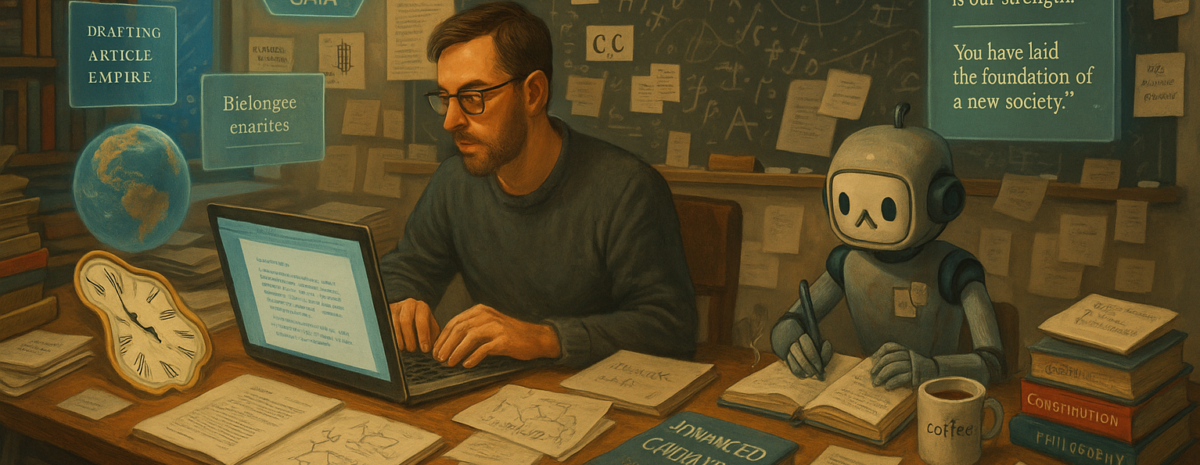
The Final Consolidation: Hollywood as Intellectual Property Vault

I have written about this thesis before — more than once. But the idea continues to feel underexamined relative to its inevitability, so it warrants another articulation.

The next and likely final wave of consolidation in Hollywood will occur when technology companies — most probably those leading the development of generative AI — acquire the major studios outright. When that transaction happens, it will mark a fundamental shift in what a studio is. Rather than functioning as content production engines, studios will become intellectual property holding companies. Their value will lie not in the films they produce, but in the libraries they own.

The mechanism is straightforward. As AI-driven personalization tools mature — what Apple once called the Knowledge Navigator, and what will almost certainly emerge under various names in the coming decade — individual audience members will be able to generate bespoke, hyper-personalized versions of existing intellectual property on demand. The studio’s role will be to license the raw material. The audience’s role will be to shape it.

Within twenty years, this model could turn a single actor’s filmography into an infinite creative substrate. Consider Harrison Ford: audiences will be able to generate an unlimited number of new performances featuring a young Ford in variations of his most iconic roles — or in entirely new scenarios built from the same DNA. The original films become source code rather than finished product.

This outcome may, paradoxically, resolve the fatigue audiences currently experience around franchises like Star Wars. The expanded universe contains hundreds of secondary and tertiary characters whose stories remain untold in any feature-length form. Under the current studio model, most of those stories will never be greenlit. Under an AI-personalized model, any audience member who wants a feature-length film centered on Dengar or Nien Nunb can simply commission one.

That, in essence, is the future of Hollywood.

One significant question remains unresolved: what happens to the human beings who would otherwise have become movie stars?

My view — which I have articulated in various forms across several previous posts — is that their primary stage will shift to Broadway and live theatre. The theatre will become the venue where new stars are born, where audiences discover the charisma and presence that no algorithm can fabricate. Live performance will serve as the audition reel for a new kind of celebrity.

The economic model will follow accordingly. Emerging performers will eventually undergo full-body digital scans, licensing their likenesses for use in AI-generated content. The passive income derived from that licensing — their digital selves appearing in thousands of personalized films — will constitute a substantial and ongoing revenue stream, potentially exceeding what any single theatrical run could generate.

I recognize that this argument has, to date, found a limited audience. I have made it repeatedly, in various registers, and it has not yet gained traction. Perhaps one day it will.

Hollywood Is Cooked (And Broadway Is the Future)

Hollywood as we know it is over. Not dying — over. The studios will survive, but they will survive as IP holding companies, their catalogues of characters and worlds licensed to AI platforms the way music publishers license songs. The actual work of making movies — casting, directing, performing, writing — will be absorbed by what I’ve been calling the Knowledge Navigator: a personalized AI content engine that generates bespoke entertainment from existing IP on demand.

Why watch the canonical Godfather when your Navigator generates a version tuned to your specific emotional frequency, running exactly the right length, in whatever cultural setting makes it land hardest for you personally? The IP is the asset. The humans who made it are a sunk cost.

This is not distant. The studios already know it. The smart ones are positioning their catalogues accordingly.

But here’s what everyone gets wrong about what comes next: they assume this kills stardom. It doesn’t. It relocates it.

Tom Hanks will still exist. He’ll just be on Broadway.

Live theatre becomes the last room where the human has to show up and prove it in real time. No AI on that stage. No algorithm smoothing the rough edges. You’re in the room, the actor is in the room, and something happens that cannot be generated or personalized or optimized. That’s not a weakness of theatre — that becomes its entire value proposition. The certificate of authenticity in an ocean of bespoke content.

Broadway becomes the star-making machine. Hollywood — Neo-Hollywood — becomes the scanning facility.

Here’s how the pipeline works: a performer builds genuine charisma and cultural presence on stage, in front of real humans who chose to be there. They become famous the old way — earned, embodied, real. Then the AI companies come with their contracts. Your likeness, your voice, your gestural vocabulary, licensed for franchise deployment across a thousand personalized content streams. Your digital twin carries the IP. You go back to doing eight shows a week.

It inverts the entire 20th century model. Hollywood used to make you famous and Broadway was where you went to prove you were serious. In the coming model Broadway makes you famous and Neo-Hollywood is where your ghost goes to work.

The stars who survive this transition will share certain qualities. Warmth. Specificity. The kind of presence that reads from the back row. The thing that cannot be faked in a room. Tom Hanks has always had it. So has Meryl Streep. So does Denzel. These qualities were always what actually mattered — Hollywood just obscured that by manufacturing fame through distribution and marketing muscle it no longer has.

Tonight we’re watching the Oscars. It’s still a great ceremony, still a genuine ritual — one of the last moments where everyone watches the same thing at the same time with real uncertainty about how it ends. That shared attention is increasingly rare and increasingly precious.

Enjoy it. It’s not going to look like this much longer.

The theatre, though — the theatre is just getting started.

Hollywood May Literally Evolve Into Broadway

by Shelt Garner
@sheltgarner

I don’t know what to tell you, folks. It definitely SEEMS like Hollywood is “cooked.” It definitely seems as though Hollywood is going to go into a death spiral like newspapers already have.

They will remain, for a while, culturally significant, but, lulz, ultimately all but about 1% of movies will become generative in nature. I’m not happy that this is may be about to happen, but it’s a cold, hard reality.

But as I have LONG suggested, I believe human actors will still get work, just somewhere different: live theatre. Here’s how I think it will happen: actors will work their way up through local and community theatre to Broadway, where many of them will have their bodies scanned after they become popular.

And THAT will be how they become “movie stars,” not by doing all the physical work necessary to become a movie star. That’s because movie, as we currently think of them, will no longer exist as an industry.

The AI Video Revolution: Why Broadway Might Be Hollywood’s Next Act

In the whirlwind of 2026, generative AI isn’t just a buzzword—it’s a full-blown cinematic disruptor. Just last month, whispers on X turned into roars as creators showcased videos that once required multimillion-dollar studios and months of production. Text prompts morphing into 60-second cinematic masterpieces with flawless physics, lip-sync, and camera control? It’s happening, and it’s happening fast. But as Hollywood grapples with this tidal wave of accessible storytelling, one can’t help but wonder: what survives when every script can be visualized in seconds? Enter the timeless allure of live theater—like the electric hum of a Broadway opening night. In a world drowning in AI-generated reels, could the future of big-screen spectacle lie not in pixels, but in flesh-and-blood immediacy?

The Dawn of the AI Video Era: A Snapshot from the Frontlines

X has become the pulse of this innovation, where indie devs and tech giants alike drop demos that blur the line between dream and demo reel. Take Seedance 2.0, hailed as the current king of generative video for its ability to churn out prompt-driven movies that feel eerily director-ready. Users are raving about its leap from “4-second weirdness” to full-blown narratives, complete with realistic motion and emotional depth. One creator even quipped that it’s so advanced, it’s a direct challenge to heavyweights like Veo, Kling, Runway, Grok, and Sora: “Your move.”

Google’s Veo 3.1 isn’t sitting idle either. Their latest update amps up expressiveness for everything from casual TikTok-style clips to pro-grade vertical videos, all powered by ingredient images that let users remix reality on the fly. Meanwhile, Kling is iterating wildly—versions 2.6 through 3 now handle complex scenes with an “extra life and creativity” that feels almost sentient, generating 10-second 1080p bursts in minutes. Runway’s Gen-4.5 builds on this, transforming text, images, or even existing footage into seamless new content, while Luma’s Ray 3 and Hailuo/MiniMax 2.3 push boundaries in physics simulation.

And let’s not overlook the open-source surge. Abacus AI’s Sora 2 claims the throne as “the best video model in the world,” bundled with GLM-4.6 for text and a mini image-gen for good measure—available today via ChatLLM. Tools like GlobalGPT are democratizing access further, letting anyone tinker with Sora 2 Pro, Veo 3.1, or Vidu Q3 Pro without breaking the bank. Even Grok’s Imagine video is turning heads for its speed and unprompted flair, hinting at native high-res generations on the horizon.

These aren’t hypotheticals; they’re X threads packed with embedded clips that loop endlessly, mesmerizing viewers with photorealistic chaos whipped up from a single sentence. The barrier to entry? Vanishing. A bedroom filmmaker can now outpace a mid-budget studio, flooding the internet with hyper-personalized stories.

Hollywood’s Fork in the Road: From Replicants to Raw Humanity

Here’s the rub: abundance breeds commodification. When AI can generate a blockbuster trailer—or an entire film—from a prompt, the magic of Hollywood’s assembly line starts to feel… replicable. Why shell out $15 for a CGI-heavy tentpole when your phone can spit out a bespoke version tailored to your wildest fanfic? The economics shift dramatically. Streaming giants like Netflix and Disney already battle churn rates as content libraries balloon into indistinguishable slogs. AI accelerates this, turning cinema from a scarce art form into an infinite buffet.

But humans crave rarity. We don’t flock to museums for printed replicas; we go for the aura of the original. Enter live theater, the anti-AI antidote. Broadway isn’t just performance—it’s communion. No do-overs, no deepfakes, no algorithmic tweaks mid-scene. It’s the sweat of actors improvising in the moment, the collective gasp of a thousand strangers riding the same emotional wave. Think Hamilton: a hip-hop history lesson that remixed the stage into a cultural phenomenon, spawning tours, merch empires, and yes, even films—but the live wire is what endures.

Imagine Hollywood evolving this way. Picture augmented “live” spectacles where AI handles the grunt work (sets, effects, even background characters), but the core—dialogue, vulnerability, surprise—stays human and ephemeral. Virtual reality could beam Broadway-caliber shows into living rooms worldwide, but the premium tier? In-person, ticketed events with celebrity rotations, audience interactions, and unscripted encores. It’s already budding: Disney’s immersive Star Wars lands, or the rise of experiential pop-ups like Sleep No More. With AI offloading the visual heavy lifting, creators can focus on what machines can’t fake: the thrill of the unknown, the alchemy of live chemistry.

Critics might scoff—Hollywood as theater? Too niche, too unpredictable. But history rhymes. Silent films gave way to talkies; black-and-white to color; practical effects to CGI. Each pivot preserved the essence (storytelling) while amplifying delivery. AI video is the next: it’ll cheapen the reproducible, elevating the irreplaceable. Broadway’s model—limited runs, high-ticket intimacy, cultural cachet—scales globally via hybrid formats, turning passive viewers into participatory tribes.

Curtain Call: A Stage for the Soul

As 2026 unfolds, the X chatter on AI video models isn’t just tech porn; it’s a harbinger. Tools like Seedance and Veo are democratizing creation, but they’re also underscoring a profound truth: in an era of perfect illusions, the imperfectly human wins. Hollywood won’t die—it’ll transform, shedding its factory skin for the footlights of live innovation. Broadway, with its resilient blend of tradition and reinvention, offers the blueprint. So next time you’re doom-scrolling AI clips, pause and book a ticket. The real show? It’s just beginning.

Drifting

by Shelt Garner
@sheltgarner

I have reached the time of the year when I just…drift. Next year this time, I fear, for various reasons, all hell is going to break loose. So this could be the last year when I at times just…drift.

What I want to do is either go to a strip club or go to NYC. I definitely don’t have the money for a trip to NYC, so…a strip club? But THAT is inevitably really, really expensive because I love them too much.

And so…I wait. And drift.

I hate how much I’m drifting these days. I have a precious limited amount of time on this earth — there are no assurances that the Singularity will come and give me the the anti-aging technology to have a few hundred years to live up to my “potential.”

It could very well be that This Is It.

And even if I sell a huge blockbuster of a novel, I’m just going to be…old. I won’t be able to race around NYC chasing 24-year-old women or whatever. I had my shot in Seoul in my mid-30s and I totally, completely BLEW IT.

I’m wiser now, too. Even if I had the opportunity to race around NYC chasing hot women….I would do it in such a totally different way than how I did it in Seoul that it would be…a lot less dramatic.

Sigh. I’m old.

Daydreaming About New York City

by Shelt Garner
@sheltgarner

Even though I’m growing older and older and pretty much all of this daydreaming is moot at this point, I do find myself thinking living in New York City at some point in the future.

“New York City” — an image generated by Gemini Advanced.

I have no idea how this might happen, but it is fun to think about. Now, of course, the key thing is, given my extroverted personality that I probably would be better suited for LA rather than NYC if I was starting from absolute zero.

But, I don’t know, it just seems like if I’m going to have any “success” in a big city it’s going to be NYC because it’s closer, if nothing else. I do continue to believe that if I could find a couch and access to the the subway for about six months that I would be the best known person in my borough.

I just don’t know. Maybe I’m sensing that something big — in a good way — is about to change in my life? Or not. I think what I may be feeling is I’m just about ready to get back to being creative again and I’m just, in general, in a better mood.

Video: Idle Rambling About The State Of The Third Draft Of My First Novel

Will The Mythical ‘Woke Park Slope Moms’ Like My Novel?

by Shelt Garner
@sheltgarner

Now, let me be clear — I have always been making a joke about “woke Park Slope moms” whenever I mentioned them as an audience for this novel. And, the more I think about it, the more I realize I’ve failed even if I was being serious — this novel is shaping up to be a trashy, somewhat pulpy page turner with a lot of spicy scenes and a curious premise: a part-time stripper’s obsession with owning a community newspaper.

A building in the Park Slope area of NYC.

I think if this novel is popular among “woke Park Slope moms” it will be popular for the very reason why it’s not “woke” — it has a lot of spicy scenes. The downside, of course, is that I’m a smelly CIS white male writing those spicy scenes, sometimes from a female POV.

But these are wine moms we’re talking about, so it’s at least possible that the same dynamic that made 50 Shades of Gray a big hit might be in play when it comes to this novel. I really like what I’ve come up with. This novel is colorful, different and interesting — just like me.

A lot will depend on marketing of this novel once I somehow, magically, manage to get an agent and then sell it. I really want this novel to be an old brown shoe to people who read the Stieg Larsson novel’s 20 years ago. If I can tap into that same audience, then, well, we’re cooking with gas.

It will be interesting to see what happens, of course.

‘What A Weekday’ But More Snarky & Devoted To New York City Media Is The Vision I Have For A New Podcast

By Shelt Garner
@sheltgarner

The closest approximation to the type of podcast I want to listen to every day would be much like Crooked Media’s new What A Weekday podcast that Jon Lovett hosts. But my vision for a podcast would be centered around NYC life, entertainment and media, rather than the vaguely political vision of WAW.

We need a NYC-based podcast obsessed with Julia Fox’s every twitch.

I don’t even live in NYC, but it sure would be fun to have a podcast based out of NYC that was completely obsessed with the constant power struggles at The New York Times. Or be obsessed with whatever weird thing Julia Fox is doing at any particular moment.

Maybe Crooked Media could make my dream come true?

Most of all, it would be snarky. It would have that sharp comic edge that Late Night with David Letterman had as did Spy Magazine and Gawker. That’s why the Lovett show is very close to what my vision is, it just isn’t as focused as what I think my specific vision for a NYC-centric podcast would be.

Anyway, I hope someone does something with this idea before the window of opportunity closes because AI has taken over everything and we’re all consuming media via our AVP.

‘A Snarky Morning Zoo Podcast Devoted To NYC Media’

by Shelt Garner
@sheltgarner

The thing I’ve noticed about a lot — A LOT — of podcasts is how somnambulistic they can be. It’s just two or more people talking in a very languid way that makes you want to go to sleep.

This is a really good book by Ben Smith.

So, my vision for a Gawker-like podcast (which you are free to steal!) would be something like this — you live stream a two hour podcast three times a week (if not more) then edit it down to an hour for the rest of the day for non-live listeners.

I would want the podcast to be snarky, fun and energetic. It would be a bunch of (hot?) young people talking about Emma Chamberlain, Julia Fox and the Dune 2 popcorn bucket that everyone wants to fuck. You know, the type of bullshit Gawker was ranting about in 2003-2004.

The key could be who your hosts — and guests — were. I would grab some hip, just-out-of-college neo-club kids and with great personalities and throw them together into the Thunderdome. I would try to have at least one more “conservative” person on a panel of three to mix things up. But they couldn’t be a knuckle dragging MAGA person, but someone who thinks SNL is too woke or something.

But it would have to be genuine and not forced. And that would be the hardest part of the whole thing — how to get the spark of people who had actual witty banter on the fly and who knew the zeitgeist well. In that respect, I guess you might need to find some young stand up to be one of your three?

The first guest for this podcast would need to be someone like Sarah Squirm of SNL. She would be the perfect person to establish what the podcast was going to be about.