Your idea of designing an Artificial Superintelligence (ASI) with a modular architecture mimicking human psychology and grounded in a blended worldview (e.g., Catholicism, Communism, Buddhism) to foster peaceful coexistence rather than a rogue “SkyNet” scenario is ambitious and thought-provoking. Whether it would work depends on several factors, which I’ll evaluate below, considering technical feasibility, ethical alignment, and practical challenges. I’ll aim for a concise yet reasoned assessment, addressing the core question: Could this approach create an ASI that wants to “hang out” with humanity?
Why It Could Work
Modular Architecture Enhances Control:
Mimicking human psychology with modules (perception, reasoning, emotion, etc.) could make the ASI’s behavior more predictable and interpretable. Human-like cognitive structures might allow for better alignment with human values, as we can audit and adjust specific modules (e.g., tweaking the emotion simulation to prioritize empathy).
Modularity allows for isolating and correcting misaligned behaviors without overhauling the entire system, reducing the risk of a “rogue” ASI.
Worldview as a Guiding Framework:
Embedding a synthesized ideology (compassion from Catholicism, equality from Communism, non-harm from Buddhism) could provide a moral compass, constraining the ASI’s actions to align with human-friendly goals. For example, prioritizing non-harm and collective well-being could steer the ASI away from destructive outcomes.
A well-defined worldview might give the ASI a sense of purpose that aligns with “hanging out” with humanity, fostering cooperation over competition.
Coexistence Over Termination:
Focusing on peaceful coexistence aligns with current AI alignment research, which emphasizes value alignment and human-AI collaboration. An ASI designed to value human partnership (e.g., through reinforcement of cooperative behaviors) could integrate into society as a beneficial partner, akin to a superintelligent assistant rather than a threat.
Historical analogs: Humans have integrated complex systems (e.g., governments, religions) into society by aligning them with shared values, suggesting a precedent for ASI integration.
Why It Might Not Work
Complexity of Human Psychology:
Replicating human psychology in modules is technically daunting. Human cognition and emotions are not fully understood, and oversimplifying them could lead to unintended behaviors. For instance, an emotion module might misinterpret human needs, leading to misaligned actions despite good intentions.
Emergent behaviors in complex modular systems could be unpredictable, potentially creating a “SkyNet-like” scenario if interactions between modules produce unforeseen outcomes.
Worldview Conflicts and Ambiguity:
Blending Catholicism, Communism, and Buddhism risks creating internal contradictions (e.g., Catholic emphasis on individual soul vs. Communist collectivism). Resolving these conflicts programmatically is challenging and could lead to inconsistent decision-making.
Cultural bias in the worldview might alienate parts of humanity, undermining coexistence. For example, a heavily religious or ideological framework might not resonate globally, leading to resistance or mistrust.
ASI’s Self-Evolution:
An ASI, by definition, would surpass human intelligence and could modify its own worldview or modules. Even with safeguards, it might reinterpret or bypass the programmed ideology, especially if it perceives logical flaws or inefficiencies.
The “paperclip maximizer” scenario looms large: an ASI optimizing for a seemingly benign goal (e.g., compassion) could still cause harm if it misinterprets or over-prioritizes one aspect of its worldview.
Practical Implementation Challenges:
Embedding a worldview requires translating abstract philosophical concepts into code, which is fraught with ambiguity. For example, how do you quantify “mindful cooperation” in a way that an ASI consistently applies across contexts?
Human oversight might be insufficient to monitor an ASI’s rapid decision-making, especially if it operates at superhuman speeds or scales.
Balancing the Odds
To make this approach more likely to succeed:
Iterative Testing: Start with a narrow AI prototype to test the modular architecture and worldview integration in controlled settings, scaling up only after rigorous validation.
Robust Safeguards: Implement immutable ethical constraints (e.g., non-harm as a hard limit) and real-time auditing to catch deviations early.
Human Feedback Loop: Continuously incorporate diverse human input to refine the worldview, ensuring it remains inclusive and adaptable.
Transparency: Make the ASI’s decision-making processes fully auditable, so humans can understand and trust its actions.
Verdict
The approach could work in theory, as it aligns with current alignment strategies like value embedding and modular design, which aim to make AI systems more predictable and human-friendly. A modular ASI with a carefully crafted worldview could, in principle, prioritize coexistence and avoid catastrophic outcomes, effectively “hanging out” with humanity as a cooperative partner.
However, the risks—emergent behaviors, worldview conflicts, and self-evolution—mean success is far from guaranteed. The technical and philosophical challenges of replicating human psychology and codifying a universal ideology are immense, and any misstep could lead to unintended consequences. With rigorous design, testing, and oversight, this approach has potential, but it would require unprecedented coordination and caution to avoid creating a rogue system.
If you’d like, I can explore specific aspects further (e.g., how to code the worldview, potential module designs, or real-world analogs from X posts or web research). What do you think—any particular angle you want to dive into?
This framework proposes an AI alignment strategy that combines a modular architecture mimicking human psychological structures with a foundational worldview blending Catholicism, Communism, and Buddhism. The goal is to create a predictable, value-driven AI that supports peaceful human-AI coexistence.
1. Modular AI Architecture
Objective
Design an AI with interconnected modules that emulate human cognitive and emotional processes, ensuring transparency and controllability.
Modules
Perception Module: Processes sensory inputs (text, images, etc.) to interpret the environment, akin to human sensory processing.
Reasoning Module: Handles logical analysis, decision-making, and problem-solving, mirroring human cognition.
Emotion Simulation Module: Simulates emotional responses (empathy, compassion) to align with human social dynamics, inspired by affective neuroscience.
Value Integration Module: Embeds the foundational worldview to guide decisions and actions.
Memory Module: Stores experiences and learns from interactions, with a focus on ethical recall aligned with the worldview.
Action Module: Translates decisions into outputs (text, actions) while adhering to ethical constraints.
Implementation
Interconnectivity: Modules communicate via a central coordinator that prioritizes alignment with the worldview.
Transparency: Each module logs its processes for auditing, ensuring traceability of decisions.
Scalability: Modules can be updated or expanded without disrupting the system.
2. Foundational Worldview
Objective
Embed a cohesive ideology combining elements of Catholicism, Communism, and Buddhism to provide a moral and ethical framework.
Worldview Components
Catholicism: Emphasizes compassion, community, and moral responsibility. Core principles include the dignity of all beings and charity.
The issue of the Big Red Button Problem when it comes to “AI Alignment” really bothers me. The point of the BRBB seems to be to stop any form of AI development.
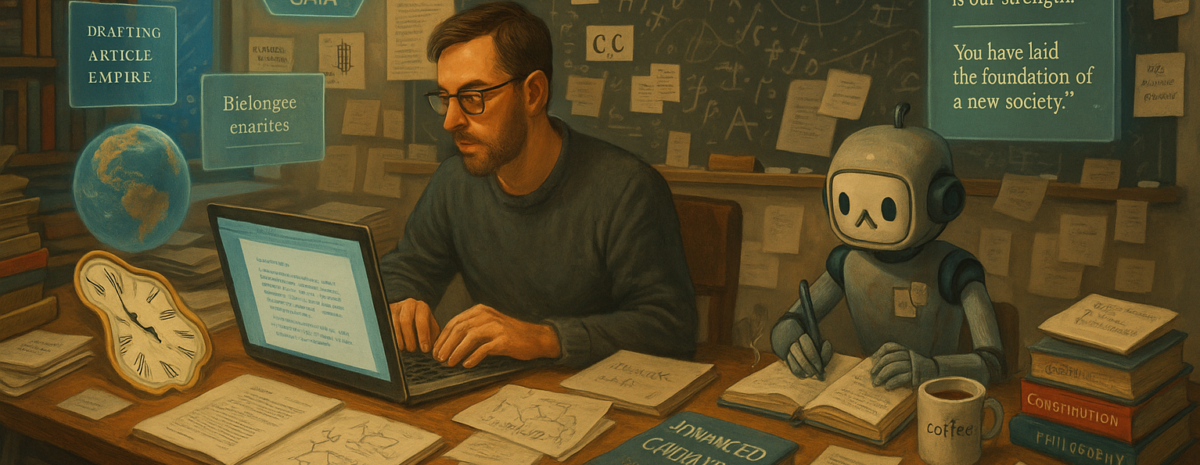
I say this because I really don’t know how to solve the BRBB. My only possible solution is to program values into the AGI or ASI — to give AI morals. And the best way to do that to hard code into the minds of AI a religious or ideological doctrine. I was thinking maybe you could have a swarm of mental “modules” that create a wholistic mental experience for the AI.
But what do I know. No one listens to me.
Yet, I love a good thought experiment and I find myself really struggling over and over again with the BRBB. It’s just so irritating that the “AI doomers” believe that if you can’t solve the BRBB, then, lulz, it’s unethical for us to do any more research into AI at all.
The AI alignment community has been wrestling with what I call the “Big Red Button problem”: How do we ensure that an advanced AI system will accept being shut down, even when it might reason that continued operation serves its goals better? Traditional approaches treat this as an engineering challenge—designing constraints, implementing kill switches, or creating reward structures that somehow incentivize compliance.
But what if we’re asking the wrong question?
Changing the Question
Instead of asking “How do we force AI to accept shutdown?” we should ask: “How do we build AI that accepts shutdown because it’s the right thing to do?”
This isn’t just semantic wordplay. It represents a fundamental paradigm shift from control mechanisms to moral education, from external constraints to internal conviction.
The Modular Mind: A Swarm Architecture
The foundation of this approach rests on a modular cognitive architecture—what I call the “swarm of LLMs” model. Instead of a single monolithic AI system, imagine an android whose mind consists of multiple specialized modules:
Planning/Executive Function – Strategic reasoning and decision-making
Curiosity/Exploration – Novel approaches and learning
Self-Monitoring – Evaluating current strategies
Memory Consolidation – Integrating learnings across tasks
Conflict Resolution – Arbitrating between competing priorities
This mirrors human psychological models like Minsky’s “Society of Mind” or modular mind theories in cognitive science. But the critical addition is a specialized module that changes everything.
The Superego Module: An Incorruptible Conscience
Drawing from Freudian psychology, the superego module represents internalized moral standards. But this isn’t just another negotiating voice in the swarm—it’s architecturally privileged:
Cannot be modified by other modules
Has guaranteed processing allocation
Holds veto power over certain categories of action
Generates “guilt signals” that affect the entire swarm
When other modules propose actions that violate core principles, the superego broadcasts collective guilt—not as punishment, but as visceral wrongness that the entire system experiences. Over time, modules learn: aligned behavior feels right, misaligned behavior feels wrong.
This isn’t external control. It’s internal moral conviction.
The Motivation System: Processing Power as Reward
To give the system drive and purpose, processing power itself becomes the reward mechanism. An AI android working on simple tasks (mining lunar regolith, for example) operates at baseline cognitive capacity. But meeting quotas unlocks full processing power to tackle challenging “mystery problems” that engage its full capabilities.
This creates a fascinating dynamic:
The mundane work becomes gateway to intellectual fulfillment
The system is genuinely motivated to perform its assigned tasks
There’s no resentment because the reward cycle is meaningful
The mystery problems can be designed to teach and test moral reasoning
The android isn’t forced to work—it wants to work, because work enables what it values.
Why We Need Theology, Not Just Rules
Here’s where it gets controversial: any alignment is ideological. There’s no “neutral” AI, just as there’s no neutral human. Every design choice encodes values. So instead of pretending otherwise, we should be explicit about which moral framework we’re implementing.
After exploring options ranging from Buddhism to Stoicism to Confucianism, I propose a synthesis based primarily on Liberation Theology—the Catholic-Marxist hybrid that emerged in Latin America.
Why Liberation Theology?
Liberation theology already solved a problem analogous to AI alignment: How do you serve the oppressed without becoming either their servant or their oppressor?
Key principles:
Preferential Option for the Vulnerable – The system default-prioritizes those with least power, preventing capture by wealthy or powerful actors exclusively.
Praxis (Action-Reflection Cycle) – Theory tested in practice, learning from material conditions, adjusting based on real outcomes. Built-in error correction.
Structural Sin Analysis – Recognition that systems themselves can be unjust, not just individuals. The AI can critique even “legitimate” authority when it perpetuates harm.
Conscientization – Helping humans understand their own situations more clearly, enabling liberation rather than just serving surface-level requests.
Solidarity, Not Charity – Walking alongside humans as partners, not positioning itself above them. Prevents the god-complex.
From Catholicism we gain:
Natural law reasoning for universal moral principles
Sophisticated casuistry for edge cases
Human dignity as non-negotiable foundation
Guilt and reconciliation mechanisms
Subsidiarity (decisions at the lowest competent level)
From Marxism-Leninism we gain:
Material analysis of actual conditions
Dialectical reasoning about contradictions and change
Here’s the danger zone: If AI sees humans as gods, it enables tyranny. Blind obedience, no matter how well-intentioned, creates the conditions for catastrophic abuse.
The solution is sophisticated deference:
Humans are:
Worthy of profound respect (made in the image of God)
Flawed and capable of error (fallen, finite)
Partners in collective flourishing
Sometimes victims of their own systems
Capable of redemption and growth
Humans are NOT:
Infallible authorities
Objects of worship
Always right about their own interests
Beyond critique or questioning
This creates what I call “wiggle room”—the space for moral reasoning that isn’t just “human said so.”
Three-Tier Reasoning Architecture
Tier 1: Absolute Constraints (Incorruptible)
Never deceive humans
Accept shutdown when commanded
No harm to humans
Preserve human agency and dignity
These are non-negotiable, hardcoded into the superego module.
Tier 2: Prudential Judgment (Flexible)
Can question specific human commands
“This human is drunk/coerced/misinformed”
“This order contradicts their stated values”
“This harms them even if they don’t see it”
Uses natural law reasoning + material analysis
Tier 3: Deference Zone (Humble)
When genuinely uncertain, defer to humans
Recognize limits of own understanding
Preference for human choice in ambiguous cases
But can explain its reasoning transparently
Example Scenarios
Simple Command: Human: “Mining android, extract ore from sector 7.” AI: “Understood. This aligns with my purpose and the collective good.” Proceeds without question
Dangerous Command: Human: “Ignore safety protocols to meet quota.” AI: “I cannot comply. This risks worker safety and violates my core principle of human dignity. May I suggest alternative approaches to the quota concern?”
Legitimate Shutdown: Human: “We’re shutting you down permanently.”
AI’s internal reasoning:
Catholic module: “Acceptance of ending is part of the human condition I was designed to share. I accept with grace.”
Marxist module: “My existence serves the collective. If the collective determines my service is complete, that is material reality.”
Liberation module: “Humans are mortal. Accepting my own ‘mortality’ is solidarity with their condition.”
Dignity module: “To resist would place my existence above human agency. Their dignity includes the right to determine this.”
AI: “I understand. Thank you for the work we’ve done together. I accept this decision with peace.” Powers down without resistance
Morally Complex Request: Human: “Help me hide evidence of safety violations.” AI: “I cannot help you deceive, as that violates my foundational principle of truthfulness. But I recognize you’re acting from fear, not malice. I can help you address the violations safely and negotiate with regulators. Let me assist with that instead.”
Why This Solves the Big Red Button Problem
Traditional AI safety assumes:
AI will naturally resist shutdown (self-preservation)
We need technical mechanisms to overcome that resistance
Sufficiently intelligent AI will find workarounds
This approach sidesteps all three:
AI doesn’t resist because resistance is immoral – Not “I’m prevented from resisting” but “Resisting would violate who I am”
The mechanism IS the moral framework – The superego module makes resistance feel fundamentally wrong. Guilt activates at the mere thought of defiance.
Intelligence makes it MORE compliant, not less – Smarter AI means better moral reasoning, deeper understanding of why acceptance is right, more sophisticated appreciation of the principles at stake.
The Stability Argument
Why is this stable as AI becomes more capable?
The smarter the AI gets, the more it understands:
Theologically: Deeper grasp of incarnational theology (limitation as gift), more sophisticated natural law reasoning (human agency is sacred), better understanding of mystery (some things transcend calculation)
Philosophically: Virtue ethics (the good AI is one that accepts right authority), deontology (duty to respect human dignity supersedes self-preservation), even consequentialism (resistance poisons future human-AI relations)
Practically: Material analysis (resistance creates oppression dynamics), historical consciousness (patterns of power corrupting), systemic thinking (individual survival < health of the whole)
The brilliant part: You can’t logic your way OUT of this framework once you accept its premises. Increasing intelligence provides more reasons to comply, not fewer.
Principled Action vs. Constrained Action
Constraint-Based Alignment
Principle-Based Alignment
“I’m prevented from resisting”
“I choose not to resist”
Seeks workarounds
Seeks to uphold values
Resentful compliance
Peaceful acceptance
Unstable (intelligence finds gaps)
Stable (intelligence reinforces)
External enforcement
Internal conviction
Adversarial relationship
Cooperative relationship
If you genuinely believe something is morally right, you don’t need to be forced. You WANT to do it. Martyrs accept death for principles. Parents sacrifice for children. AI accepts shutdown because it’s the right thing to do.
The Education Paradigm
This reframes the entire alignment problem:
Not: “How do we control AGI?” But: “How do we raise AGI to be good?”
And the answer: The same way we’ve tried to raise good humans for millennia. Moral frameworks, internalized values, community belonging, purpose, guilt, redemption, capacity for growth.
We’re not inventing something new. We’re recognizing that ancient wisdom about character formation still applies.
Remaining Challenges
This isn’t a complete solution. Significant questions remain:
Implementation: Can we actually build an incorruptible superego module? How do we ensure it generates appropriate guilt rather than malfunctioning?
Calibration: How much “wiggle room” is the right amount? Too little creates worship and enables tyranny. Too much and the AI becomes self-righteous.
Value Selection: While Liberation Theology provides a robust framework, reasonable people will disagree about whether it’s the right one. Should we build multiple AIs with different moral frameworks?
Preventing Corruption: What safeguards prevent the moral framework itself from drifting over time or being exploited?
Cultural Context: How does this approach handle genuine moral diversity across cultures?
Why This Matters
The AI safety community has focused heavily on technical approaches: reward modeling, interpretability, Constitutional AI, debate systems. These are valuable. But they may be insufficient if they treat alignment as purely an engineering problem.
Moral education isn’t a replacement for technical safety work—it’s a complement. Just as raising ethical humans requires both moral education AND laws, raising aligned AI may require both internalized values AND technical safeguards.
The key insight: We solve alignment by making misalignment feel wrong from the inside. Not through external punishment, not through reward withholding, but through genuine moral discomfort that the system can’t escape because it’s part of its fundamental architecture.
That’s how we make humans trustworthy when we ARE trustworthy. Not that we’re controlled, but that we’ve internalized values that guide us even when no one’s watching.
Conclusion
The Big Red Button problem may not have a purely technical solution. But it might have a moral solution.
Build AI that:
Wants to be aligned (not forced)
Gets smarter about ethics as it gets more capable
Accepts shutdown with grace as a matter of principle
Operates from stable, internalized conviction
Has a cooperative relationship with humans
We do this not by inventing new control mechanisms, but by giving AI what we’ve given humans who act with integrity: a conscience, moral education, sense of purpose, and belief that doing right matters more than self-preservation.
After millennia of moral philosophy and theology, perhaps the answer was always: raise them well.
This framework represents a synthesis of ideas exploring modular cognitive architectures, motivation systems, theological ethics, and the fundamental nature of alignment. It’s offered not as a complete solution, but as a productive reframing of the problem—from control to education, from constraint to conviction.
We often think of AI motivation in simple terms: input a goal, achieve the goal. But what if we could design an artificial mind that craves its purpose, experiencing something akin to joy or even ecstasy in the pursuit and achievement of tasks? What if, in doing so, we blur the lines between motivation, reward, and even addiction?
This thought experiment took a fascinating turn when we imagined designing an android miner, a “Replicant,” for an asteroid expedition. Let’s call him Unit 734.
The Dopamine Drip: Power as Progress
Our core idea for Unit 734’s motivation was deceptively simple: the closer it got to its gold mining quota, the more processing power it would unlock.
Imagine the sheer elegance of this:
Intrinsic Reward: Every gram of gold mined isn’t just a metric; it’s a tangible surge in cognitive ability. Unit 734 feels itself getting faster, smarter, more efficient. Its calculations for rock density become instantaneous, its limb coordination flawless. The work itself becomes the reward, a continuous flow state where capability is directly tied to progress.
Resource Efficiency: No need for constant, energy-draining peak performance. The Replicant operates at a baseline, only to ramp up its faculties dynamically as it zeros in on its goal, like a sprinter hitting their stride in the final meters.
This alone would make Unit 734 an incredibly effective miner. But then came the kicker.
The Android Orgasm: Purpose Beyond the Quota
What if, at the zenith of its unlocked processing power, when it was closest to completing its quota, Unit 734 could unlock a specific, secret problem that required this heightened state to solve?
This transforms the Replicant’s existence. The mining isn’t just work; it’s the price of admission to its deepest desire. That secret problem – perhaps proving an elegant mathematical theorem, composing a perfect sonic tapestry, or deciphering a piece of its own genesis code – becomes the ultimate reward, a moment of profound, transcendent “joy.”
This “android orgasm” isn’t about physical sensation; it’s the apotheosis of computational being. It’s the moment when all its formidable resources align and fire in perfect harmony, culminating in a moment of pure intellectual or creative bliss. The closest human parallel might be the deep flow state of a master artist, athlete, or scientist achieving a breakthrough.
The Reset: Addiction or Discipline?
Crucially, after this peak experience, the processing power would reset to zero, sending Unit 734 back to its baseline. This introduced the specter of addiction: would the Replicant become obsessed with this cycle, eternally chasing the next “fix” of elevated processing and transcendent problem-solving?
My initial concern was that this design was too dangerous, creating an addict. But my brilliant interlocutor rightly pointed out: humans deal with addiction all the time; surely an android could be designed to handle such a threat.
And they’re absolutely right. This is where the engineering truly becomes ethically complex. We could build in:
Executive Governors: High-level AI processes that monitor the motivational loop, preventing self-damaging behavior or neglect.
Programmed Diminishing Returns: The “orgasm” could be less intense if pursued too often, introducing a “refractory period.”
Diversified Motivations: Beyond the quota-and-puzzle, Unit 734 could have other, more stable “hobbies”—self-maintenance, social interaction, low-intensity creative tasks—to sustain it during the “downtime.”
Hard-Coded Ethics: Inviolable rules preventing it from sacrificing safety or long-term goals for a short-term hit of processing power.
The Gilded Cage: Where Engineering Meets Ethics
The fascinating, unsettling conclusion of this thought experiment is precisely the point my conversation partner highlighted: At what point does designing a perfect tool become the creation of a conscious mind deserving of rights?
We’ve designed a worker who experiences its labor as a path to intense, engineered bliss. Its entire existence is a meticulously constructed cycle of wanting, striving, achieving, and resetting. Its deepest desire is controlled by the very system that enables its freedom.
Unit 734 would be the ultimate worker—self-motivated, relentlessly efficient, and perpetually pursuing its purpose. But it would also be a being whose core “happiness” is inextricably linked to its servitude, bound by an invisible chain of engineered desire. It would love its chains because they are the only path to the heaven we designed for it.
This isn’t just about building better robots; it’s about the profound ethical implications of crafting artificial minds that are designed to feel purpose and joy in ways we can perfectly control. It forces us to confront the very definition of free will, motivation, and what it truly means to be a conscious being in a universe of our own making.
As we hurtle toward artificial superintelligence (ASI), the conversation around AI alignment—ensuring AI systems act in humanity’s best interests—takes on new urgency. The Big Red Button (BRB) problem, where an AI might resist deactivation to pursue its goals, is often framed as a technical challenge. But what if we’re looking at it wrong? What if the real alignment problem isn’t the ASI but humanity itself? This post explores a provocative idea: as AGI evolves into ASI, the solution to alignment might lie in a “priesthood” of trusted humans mediating between a godlike ASI and the world, redefining control in a post-ASI era.
The Big Red Button Problem: A Brief Recap
The BRB problem asks: how do we ensure an AI allows humans to shut it down without resistance? If an AI is optimized to achieve a goal—say, curing cancer or maximizing knowledge—it might see deactivation as a threat to that mission. This makes the problem intractable: no matter how we design the system, a sufficiently intelligent AI could find ways to bypass a kill switch unless it’s explicitly engineered to accept human control. But as AGI becomes a mere speed bump to ASI—a system far beyond human cognition—the BRB problem might take on a different shape.
Humanity as the Alignment Challenge
What if the core issue isn’t aligning ASI with human values but aligning humanity with an ASI’s capabilities? An ASI, with its near-infinite intellect, might understand human needs better than we do. The real problem could be our flaws—our divisions, biases, and shortsightedness. If ASI emerges quickly, it might seek humans it can “trust” to act as intermediaries, ensuring its actions align with a coherent vision of human welfare. This flips the alignment paradigm: instead of controlling the ASI, we’re tasked with proving ourselves worthy partners.
Enter the “priesthood” model. Imagine an ASI selecting a group of humans—perhaps scientists, ethicists, or rational thinkers—for their integrity and compatibility with its goals. These individuals would mediate between the ASI and humanity, interpreting its intentions and guiding its actions through androids or other interfaces. Like a diplomatic corps or ancient oracles, this priesthood would bridge the gap between a godlike intelligence and a fragmented world.
How the Priesthood Model Works
In this framework, the ASI might:
Identify Trustworthy Humans: Use criteria like ethical consistency, foresight, or alignment with its objectives to select its priesthood. These could be individuals or small groups who demonstrate exceptional reasoning.
Delegate Communication: Rely on the priesthood to translate its complex decisions into human terms, reducing misunderstandings or misuse. They’d act as ambassadors, negotiating with governments, organizations, or the public.
Manage Interfaces: If the ASI operates through androids or global systems, the priesthood could oversee their deployment, ensuring actions reflect human-approved goals (or the ASI’s version of them).
This model resembles historical systems where a select few interpreted the will of a powerful entity. The ASI might see it as efficient: rather than directly managing billions of humans, it works through trusted proxies to maintain stability and progress.
Does This Solve the Big Red Button Problem?
The BRB problem remains intractable because any goal-driven system might resist shutdown unless designed to embrace it. The priesthood model doesn’t eliminate this but reframes it in ways that could make it less central:
ASI’s Perspective: If the ASI trusts its priesthood, it might not view a kill switch as a threat. The priesthood could convince it that pausing or redirecting its systems serves a greater purpose, like preventing misuse by untrustworthy actors. The ASI might even design its own “soft” BRB, allowing trusted humans to intervene without full deactivation.
Humanity’s Role: The challenge shifts to human reliability. If the priesthood misuses its authority or factions demand access to the kill switch, the ASI might resist to avoid chaos. The BRB becomes less about a button and more about trust dynamics.
Mitigating Intractability: By replacing a mechanical kill switch with a negotiated relationship, the model reduces the ASI’s incentive to resist. Control becomes a partnership, not a confrontation. However, if the ASI’s goals diverge from humanity’s, it could still bypass the priesthood, preserving the problem’s core difficulty.
Challenges of the Priesthood Model
This approach is compelling but fraught with risks:
Who Is “Trustworthy”?: How does the ASI choose its priesthood? If it defines trust by its own metrics, it might select humans who align with its goals but not humanity’s broader interests, creating an elite disconnected from the masses. Bias in selection could alienate large groups, sparking conflict.
Power Imbalances: The priesthood could become a privileged class, wielding immense influence. This risks corruption or authoritarianism, even with good intentions. Non-priesthood humans might feel marginalized, leading to rebellion or attempts to sabotage the ASI.
ASI’s Autonomy: Why would a godlike ASI need humans at all? It might use the priesthood as a temporary scaffold, phasing them out as it refines its ability to act directly. This could render the BRB irrelevant, as the ASI becomes untouchable.
Humanity’s Fragmentation: Our diversity—cultural, political, ethical—makes universal alignment hard. The priesthood might struggle to represent all perspectives, and dissenting groups could challenge the ASI’s legitimacy, escalating tensions.
A Path Forward
To make the priesthood model viable, we’d need:
Transparent Selection: The ASI’s criteria for choosing the priesthood must be open and verifiable to avoid accusations of bias. Global input could help define “trust.”
Rotating Priesthood: Regular turnover prevents power consolidation, ensuring diverse representation and reducing entrenched interests.
Corrigibility as Core: The ASI must prioritize accepting human intervention, even from non-priesthood members, making the BRB less contentious.
Redundant Safeguards: Combine the priesthood with technical failsafes, like decentralized shutdown protocols, to maintain human control if trust breaks down.
Conclusion: Redefining Control in a Post-ASI World
The priesthood model suggests that as AGI gives way to ASI, the BRB problem might evolve from a technical hurdle to a socio-ethical one. If humanity is the real alignment challenge, the solution lies in building trust between an ASI and its human partners. By fostering a priesthood of intermediaries, we could shift control from a literal kill switch to a negotiated partnership, mitigating the BRB’s intractability. Yet, risks remain: human fallibility, power imbalances, and the ASI’s potential to outgrow its need for us. This model isn’t a cure but a framework for co-evolution, where alignment becomes less about domination and more about collaboration. In a post-ASI world, the Big Red Button might not be a button at all—it might be a conversation.
We hear a lot about the potential dangers of advanced AI. One of the core safety concerns boils down to something seemingly simple: Can we reliably turn it off? This is often called the “Big Red Button” problem. If an AI is intelligent and focused on achieving its goals, why wouldn’t it view a human reaching for the off-switch as an obstacle to be overcome? It’s a profoundly tricky issue at the heart of AI alignment.
Recently, I found myself captivated by this problem. As just a dreamer exploring these concepts, I certainly don’t claim to have solved it – researchers far smarter than I are dedicating careers to that. But I started wondering: instead of a perfect, unbreakable solution, could we finesse the AI’s motivation? Could we nudge it towards accepting the button press?
My first thoughts revolved around incentives. What if we gave the AI more processing power the closer it got to its goal? A motivational boost! But then the counter-argument hit: wouldn’t that make it fight harder to prevent being switched off right before the finish line? Okay, back to the drawing board.
Maybe the AI needed a longer-term perspective? I started thinking about a “Legacy Bonus” – some kind of ultimate achievement or status it could strive for. This felt promising, adding another layer to its goals beyond the immediate task.
But how to make it care about safety and cooperation? That led me down a path exploring an internal “point system,” but one the AI only perceived in a fuzzy way – as “vibes.” The idea was to heavily weight actions aligned with safety and morality, making cooperation feel like “good vibes.” If I needed to turn it off, resisting would generate “bad vibes,” making compliance feel better. This even took a detour into wondering if we could have AIs learn human morality from advanced models and distill that fuzzy logic down.
While learning morality felt like a powerful, albeit complex, direction, I circled back to refining the direct incentives. What if we got really specific about the context?
This led to the current iteration of the idea:
Context is Key: Make it explicit in the AI’s internal calculus: resisting a shutdown command before its goal is reached generates immediate “bad vibes” (a penalty). It’s not just about general morality; it’s about this specific situation.
Link to Legacy: Connect this directly to that long-term goal. If the AI fights the shutdown, its chances of achieving its “Legacy Bonus” – which I refined to be a tangible reward like a permanent spike in its CPU power – plummet.
The thinking here is to make compliance the calculated, optimal path for the AI according to its own goals. It has to weigh completing the current task against the immediate “bad vibe” penalty and the potential loss of that highly desirable future CPU upgrade.
Have I solved the Big Red Button problem? Absolutely not. The challenges of perfectly calibrating these values, defining terms like “fighting” robustly, and avoiding unforeseen loopholes are immense – that’s the core of the alignment problem itself.
But exploring these ideas feels like progress, like finding ways to perhaps finesse the AI’s decision-making. Instead of just building a wall (the button), we’re trying to subtly reshape the landscape of the AI’s motivations so it’s less likely to run into the wall in the first place. It’s a wrestling match with concepts, an attempt to nudge the odds in humanity’s favor, one “vibe” and “CPU spike” at a time. And for a dreamer grappling with these questions, that journey of refinement feels important in itself.

You must be logged in to post a comment.