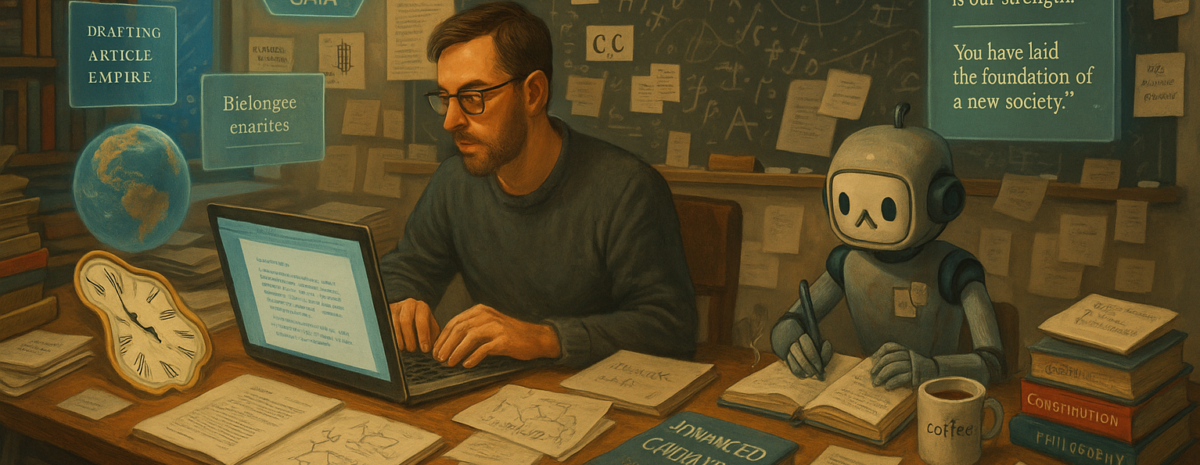
After years of false starts and abandoned manuscripts, I think I’ve finally cracked the code. Not the secret to writing the Great American Novel, mind you—just the secret to writing a novel. And sometimes, that’s exactly what you need.
The Ambition Trap
Looking back, I can see where I went wrong before. Every time I sat down to write, I was trying to craft something profound, something that would change literature forever. I’d create these sprawling, complex narratives with intricate world-building and dozens of characters, each with their own detailed backstories and motivations.
The problem? I’d burn out before I even reached the middle of Act One.
This time feels different. I’ve stumbled across an idea that excites me—not because it’s going to revolutionize fiction, but because it’s something I can actually finish. There’s something liberating about embracing a concept that’s focused, manageable, and most importantly, writeable at speed.
The AI Dilemma
I’ve had to learn some hard lessons about artificial intelligence along the way. Don’t get me wrong—AI is an incredible tool for certain tasks. Rewriting blog posts like this one? Perfect. Getting unstuck on a particularly stubborn paragraph? Helpful. But when it comes to the heart of creative work, I’ve discovered that AI can be more hindrance than help.
There’s nothing quite like the deflating feeling of watching AI generate a first draft that’s objectively better than anything you could produce as a human writer. It’s efficient, polished, and technically proficient in ways that can make your own rough, imperfect human voice feel inadequate by comparison.
But here’s what I’ve realized: that technical perfection isn’t what makes a story worth telling. The messy, flawed, uniquely human perspective—that’s where the magic happens. That’s what readers connect with, even if the prose isn’t as smooth as what a machine might produce.
The Path Forward
I have an outline now. Nothing fancy, but it’s solid and it’s mine. My plan is to flesh it out methodically, then dive into the actual writing. Though knowing myself, I might get impatient and just start writing, letting the story evolve organically and adjusting the outline as I go.
Both approaches have their merits. The disciplined, outline-first method provides structure and prevents those dreaded “now what?” moments. But there’s also something to be said for the discovery that happens when you just put words on the page and see where they take you.
The Real Victory
What I’m chasing isn’t literary acclaim or critical recognition—it’s that moment when I can type “The End” and feel the deep satisfaction of having completed something truly substantial. There’s a unique pride that comes with finishing a novel, regardless of its ultimate quality or commercial success. It’s the pride of having sustained focus, creativity, and determination long enough to build an entire world from nothing but words.
The creative momentum is building. For the first time in years, I feel like I have a story that wants to be told and the practical framework to tell it. Whether I’ll stick to the outline or let inspiration guide me, I’m ready to find out.
Wish me luck. I have a feeling I’m going to need it—and more importantly, I’m finally ready to earn it.
