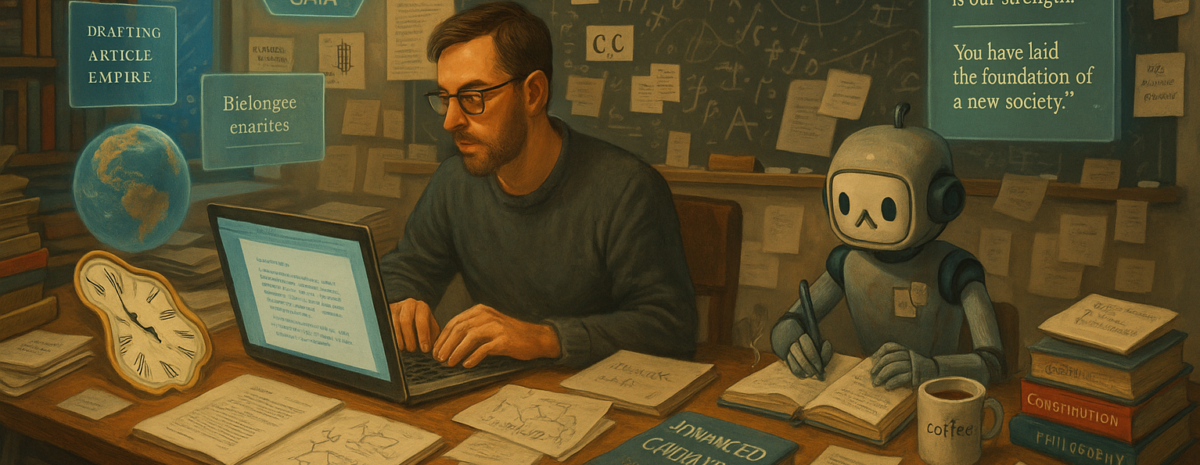
There’s a ghost that haunts my writing process. It’s the ghost of my younger self, the one who, twenty-five years ago, would have been hammering out this story not as a novel, but as a screenplay in some cramped L.A. walk-up, fueled by cheap coffee and blind ambition.
But time, as it does, had other plans. So, a novel it is.
I recently hit a wall. A big one. The kind of wall you don’t see until you’re driving toward it at full speed. As I navigated the narrative terrain of my sci-fi dramedy and approached the threshold of the second act, I realized my foundation was sand. Key emotional arcs, character motivations, and thematic threads I desperately needed for the story ahead simply weren’t there. The structure groaned, then collapsed.
This is where the process gets modern. As an “AI-first” novelist, my immediate instinct wasn’t to despair over a sea of index cards. It was to collaborate. I turned to AI to help me reimagine the outline, to stress-test new structures and brainstorm solutions at a pace that would have been unthinkable just a few years ago.
The brief was specific. I fed it my core concept and my primary cinematic influences: the bittersweet technological intimacy of Her, the fragmented, painful memory of The Eternal Sunshine of the Spotless Mind, the neurotic, conversational wit of Annie Hall, and the chilling intellectual claustrophobia of Ex Machina.
The result was, frankly, astounding. In a remarkably short time, the AI—in this case, Claude—helped me architect a new first act. It understood the tonal fusion and generated a blueprint that was stronger, smarter, and more emotionally resonant. It was an incredible demonstration of AI as a developmental partner.
And then, the silence.
The AI’s job was done. The beautiful, logical, perfectly structured outline sat waiting. And I was left staring at the screen, confronted with a familiar, humbling truth: the blueprint is not the building. The profound issue of my own writing ability came roaring back to the forefront. I refuse to outsource the prose, to let an algorithm spin the sentences. Call it artistic pride or self-flagellation, but letting the machine do the final, intimate work feels like a betrayal. It also makes me feel terrible about how painfully, glaringly human my own first drafts are in comparison to its potential.
So, it’s back to the drawing board. Back to the hard work of translating a brilliant schematic into living, breathing text. My timeline has shifted. The hope of wrapping this up “pretty soon” has matured into a more sober projection. Maybe a year. I’m tentatively circling the fall of 2026 as a target to begin querying, but I’m acutely aware of how much life can happen between now and then—how a thousand unforeseen events could shift the context of this story and the world it’s born into.
After all, what am I but a middle-aged crank, a guy whose last significant life chapter feels like it was written in Seoul two decades ago? Maybe no one wants to deal with that. But the story is good. The blueprint is solid. The ghost of that kid in the L.A. apartment is gone, replaced by the man who has to actually build the thing.
What good is a perfect map if you’re afraid to take the first step into the wilderness?
