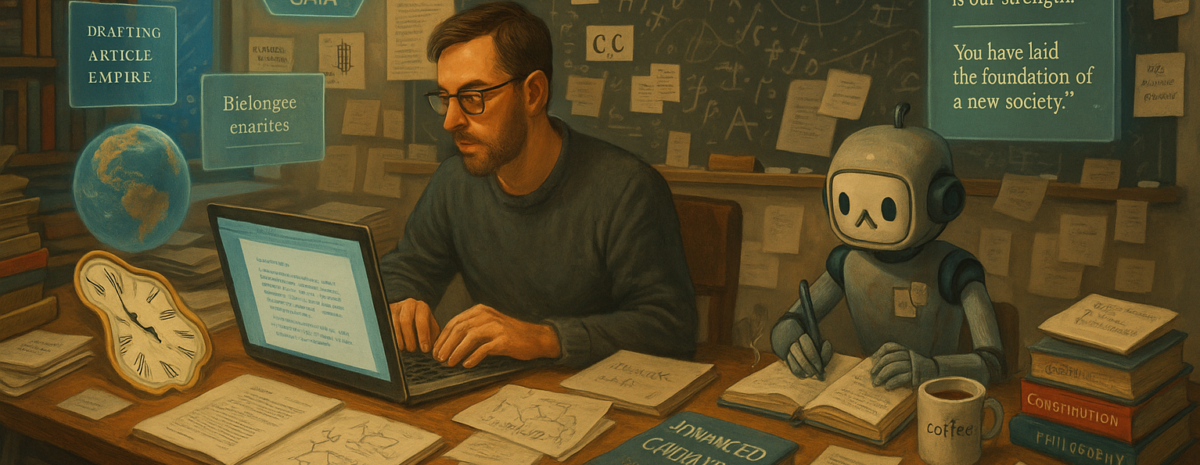
There’s something beautifully absurd about sitting in the middle of nowhere, watching a movie you hate, all in service of a story you desperately want to tell. Welcome to the modern writer’s existence—a peculiar blend of compromise, inspiration, and the occasional existential crisis.

The Road Not Taken (Because I’m Too Old for That Nonsense)
I catch myself daydreaming sometimes: What if I was 25 years younger? Then I could have that total blind ignorance needed to pack up everything, move to Los Angeles, and attempt to be a screenwriter. I’d write something revolutionary—a screenplay that somehow marries the sleek dystopian eeriness of Subservience with the neurotic charm of Annie Hall.
But here’s the thing about being older and (allegedly) wiser: you know exactly how many dreams crash and burn in Hollywood every day. So instead of chasing that particular windmill, I’m channeling that same creative energy into a novel. Sometimes the detour becomes the destination.
The Muse Behind the Madness
Every story needs its spark, and mine comes from memory—specifically, the memory of Annie Shapiro, the woman who changed my life in Seoul. She was what you might call “late crazy Annie,” a force of nature with quirks so distinctive they practically begged to be immortalized in fiction.
Annie was the kind of person who made you question everything you thought you knew about how people should move through the world. Her particular brand of beautiful chaos is exactly what I want to transplant into my own take on the “manic pixie dream girl” trope—except in my version, she’s not quite human. She’s a bot, which adds layers of meaning to the whole concept that I’m still unpacking.
The Research We Do (And Don’t) Love
Which brings me to my current predicament: slowly, painfully making my way through Subservience on Netflix. This movie grates on every nerve I have. It’s exactly the kind of film I would normally avoid like a tax audit, but here I am, subjecting myself to it for the sake of my craft.
Why? Because I need to “comp” my novel—industry speak for finding comparable works that help explain what you’re trying to create. And unfortunately, Subservience hits some of the same thematic territory I’m exploring, even if it does so in ways that make me want to throw things at my screen.
The irony isn’t lost on me: I’d much rather spend this afternoon rewatching Annie Hall for the hundredth time, absorbing Woody Allen’s masterful character work and dialogue. But that’s not going to help me understand how modern audiences relate to stories about artificial beings and human connection.
The Vomit Draft Philosophy
Right now, I’m working on what writers affectionately call a “vomit draft”—that first, messy attempt to get the story out of your head and onto the page. Character development will come later. Plot refinements can wait. For now, it’s just about capturing the essence of what this story wants to be.
There’s something liberating about giving yourself permission to write badly at first. It’s the antidote to perfectionism, the enemy of all creative work. You can’t edit a blank page, as they say, but you can absolutely improve a terrible first draft.
Geography Is Not Destiny
Living in the middle of nowhere used to feel like a creative death sentence. How could real stories emerge from a place where nothing happens? But I’m learning that distance from the industry might actually be an advantage.
Out here, away from the noise and trends and what’s supposed to be important, you can focus on what actually matters: the characters, the emotions, the human (or in this case, artificial) truths you’re trying to explore. Maybe the best stories don’t come from Los Angeles after all. Maybe they come from wherever you are when you’re brave enough to write them.
The Long Game
So here I am, laptop open, Subservience paused on my laptop, notebook filled with observations about what works and what doesn’t in contemporary AI narratives. It’s not the writing life I imagined at 25, but it might be exactly the one I need at this stage of my life.
Sometimes the best stories come not from blind ambition, but from the wisdom that comes with knowing exactly what you’re up against—and choosing to write anyway.
