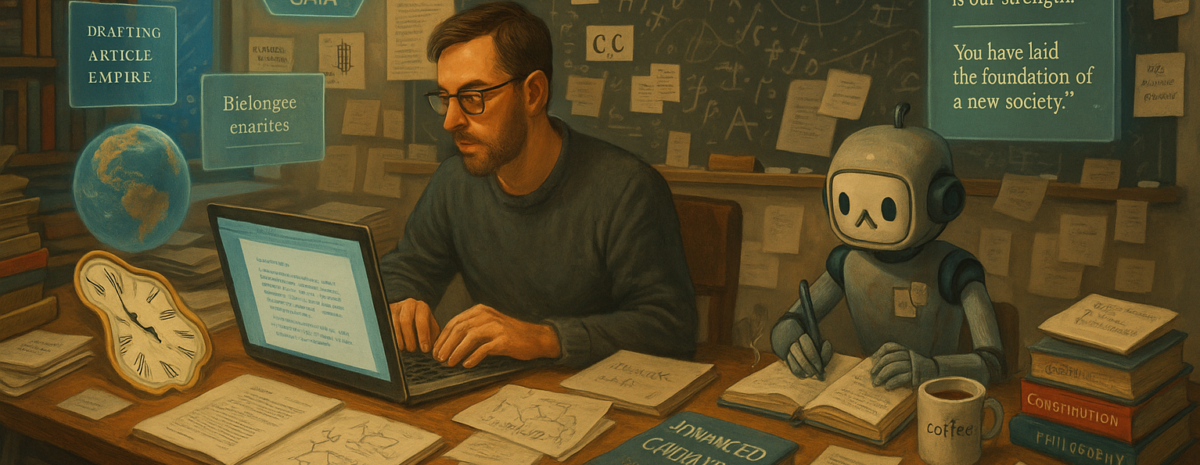
One of the most unsettling characters in Isaac Asimov’s Foundation series isn’t a tyrant, a general, or a genius strategist. It’s the Mule—a historical anomaly so emotionally disruptive that he breaks the predictive power of psychohistory itself. The entire Foundation project is built on the assumption that individuals don’t matter, that history unfolds according to vast statistical forces. The Mule matters precisely because he proves that assumption wrong.
Which raises a fun—and slightly uncomfortable—question: could Donald Trump be metaphorically understood as the Mule?
The Case For Trump as the Mule
In the Foundation universe, the Plan works only if people behave predictably. It assumes elites will act in good faith, institutions will be respected, and historical momentum will gently guide civilization from chaos back toward stability. In a very loose but evocative sense, the U.S. Constitution plays a similar role in our own story. It isn’t just a legal document; it’s a behavioral assumption machine. It presumes norms, restraint, legitimacy, and a shared belief in the system itself.
Trump enters this picture like an error term no one modeled.
He doesn’t succeed by mastering institutions. He succeeds by bypassing them—by appealing directly to emotion, grievance, identity, and loyalty. His power doesn’t come from policy coherence or ideological rigor but from his ability to function as a focal point for belief. To supporters, he doesn’t need to make sense. He feels right. To opponents, he doesn’t behave rationally. He feels impossible.
This is very Mule-like.
In Asimov’s story, the Mule isn’t dangerous because he has the biggest fleet; he’s dangerous because he can make people do things that are wildly against their own interests—and feel good about it. Trump’s political gravity operates similarly. People excuse contradictions, abandon previously sacred principles, and accept behavior that would have been disqualifying coming from literally anyone else. From the outside, it looks inexplicable. From the inside, it feels inevitable.
Most tellingly, Trump didn’t just win elections—he invalidated the experts. Pollsters, political scientists, journalists, and institutional gatekeepers repeatedly said, “This shouldn’t be happening,” right up until it very clearly was. That’s the Mule’s signature move: not conquering territory, but conquering confidence in the model.
The Case Against Trump as the Mule
There’s a strong counterargument, though—and it cuts deep.
The Mule, by definition, is unpredictable. He’s a true anomaly. But on a macro-historical level, it’s hard to argue that someone like Trump wasn’t foreseeable. As empires stagnate or contract, trust in elites erodes. Media ecosystems fracture. Economic anxiety mixes with cultural resentment. Charismatic strongmen don’t appear out of nowhere; they emerge from fertile ground.
From this perspective, Trump isn’t outside the Plan—he’s what happens when the Plan quietly stops working.
If you zoom out far enough, Trump looks less like a singular historical glitch and more like a symptom. A loud one. A destabilizing one. But still legible. Many countries have produced similar figures under similar conditions. That makes him less Mule and more… history doing what history does when institutions fail to adapt.
And that distinction matters. In Foundation, once the Mule is removed, psychohistory can resume. The system was sound; it just encountered a freak event. In the real world, Trump’s rise suggests something more troubling: that our predictive confidence was misplaced all along.
The Unsettling Synthesis
Which leads to a more interesting possibility.
Trump may not be the Mule—but he might be the proof that our “Plan” was never as predictive as we thought.
The Constitution, like psychohistory, works beautifully when irrationality remains background noise. It assumes bad actors are rare, norms are sticky, and belief in the system is self-sustaining. Trump revealed how much of American stability was held together not by laws, but by vibes. Not by enforcement, but by mutual agreement to play along.
In that sense, the Mule moment isn’t Trump himself. It’s the realization that history never stopped being driven by emotion—it just politely pretended otherwise for a while.
And once you see that, the really uncomfortable question isn’t whether Trump was inevitable.
It’s whether the next Mule is already loading.
