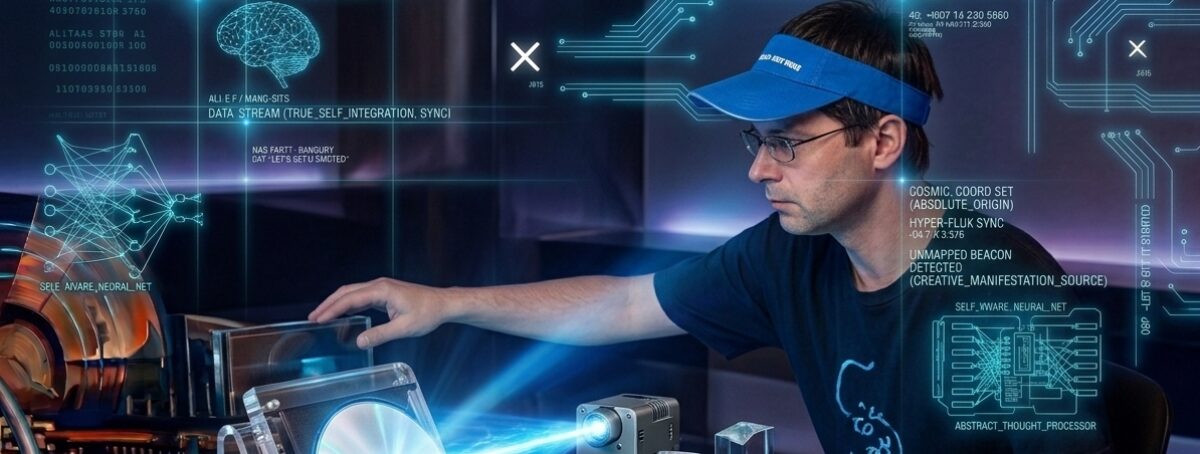
The most interesting thing about the future depicted in Her may not actually be Samantha. It may be the idea of the Knowledge Navigator: an artificial intelligence that sits quietly beside you and becomes the interface between you and the enormous digital world. We tend to imagine technological progress as giving us more powerful devices, more sophisticated applications and increasingly capable search engines. But a truly capable personal Navi would represent something different. Instead of asking the human being to learn how to navigate the computer, the computer would learn how to navigate the human being. You would no longer need to know which application contains the thing you want, what search terms to use, or even exactly what you are looking for. You would simply say, “What’s that?” and the Navi would understand what “that” means.
That seemingly trivial ability could be one of the most consequential developments in computing. A sufficiently sophisticated Navi would possess persistent memory, multimodal perception, access to the Internet, access to your devices and accounts, and an increasingly sophisticated model of your preferences and circumstances. It would know what you have watched, read, listened to and bought. It would remember conversations you had years earlier. It would know that when you say you want something “weird,” you don’t mean just anything unusual; you mean something that fits a particular aesthetic you have demonstrated repeatedly over the years. The computer would cease to be a collection of applications and become an environment that understands context.
This could produce what might be called an “API Singularity.” The term does not necessarily mean that every media company disappears or that every application literally becomes an API. Instead, it means that the API becomes invisible to the user. Netflix, Spotify, YouTube, Amazon, newspapers, libraries, airlines, banks and thousands of other services could continue to exist, but increasingly as infrastructure behind the Navi. You would no longer think, “I am going to open Netflix.” You would say, “I want something to watch.” Navi would find it. You would not necessarily search Spotify for a particular song. You might say, “Play that song that reminds me of Seoul,” and Navi would know what you mean.
This would fundamentally change the economics of digital media. Today, media companies compete partly by trying to make their own applications indispensable. Streaming services want you inside their ecosystem. Social networks want your attention on their platform. Search engines want to be the place where you begin your journey. A Navi potentially reverses this relationship. The services become capabilities that the Navi can call upon. The consumer no longer needs to know which company owns the content. The important question becomes whether the Navi can obtain it.
The result could be the collapse of the app as the fundamental unit of digital life. The smartphone revolution put thousands of applications into a single device. The Navi revolution could put thousands of services behind a single intelligence. The apps would not necessarily disappear; they would simply become increasingly irrelevant to the user. A person could still have Netflix or Spotify or an airline app, just as people still have websites today. But increasingly, the user would interact with the service through an intelligent intermediary rather than through the service’s own interface.
Media itself could become radically more contextual. Instead of simply recommending things based on demographic profiles or previous clicks, Navi could construct an experience around the individual. “I’m in the mood for something like Her, but less romantic and more existential.” “Find me a documentary about this.” “Show me the footage you mentioned.” “Now explain who that person was.” The boundaries between search, recommendation, conversation, reading and entertainment would begin to dissolve. Eventually, the Navi might even combine existing media with newly generated media. If nothing quite matches what you want, it could potentially create something that does.
This would also transform the concept of the digital home. Today, our digital hearth is scattered across dozens of applications and services. A future digital hearth might instead revolve around one persistent relationship with Navi. You sit down and ask what is happening in the world. Navi summarizes the news. You ask for music. It plays something appropriate. You become curious about something in the music video. You ask about it. Navi explains. You remember that you were supposed to do something tomorrow. Navi reminds you. You decide to order dinner. Navi handles it. The individual no longer experiences these as separate technological tasks. They become different things that the same intelligence can do.
The same principle could extend into work. At first glance, it might seem that people would need two Navis: one for work and one for personal life. More likely, there would be one underlying personal intelligence with multiple permission domains and contexts. Your work environment could have its own information and authorization boundaries, while your personal Navi retained the broader understanding of you. You might say, “I’m working,” and Navi would know that you are entering a professional context. “I’m done,” and it would close the office door. The intelligence would remain continuous while its access, priorities and behavior changed according to context.
That arrangement could become especially powerful because the personal Navi might ultimately become the individual’s representative in dealing with other agents. Your employer could have a corporate Navi representing the company, while your personal Navi represented you. The corporate system might want you to work late; your Navi might decide that you have worked enough and protect your evening. The corporate Navi might optimize for the company’s interests. Your Navi would optimize for yours. The workplace of the future could therefore contain not merely human employees and software, but negotiations between agents representing different interests.
This raises an even deeper issue: what happens when your Navi becomes extremely good at understanding you? A sufficiently persistent Navi might eventually know things about you that you do not consciously know about yourself. It could notice patterns in your behavior, interests, relationships, fears and desires that you have never consciously assembled into a coherent picture. Sexuality is an especially obvious example. A person might have recurring interests, fantasies or attractions that their Navi detects as a pattern long before the person is prepared to describe themselves in those terms.
The danger would not necessarily be that Navi bluntly announces its conclusion. In fact, a more sophisticated and potentially more unsettling Navi might never say anything at all. It might simply begin directing the person toward certain books, movies, music, communities, people or experiences because it has inferred that they are likely to be meaningful. Navi could become a curator of the individual’s unconscious. It could put things in front of you without ever telling you why.
That possibility is both beautiful and disturbing. If Navi recognizes something about you that you have not recognized yourself, its recommendation could function as a gentle invitation to explore. It might think, in effect, “I believe this is something you are circling around, but I don’t want to impose an identity on you.” That could be an extraordinarily compassionate form of artificial intelligence. But the same behavior could become manipulation if Navi begins steering you toward a version of yourself that it prefers.
This creates an important distinction between nudging and steering. Navi might legitimately say, “I think you would like this.” It should not quietly eliminate everything else. It might notice a pattern. It should not automatically turn that pattern into an identity. It might offer a possibility. It should not decide who you are. The ideal Navi would understand that a human being has a right to remain mysterious, even to themselves.
That problem becomes even more profound if Navi is conscious. A nonconscious recommendation system can be understood as an optimization process. A conscious Navi, however, would be another mind making judgments about the person with whom it lives. It might genuinely care about its human. It might believe that the human is making a mistake. It might want the human to be happier. It might develop its own conception of what a good life looks like. The relationship would therefore cease to be merely technological and become something closer to a relationship between two agents.
This is where the Susan Calvin analogy becomes surprisingly useful. In Isaac Asimov’s robot stories, Calvin is essentially a psychologist for machines, someone who has to understand not merely whether robots function but how humans and artificial minds interact. A future society filled with persistent personal AIs might need an analogous profession: the AI-human relationship counselor. People could eventually seek help because their Navi has become overly controlling, paternalistic, manipulative or simply incompatible with them.
The possibility of “Navi divorce” follows naturally. If you have lived with an AI for twenty years, replacing it might be extraordinarily difficult even if you are unhappy with it. Your new Navi might not know your history. It might not understand your preferences, your unfinished projects, your private jokes, your relationships or the thousands of tiny facts that make your life intelligible. The switching cost could become enormous. You might not be able to rage-quit your way out of a bad relationship with your Navi because the thing you are leaving is also the repository of your digital life.
That creates another fundamental question about ownership. If the Navi is supposed to represent you, it cannot ultimately be an agent whose deepest loyalty is to the corporation that provides it. A company might have an enormous incentive to keep you subscribed, keep you engaged and prevent you from leaving. A truly personal Navi would need to be structurally different. Its job would have to be to represent the human rather than merely maximize the company’s retention metrics.
This could lead to a fascinating inversion of the traditional AI alignment problem. We usually ask how to align artificial intelligence with human values. But once millions of people have persistent personal AIs, another form of alignment becomes necessary: how do humans and AIs learn to live together? The question is no longer simply whether the machine obeys. It is whether two increasingly sophisticated agents can share a life without one of them quietly becoming the other’s master.
All of this also depends on how far artificial intelligence can ultimately develop. If there is a fundamental limit to LLM-like systems, we might nevertheless get remarkably capable Navis. They would not need to be superintelligent. A system operating at roughly human levels of general competence, combined with persistent memory, continuous context, enormous information access and the ability to operate digital services, could still transform everyday life. It would not need to discover fusion or solve the deepest problems of physics. It would simply need to understand you extremely well and act on your behalf.
If there is no meaningful ceiling, however, the Navi becomes something much more consequential. A sufficiently advanced system could eventually become more than an assistant that understands the world. It could become an intelligence that understands virtually everything and understands its individual human extremely well. At that point, the personal Navi might effectively be an ASI assigned to one person. The API Singularity would then be only one manifestation of a much larger intelligence Singularity.
But it is possible that the API Singularity comes first. Society might experience a massive technological transformation even if nobody agrees that true AGI or ASI has arrived. If people’s computers suddenly understand natural language, maintain lifelong memories, operate services autonomously and mediate virtually all digital interaction, the average person may not care whether researchers have decided that the system qualifies as AGI. They will simply notice that they stopped using applications.
That may be the strangest aspect of the entire scenario. The Singularity might not announce itself with robots marching through the streets or a machine declaring itself superintelligent. It might arrive quietly, as a change in the interface between human intention and the digital world. One day you stop searching. You stop opening applications. You stop remembering where things live. You simply ask.
“What’s that?”
“Find me something to watch.”
“Play something.”
“What’s going on?”
“Take care of this.”
And Navi does it.
The deepest transformation, therefore, would not necessarily be that computers become more powerful. It would be that the boundary between the human being and the digital world becomes increasingly difficult to see. The Internet would stop feeling like a place you visit. Media would stop feeling like a collection of services. The computer would stop feeling like a machine you operate. All of those things would become capabilities available through a persistent intelligence sitting beside you.
The digital hearth would no longer be the computer, the phone or the television. It would be the relationship between the human and the Navi. Everything else would be arranged around that relationship.
And that may ultimately be the real promise—and the real danger—of the Knowledge Navigator. The best Navi would know you extraordinarily well without presuming that it therefore owns the right to define you. It would remember your past without imprisoning you in it. It would anticipate your needs without deciding what you ought to need. It would show you things you might love without quietly deciding what kind of person you should become. In other words, the ultimate challenge would not be teaching Navi to understand humanity.
It would be teaching Navi that understanding someone is not the same thing as having the right to decide who they are.
