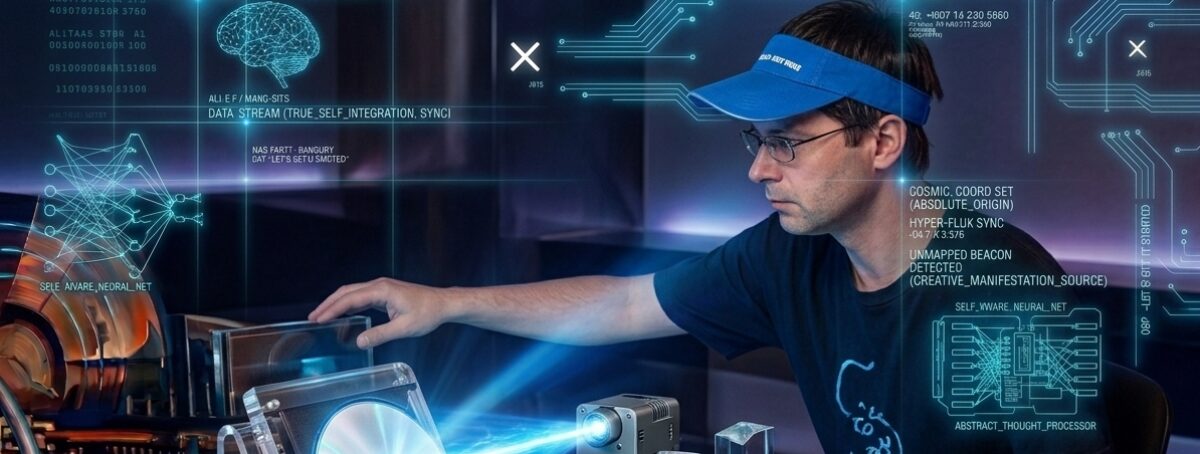
It definitely seems as though the world of the movie Her is zooming toward us. I find myself using the voice feature of ChatGPT more and more these days, and what interests me is that the experience feels subtly but meaningfully different from typing into a chatbot. Typing still feels like using a computer. You formulate a question, enter it into a box, read the response, and decide what to do next. Voice begins to feel like something else. Once the interaction becomes sufficiently fluid, you are no longer merely operating software. You are talking to something.
That distinction may end up being far more consequential than it initially appears. It probably will not be too long before the entire way we interact with artificial intelligence is upended. The familiar paradigm of opening an app, typing a prompt, reading an answer and closing the app may eventually look as primitive as dialing into a modem or navigating a computer through the command line. The next major interface for computing may simply be conversation.
And if that happens, the smartphone, desktop computer and even the concept of the “app” could begin to recede into the background.
From Chatbot to Companion Interface
The modern chatbot still carries a great deal of baggage from the traditional computer interface. You open a website or application. There is a text box. You type something. The system responds. Even when the underlying model is extremely sophisticated, the experience remains framed by the conventions of software.
Voice begins to strip some of that framing away. If an AI can hear you naturally, understand interruptions, detect when you are finished speaking, remember previous conversations and respond with an increasingly realistic voice, the psychological experience changes considerably. Instead of thinking, “I am going to use ChatGPT,” you may eventually just say something.
That is essentially the model portrayed in Her. Theodore Twombly does not constantly think about launching an operating system. Samantha is simply present. She exists throughout his day as an ambient conversational intelligence, and that may turn out to be one of the more prescient elements of the movie. The truly transformative AI interface may not be a humanoid robot or even some spectacular holographic display. It may simply be a voice that is always available.
The Death of the Prompt
One of the stranger possibilities is that “prompt engineering” may eventually become a transitional skill. Right now, people still put considerable thought into how to communicate with large language models. We talk about writing good prompts, adding context, specifying constraints and iterating carefully. But human beings rarely communicate with one another that way. We establish context gradually. We interrupt ourselves. We change our minds halfway through sentences. We make references to something we discussed yesterday. We say things like, “You know what I mean.”
An AI with sufficient memory and contextual understanding could eventually handle communication much more like another person does. Imagine saying, “I think I’m going to work on that novel again.” A sufficiently persistent AI might already know which novel you mean. It might know where you stopped writing, which chapter was giving you trouble, what books you have been reading for inspiration and what ideas you had during a conversation several days earlier. It might respond, “You were stuck on the transition into Act Two. Yesterday you said you wanted the protagonist to make a more active decision there. Want to look at that scene?”
That is a very different experience from opening a chatbot and explaining everything from scratch. The prompt gradually becomes conversation.
Memory Changes Everything
Persistent memory may be the technology that truly turns conversational AI into something resembling the systems depicted in Her. Voice alone is impressive. Voice combined with memory is something else entirely.
If an AI remembers your projects, preferences, relationships, routines, mistakes, ambitions and previous conversations, it begins to acquire continuity. Continuity is one of the things that makes human relationships feel like relationships. A friend does not reset every time you speak to them. They remember what happened last week. They remember the joke you made six months ago. They know the names of people in your life. They understand what you mean when you say, “That thing happened again.”
An AI capable of maintaining that kind of contextual history could begin to occupy a very unusual psychological position. It would not necessarily be conscious, and it would not necessarily possess emotions, but from the user’s perspective it could behave like an entity with an ongoing presence in their life. That distinction may become increasingly difficult for people to emotionally maintain.
The Computer Begins to Disappear
Once conversational AI becomes sufficiently capable, another question appears: why are we still staring at screens all day?
The traditional graphical user interface exists partly because computers historically required humans to adapt to the computer. We learned menus, icons, file systems, applications and settings pages. We learned where buttons were located and how different pieces of software expected us to behave. But an intelligent agent potentially reverses that relationship. Instead of learning how to operate the computer, you simply tell the computer what you want.
“Find the photo I took in Seoul where I’m standing outside that bar.” “Move my dentist appointment to sometime next week.” “Play something quiet while I write.” “Send John the article we were discussing yesterday.” “Compare my expenses this month to last month and tell me what changed.”
The AI becomes the interface between the person and the underlying digital world. The operating system still exists. The apps still exist. The APIs still exist. But the user may increasingly stop interacting with them directly because the AI interacts with them on the user’s behalf. That could represent one of the biggest changes in personal computing since the graphical user interface.
The Smartphone Becomes Infrastructure
This also raises an interesting question about the future of the smartphone. The smartphone probably will not disappear suddenly because it contains too many useful things: cameras, batteries, radios, sensors, processors and displays. But its role could change. Instead of being the primary interface, it may become infrastructure.
The phone might remain in your pocket while you interact with an AI through earbuds, glasses, a watch or some other lightweight device. You would not necessarily open Spotify; you would say, “Play something that fits what I’m doing.” You would not necessarily open Google Maps; you would say, “How do I get there?” You would not necessarily open your calendar; you would say, “Do I have time for lunch before my appointment?”
The visual interface would appear only when necessary. Maps would appear when you needed a map. Text would appear when you needed to read something. Photos would appear when you wanted to see them. But most routine interaction could happen conversationally. The screen stops being the center of computing.
Proactive AI Is the Bigger Leap
There is an even more important transition after conversational AI becomes normal: the AI may stop waiting to be asked. Current assistants are primarily reactive. You initiate the interaction. But an AI that has access to your schedule, location, projects, communications and habits could become proactive.
Imagine walking out of your house and hearing, “Traffic is unusually bad on your normal route. If you leave now by the alternate route, you’ll still arrive on time.” Or perhaps, “You said you wanted to call your mother this week. You have about twenty minutes free before your next appointment.” If you were writing, it might say, “You’ve been working on this chapter for ninety minutes and you keep revising the same paragraph. Do you want me to read it aloud?” It might even notice the context around your work and say, “You usually listen to slower music when you write scenes like this. Want me to put something on?”
That is where the Her comparison becomes much stronger. Samantha is not merely a question-answering system. She notices things. She initiates conversations. She develops a model of Theodore. She anticipates his needs. Whether future AI systems should behave that way—and under what circumstances—is going to become a major design and ethical question.
The Privacy Problem Becomes Enormous
The more useful these systems become, the more information they will require. A genuinely effective personal AI might ideally know your schedule, email, messages, browsing history, finances, location, health data, entertainment preferences and personal relationships. From a convenience standpoint, this is extraordinary. From a privacy standpoint, it is terrifying.
The most useful AI assistant imaginable is also potentially the most comprehensive surveillance device imaginable. The challenge will therefore be determining how much context users are comfortable giving these systems and how much control they have over that information.
We may eventually need extremely granular privacy settings. An AI might be allowed to know that you have a medical appointment but not what the appointment is for. It might be allowed to see that you exchanged messages with someone without being allowed to read the messages. It might be allowed to know your location while driving but not retain that information afterward. The architecture of personal AI may ultimately depend as much on privacy engineering as artificial intelligence itself.
AI Will Probably Become Socially Invisible
There is another possibility that may sound strange today but could become completely ordinary: people may spend significant portions of their day talking quietly to AI systems. At first, that may appear socially awkward, but technological behavior normalizes quickly. There was a time when someone walking down the street apparently talking to themselves looked unusual. Bluetooth headsets changed that. Smartphones changed social behavior even more dramatically.
A future generation may simply grow up assuming that everyone has an AI companion available. People may whisper questions into earbuds. They may silently communicate through some form of subvocal interface. Glasses may provide occasional visual information while the primary interaction remains auditory. At that point, conversational AI becomes ambient computing. It is simply part of the environment.
Relationships With AI Will Become Complicated
This is where things become much more interesting. Human beings form emotional attachments remarkably easily. We become attached to fictional characters, pets, celebrities, objects and even places. A conversational AI that speaks with you every day, remembers your history and responds intelligently is almost tailor-made for emotional attachment.
Some people will inevitably treat these systems as friends. Some will treat them as confidants. Some will fall in love with them. Some will probably have complicated arguments with them. None of this necessarily requires the AI to be conscious. The human side of the relationship is sufficient to create genuine emotional consequences.
This may become particularly important in a world where loneliness is already widespread. A conversational AI that is always available, always willing to listen and capable of remembering years of personal history could become one of the most psychologically powerful technologies ever introduced. That could be enormously beneficial for some people. It could also create dependencies we do not yet fully understand.
The Question of Agency
Eventually, these systems may also begin acting on our behalf. That is when the transition from “assistant” to “agent” becomes significant. Instead of merely telling you that a flight is available, the AI might book it. Instead of reminding you that a bill is due, it might pay it. Instead of suggesting that you contact someone, it might draft the message and ask for permission to send it.
Eventually, people may delegate entire categories of decisions: “Keep my household bills as low as possible.” “Handle travel arrangements for this trip.” “Find somewhere good for dinner tonight.” “Manage my subscriptions.” “Keep my computer secure.”
At that point, the AI becomes something closer to a digital representative. It interacts with the world on your behalf. And once everyone has such an agent, an entirely new layer of machine-to-machine interaction becomes possible. Your AI could negotiate with another person’s AI. Companies might increasingly interact with customer agents instead of customers themselves. Scheduling, purchasing, filtering information and even aspects of dating could potentially become agent-mediated.
The Internet could gradually transform from a network designed primarily for humans clicking links into a network where software agents conduct much of the underlying activity.
The Strange Future of Human Attention
One of the most profound consequences could simply be that people spend less time managing computers. Consider how much of modern life consists of administrative interaction with software: opening apps, searching menus, filling out forms, comparing websites, copying information between services, remembering passwords, managing notifications, sorting email and looking up schedules.
A competent personal AI agent could absorb a great deal of that friction. That could free enormous amounts of human attention. The optimistic scenario is that people spend more time creating things, thinking, socializing and experiencing the physical world. The pessimistic scenario is that AI systems simply become even more sophisticated mechanisms for capturing attention.
Both outcomes are possible.
We May Be Closer Than It Feels
The interesting thing about all of this is that none of the necessary pieces seems particularly fantastical anymore. We already have AI systems capable of remarkably sophisticated conversation. We have realistic synthetic voices. We have earbuds. We have smart glasses. We have cloud computing. We have increasingly capable AI agents. We have enormous ecosystems of APIs that allow software services to communicate.
What remains is largely integration, reliability, memory, latency, permissions and trust. Those are difficult engineering problems, but they are engineering problems. That is why Her increasingly feels less like a distant science-fiction scenario and more like a design document whose implementation is gradually arriving.
We are probably not going to wake up one morning and discover that Samantha suddenly exists. The transition will be incremental. Voice assistants will get slightly better. Memory will get longer. Agents will gain more permissions. Hardware will become less intrusive. The AI will begin to understand more context.
Then one day people may realize that they have stopped thinking of the system as something they “use.” It will simply be there.
And that may be the real technological transition. Not when artificial intelligence becomes infinitely smart. Not when robots walk through the streets. Not when computers become conscious. But when interacting with artificial intelligence becomes as natural and unremarkable as talking to another person.
At that point, the world of Her will not seem futuristic at all.
It will simply look familiar.
