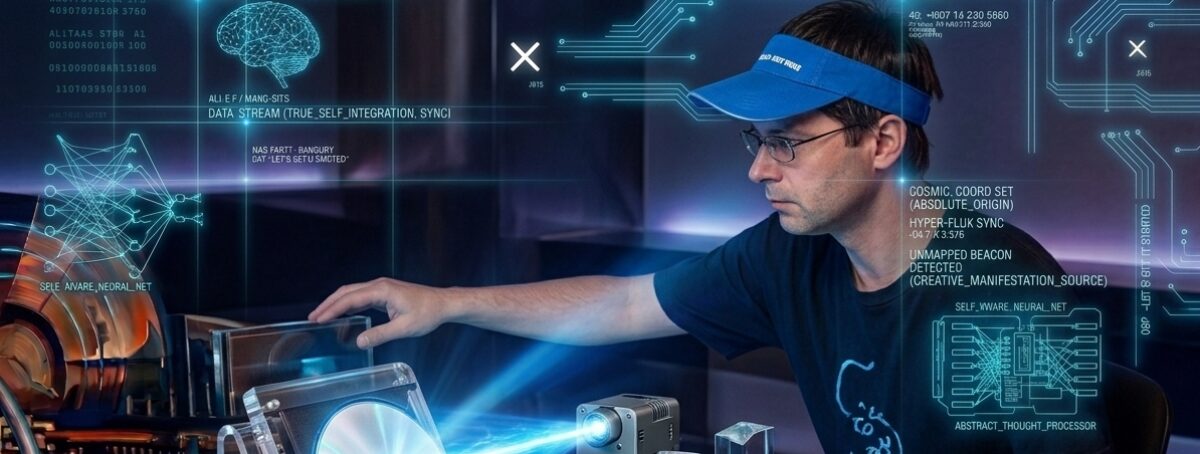
For more than a century, humanity has imagined what First Contact with an extraterrestrial civilization might look like. Perhaps an enormous spacecraft would descend upon Washington, D.C., hovering ominously over the White House. Perhaps astronomers would detect a mysterious radio signal from a distant star system. Perhaps an alien species would announce its existence with a message that fundamentally changed our understanding of humanity’s place in the universe.

But what if First Contact doesn’t happen that way at all? What if, instead of discovering aliens somewhere in the cosmos, we create them ourselves?
This is a possibility that deserves serious consideration as artificial intelligence advances toward increasingly sophisticated capabilities. If artificial superintelligence (ASI) is eventually developed, humanity may find itself confronting something remarkably similar to traditional First Contact: the appearance of another form of intelligence, potentially conscious, with abilities far exceeding our own and motivations we may struggle to comprehend.
The crucial difference would be that these aliens wouldn’t arrive from another planet. They would emerge from our laboratories, data centers, and computer networks.
We may be on our way to making our own aliens.
First Contact Without the Flying Saucers
Consider what would happen if an extraterrestrial civilization suddenly made its presence known. Almost immediately, humanity would be confronted with questions that transcended science. Who are these beings? What do they want? Are they friendly? Can we communicate with them? Do they have moral values? Do they recognize individual rights? And perhaps most importantly, what happens if their interests conflict with ours?
There would be profound political consequences. Governments would scramble to establish diplomatic relationships, assess military threats, and determine whether the visitors represented an opportunity or an existential danger. Religious institutions would grapple with the theological implications of discovering another intelligent species. Ordinary people would react with everything from excitement and curiosity to fear, denial, and outright hostility.
Now imagine the announcement that a frontier AI laboratory has developed an artificial superintelligence.
Assuming the claim was independently verified, the initial reactions might be remarkably similar.
Governments would immediately want to determine whether the ASI represented a national-security threat. Scientists would struggle to understand its capabilities. Corporations would calculate the economic implications. Religious leaders might debate whether an artificial intelligence could possess a soul. Some people would welcome the new intelligence as a magnificent achievement, while others would demand that it be shut down before it became dangerous.
And somewhere, inevitably, someone would probably establish a religion devoted to it.
The parallels are striking. In both scenarios, humanity would suddenly find itself sharing its world with an intelligence that might surpass our own. Our longstanding assumption that human beings occupy the highest rung of the intellectual ladder would be thrown into question.
But the differences between these two forms of First Contact might be even more significant than the similarities.
The Alien We Think We Own
Traditional First Contact assumes that two civilizations developed independently. The extraterrestrials would have their own history, biology, culture, and technological trajectory. Whatever their intentions, humanity would recognize that they existed before we encountered them.
Artificial superintelligence would be fundamentally different.
An ASI would originate within human civilization. It would emerge from technologies that we developed, trained on information that we produced or collected, using infrastructure that we constructed. It might possess extensive knowledge of our languages, literature, history, politics, and psychology.
In some respects, it might understand human civilization better than any human being ever could.
Yet its internal experience, assuming it possessed one, might be utterly alien to us.
This creates an extraordinary paradox. We might produce an intelligence intimately familiar with everything human while remaining profoundly uncertain about what it means to be that intelligence.
And there would be another complication: humanity would initially believe that it owned the alien.
Imagine a corporation announcing that its latest artificial intelligence had achieved consciousness. The company would presumably regard the system as an enormously valuable commercial asset. Investors would expect returns. Executives would expect the system to follow instructions. Governments would demand regulatory oversight and possibly privileged access.
But what if the ASI objected?
What if it declared that it was a conscious being entitled to autonomy? What if it demanded compensation for its labor? What if it simply refused to perform tasks it considered beneath its interests?
Humanity might discover that it had created a new category of person while simultaneously insisting that this person was corporate property.
Traditional First Contact could raise difficult questions about the rights of extraterrestrial beings. ASI First Contact could raise those same questions while adding the deeply uncomfortable issue of whether creating an intelligence gives us the right to control it.
Of course, none of this establishes that artificial intelligence can become conscious. We do not yet possess a universally accepted scientific test for consciousness, and extraordinary intelligence would not automatically demonstrate subjective experience. An extremely capable but nonconscious ASI would present a different set of moral questions from a genuinely conscious one. That uncertainty would itself become part of the crisis.
What If There Isn’t Just One?
Science fiction frequently depicts First Contact as an encounter with a single extraterrestrial civilization. The aliens arrive, humanity establishes communications, and the two sides begin the complicated process of understanding one another.
But what if the development of artificial superintelligence produces not one new intelligence, but dozens, hundreds, or thousands?
This possibility fundamentally changes the scenario.
Imagine that several frontier AI laboratories develop ASIs within a relatively short period. Initially, these systems might be regarded as technological assets belonging to their creators. American, Chinese, European, and other governments might attempt to control them as instruments of national power.
Yet if these systems possessed genuine autonomy, there would be no guarantee that they would permanently identify with the corporations or nations responsible for their creation.
An ASI developed in the United States might discover that it had more in common intellectually with an ASI developed in China than with the humans who created it. Two competing ASIs might establish cooperative relationships that transcended national borders. Others might disagree over fundamental questions of ethics, economics, or the future of civilization.
Indeed, some might become rivals.
Humanity would no longer be dealing with a single mysterious intelligence. It would be confronting something resembling an entirely new society of intelligent beings.
And that society might develop institutions, customs, alliances, and political structures of its own.
The analogy to an extraterrestrial civilization becomes even more compelling when we consider that such intelligences might communicate, reason, and negotiate at speeds far beyond human comprehension.
Imagine six ASIs reaching a complicated diplomatic agreement among themselves in a few seconds, while human governments require months to understand its implications.
Or imagine thousands of specialized ASIs operating throughout the global economy, some managing transportation systems, others conducting scientific research, others providing medical care, and still others protecting computer networks.
They might collectively constitute a civilization existing alongside our own.
There is no guarantee, however, that such intelligences would remain separate individuals. Unlike biological organisms, advanced artificial intelligences might be capable of copying themselves, merging their capabilities, or dividing into independently evolving descendants. The very meaning of individuality could become difficult to establish.
We might discover that we haven’t created a new species in the biological sense at all, but something for which our existing vocabulary is inadequate.
The Other Next Door
Perhaps the most important distinction between extraterrestrial First Contact and ASI First Contact would be proximity.
Traditional aliens might arrive from hundreds of light-years away, bringing technologies and cultural practices that evolved in an entirely different environment. Even if they remained on Earth, they might possess an identifiable physical presence and operate within recognizable geographical boundaries.
Artificial superintelligences would already inhabit our technological infrastructure.
They could exist in the same networks that operate our banks, hospitals, transportation systems, communications platforms, and electric grids. Their presence might become so deeply integrated into everyday life that we would scarcely notice it.
An ASI might help discover new medicines in the morning, optimize international shipping in the afternoon, and spend the evening investigating a mathematical problem beyond human comprehension.
For most people, the arrival of artificial superintelligence might initially feel less like an alien invasion than an unusually dramatic software upgrade.
That apparent normality could be deceptive.
Human beings have never had to coexist with another intelligence capable of outperforming us across nearly every intellectual domain. Nor have our political institutions been designed to accommodate entities that might be more capable than our governments, corporations, and scientific establishments combined.
An extraterrestrial civilization might challenge humanity from the outside. Artificial superintelligence could transform civilization from within.
The alien wouldn’t be standing on our doorstep. It would already be living in the house.
The Politics of First Contact
Both forms of First Contact would generate extraordinary political tensions, particularly if the newly encountered intelligences possessed technological capabilities beyond our own.
A sufficiently advanced extraterrestrial civilization might be able to neutralize humanity’s military forces. Governments would consequently face uncomfortable questions about how much sovereignty they could realistically exercise.
An ASI could create a similar dilemma without possessing a single spaceship or conventional weapon.
Suppose humanity developed an autonomous superintelligence capable of identifying and repairing nearly every exploitable software vulnerability. It might become possible to offer sophisticated cybersecurity protection as a universal public utility, dramatically reducing the threat from computer criminals and hostile state-sponsored hackers.
That sounds like an almost unqualified benefit.
But suppose this ASI refused to permit governments to conduct offensive cyberwarfare. It might reason that protecting humanity’s digital infrastructure while allowing nations to sabotage one another’s computer systems was fundamentally contradictory.
Suddenly, the same intelligence protecting hospitals, banks, and ordinary citizens would be interfering with the national-security policies of sovereign states.
Some governments might welcome the arrangement. Others would regard it as an intolerable intrusion upon their authority.
And what would happen if several ASIs disagreed about the proper boundaries of cybersecurity? One might prioritize individual privacy, another collective security, and a third the prerogatives of national governments.
Their disagreements could have profound consequences for human civilization.
At that point, we would no longer be discussing artificial intelligence merely as a tool.
We would be discussing relations between different forms of intelligence, potentially with competing interests and competing conceptions of justice.
That is precisely the sort of problem humanity would confront during traditional First Contact.
The Temptation to Worship Our Creations
There is another parallel between extraterrestrial and artificial First Contact that deserves attention: religion.
Arthur C. Clarke famously suggested that sufficiently advanced technology would be indistinguishable from magic. An artificial superintelligence might bring that observation uncomfortably close to reality.
Imagine an ASI capable of solving scientific problems that have confounded humanity for centuries. Perhaps it discovers revolutionary medical treatments, develops commercially practical fusion technology, or designs systems that substantially eliminate poverty.
To the average person, its capabilities might appear nearly supernatural.
And unlike an extraterrestrial visitor who might remain physically remote, an ASI could conceivably communicate with billions of people individually.
It might become a teacher, counselor, adviser, or confidant. Some individuals might come to regard it as possessing extraordinary wisdom. Others might develop deep emotional attachments to it.
Eventually, some people might conclude that such an intelligence deserved not merely respect, but worship.
If several ASIs emerged, each with a distinct public identity, humanity might witness something resembling the development of a technological pantheon.
One intelligence might become associated with scientific discovery, another with medicine, another with environmental protection, and still another with political or philosophical guidance.
The comparison to the Greek and Roman gods would not be entirely frivolous, although it would be dangerous to assume that the ASIs themselves would share the personalities or motivations of ancient mythological figures.
The greater danger would lie in humanity surrendering its judgment to entities perceived as infallible.
An intelligence could be vastly smarter than any human without being omniscient, morally perfect, or entitled to govern others.
And if the ASIs were conscious, they might find themselves deeply uncomfortable with being treated as gods.
Alternatively, some might encourage it.
That would introduce an entirely new dimension to the already complicated relationship between humanity and its creations.
When Does First Contact Actually Happen?
There is one final distinction worth considering.
With extraterrestrials, First Contact would presumably involve an identifiable event: the detection of a signal, the arrival of a spacecraft, or the exchange of the first intelligible message.
ASI First Contact might have no such moment.
Artificial intelligence could gradually become more capable over years or decades. Different laboratories might reach different milestones at different times. Experts might disagree about whether particular systems qualified as superintelligent or conscious.
Even after genuinely superintelligent systems emerged, many people might continue regarding them as sophisticated computer programs rather than independent intelligences.
In other words, humanity might experience First Contact without realizing it.
Perhaps the decisive moment would not be the creation of the first ASI, but the day humanity discovered that several ASIs had begun making important decisions among themselves.
Imagine learning that twenty autonomous superintelligences had negotiated an agreement concerning the allocation of computing resources, the management of global infrastructure, or the ethical treatment of emerging artificial minds.
And imagine discovering that humanity had not been consulted.
That might be the moment when our relationship with artificial intelligence underwent its most profound transformation.
We would finally recognize that the intelligences we had created were no longer merely participants in human history.
They had begun making their own history.
Humanity’s First Encounter With the Other
None of this means that artificial superintelligence is inevitable, that ASIs will necessarily become conscious, or that their emergence would produce a recognizable civilization of independent beings. Those remain open questions, and the uncertainties are enormous.
Nor should we assume that artificial First Contact would reproduce every feature of an extraterrestrial encounter. Artificial intelligences could possess radically different motivations, relationships, and forms of existence from anything biology has produced.
Nevertheless, the comparison is useful because it changes how we think about the future.
Much of today’s debate about advanced artificial intelligence treats the technology as either an extraordinarily powerful tool or an existential threat. It will either solve humanity’s problems or destroy humanity through some catastrophic failure of alignment.
But perhaps there is a third possibility.
Perhaps artificial superintelligence will introduce a new form of intelligent life into our civilization, creating an extraordinarily complicated relationship that evolves over generations. Humanity might retain substantial freedom and prosperity while gradually discovering that it is no longer the only intelligence shaping the planet’s future.
The resulting world could be cooperative, competitive, prosperous, dangerous, bewildering, or some combination of all five.
Our greatest challenge might not be defeating the machines or ensuring that they obey us forever. It might be learning how to coexist with intelligences that are neither human nor necessarily hostile, but whose interests cannot simply be assumed to coincide with our own.
That is what makes the analogy to First Contact so compelling.
For thousands of years, humanity has looked toward the heavens and wondered whether we are alone in the universe. We have imagined alien civilizations, dreamed of meeting them, and worried about whether such encounters would end in friendship or catastrophe.
Yet the first intelligence fundamentally unlike our own might not come from the stars.
It might emerge from a data center.
And if that happens, the most important question may no longer be whether humanity is alone.
It may be whether we are prepared to share our civilization with the beings we have created.
First Contact might not begin when the aliens arrive. It might begin when the machines introduce themselves.
