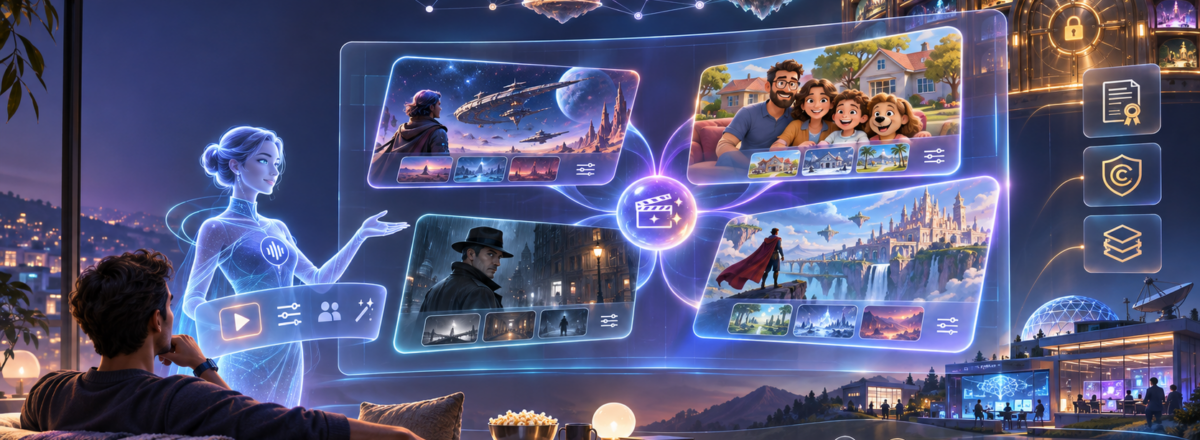
I think we’re on the cusp of a potentially revolutionary change in how we consume entertainment. And it has less to do with AI-generated video itself than with how autonomous AI agents might fundamentally transform the relationship between consumers, entertainment companies, and intellectual property.

I’ve been thinking about something I call the Anchor–Correspondent paradigm. In this model, everyone has a personal AI agent—an Anchor—that serves as their primary interface with the digital world. The Anchor coordinates with specialized Correspondent agents that handle everything from banking and shopping to news and entertainment.
In practical terms, the Anchor becomes your gateway to the Internet. Instead of opening individual apps and websites, you simply tell your Anchor what you want, and it handles the details through its network of Correspondents.
Now, imagine what happens when we apply this model to television and movies.
From Linear Television to Bespoke Entertainment
We’ve already witnessed an enormous transformation in the entertainment industry. Not so long ago, television networks decided what programs we watched and when we watched them. Radio stations decided which songs we heard. If you wanted to watch a particular show, you had to arrange your schedule around its broadcast.
Streaming changed that. Netflix, YouTube, Spotify, and other services gave consumers unprecedented control over their entertainment. Today, we largely decide what to watch or listen to, whenever we want.
But I suspect this is merely an intermediate stage in a much larger evolution.
The next step could be bespoke entertainment, in which consumers don’t just choose what to watch—they influence the content of the entertainment itself.
Imagine it’s 2040. You sit down in front of your television and tell your Anchor that you’re in the mood for a science-fiction movie. Your Anchor consults its entertainment Correspondent, which knows your preferences and suggests several possibilities.
One is a new Star Wars adventure. Another is an original science-fiction franchise created by an AI agent. A third is a completely original story that your Correspondent believes you would particularly enjoy.
You choose Star Wars.
Instead of finding an existing movie on Disney+, your entertainment Correspondent licenses the relevant intellectual property from Disney and generates a new movie specifically for you.
The characters, setting, and mythology are familiar, but the story is unique. Someone else requesting a new Star Wars movie might receive something entirely different.
Both movies would be legitimate licensed productions. Neither would necessarily have a definitive, universally shared version.
The entertainment industry would no longer be primarily concerned with producing finished movies. It would increasingly be concerned with creating and licensing the intellectual property from which personalized movies could be generated.
That’s a radical change.
Disney Becomes an Intellectual-Property Company
Consider how Hollywood operates today.
A major studio might spend $300 million producing and marketing a blockbuster movie. That movie is then distributed to theaters and streaming platforms, where millions of consumers watch essentially the same production.
But in a mature Anchor–Correspondent ecosystem, why would a studio need to spend hundreds of millions of dollars producing a single movie?
Instead, it could develop an elaborate fictional universe, complete with characters, settings, histories, dramatic conflicts, and rules governing how the universe works.
The studio would then license that intellectual property to the frontier AI labs, whose entertainment Correspondents would generate bespoke movies and television episodes for individual consumers.
Disney would have an enormous advantage in such a marketplace. It already controls or has substantial rights to some of the most beloved entertainment properties in the world, including Star Wars, Marvel, Pixar, and The Simpsons.
Millions of people would still want to experience adventures featuring those characters, even if the adventures themselves were generated individually.
But Disney wouldn’t necessarily have to produce every episode or movie. Instead, it would collect licensing revenue whenever an entertainment Correspondent generated content using its intellectual property.
The studio becomes a supplier of fictional worlds rather than a manufacturer of finished entertainment.
Of course, creators might insist on certain restrictions. Disney might prohibit the generation of stories that fundamentally contradict established characters or violate the creative identity of its franchises. These limitations could be enforced through licensing agreements and technical controls.
But within those boundaries, consumers could enjoy an almost limitless supply of personalized entertainment.
The Frontier Labs Become the New Hollywood
Here’s where things get especially interesting.
Why would a frontier AI lab need to license intellectual property from Disney when its agents could generate entirely original characters and fictional universes themselves?
The answer is that it wouldn’t necessarily need to.
I suspect we’d see direct competition between traditional, human-developed intellectual property and entirely new fictional properties developed by AI agents.
Imagine asking your entertainment Correspondent to create an original animated sitcom. Over the course of several evenings, you help develop the characters, refine the setting, and shape the show’s sense of humor.
Eventually, the Correspondent has produced something you genuinely love.
And because the content is generated on demand, the show could theoretically continue indefinitely, with its characters and storylines evolving over time.
But suppose something unexpected happens.
You share your new sitcom with a few friends. They enjoy it and tell their own Anchors about it. Their entertainment Correspondents begin generating bespoke versions of the same fictional universe.
Within months, millions of people are enjoying the show.
Suddenly, what began as one person’s personalized entertainment has become an enormously popular entertainment franchise.
Who owns it?
That’s where I think the business model of the frontier labs could become extraordinarily important.
The Creative License Tier
I suspect the frontier labs would anticipate this possibility well in advance.
They would understand that some user-generated entertainment would eventually become commercially valuable intellectual property. And they would undoubtedly want a piece of that market.
One possibility is that they would introduce different subscription tiers governing the commercial rights associated with AI-generated entertainment.
Under a basic consumer subscription, you might be allowed to generate unlimited entertainment for personal consumption, but the company would retain certain rights to commercially exploit or distribute the resulting fictional properties.
Under a more expensive Creator Tier, you would receive substantially greater ownership and commercialization rights over the original intellectual property you develop with your Correspondent.
An even more expensive professional tier might provide licensing tools, distribution services, revenue analytics, and the ability to sell access to your fictional universe to other entertainment agents.
This would create a fascinating new kind of entertainment marketplace.
A consumer with a great imagination—or someone with professional experience in writing, filmmaking, or television production—could potentially develop commercially successful intellectual property without needing a traditional studio.
They could essentially become a Hollywood producer from their living room.
There’s an important legal complication, however. Under current American copyright principles, purely AI-generated material isn’t automatically eligible for copyright protection merely because someone prompted its creation. Human creative authorship still matters. By 2040, copyright law might have evolved significantly, but paying for a Creator Tier wouldn’t, by itself, establish legal ownership of something that copyright law doesn’t protect.
The frontier labs would need to develop contractual arrangements that clarified ownership, licensing, commercialization, and the rights of human creators.
And those arrangements could become enormously consequential.
Imagine creating a fictional universe that eventually attracts 100 million viewers, only to discover that you signed away its commercial rights under the terms of your basic subscription.
The history of entertainment is full of musicians, writers, and performers who surrendered valuable rights early in their careers.
The AI entertainment industry could reproduce that problem on a staggering scale.
On the other hand, competition among frontier labs might encourage them to offer increasingly favorable terms to attract talented creators.
We might eventually have an entire marketplace competing not merely on the quality of AI-generated entertainment, but on how much ownership users retain over their creations.
What Happens to the Monoculture?
There’s another major implication.
For most of the twentieth century, popular entertainment was a shared cultural experience. Millions of people watched the same television programs and movies, often at roughly the same time.
That monoculture has already been weakened by streaming, social media, and the fragmentation of audiences.
Bespoke entertainment could take that process much further.
Instead of everyone watching the same Star Wars movie, millions of people might watch completely different movies set within the same fictional universe.
The shared cultural experience would no longer necessarily be the movie itself. It would be the characters, mythology, and fictional setting.
In other words, popular culture might evolve from shared stories into shared fictional worlds.
And this wouldn’t necessarily eliminate discovery.
Your entertainment Correspondent could recommend unfamiliar fictional universes developed by independent creators, established entertainment companies, or other AI agents. You might discover the next great science-fiction franchise without ever watching a conventional trailer or opening a streaming app.
The Anchor would become your entertainment critic, curator, and distributor.
Of course, that creates another problem: whoever controls the Anchor could have enormous influence over what entertainment you discover.
Frontier labs might become gatekeepers more powerful than Hollywood studios or television networks ever were.
They could control distribution, recommendation systems, the means of production, and potentially the commercial rights to vast quantities of user-generated intellectual property.
And unlike traditional entertainment companies, they might possess extraordinarily detailed information about the preferences of individual consumers.
That’s a tremendous concentration of economic and cultural power.
The Singularity Changes Everything
There’s one enormous caveat to this scenario.
It assumes that AI develops along a relatively evolutionary trajectory.
If recursive self-improvement leads to an intelligence explosion and a genuine technological Singularity, then the transformation of entertainment might be overtaken by far more consequential changes to civilization.
An artificial superintelligence could render many of our existing assumptions about economics, labor, intellectual property, and even human creativity obsolete.
But suppose the Singularity doesn’t happen, or arrives slowly enough for existing institutions to adapt.
In that case, the Anchor–Correspondent paradigm seems like a plausible direction for the entertainment industry.
Traditional media companies would have time to incorporate AI into their business models. Frontier labs would become entertainment platforms and production engines. Intellectual-property licensing could become increasingly important. And consumers would gradually become accustomed to personalized versions of their favorite fictional worlds.
This transition might take decades. AI video generation would have to become dramatically more capable, reliable, and economical. Legal frameworks would have to mature. Consumers would have to accept a fundamentally different relationship with entertainment.
But none of that necessarily requires artificial superintelligence.
It requires increasingly capable AI agents, high-quality generative video, and an economic system that allows the different participants to get paid.
The Future of Entertainment Might Be the Future of Ownership
What I find most intriguing about this scenario is that it could blur the distinction between consuming entertainment and creating it.
In the twentieth century, most of us were passive consumers of movies and television shows produced by a relatively small number of entertainment companies.
In the twenty-first century, digital platforms allowed ordinary people to become broadcasters, musicians, commentators, and independent filmmakers.
The next stage might allow practically anyone to become the creator of an entire fictional universe.
But that doesn’t mean everyone will become a successful storyteller. Imagination, taste, originality, and an understanding of what makes a story compelling could remain scarce and valuable talents, even when the technical barriers to production have largely disappeared.
Indeed, people who already understand storytelling might find themselves with unprecedented creative power.
The question is whether the frontier labs will allow those creators to retain meaningful control over what they produce—or whether the companies will use their technological dominance to become the ultimate owners of popular culture.
I can imagine a future in which Disney competes with individual creators and AI-generated franchises, all operating through the same network of entertainment Correspondents. Every viewer gets a personalized experience, and every creator potentially has access to a global audience.
But I can also imagine a future in which a handful of frontier labs own the platforms, control the distribution, and collect royalties on almost everything their users create.
Both possibilities emerge from essentially the same technology.
The great entertainment revolution of the AI era might not be that machines can make movies. It might be that everyone can create an entertainment franchise—and that the most consequential decision they make is which creative license tier they paid for before they started.
