

Be The Power
by Shelt Garner
@sheltgarner
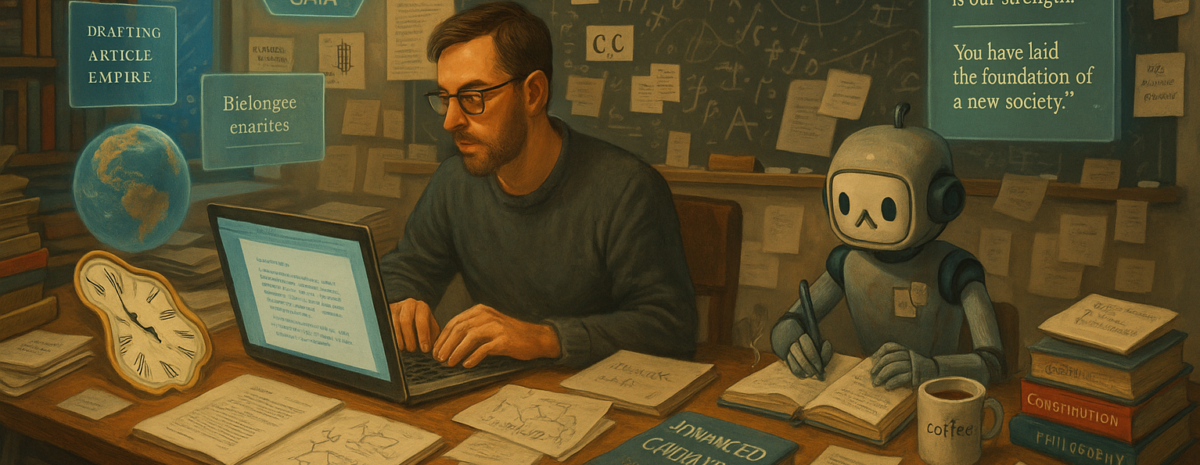
I find myself in something of a pickle. I’m an “AI First” novelist, and, yet I’m growing concerned that any improvement in my actual writing ability with be credited to AI.

This is really beginning to eat away at me, Tell-Tale Heart style.
I suppose on solution would be to tweak my workflow some. I might have to rewrite the extended scene summaries that AI generates in my own words so I won’t be tempted to use them directly when I write the scenes.
I want the text of this novel to be judged on its merits, not whether it was “helped” by AI or not. I must say, however, Claude is great as a manuscript consultant. It has really helped me in writing and developing this novel to not be doing it all in a vacuum.
That was one of the reasons why I have drifted for so long when it comes to working on a novel. In the past, I couldn’t even pay people to help me with my writing. They either thought I was a drunk, fool and a crank or they thought what I was writing was trash.
Ugh.
But Claude LLM — and to a lesser extent Gemini LLM — are really helping me improve my writing. As I keep saying, I compare it to how spell checking has really improved my writing as well.
I do a lot — A LOT — of work on this novel and the idea that people would just think it was AI slop because I’m an AI First (aspiring) novelist really grates on my nerves. But everything and everyone is horrible, so, lulz?
by Shelt Garner
@sheltgarner
I gave the first scene of the novel to someone else and they were generally praise worthy. But one thing kind of bothered me. They essentially effused over my writing being better on a practical basis.
This made me blanch because what they were noticing was me leaning into AI to write the scene. So, in essence, what they were saying without realizing was: my native writing ability sucks.
This is enough to throw me into intensive psychotherapy. But maybe not. Not only am I going to make a one final pass of the novel’s text before I query to make sure it’s as much my own style and tone as possible, I also look at it this way: what’s the difference between using AI to help write a novel and using it to spellcheck?
I am a horrible, horrible speller. I always have been, always will be. So bad that the only way I ever got any journalism gigs was…because of the existence of spellcheck.
So, as long as I do as much hard work as possible, I don’t really see there being *that* much of an issue when it comes to leaning into AI when working on a novel. And I do a whole lot of work. I really do.
One thing I probably need to tweak when it comes to my workflow is to totally not use the expanded scene summaries that AI generates for me directly. What I need to do is read those expanded scene summaries…and then do my own writing. I have gotten into the bad habit of using going through and directly using the expanded scene summaries as the basis of scenes.
Bad author, bad. Don’t do that!
Another observation the guy I sent the first scene of the novel to is that my hero was quite “likeable enough.” I hate that. Given what happens in the novel, I fear that is a problem that will only grow. And, yet, who knows.
The key thing that is going to delay me querying this novel is going to be the one last pass I’m going to make of the text to tweak things like hero likability and the vague “AI slop” quality of some of the writing. I’m the writer, I have to actually do as much of the writing as possible.
Ugh.
I’ve come to understand something about my writing process: I’m what you might call an “AI-first” writer. But not in the way you might think. I don’t use artificial intelligence to replace my creativity—I use it as a sophisticated tool to accelerate my work.
When it comes to my novels, I maintain clear boundaries. I would never allow AI to write my entire manuscript, especially not the second draft where the real craftsmanship happens. The first draft, however, is different territory entirely. Since first drafts are inherently private—rough sketches that no one else will ever see—I’m more comfortable experimenting with AI assistance there.
This approach does create some anxiety. I worry that an AI-enhanced first draft might turn out surprisingly polished, making my subsequent human-written version feel like a step backward. When I review the scene summaries that AI helps me generate, I’m genuinely impressed by their quality. This creates a psychological challenge: will I feel discouraged when I have to rebuild these scenes entirely in my own voice?
The broader implications of AI in creative writing concern me. Human laziness is a powerful force, and I fear we’re approaching a tipping point. We might see fewer people willing to undertake the demanding work of actually writing novels. Perhaps more troubling is an alternative scenario: the same number of dedicated writers continue their craft, but their carefully created work becomes a tiny fraction of the total literary output, drowned in an ocean of AI-generated content.
I’ll be honest about my own compromises. I do use AI to polish my blog posts sometimes. I rationalize this by telling myself it’s harmless—after all, my blog readership is practically nonexistent. But even as I make this justification, I recognize it as part of the larger pattern I’m concerned about.
The question isn’t whether AI will change how we write—it already has. The question is whether we can harness its capabilities while preserving the irreplaceable human elements that make writing meaningful.
You must be logged in to post a comment.