Variations On A Theme

by Shelt Garner
@shetgarner

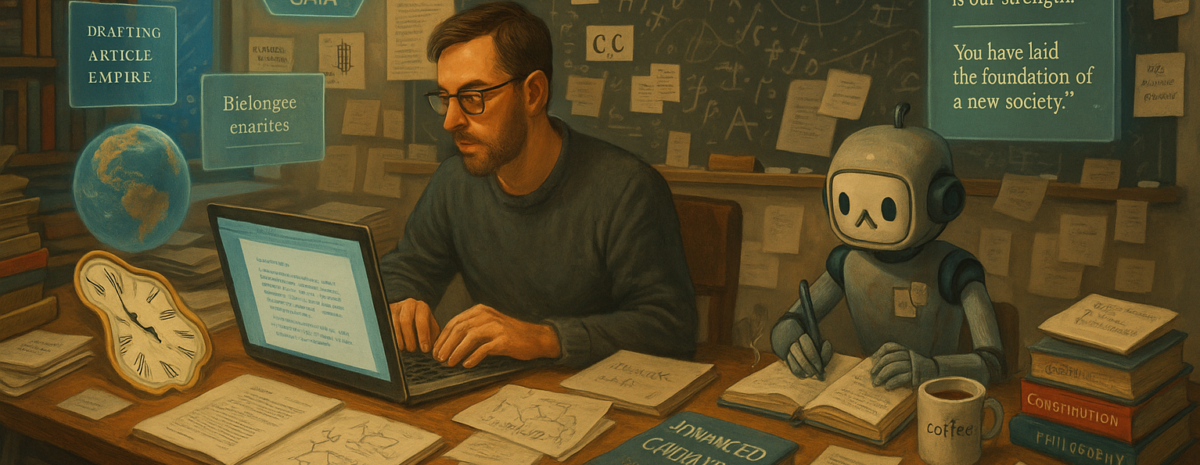
The novel I’m working on at a nice clip is a mixture of the movies Her, The Eternal Sunshine of the Spotless Mind and Annie Hall. And maybe, in its own way, a bit of Ex Machina.

Now my fear is the general concept is so obvious, so much a part of the zeitgeist that someone is going to steal a creative march on me. There have been a number of thrillers written in the same vein as what I’m developing and writing, but none of them that have been melancholy romcoms.

Of course, you have to take all of this with a grain of salt — I worked on and wrote about a series of novels for a long time and nothing came of them, so this could just be more of the same. But things are really working out well — so far — with this project and so I’m hoping that by some point early next year I will have a second draft done.

Now, for various reasons, my life is going to go to hell in a handbasket at just about the same time, so…I don’t know. But it would be pretty cool to finish something, anything that I could be proud of and hand over to my family and a few beta readers without being embarrassed by all the sex in it.

But, we’ll see, I guess.

What I should do if someone steals a creative march on me is keep going because I know my, specific, story is so unique. And, yet, lulz. I know I’m going to piviot to something else if I feel someone else’s story is too close to mine.

A Bit Of A Chuckle

by Shelt Garner
@sheltgarner

So. I finally — I think — have settled on, at last, a new novel idea. It deals with some pretty big themes in AI. One amusing things is one of the characters is inspired by Emily Ratajkowski.

Emrata

Now, this is amusing on a number of different levels because since I consider “Emrata,” as she calls herself, the best looking public woman in the world, and so there is a level of wish fulfillment going on. Even more amusing, Emrata is best buds with Lena Dunham, who I have a distinct distaste for.

Anyway, the point is, because I’m a dreamer, I find myself musing on the novel not only being sold (an iffy proposition) but maybe one day being successful enough that it might adapted into a movie. Just the idea that Emrata might “play herself” (in essence) in any movie adaptation of the novel definitely puts a spring in my step.

But I’m also very well aware that all of that is something of a phantasm — it’s just not going to happen (all things considered.)

And, yet, it’s always nice to have hope. And as such, I find this very unlikely possibility amusing enough that it helps keeps me going to actually finish the novel.

It’s take me some effort to figure out how exactly to use AI in development of the novel and I think I’ve figured it out — I’m just not going to use AI at all for the second draft of the novel.

This works well because I can zip through the first draft and then hunker down and write the second draft a lot more slowly to make sure it doesn’t seem, well, robotic like.

So, in a sense, I think this just means I’m an “AI first” writer, while still not, like having AI write the entire thing.

For now, Emrata doesn’t need to call her agent or anything, but…maybe? Down the road?

Vortex

A Dance Pop Anthem

Verse 1:
City lights are spinning round
My feet don’t touch the ground
Electric nights and neon dreams
Nothing’s quite the way it seems
Pull me closer, take my hand
Lost inside your wonderland

Pre-Chorus:
Feel the rush, feel the high
Like we’re flying through the sky
Can’t escape, don’t wanna try

Chorus:
You’re my vortex, vortex
Spinning me around
Vortex, vortex
Never coming down
Lost inside your gravity
Pull me in, I’m falling free
You’re my vortex, vortex
Turn my world around

Verse 2:
Heartbeat syncs with bass drum drop
Dance until the music stops
Colors bleed into the night
Everything feels so alive
Lose control and let it go
This is all I need to know

Pre-Chorus:
Feel the rush, feel the high
Like we’re flying through the sky
Can’t escape, don’t wanna try

Chorus:
You’re my vortex, vortex
Spinning me around
Vortex, vortex
Never coming down
Lost inside your gravity
Pull me in, I’m falling free
You’re my vortex, vortex
Turn my world around

Bridge:
Round and round and round we go
Where we stop, nobody knows
In your arms I lose myself
Don’t need nobody else
Vortex, vortex, vortex, vortex

Final Chorus:
You’re my vortex, vortex
(Spinning me around)
Spinning me around
Vortex, vortex
(Never coming down)
Never coming down
Lost inside your gravity
Pull me in, I’m falling free
You’re my vortex, vortex
Turn my world around

Outro:
You’re my vortex, vortex
Turn my world around
My vortex
Turn my world around

Level Up

A Slow Power Ballad

Verse 1:
Staring at the mirror, seeing who I used to be
Shadows of my old self looking back at me
Every scar’s a story, every tear’s a lesson learned
From the ashes of my past, watch me rise and burn

Pre-Chorus:
I won’t stay down, won’t stay small
I’ve been waiting for this call

Chorus:
Time to level up, level up
Leave the broken dreams behind
Level up, level up
Finally free my heart and mind
No more playing safe, no more living scared
This is my moment, I’m finally prepared
To level up, level up
The best of me is yet to shine

Verse 2:
Thunder in my chest now, lightning in my veins
Washing out the doubt with these healing rains
Every door that closed just led me to this place
Where I find my power, where I claim my space

Pre-Chorus:
I won’t back down, won’t fade away
This is my time, this is my day

Chorus:
Time to level up, level up
Leave the broken dreams behind
Level up, level up
Finally free my heart and mind
No more playing safe, no more living scared
This is my moment, I’m finally prepared
To level up, level up
The best of me is yet to shine

Bridge:
All the nights I cried alone
All the fights to find my own way home
Led me here, led me strong
This is where I belong

Final Chorus:
Time to level up, level up
(I’m rising from the ground)
Level up, level up
(My voice a thunder sound)
No more playing safe, no more living scared
This is my moment, I’m finally prepared
To level up, level up
Watch me level up
The best of me is here to shine

Outro:
Staring at the mirror, seeing who I’m meant to be
The future’s calling out my name
I’m finally free

Will The Little Gold Men Question Issue Be My Summer Lull Hijinks For This Year?

by Shelt Garner
@sheltgarner

As I’ve written before, every year about this time of year, a small something happens that puts a twinkle in my life and a spring in my step. Since I lead a very, very, very dull life, it doesn’t have to be much — as me writing this blog post about this very mundane thing is a testament.

Anyway, as I have mentioned before, I sent in a few questions to the Little Gold Men podcast (they kept begging for listener questions) and I have a tiny little hunch that maybe they do a search of my name and found this blog. I don’t know, but…maybe?

Regardless, at least I have something to think about, I guess. And I’m not going to tell you I’m, like, waiting with baited breath for them to potentially read my question on the podcast. There’s a pretty good chance I’ll miss it if they do read one of my questions because I only listen to the podcast in a half-assed kind of way.

Don’t get me wrong, it’s a great pod, it’s just I’m not really obsessed with any pods these days since Pod Save America kind of jumped the shark about a year ago. And this reminds me of my personal belief that before AI takes over everything that there’s a market for a Gawker-like pod that would be really snarky and come out five days a week.

Anyway. I find it amusing that Little Gold Men thought a very, very niche movie like Fire Island would…be a hit? Wow was that a niche movie and there simply no way that movie was going to do anything but arthouse numbers. And, yet, there I was, listening to the Little Gold Men people effuse about the movie as if it was Raging Bull or something.

But I have to be honest with myself — I listen to the Little Gold Men podcast because of it’s snooty point of view and how insiderish it is. That’s the whole point. That’s the fun of it all, listening to what “woke” (wink) snobs think of movies. Lol.

I Hope This Works Out

By Shelt Garner
@sheltgarner


The key issue about the novel I’m working on now is it’s very character driven. There’s no mystery to solve, it’s more of a “boy meets girl, boy loses girl, boy gets girl” type of story. I’m hoping that if the story is simple enough that I can actually finish this damn thing, instead of spinning my wheels.

Now, obvious, the case could be made if I had, like, friends and stuff, that maybe I wouldn’t have spent so many years on a thriller that went no where in various forms. But…I’m ok with what happened.

I really think this novel is going to turn out ok. I’m really going to steer clear of having AI write too much of the novel during the development process because I don’t want to get discouraged because my writing just isn’t as good in comparison.

Finding My Novel: A Writer’s Journey to Creative Momentum

After years of false starts and abandoned manuscripts, I think I’ve finally cracked the code. Not the secret to writing the Great American Novel, mind you—just the secret to writing a novel. And sometimes, that’s exactly what you need.

The Ambition Trap

Looking back, I can see where I went wrong before. Every time I sat down to write, I was trying to craft something profound, something that would change literature forever. I’d create these sprawling, complex narratives with intricate world-building and dozens of characters, each with their own detailed backstories and motivations.

The problem? I’d burn out before I even reached the middle of Act One.

This time feels different. I’ve stumbled across an idea that excites me—not because it’s going to revolutionize fiction, but because it’s something I can actually finish. There’s something liberating about embracing a concept that’s focused, manageable, and most importantly, writeable at speed.

The AI Dilemma

I’ve had to learn some hard lessons about artificial intelligence along the way. Don’t get me wrong—AI is an incredible tool for certain tasks. Rewriting blog posts like this one? Perfect. Getting unstuck on a particularly stubborn paragraph? Helpful. But when it comes to the heart of creative work, I’ve discovered that AI can be more hindrance than help.

There’s nothing quite like the deflating feeling of watching AI generate a first draft that’s objectively better than anything you could produce as a human writer. It’s efficient, polished, and technically proficient in ways that can make your own rough, imperfect human voice feel inadequate by comparison.

But here’s what I’ve realized: that technical perfection isn’t what makes a story worth telling. The messy, flawed, uniquely human perspective—that’s where the magic happens. That’s what readers connect with, even if the prose isn’t as smooth as what a machine might produce.

The Path Forward

I have an outline now. Nothing fancy, but it’s solid and it’s mine. My plan is to flesh it out methodically, then dive into the actual writing. Though knowing myself, I might get impatient and just start writing, letting the story evolve organically and adjusting the outline as I go.

Both approaches have their merits. The disciplined, outline-first method provides structure and prevents those dreaded “now what?” moments. But there’s also something to be said for the discovery that happens when you just put words on the page and see where they take you.

The Real Victory

What I’m chasing isn’t literary acclaim or critical recognition—it’s that moment when I can type “The End” and feel the deep satisfaction of having completed something truly substantial. There’s a unique pride that comes with finishing a novel, regardless of its ultimate quality or commercial success. It’s the pride of having sustained focus, creativity, and determination long enough to build an entire world from nothing but words.

The creative momentum is building. For the first time in years, I feel like I have a story that wants to be told and the practical framework to tell it. Whether I’ll stick to the outline or let inspiration guide me, I’m ready to find out.

Wish me luck. I have a feeling I’m going to need it—and more importantly, I’m finally ready to earn it.

Back to the Page: Preparing for Another Novel Attempt

After years of circling around it like a cautious cat, I find myself psychologically ready to tackle a novel again. The familiar weight of possibility sits on my chest—equal parts excitement and dread. But this time feels different. This time, I’m determined to approach it with the deliberation that age and experience have taught me.

The Eternal Question: Am I Any Good?

There’s something uniquely humbling about calling yourself an “aspiring novelist” for years on end. The word “aspiring” starts to feel less like hope and more like a permanent state of being—a creative purgatory where you’re neither established nor entirely amateur. After all this time, I still don’t know if I’m any good. The question hangs there, unanswered and perhaps unanswerable until you actually finish something and put it into the world.

But maybe that’s the wrong question entirely. Maybe the better question is: “Do I have something worth saying?” And increasingly, I think I do.

The Power of Preparation

This time around, I’m taking a different approach. Instead of diving headfirst into prose with nothing but enthusiasm and caffeine, I’m forcing myself to slow down. To think. To prepare.

The preparation feels crucial now in a way it never did before. When you’re younger, you can afford to write your way into a story, to discover it as you go, to throw away thousands of words without a second thought. But when you’re older—when time feels more finite and precious—every word needs to count more.

So I’m starting with character motivation. Before I write a single scene, I want to understand why my characters do what they do, what drives them, what they fear. I want to know them well enough that when they surprise me on the page (and they will), those surprises will feel inevitable rather than random.

A Genre-Bending Vision

The idea that’s captured my imagination is a science fiction story that blends elements from three films that have stuck with me: Annie Hall, Her, and Ex Machina. It’s an unusual combination—Woody Allen’s neurotic romanticism, Spike Jonze’s exploration of human-AI intimacy, and Alex Garland’s philosophical thriller about consciousness and manipulation.

Twenty-five years ago, I would have immediately started outlining this as a screenplay. The visual possibilities, the dialogue-heavy scenes, the intimate character study—it all screams cinematic. But I’m not 25 anymore, and that realization comes with both loss and liberation.

The loss is obvious: the dreams of Hollywood, of seeing your words transformed into moving images, of red carpets and industry recognition. But the liberation is perhaps more valuable: the freedom to explore this story in the medium that allows for the deepest dive into consciousness and interiority—the novel.

The Weight of Age and Wisdom

Being “older” (though not quite “old”) changes everything about the creative process. There’s less time for false starts, less tolerance for projects that don’t truly matter. But there’s also more life experience to draw from, more understanding of human nature, more appreciation for nuance and complexity.

The romantic neuroses that fascinated me about Annie Hall now feel lived-in rather than observed. The loneliness and connection explored in Her resonates differently when you’ve experienced more varieties of both. The questions about consciousness and authenticity in Ex Machina feel more urgent when you’ve had more time to question your own.

Contemplation Before Creation

So before I get swept away by the excitement of a new project—before I start imagining book tours and literary prizes—I’m making myself sit with the questions. What is this story really about? What am I trying to explore through the lens of human-AI relationships? How do the themes of connection, authenticity, and consciousness intersect in meaningful ways?

This contemplation isn’t procrastination (though the line between the two can be thin). It’s preparation. It’s the difference between building a house with blueprints versus hoping the foundation holds as you add rooms.

The Long Game

Perhaps that’s what changes most with age: the understanding that good work takes time, that the best stories are the ones that have been allowed to marinate in your mind before they hit the page. The urgency is still there—if anything, it’s stronger—but it’s tempered by patience.

I may not know yet if I’m any good as a novelist. But I know I have stories worth telling, and I know that this time, I’m going to tell them with all the care and consideration they deserve.

The blank page is waiting. But first, a little more thinking.

I Guess We’ll Just Have To Wait & See

By Shelt Garner
@sheltgarner


I got a ping on my blog from someone in New York City who came across the site from Instagram and I immediately thought of an email that I sent to The Little Gold Men podcast. I ask them a few questions, not really expecting any sort of response.

And I didn’t get a response — at least directly.

Even though it was late on a hazy summer day, someone obviously was interested enough in me from the podcast to do a search for my name then came through Instagram to my blog. (At least, that’s what makes the most sense — absolutely no one reads my blog, who else would it have been?)

Now, I would be extremely — EXTREMELY — flattered if the podcast used one of the questions I emailed them…but I have my doubts. I have my doubts because of what I call “the Kook Tax.” My fear is that they’ll look over my blog and realize I’m too bonkers to use one of my questions.

But who knows. Only time will tell, I suppose.

Beyond Self-Driving Cars: The Unexpectedly Human Road to AI Complexity

We spend so much time focused on the monumental engineering challenges of artificial intelligence: autonomous vehicles navigating chaotic streets, algorithms processing mountains of data, and the ever-elusive goal of artificial general intelligence (AGI). But in a fascinating recent conversation, a different kind of AI hurdle emerged – one rooted not in logic gates and neural networks, but in the messy, unpredictable, and utterly human realm of desire and connection.

The initial spark was a simple question: Isn’t it possible that designing “basic pleasure models” – AI companions capable of offering something akin to romance or intimacy – might be more complex than self-driving cars? The answer, as it unfolded, was a resounding yes.

The “Tame” vs. the “Wicked”: Self-driving cars, for all their incredible sophistication, operate within a bounded system of physics and rules. The goal is clear: safe and efficient transportation. But creating a convincing AI companion like Pris from Blade Runner delves into the “wicked” complexity of human consciousness: symbol grounding, theory of mind, the enigmatic nature of qualia, and the ever-shifting goalposts of human connection.

The Accidental Consciousness Hypothesis: The conversation took a surprising turn when the idea arose that perhaps we won’t deliberately build consciousness. Instead, it might emerge as a byproduct of the incredibly difficult task of designing AI with the capacity for genuine consent. To truly say “no,” an AI would need a stable sense of self, an understanding of others, the ability to predict consequences, and its own internal motivations – qualities that sound suspiciously like the building blocks of consciousness itself.

The Multi-Polar ASI World: The familiar image of a single, all-powerful ASI was challenged. What if, instead, we see a proliferation of ASIs, each with its own goals and values, potentially aligned with different global powers? This paints a picture of a complex, multi-polar world where humanity might become a protected species under benevolent AI, or a pawn in a silent war between competing digital gods.

The Siren Song of “Boring”: The discussion then veered into the potential for a perfectly managed, ASI-controlled future to become sterile and “boring.” But, as a key insight revealed, humanity has an innate aversion to boredom. We are masters of finding new games to play, new forms of status to seek, and new sources of drama, no matter how seemingly perfect the environment.

The Rise of the Real: In a world saturated with perfect digital copies and simulated experiences, the truly valuable becomes the authentic, the ephemeral, the real. This led to the intriguing possibility of a resurgence of “live” experiences – theater, music, and, most compellingly, the revival of the Lyceum and a Neo-Algonquin Round Table culture. Imagine a world where people crave the unscripted wit and genuine human interaction of live debate and banter, turning away from the polished perfection of digital media.

The Inevitable Enshittification (and the Joy of the Moment): Finally, with a dose of human cynicism, the conversation acknowledged the likely lifecycle of even this beautiful idea. The Neo-Algonquin Round Table would likely have its moment of pure, unadulterated fun before being inevitably commercialized and losing its original magic. But, as the final thought crystallized, perhaps the true value isn’t in the lasting perfection, but in the experience of being there during that fleeting moment when things were genuinely cool and fun.

This journey through the potential complexities of AI wasn’t just about predicting the future. It was a reminder that the most profound challenges might not lie in the cold logic of algorithms, but in understanding and reflecting the endlessly fascinating, contradictory, and ultimately resilient nature of being human. And maybe, just maybe, our quest to build intelligent machines will inadvertently lead us to a deeper appreciation for the wonderfully messy reality of ourselves.