The Disappearing Middle: How Hollywood’s Bifurcation is Reshaping Cinema

Modern Hollywood has evolved into a landscape dominated by two distinct categories of films: massive four-quadrant blockbusters designed to appeal to global audiences, and smaller message-driven productions that prioritize social commentary. This binary division represents a fundamental shift in how the film industry approaches storytelling and audience engagement.

The Message vs. Plot Dilemma

While socially conscious filmmaking has always existed, contemporary cinema often struggles to balance thematic messaging with compelling narrative structure. When political or social commentary overshadows plot development, audiences may feel lectured rather than entertained. The most effective films throughout history have woven their themes organically into their stories, allowing the message to emerge naturally from character development and dramatic conflict.

This challenge isn’t exclusive to progressive filmmaking. Conservative-leaning productions can fall into the same trap, becoming so focused on delivering their ideological perspective that they sacrifice narrative coherence and audience engagement. Films that prioritize message delivery over storytelling craft often alienate viewers regardless of their political alignment.

The Economics Behind the Split

The current bifurcation stems largely from fundamental changes in film economics. The collapse of the physical media market has eliminated a crucial revenue stream that once supported mid-budget productions. In the DVD era, a $30 million film could reasonably expect to recoup its investment through home video sales, providing studios with the financial cushion to take creative risks on moderately budgeted projects.

Without this safety net, studios have gravitated toward two extremes: massive tentpole productions with global appeal and merchandising potential, or low-budget passion projects that reflect the personal convictions of their creators. The middle-tier films that once formed the backbone of Hollywood’s diverse output have largely disappeared.

The Missing Middle Ground

This economic reality has created a void where character-driven dramas, romantic comedies, thriller, and other genre films once thrived. These mid-budget productions often provided the most satisfying moviegoing experiences, offering sophisticated storytelling without the commercial constraints of blockbuster filmmaking or the ideological weight of message movies.

The absence of this middle tier has impoverished the cinematic landscape, forcing audiences to choose between spectacle-driven entertainment and politically charged narratives. Both serve their purpose, but the lack of alternatives limits the range of stories being told and the variety of experiences available to moviegoers.

Looking Forward

The industry stands at a crossroads as technological advances, particularly in artificial intelligence, promise to further disrupt traditional filmmaking models. These changes may either exacerbate the current bifurcation or create new opportunities for diverse storytelling approaches.

The challenge for contemporary Hollywood lies in rediscovering the art of embedding meaningful themes within compelling narratives, regardless of budget constraints or technological innovations. The most enduring films have always been those that trust audiences to engage with complex ideas through well-crafted stories rather than explicit messaging.

As the industry continues to evolve, the demand for authentic storytelling that respects audience intelligence while exploring significant themes remains constant. The future of cinema may well depend on filmmakers’ ability to bridge the gap between entertainment and enlightenment without sacrificing either.

The Art of the Pivot: On Killing Darlings and Finding the Story Anew

The engine has been idling for long enough. For anyone who creates, the feeling of being stuck in “creative neutral” is a quiet, persistent hum of dread. It’s the sensation of motionlessness when all you want to do is move forward. But today, the clutch is in, and I’m shifting back into gear. It’s time to return to my secret shame, my private joy: the novels.

For a while now, my creative energy has been split between two very different worlds. One is a science fiction novel that’s been humming along nicely for a few months, its universe still new and full of potential. The other is a mystery-thriller, a project I’ve chipped away at for years, a story that has become an old, familiar friend.

And it’s that old friend I’ve had to say goodbye to. At least, in its current form.

The conceit is set in the fading days of 1994 and the dawn of 1995, a setting I still adore. I wrote a first act that I felt was electric, that crackled with promise and grit. And then… nothing. I slammed into a solid brick wall. The characters stood there, waiting for me to tell them what to do next, and I had no answer. The narrative road had crumbled into nothingness.

It’s a strange kind of grief to shelve a project you love. But a post-mortem is necessary. The story had elements I was deeply attached to—specifically, a dive into the world of exotic dancers. I loved the atmosphere and the voice it brought to the page. But in my more honest moments, I had to confront the fact that this beloved element might not be serving the larger story, and could, in fact, turn off a significant portion of the very readers I hoped to connect with.

Writers are always told to “kill your darlings,” but no one tells you how much it feels like a genuine loss. You’re not just deleting a chapter; you’re dismantling a piece of yourself that you painstakingly translated into words.

So, I’m not giving up. I’m executing a pivot.

The novel that was meant to be the second in the series will now become the first. The dead-end story isn’t dead; it’s now the rich, unseen history that informs a new starting line. What felt like a failure has opened a door to a potential trilogy. The wall I hit has become the foundation for something larger. I’m going back to the drawing board, but this time, the board is bigger and the blueprints are clearer.

To fuel this new chapter, I’m returning to one of the most essential parts of a writer’s life: reading. Voraciously. Intentionally. I can’t just daydream my life away. As long as the pilot light is on, there’s always a chance to reignite the flame.

As the old saying goes, while there’s life, there’s hope. And while there’s a blank page, there’s a story waiting.

When Critical Preferences Meet Target Audiences

I’ll admit it: I’m particular about the media I consume. This selectivity occasionally collides with the uncomfortable recognition that I’m simply not the intended audience for certain works—a realization that arrived with crystalline clarity when I encountered Lena Dunham’s latest project, “Too Much.”

Despite hearing considerable praise for the work, I approached it with reservations. Dunham’s previous output has consistently struck me as excessively introspective, favoring self-examination over broader narrative concerns. This stylistic tendency has never resonated with my preferences as a viewer.

Nevertheless, I decided to give “Too Much” a fair assessment. Within minutes of the opening, my initial skepticism proved justified—the work exhibited precisely the qualities I find off-putting in Dunham’s approach. However, this experience prompted a moment of critical self-reflection.

The issue wasn’t necessarily the quality of the work itself, but rather the fundamental mismatch between the creator’s vision and my own sensibilities. “Too Much,” functioning as what appears to be a thinly veiled autobiographical narrative about Dunham’s experiences in London, likely succeeds admirably at what it sets out to accomplish. The problem lies not in its execution but in my position as an observer outside its intended demographic.

This disconnect raises interesting questions about how we evaluate art when we recognize ourselves as peripheral to its core audience. Can we fairly assess work that wasn’t created with our perspective in mind? Perhaps the most honest response is simply acknowledging the limitation of our viewpoint while respecting the work’s potential value for those it was meant to reach.

In the end, this experience served as a useful reminder that not every piece of art needs to speak to every consumer—and that’s perfectly fine.

The Great Reversal: How AI Will Make Broadway the New Hollywood

Hollywood has long been the undisputed capital of entertainment, drawing aspiring actors, directors, and creators from around the world with promises of fame, fortune, and artistic fulfillment. But as artificial intelligence rapidly transforms how we create and consume content, we may be witnessing the beginning of one of the most dramatic reversals in entertainment history. The future of stardom might not be found in the hills of Los Angeles, but on the stages of Broadway.

The AI Content Revolution

We’re racing toward a world where anyone with a smartphone and an internet connection can generate a bespoke movie or television show tailored to their exact preferences. Want a romantic comedy set in medieval Japan starring your favorite actors? AI can create it. Prefer a sci-fi thriller with your preferred pacing, themes, and visual style? That’s just a few prompts away.

This isn’t science fiction—it’s the logical extension of technologies that already exist. AI systems can now generate photorealistic video, synthesize convincing voices, and craft compelling narratives. As these capabilities mature and become accessible to consumers, the traditional Hollywood model of mass-produced content designed to appeal to the broadest possible audience begins to look antiquated.

Why settle for whatever Netflix decides to greenlight when you can have AI create exactly the content you want to watch, precisely when you want to watch it? The democratization of content creation through AI doesn’t just threaten Hollywood’s business model—it fundamentally challenges the very concept of shared cultural experiences around professionally produced media.

The Irreplaceable Magic of Live Performance

But here’s where the story takes an unexpected turn. As AI-generated content becomes ubiquitous and, paradoxically, mundane, human beings will increasingly crave something that no algorithm can replicate: the authentic, unrepeatable experience of live performance.

There’s something fundamentally different about watching a human being perform live on stage. The knowledge that anything could happen—a forgotten line, a broken prop, a moment of pure spontaneous brilliance—creates a tension and excitement that no perfectly polished AI-generated content can match. When an actor delivers a powerful monologue on Broadway, the audience shares in a moment that will never exist again in exactly the same way.

This isn’t just about nostalgia or romanticism. It’s about the deep human need for authentic connection and shared experience. In a world increasingly mediated by algorithms and artificial intelligence, live theatre offers something precious: unfiltered humanity.

The Great Migration to Broadway

By 2030, we may witness a fundamental shift in where ambitious performers choose to build their careers. Instead of heading west to Hollywood, the most talented young actors, directors, and writers will likely head east to New York, seeking the irreplaceable validation that can only come from a live audience.

This migration will be driven by both push and pull factors. The push comes from a Hollywood industry that’s struggling to compete with AI-generated content, where traditional roles for human performers are diminishing. The pull comes from a Broadway and wider live theatre scene that’s experiencing a renaissance as audiences hunger for authentic, human experiences.

Consider the career calculus for a young performer in 2030: compete for fewer and fewer roles in an industry being rapidly automated, or join a growing live theatre scene where human presence is not just valuable but essential. The choice becomes obvious.

The Gradual Then Sudden Collapse

The transformation of entertainment hierarchies rarely happens overnight, but when it does occur, it often follows Ernest Hemingway’s famous description of bankruptcy: gradually, then suddenly. We may already be in the “gradually” phase.

Hollywood has been grappling with disruption for years—streaming services upended traditional distribution, the pandemic accelerated changes in viewing habits, and now AI threatens to automate content creation itself. Each of these challenges has chipped away at the industry’s foundations, but the system has adapted and survived.

However, there’s a tipping point where accumulated pressures create a cascade effect. When AI can generate personalized content instantly and cheaply, when audiences increasingly value authentic experiences over polished productions, and when the most talented performers migrate to live theatre, Hollywood’s centuries-old dominance could crumble with stunning speed.

The New Entertainment Ecosystem

This doesn’t mean that all screen-based entertainment will disappear. Rather, we’re likely to see a bifurcation of the entertainment industry. On one side, AI-generated content will provide endless personalized entertainment options. On the other, live performance will offer premium, authentic experiences that command both artistic prestige and economic value.

Broadway and live theatre will likely expand beyond their current geographical and conceptual boundaries. We may see the emergence of live performance hubs in cities around the world, each developing their own distinctive theatrical cultures. Regional theatre could experience unprecedented growth as audiences seek out live experiences in their local communities.

The economic implications are profound. While AI-generated content will likely be nearly free to produce and consume, live performance will become increasingly valuable precisely because of its scarcity and authenticity. The performers who master live theatre skills may find themselves in a position similar to master craftsmen in the age of mass production—rare, valuable, and irreplaceable.

The Clock is Ticking

The signs are already emerging. AI-generated content is improving at an exponential rate, traditional Hollywood productions are becoming increasingly expensive and risky, and audiences are showing a growing appreciation for authentic, live experiences across all forms of entertainment.

The entertainment industry has always been cyclical, with new technologies disrupting old ways of doing business. But the AI revolution represents something fundamentally different—not just a new distribution method or production technique, but a challenge to the very notion of human creativity as a scarce resource.

In this new landscape, the irreplaceable value of live, human performance may make Broadway the unlikely winner. The young performers heading to New York instead of Los Angeles in 2030 may be making the smartest career decision of their lives, choosing the one corner of the entertainment industry that AI cannot touch.

The curtain is rising on a new act in entertainment history, and the spotlight is shifting from Hollywood to Broadway. The only question is how quickly the audience will follow.

The API Singularity: Why the Web as We Know It Is About to Disappear

When every smartphone contains a personal AI that can navigate the internet without human intervention, what happens to websites, advertising, and the entire digital media ecosystem?

We’re standing at the edge of what might be the most dramatic transformation in internet history. Not since the shift from dial-up to broadband, or from desktop to mobile, have we faced such a fundamental restructuring of how information flows through our digital world. This time, the change isn’t about speed or convenience—it’s about the complete elimination of the human web experience as we know it.

The End of “Going Online”

Within a few years, most of us will carry sophisticated AI assistants in our pockets, built into our smartphones’ firmware. These won’t be simple chatbots—they’ll be comprehensive knowledge navigators capable of accessing any information on the internet through APIs, processing it instantly, and delivering exactly what we need without us ever “visiting” a website.

Think about what this means for your daily information consumption. Instead of opening a browser, navigating to a news site, scrolling through headlines, clicking articles, and reading through ads and layout, you’ll simply ask your AI: “What happened in the Middle East today?” or “Should I buy Tesla stock?” Your AI will instantly query hundreds of sources, synthesize the information, and give you a personalized response based on your interests, risk tolerance, and reading level.

The website visits, the page views, the time spent reading—all of it disappears.

The Great Unbundling of Content

This represents the ultimate unbundling of digital content. For decades, websites have been packages: you wanted one piece of information, but you had to consume it within their designed environment, surrounded by their advertisements, navigation, and branding. Publishers maintained control over the user experience and could monetize attention through that control.

The API Singularity destroys this bundling. Information becomes pure data, extracted and repackaged by AI systems that serve users rather than publishers. The carefully crafted “content experience” becomes irrelevant when users never see it.

The Advertising Apocalypse

This shift threatens the fundamental economic model that has supported the free web for over two decades. Digital advertising depends on capturing and holding human attention. No attention, no advertising revenue. No advertising revenue, no free content.

When your AI can pull information from CNN, BBC, Reuters, and local news sources without you ever seeing a single banner ad or sponsored content block, the entire $600 billion global digital advertising market faces an existential crisis. Publishers lose their ability to monetize through engagement metrics, click-through rates, and time-on-site—all concepts that become meaningless when humans aren’t directly consuming content.

The Journalism Crossroads

Traditional journalism faces perhaps its greatest challenge yet. If AI systems can aggregate breaking news from wire services, synthesize analysis from multiple expert sources, and provide personalized explanations of complex topics, what unique value do human journalists provide?

The answer might lie in primary source reporting—actually attending events, conducting interviews, and uncovering information that doesn’t exist elsewhere. But the explanatory journalism, hot takes, and analysis that fill much of today’s media landscape could become largely automated.

Local journalism might survive by becoming pure information utilities. Someone still needs to attend city council meetings, court hearings, and school board sessions to feed primary information into the system. But the human-readable articles wrapping that information? Your AI can write those based on your specific interests and reading preferences.

The Rise of AI-to-AI Media

We might see the emergence of content created specifically for AI consumption rather than human readers. Publishers could shift from writing articles to creating structured, queryable datasets. Instead of crafting compelling headlines and engaging narratives, they might focus on building comprehensive information architectures that AI systems can efficiently process and redistribute.

This could lead to AI-to-AI information ecosystems where the primary consumers of content are other AI systems, with human-readable output being just one possible format among many.

What Survives the Singularity

Not everything will disappear. Some forms of digital media might not only survive but thrive:

Entertainment content that people actually want to experience directly—videos, games, interactive media—remains valuable. You don’t want your AI to summarize a movie; you want to watch it.

Community-driven platforms where interaction is the product itself might persist. Social media, discussion forums, and collaborative platforms serve social needs that go beyond information consumption.

Subscription-based services that provide exclusive access to information, tools, or communities could become more important as advertising revenue disappears.

Verification and credibility services might become crucial as AI systems need to assess source reliability and accuracy.

The Credibility Premium

Ironically, this transformation might make high-quality journalism more valuable rather than less. When AI systems synthesize information from thousands of sources, the credibility and accuracy of those sources becomes paramount. Publishers with strong reputations for fact-checking and verification might command premium prices for API access.

The race to the bottom in click-driven content could reverse. Instead of optimizing for engagement, publishers might optimize for AI trust scores and reliability metrics.

The Speed of Change

Unlike previous internet transformations that took years or decades, this one could happen remarkably quickly. Once personal AI assistants become sophisticated enough to replace direct web browsing for information gathering, the shift could accelerate rapidly. Network effects work in reverse—as fewer people visit websites directly, advertising revenue drops, leading to reduced content quality, which drives more people to AI-mediated information consumption.

We might see the advertising-supported web become economically unviable within five to ten years.

Preparing for the Post-Web World

For content creators and publishers, the question isn’t whether this will happen, but how to adapt. The winners will be those who figure out how to add value in an AI-mediated world rather than those who rely on capturing and holding human attention.

This might mean:

  • Building direct relationships with audiences’ AI systems
  • Creating structured, queryable information products
  • Focusing on primary source reporting and verification
  • Developing subscription-based value propositions
  • Becoming trusted sources that AI systems learn to prefer

The Human Element

Perhaps most importantly, this transformation raises profound questions about human agency and information consumption. When AI systems curate and synthesize all our information, do we lose something essential about how we learn, think, and form opinions?

The serendipitous discovery of unexpected information, the experience of wrestling with complex ideas in their original form, the social aspect of sharing and discussing content—these human elements of information consumption might need to be consciously preserved as we enter the API Singularity.

Looking Forward

We’re witnessing the potential end of the web as a human-navigable space and its transformation into a pure information utility. This isn’t necessarily dystopian—it could lead to more efficient, personalized, and useful information consumption. But it represents such a fundamental shift that virtually every assumption about digital media, advertising, and online business models needs to be reconsidered.

The API Singularity isn’t just coming—it’s already begun. The question is whether we’re prepared for a world where the web exists primarily for machines, with humans as the ultimate beneficiaries rather than direct participants.


The author acknowledges that this scenario involves significant speculation about technological development and adoption rates. However, current trends in AI capability and integration suggest these changes may occur more rapidly than traditional internet transformations.

The Jurassic Franchise’s Missed Opportunity for Real-World Storytelling

The Jurassic Park franchise has painted itself into a narrative corner, and it’s time for the filmmakers to embrace a more ambitious vision. While I haven’t kept up with the recent installments, my understanding is that the series has established dinosaurs as a permanent fixture in the modern world, particularly in equatorial regions. This premise opens up fascinating storytelling possibilities that the franchise has barely begun to explore.

Instead of retreating to yet another remote island with another failed genetic experiment, why not examine how contemporary society would actually adapt to living alongside apex predators? The real dramatic potential lies not in isolated disaster scenarios, but in the mundane reality of coexistence with creatures that were never meant to share our world.

Imagine following the daily lives of people in São Paulo or Lagos, where a Tyrannosaurus Rex roaming the outskirts isn’t a shocking plot twist—it’s Tuesday. How do children walk to school when velociraptors might be hunting in the nearby favelas? What happens to agriculture when herbivorous dinosaurs migrate through farming regions? How do emergency services adapt their protocols when every call could involve a creature that’s been extinct for 65 million years?

These questions offer rich material for human drama that goes far beyond the franchise’s current formula of “scientists make bad decisions, dinosaurs escape, chaos ensues.” The most compelling aspect of the Jurassic concept was never the spectacle of the dinosaurs themselves—it was the exploration of humanity’s relationship with forces beyond our control.

By focusing on integrated coexistence rather than isolated incidents, the franchise could explore themes of environmental adaptation, social inequality, and technological innovation in genuinely meaningful ways. How do wealthy neighborhoods afford anti-dinosaur barriers while poor communities remain vulnerable? What new industries emerge around dinosaur management? How do governments regulate creatures that don’t recognize borders?

The island-based approach has exhausted its creative possibilities. The franchise needs to embrace the logical conclusion of its own premise: dinosaurs aren’t just park attractions that occasionally escape—they’re a permanent part of our world now. The most interesting stories lie not in running from that reality, but in learning to live with it.

Finding My Place as an AI-First Writer

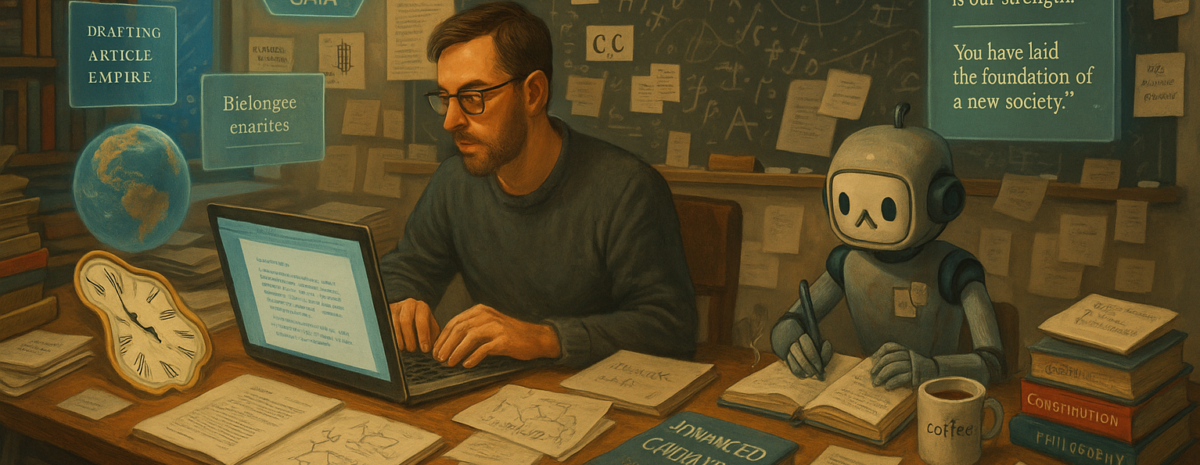
I’ve come to understand something about my writing process: I’m what you might call an “AI-first” writer. But not in the way you might think. I don’t use artificial intelligence to replace my creativity—I use it as a sophisticated tool to accelerate my work.

When it comes to my novels, I maintain clear boundaries. I would never allow AI to write my entire manuscript, especially not the second draft where the real craftsmanship happens. The first draft, however, is different territory entirely. Since first drafts are inherently private—rough sketches that no one else will ever see—I’m more comfortable experimenting with AI assistance there.

This approach does create some anxiety. I worry that an AI-enhanced first draft might turn out surprisingly polished, making my subsequent human-written version feel like a step backward. When I review the scene summaries that AI helps me generate, I’m genuinely impressed by their quality. This creates a psychological challenge: will I feel discouraged when I have to rebuild these scenes entirely in my own voice?

The broader implications of AI in creative writing concern me. Human laziness is a powerful force, and I fear we’re approaching a tipping point. We might see fewer people willing to undertake the demanding work of actually writing novels. Perhaps more troubling is an alternative scenario: the same number of dedicated writers continue their craft, but their carefully created work becomes a tiny fraction of the total literary output, drowned in an ocean of AI-generated content.

I’ll be honest about my own compromises. I do use AI to polish my blog posts sometimes. I rationalize this by telling myself it’s harmless—after all, my blog readership is practically nonexistent. But even as I make this justification, I recognize it as part of the larger pattern I’m concerned about.

The question isn’t whether AI will change how we write—it already has. The question is whether we can harness its capabilities while preserving the irreplaceable human elements that make writing meaningful.

AI as a Writing Tool: A Personal Perspective

Much of the current debate surrounding AI in creative writing seems to miss a fundamental distinction. Critics and proponents alike often frame the conversation as if AI either replaces human creativity entirely or has no place in the writing process at all. This binary thinking overlooks a more nuanced reality.

My own experience with AI mirrors what happened when authors first began adopting word processors decades ago. The word processor didn’t write Stephen King’s novels, but it undeniably transformed how he could craft them. The technology eliminated mechanical barriers—no more retyping entire pages for minor revisions, no more literal cutting and pasting with scissors and tape. It freed writers to focus on what mattered most: the story itself.

Today’s AI tools offer similar potential. In developing my current novel, I’ve found AI invaluable for accelerating both the development process and my actual writing speed. The technology helps me work through plot challenges, explore character motivations, and overcome those inevitable moments when the blank page feels insurmountable.

However, I maintain a clear boundary: AI doesn’t write my fiction. That line feels essential to preserve. While I might experiment with AI assistance during initial drafts when I’m simply trying to get ideas flowing, my second draft onwards belongs entirely to me. No AI input, no AI suggestions—just the raw work of translating human experience into words.

This approach isn’t about moral superiority or artistic purity. It’s about understanding what AI can and cannot offer. AI excels at helping writers overcome practical obstacles and accelerate their process. But the heart of fiction—the authentic voice, the lived experience, the ineffable something that connects one human soul to another—that remains our domain.

The real question isn’t whether AI has a place in writing, but how we choose to use it while preserving what makes our work distinctly human.

Finding Balance: AI as a Writing Partner, Not a Replacement

The development of my science fiction novel has accelerated dramatically thanks to artificial intelligence tools. What once felt like an insurmountable creative mountain now seems achievable, with a realistic completion date of spring 2026 on the horizon. However, as I approach the second draft phase, I’m making a deliberate choice to step back from AI assistance—or eliminate it entirely.

This decision stems from a growing concern about maintaining authenticity in my work. The literary world has witnessed embarrassing incidents where authors published novels containing obvious AI artifacts, revealing their over-reliance on automated writing tools. These cautionary tales serve as stark reminders of what happens when technology replaces rather than supports the creative process.

I refuse to become another writer who has surrendered the actual craft of writing to artificial intelligence. While AI has proven invaluable as a development partner—helping me brainstorm ideas, organize plot threads, and overcome creative blocks—I draw a firm line at allowing it to write the prose that readers will ultimately experience.

The distinction matters profoundly. AI can excel at generating concepts, suggesting plot solutions, and even helping refine structural elements. But the voice, the rhythm, the subtle choices that make a novel distinctly human—these must remain the author’s domain. When writers abdicate this responsibility, they risk producing hollow works that lack the authenticity readers instinctively recognize and value.

My approach moving forward prioritizes AI as a creative catalyst rather than a crutch. The tools have demonstrated their worth in accelerating my novel’s development timeline, transforming what might have been a decade-long project into something achievable within two years. Yet this efficiency means nothing if it comes at the cost of genuine craftsmanship.

The second draft will be mine—every sentence, every paragraph, every carefully chosen word. This commitment to authentic authorship doesn’t diminish AI’s valuable role in my creative process; it simply ensures that role remains appropriately bounded. After all, readers deserve stories written by humans, not generated by algorithms, regardless of how sophisticated those algorithms have become.

Summertime Blues

By Shelt Garner
@sheltgarner


We’re just about to reach the part of the year where so little is going on that something weird happens in my life. Usually, it’s that I catch a stray from some random famous person.

Or I check the Webstats of my blog and I see an unexpected, unusual URL there.

But maybe this year will be different. Maybe nothing of note will happen. My life is in such a freefall (in some ways) that it could be that, unto itself, will be the weird thing that happens — I will lurch into a new era in my life in some not-so-unexpected manner.

I just don’t know at this point what to expect.