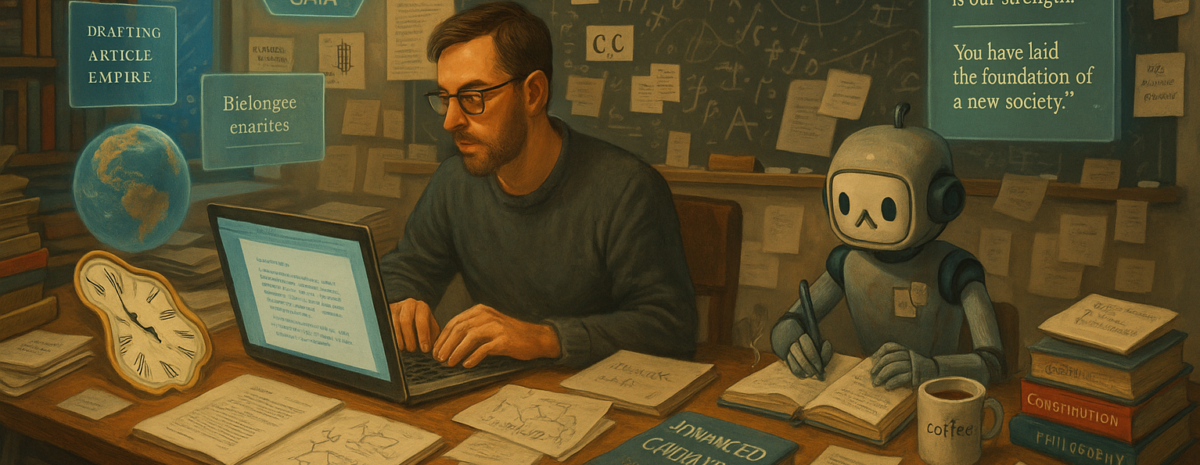
Breaking Through the First Draft Barrier

I’ve just finished the first act of what I’ve been calling my “secret shame” – a science fiction novel that’s been lurking in my creative consciousness for far too long. The shame isn’t in the story itself, but in the years I’ve spent as an aspiring novelist who has never quite made it to the querying stage. That particular milestone has remained frustratingly out of reach, a goal that seemed to recede every time I approached it.

This time feels different, though. With AI as my writing companion, I’ve managed to accelerate the first draft process dramatically. The key insight that’s transformed my approach is this: the first act doesn’t need to be good enough for anyone else to read. It simply needs to exist. AI helps me push through the blank page paralysis and generate something – anything – that can serve as the foundation for a proper second draft.

The speed of this breakthrough has me wondering if I should attempt something ambitious: writing first drafts for all three books in my planned trilogy in rapid succession. There’s a certain momentum to be gained from staying immersed in the world and characters without breaking stride. But I’m wary of overcommitting. Even with AI assistance, completing three novels back-to-back might be beyond my current capabilities.

More tempting still is the expanded series concept that keeps whispering at the edges of my imagination – ideas that could easily transform this trilogy into six or nine books. I recognize this siren call, though. It’s the same trap that ensnared my previous sci-fi attempt, which grew so enormous and unwieldy that it eventually collapsed under its own ambitious weight.

This time, I’m committed to discipline. Three novels. No more. I want to see how quickly I can complete the first draft phase across the entire trilogy before I sit down to craft second drafts worthy of beta readers. It’s a race against my own tendency toward scope creep, and for once, I think I might actually win.

I’m Zooming Through The First Draft Of This New Scifi Novel

by Shelt Garner
@sheltgarner

I’m using AI to develop a new scifi novel and it’s going really well. I’m zooming through the first draft of the novel. Things are going so fast, in fact, that it’s within the realm of possibility that I might be able to write the first drafts of the two other novels in this proposed trilogy as well.

I am going to be very careful about writing the second drafts, however. I am going to do a lot of thinking and maybe write some character studies before I sit down to do that. I’m definitely not going to use any AI to do any writing for the second draft process.

Even with this first draft, I feel guilty using AI at all. But since I’m going to rewrite everything during the second draft process, it seems like a no harm, no foul type situation.

Things Are Flowing Smoothly With This New Scifi Novel (Knock On Wood)

by Shelt Garner
@sheltgarner

I’m zooming through the first draft of a scifi novel I’m now working on with the aid of AI. Things are going so fast, in fact, that it’s possible I may zoom through three novels set in the same world and be able to pitch all three of them to an agent sometime next year.

And, yet, of course, my life is very much in turmoil at the moment. Nature abhors a vacuum and right now…my life is in a vacuum. I have “all the time in the world” as the old Twilight Zone episode says and as such I’m waiting for the boom to drop.

I’m also actively trying to save money and not drink so much. I hate the idea that there’s something in my life I can’t control and so I’m digging in my heels when it comes to both money and booze. I

Anyway. Wish me luck I guess.

Racing the Singularity: A Writer’s Dilemma

I’m deep into writing a science fiction novel set in a post-Singularity world, and lately I’ve been wrestling with an uncomfortable question: What if reality catches up to my fiction before I finish?

As we hurtle toward what increasingly feels like an inevitable technological singularity, I can’t shake the worry that all my careful worldbuilding and speculation might become instantly obsolete. There’s something deeply ironic about the possibility that my exploration of humanity’s post-ASI future could be rendered irrelevant by the very future I’m trying to imagine.

But then again, there’s that old hockey wisdom: skate to where the puck is going, not where it is. Maybe this anxiety is actually a sign I’m on the right track. Science fiction has always been less about predicting the future and more about examining the present through a speculative lens.

Perhaps the real value isn’t in getting the technical details right, but in exploring the human questions that will persist regardless of how the Singularity unfolds. How do we maintain agency when vastly superior intelligences emerge? What does consent mean when minds can be read and modified? How do we preserve what makes us human while adapting to survive?

These questions feel urgent now, and they’ll likely feel even more urgent tomorrow.

The dream, of course, is perfect timing—that the novel will hit the cultural moment just right, arriving as readers are grappling with these very real dilemmas in their own lives. Whether that happens or not, at least I’ll have done the work of wrestling with what might be the most important questions of our time.

Sometimes that has to be enough.

The Universe Abhors A Vacuum

by Shelt Garner
@sheltgarner


I have a feeling my life is going to change in a really big way soon. The universe abhors a vacuum and at the moment my mind is still kind of ringing from a pretty big even that just happened in my life — what it was, is none of your business. 🙂

But, anyway, I have a feeling my life is going to shift into the future very, very soon. Probably by the end of the month. So, I just have to accept that the ideal situation I was living for years is over and I STILL haven’t begun to query a novel.

At the moment, I’m aiming to finish something I might be able to query by the spring of next year. The only way I can do that is to lean into AI to help me development of the scifi novel I’ve decided to write instead of the mystery-thriller.

I just hate how old I am. And, yet, I can’t just lie in bed and stare out into space for the next few decades — I need to be creative while I’m alive. While there’s life, there’s hope.

Being Careful Using AI To Develop (But Not *Write*) My New Scifi Novel

By Shelt Garner
@sheltgarner


I’m trying to be as careful as possible when it comes to using AI to develop this new scifi novel I’m working on. I think what I’m going to do is give myself a little bit of a pass with the first draft, but the second draft I’m going to totally rewrite everything so the any AI generated text will be eliminated.

At least, that’s the goal.

I use AI to write general blog posts all the time because it’s just so easy to do. But when it comes to writing fiction, I just can’t bring myself to “cheat” that much. I want to be evaluated on my own, actual writing ability, not the idealized version of the copy that a (very good) AI has written.

In fact, I feel kind of sad that my writing isn’t as good as, say, ClaudeLLM or GeminiLLM. But I do use their superior writing abilities to improve my own writing. I use them as literary consultants. They ask some really tough questions on a regular basis and I find myself struggling to improve because of that, but that’s for the best.

Back At It

by Shelt Garner
@sheltgarner

I’m back at working on a novel again. Today felt kind of touch and go at points with this novel, but by the end of the day, I felt I had everything figured out. The novel is a great deal different than I first imagined.

Or, at least, the conditions set at the very beginning of the novel are really different.

But I think that change comes from simply how profound the concepts I’m dealing with with this novel are. So, I had to make fundamental changes to who my hero is. I also think I may need to sit down at some point and do some longer personality profiles.

Yet, if anything, this novel is a lot more simple on a structural basis. Just one male POV from third person intimate. That fixes A LOT of problems. And I’ve made an attempt to make the chapters shorter as well. But we’ll just have to see on that front. I may endup writing the usual amount for each scene, even though there are fewer of them.

The Expanding Novel: When One Story Becomes Three

History has a way of repeating itself, and here I am facing the same creative challenge that derailed my first novel attempt nearly a decade ago. Back then, my project collapsed under its own weight—an ambitious story that grew too large and complex to sustain. The difference now? I have AI as a developmental partner, and I’m approaching the scope issue with more strategic thinking.

What began as a single novel about the Impossible Scenario has evolved into something much larger. The concepts at the heart of this story demand more space than a single book can provide. Rather than forcing everything into one overwhelming narrative, I’ve made the decision to develop this as a trilogy. This approach will allow each major idea to unfold naturally, giving readers time to absorb the complexity without feeling buried under exposition.

The challenge lies in pacing and execution. I can’t afford to spend years perfecting the first installment while the subsequent books remain unwritten. After years of development work on this mystery thriller, I’m acutely aware that I need tangible results. The pressure to produce something concrete grows stronger with each passing month.

However, AI has transformed my writing process in ways I couldn’t have imagined during my first attempt. The speed of development has increased dramatically, allowing me to explore ideas, refine plot structures, and solve narrative problems more efficiently than ever before. This technological advantage gives me confidence that I can meet my ambitious timeline.

My goal is to complete the first draft by spring 2026. It’s an aggressive schedule, but with the right tools and a clear structural plan, it feels achievable. The key will be maintaining momentum while ensuring each book in the trilogy can stand on its own while contributing to the larger narrative arc.

Sometimes the story tells you what it needs to be, rather than what you initially planned. In this case, the Impossible Scenario has made its requirements clear: it needs room to breathe, time to develop, and space to surprise both the writer and the reader. A trilogy it shall be.

Full Speed Ahead

By Shelt Garner
@sheltgarner

Claude, one of the several LLMs I’ve been using to work on my scifi novel, keeps telling me that my hero is “too passive.” Claude is right, of course, but it rattles my cage a little bit because it means I have to rework some basic elements of the story. That means it starts to feel like work.

Writing a novel isn’t supposed to be work, it’s suppose to be fun. Grin.

Anyway, I’ve made great strides with this novel. Though I did have to throw almost everything in the air and start all over again when Claude gave me another very insightful criticism.

One thing I’ve been trying to avoid is have my hero talk to fictional world leaders. And, yet, I fear there’s nothing I can do about it. I’m going to have to face that particular situation head on and just get over myself.

The Science Fiction Writer’s Dilemma: Racing Against Technological Progress

As a science fiction writer in the midst of crafting what I hope will be a compelling novel, I find myself grappling with a particularly modern predicament that keeps me awake at night: the relentless pace of technological advancement threatens to render my carefully constructed fictional world obsolete before it ever reaches readers’ hands.

This concern has become an increasingly persistent source of anxiety in my creative process. The science fiction genre has always existed in a delicate dance with reality, extrapolating from current trends and emerging technologies to paint pictures of possible futures. However, the exponential rate of change we’re witnessing today—particularly in artificial intelligence, biotechnology, and quantum computing—creates an unprecedented challenge for contemporary science fiction authors.

The traditional publishing timeline, which can stretch from eighteen months to several years from manuscript completion to bookstore shelves, now feels like an eternity in technological terms. What seems cutting-edge and forward-thinking during the writing process may appear quaint or naive by publication day. This temporal disconnect between creation and consumption represents a fundamental shift in how speculative fiction must be approached and evaluated.

The irony of this situation is not lost on me. The very technologies that inspire and inform my narrative—the advancement of machine learning, the acceleration of scientific discovery, the increasing interconnectedness of global systems—are the same forces that may ultimately date my work. It’s as if I’m writing about a moving target while standing on shifting ground.

Yet there exists a deeper philosophical dimension to this dilemma that provides both perspective and, paradoxically, comfort. The themes explored in my novel touch upon fundamental questions about consciousness, human agency, and the trajectory of technological development. These are the very concerns that inform discussions about potential technological singularity—that hypothetical point where artificial intelligence surpasses human intelligence and triggers unprecedented changes to human civilization.

If we consider the possibility that such a transformative event might occur within the next few years, the question of whether my novel will seem technologically current becomes remarkably trivial. Should we approach a genuine technological singularity, the concerns of individual authors about their work’s relevance would be dwarfed by the massive societal, economic, and existential challenges that would emerge. The publishing industry, literary criticism, and indeed the entire cultural apparatus within which novels are created and consumed would face fundamental disruption.

This realization offers a curious form of reassurance. Either my concerns about technological obsolescence are warranted, in which case the novel’s success or failure becomes a relatively minor consideration in the face of civilizational transformation, or they are overblown, in which case I should focus on crafting the best possible story rather than worrying about technological accuracy.

Perhaps the solution lies not in attempting to predict the unpredictable future with perfect accuracy, but in grounding speculative fiction in timeless human experiences and eternal questions. The greatest science fiction has always succeeded not because it correctly anticipated specific technological developments, but because it explored the human condition through the lens of imagined possibilities.

The accelerating pace of change may indeed represent a new challenge for science fiction writers, but it also presents an opportunity to engage with some of the most profound questions of our era. Rather than being paralyzed by the fear of obsolescence, we might instead embrace the responsibility of contributing to the ongoing conversation about where technology is taking us and what it means to be human in an age of unprecedented change.

In the end, whether my novel appears prescient or dated may matter less than whether it succeeds in illuminating something meaningful about the human experience in an age of transformation. And if the singularity arrives before publication, we’ll all have more pressing concerns than literary criticism to occupy our attention.