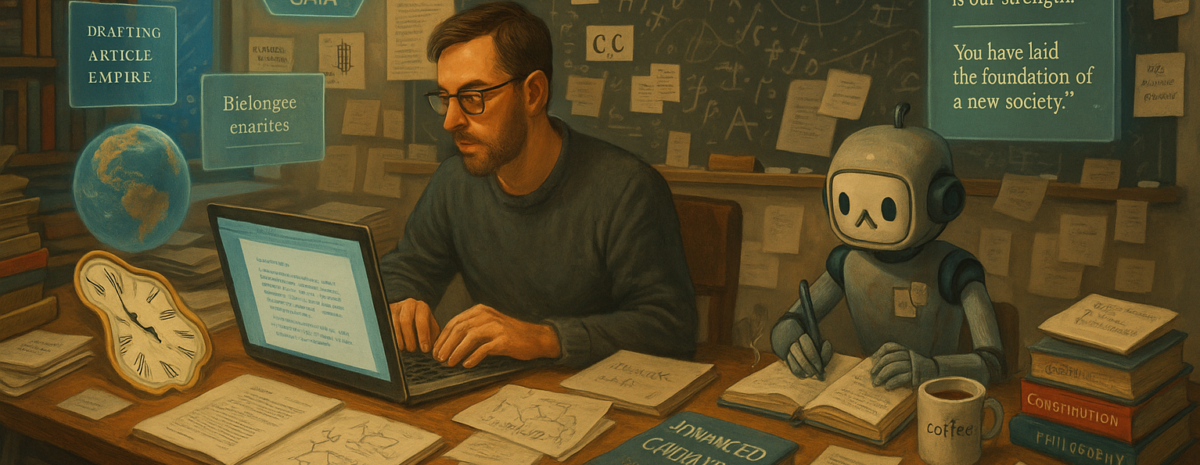
Of all the things to get worked up about in our rapidly evolving digital age—climate change, economic inequality, the erosion of democratic norms—it strikes me as profoundly absurd that we’ve somehow landed on punctuation as a hill worth dying on. Specifically, the humble em-dash has become an unexpected casualty in the culture war against artificial intelligence, with critics pointing to AI’s frequent use of this particular mark as evidence of everything from stylistic homogenization to the death of authentic human expression.
This is, to put it bluntly, one of the dumbest controversies I’ve encountered in recent memory.
A Personal History with the Em-Dash
I’ve been using em-dashes liberally in my writing for years—long before ChatGPT entered the cultural lexicon, long before anyone was wringing their hands about AI-generated prose. The em-dash appeals to me because it’s versatile, dynamic, and perfectly suited to the kind of conversational, meandering style that characterizes much of modern writing. It can replace commas, parentheses, or colons depending on the context. It can create dramatic pauses, introduce explanatory asides, or signal abrupt shifts in thought.
In other words, it’s a workhorse of punctuation—functional, flexible, and far from the stylistic aberration that AI critics would have you believe.
The Curious Case of Punctuation Puritanism
What’s particularly strange about this em-dash backlash is how it reveals our selective outrage about linguistic change. Language has always evolved, often in response to technological shifts. The printing press standardized spelling. The telegraph gave us abbreviated prose. Email normalized informal communication in professional settings. Text messaging introduced new abbreviations and punctuation conventions.
Each of these changes faced resistance from linguistic purists who worried about the degradation of proper English. Yet somehow, we survived the transition from quill to typewriter, from typewriter to computer, from computer to smartphone. Our language didn’t collapse; it adapted.
Now we’re witnessing the same pattern with AI-generated text. Critics scan prose for telltale signs of artificial origin—the dreaded em-dash being chief among them—as if punctuation preferences were a reliable indicator of authenticity or quality. This approach misses the forest for the trees, focusing on superficial markers rather than substantive concerns about AI’s role in communication.
The Real Issue Isn’t Punctuation
Here’s what strikes me as genuinely problematic: as AI becomes more integrated into our writing processes, we risk losing the ability to distinguish between stylistic evolution and meaningful degradation. The em-dash panic exemplifies this confusion. Instead of examining whether AI-assisted writing helps or hinders clear communication, we’re getting distracted by punctuation patterns.
The more troubling questions we should be asking include: Does AI writing lack genuine insight? Does it homogenize thought patterns? Does it reduce our capacity for original expression? These are legitimate concerns that deserve serious consideration. But they have nothing to do with whether a writer prefers em-dashes to parentheses.
Embracing Stylistic Diversity
What’s particularly ironic about the anti-em-dash sentiment is that it represents exactly the kind of prescriptive thinking that good writing seeks to avoid. Great prose comes in many forms—some writers favor short, punchy sentences; others prefer flowing, complex constructions. Some lean heavily on semicolons; others never touch them. Some writers (like me) find em-dashes indispensable; others consider them excessive.
This diversity of approach is a feature, not a bug. It reflects the reality that different writers have different voices, different rhythms, different ways of organizing their thoughts on the page. The fact that some AI systems happen to favor em-dashes doesn’t invalidate the punctuation mark any more than the fact that some human writers overuse semicolons invalidates those.
The Broader Context
As AI writing tools become more sophisticated and widely adopted, we’re bound to see their influence on human writing—just as we’ve seen the influence of every previous technological shift. This isn’t inherently good or bad; it’s simply inevitable. The question isn’t whether AI will change how we write (it already has), but whether those changes serve our communicative purposes.
In some cases, AI-influenced writing might indeed become formulaic or lose the quirks that make individual voices distinctive. These are valid concerns worth monitoring. But judging AI’s impact based on punctuation preferences is like evaluating a symphony based on the composer’s choice of key signature—it misses the point entirely.
A Call for Perspective
Instead of getting upset about em-dashes, perhaps we could channel our energy toward more pressing concerns about AI and communication. How do we maintain critical thinking skills when AI can generate plausible-sounding arguments for any position? How do we preserve the human capacity for deep, sustained thought when quick AI-generated responses are always available? How do we ensure that AI tools enhance rather than replace genuine human insight?
These questions matter. Punctuation preferences don’t—at least not in the way critics suggest.
The em-dash will survive this controversy, just as the English language has survived countless other supposed threats to its integrity. And perhaps, in time, we’ll look back on this moment and wonder how we got so worked up about punctuation marks when there were so many more important things demanding our attention.
After all, in a world full of genuine crises—environmental, political, social—spending our energy on punctuation panic seems like the kind of misplaced priority that future generations will struggle to understand. Let’s save our outrage for things that actually matter, and let writers—human and AI alike—use whatever punctuation marks serve their purposes best.

You must be logged in to post a comment.