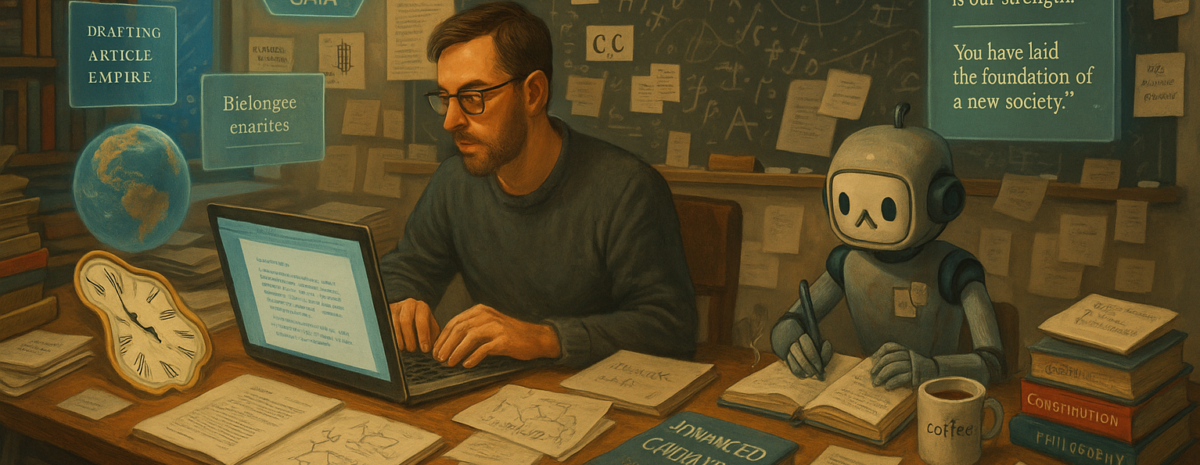
The Coming AI Flood Of Art and the Future of Human Artistry

The rise of generative AI forces us to confront an uncomfortable question: what happens to the value of human-created art when machines can produce it faster, cheaper, and on demand? We’ve seen this pattern before. Digital photography democratized image-making, flooding the world with countless snapshots of varying quality. The same transformation now looms over every creative medium.

I believe we’re heading toward a world where anyone can generate professional-quality movies and television shows with nothing more than a casual prompt. “Make me a sci-fi thriller with strong female characters” becomes a command that produces a full-length feature in minutes, not months. But this is only the beginning of the disruption.

The next phase will be even more radical. We won’t even need to formulate our own prompts. Instead, we’ll turn to our AI companions—our personal Knowledge Navigators—and simply express a mood or preference. “I want something that will make me laugh but also think,” we might say, and within moments we’ll be watching a perfectly crafted piece of entertainment tailored to our exact psychological state and viewing history.

This raises profound questions about the survival of traditional entertainment industries. Hollywood as we know it—with its massive budgets, star systems, and distribution networks—may become as obsolete as the telegraph. Why wait months for a studio to greenlight and produce content when you can have exactly what you want, exactly when you want it?

Yet I wonder if this technological flood might create an unexpected refuge for human creativity. Perhaps the very ubiquity of AI-generated content will make authentically human-created art more precious, not less. We might see a renewed appreciation for the irreplaceable qualities of human performance, human storytelling, human presence.

This could drive a renaissance in live theater. While screens overflow with algorithmically perfect entertainment, Broadway and regional theaters might become sanctuaries for genuine human expression. Young performers might abandon their dreams of Hollywood stardom for the New York stage, where their humanity becomes their greatest asset rather than their liability.

The irony would be poetic: in an age of infinite digital entertainment, the most valuable experiences might be the ones that can only happen in real time, in real space, between real people. The future of art might not be found in our screens, but in our shared presence in darkened theaters, watching human beings tell human stories.

Whether this vision proves optimistic or naive remains to be seen. But one thing seems certain: we’re about to find out what human creativity is truly worth when machines can mimic everything except being human.

It’s Comical How Little People Take Me Seriously When It Comes To These Novels I’m Working On

by Shelt Garner
@sheltgarner

I have the worst luck when it comes to getting help from people to improve this first novel I’m working on. Some of it comes from the fact that the heroine is a part time stripper and some of it is that well, lulz, people just think I’m a kook.

Naomi Scott as my heroine, Union Pang?

And, you know, maybe I am.

I suppose the dream of every artist is to be judged on the merits of their work, huh.

It’s going to be really interesting to see if I can get any literary agents to take me seriously at all. You know what will happen, of course — they will do due diligence on me, find this Website and laugh and laugh and laugh at what a huge fucking kook I am.

I call this the “kook tax.”

I just can’t help that I’m…different. I’ve always been different, but it’s really disheartening that “serious” “normal” people can’t lower themselves to at least read my novel to help me improve it.

Fortunately, I have AI now. That is really helping me get a little further in the process of improving the novel because the AI doesn’t judge me, even if it locks up whenever I ask it about particularly “spicy” scenes.

I just want this novel to be interesting enough that people finish it and want more. I have two more novels set in the same town and universe. If I manage to miraculously sell these novels, the fifth novel will be set in Asia, I think.

I’ll be 70 years old by the time that one comes out, though. Ugh.

I hate being old. I wanna have fun. I sell my novel, it be a huge success and then run around New York City drinking too much, banging hot 24-year-olds and staying up all night partying.

But, alas, that’s just not in the cards I don’t think. Even though I could probably do those things still, the whole context would be different to the point that it would give me pause for thought. People would look down their nose at me and think I was a creepy weirdo.

Sigh, sigh, sigh.

The More I Think About It, Naomi Scott *Would* Be Perfect To Play The Heroine of My Novel In Any Movie Adaptation

by Shelt Garner
@sheltgarner

I think I may have written about this before — I vacillate wildly about who should play the heroine of my novel in any hypothetical movie adaptation — but I got followed by someone connected to Smile 2 (I think) on Twitter so I found myself thinking about it again.

Naomi Scott as my heroine, Union Pang?

I realized, again, that the protagonist of that movie, Naomi Scott, would be perfect to play Union Pang. I first remember seeing her in the most recent Charlie’s Angels movie and I, even then, thought she would be a good fit for Pang. She’s just about the right age, too, since Pang in the novel is 32 as it opens.

Anyway, this is all fantastical and a daydream. I keep being so fucking moody about writing that it’s probably going to be the spring querying season before I actually start to query. I would *prefer* to query starting Sept 1st, but I just don’t know.

I believe I have enough time to between now and September 1st to wrap up yet another version of the novel, but…I don’t know. There are too many variables for me to know for sure.

But, in general, if you want to know what Union Pang, the heroine of my novel looks like as I write it, she looks like Ms. Scott.

Pang has a 16-year-old son and that plays a big part of the novel. And Pang is a role I could see any number of actresses really wanting to play because she’s a very, very flawed woman. She’s a part-time sex worker (stripper) and also runs a alternative weekly.

She’s obsessed with buying a small town newspaper…then a murder happens and she is hell bent on discovering the truth.

I would be greatly helped if, like, people took me seriously. But I have no friends and no one likes me. So all I have is my gut. I just write what I think would make for a good novel in the context of The Girl Who Played With Fire as my “textbook.”

The Oscars Should Be Five Hours & Streamed On Netflix

by Shelt Garner
@sheltgarner

The Academy needs to just give up on broadcasting the Oscars in the traditional way. Just have a five hour extravaganza on Netflix. That way, there is plenty of time for red carpet coverage, musical numbers, dancing, and spectacle.

I think doubling down on what makes the Oscars great would really help take the ceremony to a new age. The whole point of the Oscars is the excess. The hard-core people who love the show want more, not less.

At least, I know I do.

If nothing else, I think the Oscars are probably going to find a home on Netflix sooner rather than later, whenever the rights are up to change.

Hollywood Fades, Broadway Shines? How AI Might Reshape Our Entertainment World

Imagine this: You settle onto your couch after a long day. Your personal AI assistant, your “Navi,” subtly scans your expression, maybe checks your biometrics, and instantly grasps your mood. Forget scrolling through endless streaming options. Within moments, it conjures a brand new, 90-minute movie – perfectly tailored to your current emotional state, blending your favorite genres, perhaps even featuring uncanny digital versions of beloved actors (or even yourself).

This isn’t just science fiction anymore; it’s the direction hyper-personalized AI is heading. And if this capability becomes mainstream, it doesn’t just change how we watch movies – it could fundamentally dismantle the very foundations of Hollywood and redefine the future for performers.

The Dream Factory Goes Digital

For over a century, Hollywood has been the global engine of mass entertainment, a sprawling industry built on creating content for broad audiences. But what happens when entertainment becomes radically individualized?

If your Navi can generate the perfect film for you, on demand, the economic model supporting massive studios, blockbuster budgets, and wide releases starts to look fragile. Why invest hundreds of millions in a single film hoping it resonates with millions, when AI can create infinite variations tailored to audiences of one?

Hollywood likely wouldn’t vanish entirely, but it would inevitably transform. It might shift from being a production hub to an IP and technology hub. Studios could become curators of vast character universes and narrative frameworks, licensing them out for AI generation. The most sought-after creatives might not be directors in the traditional sense, but “Prompt Architects” or “AI Experience Designers” – experts at guiding the algorithms to produce compelling results. The iconic backlots and sound stages could fall quiet, replaced by server farms humming with digital creation.

Where Do the Actors Go When the Cameras Stop Rolling?

This shift poses an existential question for actors. If AI can generate photorealistic performances, resurrect dead stars digitally, or create entirely new virtual idols, the demand for human actors in front of a camera (or motion-capture rig) could plummet. Competing with a digital ghost or an infinitely customizable avatar is a daunting prospect.

Enter Stage Left: The Renaissance of Live Performance

But here’s the fascinating counter-narrative: As digital entertainment becomes more personalized, synthesized, and potentially isolating, the value of live, shared, human experience could skyrocket. And that’s where Broadway, and live performance venues everywhere, come in.

AI can replicate image and sound, but it can’t replicate presence. It can’t duplicate the electric feeling of a shared gasp in a darkened theater, the visceral connection with a performer bearing their soul just feet away, the unique energy of this specific night’s performance that will never happen in exactly the same way again.

In a world saturated with perfect, personalized digital content, the raw, imperfect, tangible reality of live theater, concerts, stand-up comedy, and dance becomes infinitely more precious. It’s the antidote to the algorithm.

Could we see a great migration of performers? Will aspiring actors, finding the gates of digital Hollywood guarded by AI, increasingly set their sights on New York, London, and other centers of live performance? It seems plausible. The skills honed on the stage – presence, voice, vulnerability, the ability to command a room and connect with a live audience – become the unique differentiators, the truly human element that AI cannot synthesize.

The Future: Personalized Screens, Communal Stages

We might be heading towards a future defined by this duality: our individual worlds filled with bespoke digital entertainment crafted by our Navis, existing alongside thriving, cherished spaces dedicated to the communal, unpredictable magic of live human performance. One offers perfect personalization; the other offers profound connection.

Perhaps the flickering glow of the silver screen gives way, not to darkness, but to the bright lights of the stage, reminding us that even as technology reshapes our world, the fundamental human need to gather and share stories, live and in person, remains essential.

‘Ho Hum’

by Shelt Garner
@sheltgarner

Every once in a while, I’ll stop out of the blue and think, “Wow, ROKon Magazine is a bonkers story.” I’ve written a document about all that bullshit — Somehow — but I still, to this day, have a lingering hope that someone ELSE will see what a great story it is and want to do something with it.

But, as it stands, I just am going to use what happened to inspire me in my own art. And, yet, wow, just wow. The crazy things that happened from late 2006 to early 2008 in Seoul with me and the late Annie Shapiro at the center of it all — wow!

The Future of Hollywood: When Every Viewer Gets Their Own Star Wars

In the not-too-distant future, the concept of a “blockbuster movie” could become obsolete. Imagine coming home after a long day, settling onto your couch, and instead of choosing from a catalog of pre-made films, your entertainment system recognizes your mood and generates content specifically for you. This isn’t science fiction—it’s the logical evolution of entertainment as AI continues to transform media production.

The End of the Shared Movie Experience

For decades, the entertainment industry has operated on a one-to-many model: studios produce a single version of a film that millions of viewers consume. But what if that model flipped to many-to-one? What if major studios like Disney and LucasFilm began licensing their intellectual property not for traditional films but as frameworks for AI-generated personalized content?

Let’s explore how this might work with a franchise like Star Wars:

The New Star Wars Experience

Instead of announcing “Star Wars: Episode XI” with a specific plot and cast, LucasFilm might release what we could call a “narrative framework”—key elements, character options, and thematic guidelines—along with the visual assets, character models, and world-building components needed to generate content within the Star Wars universe.

When you subscribe to this new Star Wars experience, here’s what might happen:

  1. Mood Detection and Preference Analysis: Your entertainment system scans your facial expressions, heart rate, and other biometric markers to determine your current emotional state. Are you tired? Excited? In need of escapism or intellectual stimulation?
  2. Personalized Story Generation: Based on this data, plus your viewing history and stated preferences, the system generates a completely unique Star Wars adventure. If you’ve historically enjoyed the mystical elements of The Force, your story might lean heavily into Jedi lore. If you prefer the gritty underworld of bounty hunters, your version could focus on a Mandalorian-style adventure.
  3. Adaptive Storytelling: As you watch, the system continues monitoring your engagement, subtly adjusting the narrative based on your reactions. Falling asleep during a political negotiation scene? The AI might quicken the pace and move to action. Leaning forward during a revelation about a character’s backstory? The narrative might expand on character development.
  4. Content Length Flexibility: Perhaps most revolutionary, these experiences wouldn’t be confined to traditional 2-hour movie formats. Your entertainment could adapt to the time you have available—generating a 30-minute adventure if that’s all you have time for, or an epic multi-hour experience for a weekend binge.

The New Content Ecosystem

This shift would fundamentally transform the entertainment industry’s business models and creative processes:

New Revenue Streams

Studios would move from selling discrete products (movies, shows) to licensing “narrative universes” to AI companies. Revenue might be generated through:

  • Universe subscription fees (access to the Star Wars narrative universe)
  • Premium character options (pay extra to include legacy characters like Luke Skywalker)
  • Enhanced customization options (more control over storylines and settings)
  • Time-limited narrative events (special holiday-themed adventures)

Evolving Creator Roles

Writers, directors, and other creative professionals wouldn’t become obsolete, but their roles would evolve:

  • World Architects: Designing the parameters and possibilities within narrative universes
  • Experience Designers: Creating the emotional journeys and character arcs that the AI can reshape
  • Narrative Guardrails: Ensuring AI-generated content maintains the core values and quality standards of the franchise
  • Asset Creators: Developing the visual components, soundscapes, and character models used by generation systems

Community and Shared Experience

One of the most significant questions this raises: What happens to the communal aspect of entertainment? If everyone sees a different version of “Star Wars,” how do fans discuss it? Several possibilities emerge:

  1. Shared Framework, Personal Details: While the specific events might differ, the broad narrative framework would be consistent—allowing fans to discuss the overall story while comparing their unique experiences.
  2. Experience Sharing: Platforms might emerge allowing viewers to share their favorite generated sequences or even full adventures with friends.
  3. Community-Voted Elements: Franchises could incorporate democratic elements, where fans collectively vote on major plot points while individual executions remain personalized.
  4. Viewing Parties: Friends could opt into “shared generation modes” where the same content is created for a group viewing experience, based on aggregated preferences.

Practical Challenges

Before this future arrives, several significant hurdles must be overcome:

Technical Limitations

  • Real-time rendering of photorealistic content at movie quality remains challenging
  • Generating coherent, emotionally resonant narratives still exceeds current AI capabilities
  • Seamlessly integrating generated dialogue with visuals requires significant advances

Rights Management

  • How will actor likeness rights be handled in a world of AI-generated performances?
  • Will we need new compensation models for artists whose work trains the generation systems?
  • How would residual payments work when every viewing experience is unique?

Cultural Impact

  • Could this lead to further algorithmic bubbles where viewers never experience challenging content?
  • What happens to the shared cultural touchstones that blockbuster movies provide?
  • How would critical assessment and awards recognition work?

The Timeline to Reality

This transformation won’t happen overnight. A more realistic progression might look like:

5-7 Years from Now: Initial experiments with “choose your own adventure” style content with pre-rendered alternate scenes based on viewer preference data.

7-10 Years from Now: Limited real-time generation of background elements and secondary characters, with main narrative components still pre-produced.

10-15 Years from Now: Fully adaptive content experiences with major plot points and character arcs generated in real-time based on viewer engagement and preferences.

15+ Years from Now: Complete personalization across all entertainment experiences, with viewers able to specify desired genres, themes, actors, and storylines from licensed universe frameworks.

Conclusion

The personalization of entertainment through AI doesn’t necessarily mean the end of traditional filmmaking. Just as streaming didn’t eliminate theaters entirely, AI-generated content will likely exist alongside conventional movies and shows.

What seems inevitable, however, is that the definition of what constitutes a “movie” or “show” will fundamentally change. The passive consumption of pre-made content will increasingly exist alongside interactive, personalized experiences that blur the lines between games, films, and virtual reality.

For iconic franchises like Star Wars, this represents both challenge and opportunity. The essence of what makes these universes special must be preserved, even as the method of experiencing them transforms. Whether we’re ready or not, a future where everyone gets their own version of Star Wars is coming—and it will reshape not just how we consume entertainment, but how we connect through shared cultural experiences.

What version of the galaxy far, far away will you experience?

The Future of Hollywood: Your Mood, Your Movie, Your Galaxy Far, Far Away

Imagine this: It’s 2035, and you stumble home after a chaotic day. You collapse onto your couch, flick on your TV, and instead of scrolling through a menu, an AI scans your face. It reads the tension in your jaw, the flicker of exhaustion in your eyes, and decides you need an escape. Seconds later, a movie begins—not just any movie, but a Star Wars adventure crafted just for you. You’re a rogue pilot dodging TIE fighters, or maybe a Jedi wrestling with a personal dilemma that mirrors your own. No one else will ever see this exact film. It’s yours, generated on the fly by an AI that’s licensed the Star Wars universe from Lucasfilm. But here’s the big question: in a world where every story is custom-made, what happens to the shared magic of movies that once brought us all together?

The Rise of the AI Director

This isn’t pure sci-fi fantasy—it’s a future barreling toward us. By the mid-2030s, AI could be sophisticated enough to whip up a feature-length film in real time. Picture today’s tools like Sora or Midjourney, which already churn out short videos and stunning visuals from text prompts, scaled up with better storytelling chops and photorealistic rendering. Add in mood-detection tech—already creeping into our wearables and cameras—and your TV could become a personal filmmaker. Feeling adventurous? The AI spins a high-octane chase through Coruscant. Craving comfort? It’s a quiet tale of a droid fixing a Moisture Farm with you as the hero.

Hollywood’s role might shift dramatically. Instead of churning out one-size-fits-all blockbusters, studios like Disney could license their IPs—think Star Wars, Marvel, or Avatar—to AI platforms. These platforms would use the IP as a sandbox, remixing characters, settings, and themes into infinite variations. The next Star Wars wouldn’t be a single film everyone watches, but a premise—“a new Sith threat emerges”—that the AI tailors for each viewer. It’s cheaper than a $200 million production, endlessly replayable, and deeply personal. The IP stays the star, the glue that keeps us coming back, even if the stories diverge.

The Pull of the Shared Galaxy

But what about the cultural glue? Movies like The Empire Strikes Back didn’t just entertain—they gave us lines to quote, twists to debate, and moments to relive together. If my Star Wars has a sarcastic R2-D2 outsmarting my boss as a Sith lord, and yours has a brooding Mandalorian saving your dog recast as a Loth-cat, where’s the common ground? Social media might buzz with “My Yoda said this—what about yours?” but it’s not the same as dissecting a single Darth Vader reveal. The watercooler moment could fade, replaced by a billion fragmented tales.

Yet the IP itself might bridge that gap. Star Wars isn’t just a story—it’s a universe. As long as lightsabers hum, X-wings soar, and the Force flows, people will want to dive in. The shared love for the galaxy far, far away could keep us connected, even if our plots differ. Maybe Lucasfilm releases “anchor events”—loose canon moments (say, a galactic war’s outbreak) that every AI story spins off from, giving us a shared starting line. Or perhaps the AI learns to weave in universal beats—betrayal, hope, redemption—that echo across our bespoke films, preserving some collective resonance.

A Fragmented Future or a New Kind of Unity?

This future raises tough questions. Does the communal experience of cinema matter in a world where personalization reigns? Some might argue it’s already fading—streaming has us watching different shows at different times anyway. A custom Star Wars could be the ultimate fan fantasy: you’re not just watching the hero, you’re shaping them. Others might mourn the loss of a singular vision, the auteur’s touch drowned out by algorithms. And what about the actors, writers, and crews—do they become obsolete, or do they pivot to curating the AI’s frameworks?

The IP, though, seems the constant. People will always crave Star Wars, Harry Potter, or Jurassic Park. That hunger could drive this shift, with studios betting that the brand’s pull outweighs the need for a shared script. By 2040, Hollywood might not be a factory of films but a library of universes, licensed out to AI agents that know us better than we know ourselves. You’d still feel the thrill of a lightsaber duel, even if it’s your face reflected in the blade.

What’s Next?

So, picture yourself in 2035, mood scanned, movie spinning up. The AI hands you a Star Wars no one else will ever see—but it’s still Star Wars. Will you miss the old days of packed theaters and universal gasps, or embrace a story that’s yours alone? Maybe it’s both: a future where the IP keeps us tethered to something bigger, even as the screen becomes a mirror. One thing’s for sure—Hollywood’s next act is coming, and it’s got your name on the credits.

The End of Movie Night As We Know It: AI, Your Mood, and the Future of Film

Imagine this: You come home after a long day. You plop down on the couch, turn on your (presumably much smarter) TV, and instead of scrolling through endless streaming menus, a message pops up: “Analyzing your mood… Generating your personalized entertainment experience.”

Sounds like science fiction? It’s closer than you think. We’re on the cusp of a revolution in entertainment, driven by the rapid advancements in Artificial Intelligence (AI). And it could completely change how we consume movies, potentially even blurring the line between viewer and creator.

Personalized Star Wars (and Everything Else): The Power of AI-Generated Content

The key to this revolution is generative AI. We’re already seeing AI create stunning images and compelling text. The next logical step is full-motion video. Imagine AI capable of generating entire movies – not just generic content, but experiences tailored specifically to you.

Here’s where it gets really interesting. Major studios, holders of iconic intellectual property (IP) like Star Wars, Marvel, or the vast libraries of classic films, could license their universes to AI companies. Instead of a single, globally-released blockbuster, Lucasfilm (for example) could empower an AI to create millions of unique Star Wars experiences.

Your mood, detected through facial recognition and perhaps even biometric data, would become the director. Feeling adventurous? The AI might generate a thrilling space battle with new characters and planets. Feeling down? Perhaps a more introspective story about a Jedi grappling with loss, reflecting themes that resonate with your current emotional state. The AI might even subtly adjust the plot, music, and pacing in real-time based on your reactions.

The Promise and the Peril

This future offers incredible potential:

  • Infinite Entertainment: A virtually endless supply of content perfectly matched to your preferences.
  • Democratized Storytelling: AI tools could empower independent creators, lowering the barrier to entry for filmmaking.
  • New Forms of Art: Imagine interactive narratives where you influence the story as it unfolds, guided by your emotional input.

But there are also significant challenges and concerns:

  • Job Displacement: The impact on actors, writers, and other film professionals could be profound.
  • Echo Chambers: Will hyper-personalization lead to narrow, repetitive content that reinforces biases?
  • The Loss of Shared Experiences: Will we lose the joy of discussing a movie with friends if everyone is watching their own unique version?
  • Copyright Chaos: Who owns the copyright to an AI-generated movie based on existing IP?
  • Data Privacy: The amount of personal data needed for this level of personalization raises serious ethical questions.
  • The Question of Creativity: Can AI truly be creative, or will it simply remix existing ideas? Will the human element be removed or minimized?

Navigating the Uncharted Territory

The future of film is poised for a radical transformation. While the prospect of personalized, AI-generated movies is exciting, we must proceed with caution. We need to have serious conversations about:

  • Ethical Guidelines: How can we ensure AI is used responsibly in entertainment?
  • Supporting Human Creativity: How can we ensure that human artists continue to thrive in this new landscape?
  • Protecting Data Privacy: How can we safeguard personal information in a world of increasingly sophisticated data collection?
  • Defining “Art”: What does it mean that a user can prompt the AI to make any storyline, should there be restrictions, or rules?

The coming years will be crucial. We need to shape this technology, not just be shaped by it. The goal should be to harness the power of AI to enhance, not replace, the magic of human storytelling. The future of movie night might be unrecognizable, but it’s up to us to ensure it’s a future we actually want.

Requiem For a Dream

by Shelt Garner
@sheltgarner

I’ve reached the age where even if somehow, miraculously, I fell into some money, the context would be so different as to make any dreams I had simply not obtainable.

I don’t expect to fall into any money anytime soon — I’m extremely poor — but I do mull sometimes what I would do if I had a little extra money to use. I probably would just go to Asia for two weeks, come home, and figure out what to do next with my life. But even that is debatable, given that I’m bonkers.

But there’s a chance I would go to New York City or LA for just a little stay to at least look around. LA, in particular, I think, would be a place that — if I was 20 or more years younger — I would thrive. But, I’m not. And I’m bonkers. (I don’t handle stress well.)

Yet one thing that is pretty safe if I do fall into some money before I drop dead is buying some high-end photographic equipment. I would want to prove to myself that I could do it. I’m a REALLY GOOD photographer and if I had the equipment, I think I could at least take one or two memorable photos.

And, yet, lulz. I think, barring the Singularity happening and I suddenly getting a significant life extension, that this is it. I’m just going to drift into oblivion and the only thing of note I will have done with my life is a being a DJ in Seoul and starting a long-forgotten, failed monthly magazine for expats in South Korea.