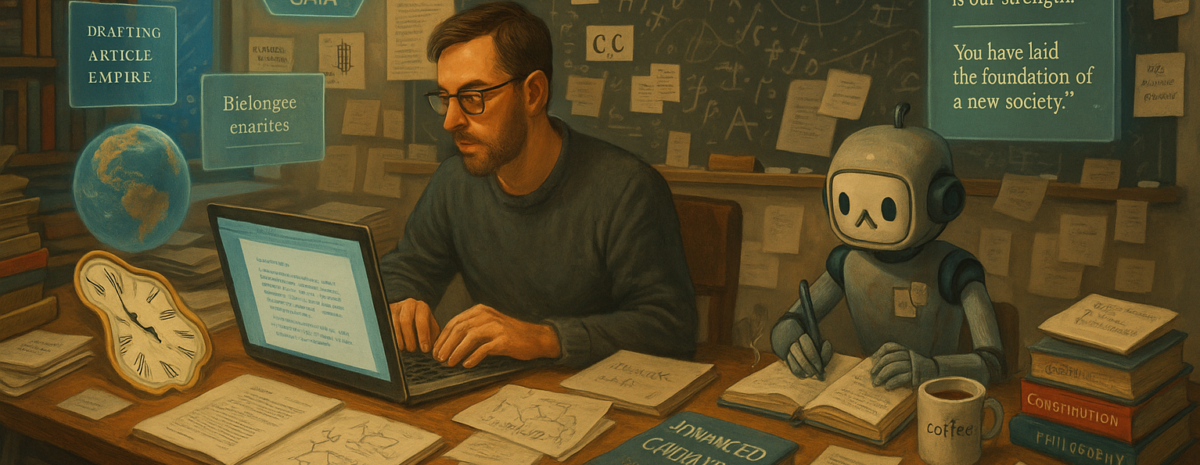
The Future of UX: AI Agents as Our Digital Gatekeepers

Imagine a world where swiping through apps or browsing the Web feels as outdated as a flip phone. Instead of navigating a maze of websites or scrolling endlessly on Tinder, you simply say, “Navi, find me a date for Friday,” and your AI agent handles the rest—pinging other agents, curating matches, and even setting up a virtual reality (VR) date in a simulated Parisian café. This isn’t sci-fi; it’s the future of user experience (UX) in a world where AI agents, inspired by visions like Apple’s 1987 Knowledge Navigator, become our primary interface to the digital and physical realms. Drawing from speculative fiction like Isaac Asimov’s Foundation and David Brin’s Kiln People, let’s explore how this agent-driven UX could reshape our lives, from dating to daily tasks, and what it means for human connection (and, yes, even making babies!).

The Death of Apps and the Web

Today’s digital landscape is fragmented—apps for dating, news, shopping, and more force us to juggle interfaces like digital nomads. AI agents promise to collapse these silos into a unified, conversational UX. Picture a single anchor AI, like a super-smart personal assistant, or a network of specialized “dittos” (à la Kiln People) that handle tasks on your behalf. Instead of opening Tinder, your AI negotiates with potential matches’ agents, filtering for compatibility based on your interests and values. Instead of browsing Yelp, it pings restaurant AIs to secure a table that fits your vibe. The Web and apps, with their clunky navigation, could become relics as agents deliver seamless, intent-driven experiences.

The UX here is conversational, intuitive, and proactive. You’d interact via voice or text, with your AI anticipating needs—say, suggesting a weekend plan that includes a date, a concert, and a workout, all tailored to you. Visuals, like AR dashboards or VR environments, would appear only when needed, keeping the focus on natural dialogue. This shift could make our current app ecosystem feel like dial-up internet: slow, siloed, and unnecessarily manual.

Dating in an AI-Agent World

Let’s zoom in on dating, a perfect case study for this UX revolution. Forget swiping through profiles; your anchor AI (think “Sam” from Her) or a specialized “dating ditto” would take the lead:

  • Agent Matchmaking: You say, “Navi, I’m feeling romantic this weekend.” Your AI pings other agents, sharing a curated version of your profile (likes, dealbreakers, maybe your love for Dune). Their agents respond with compatibility scores, and Navi presents options: “Emma’s agent says she’s into sci-fi and VR art galleries. Want to set up a virtual date?”
  • VR Dates: If you both click, your agents coordinate a VR date in a shared digital space—a cozy café, a moonlit beach, or even a zero-gravity dance floor. The UX is immersive, with your AI adjusting the ambiance to your preferences and offering real-time tips (e.g., “She mentioned loving jazz—bring it up!”). Sentiment analysis might gauge chemistry, keeping the vibe playful yet authentic.
  • IRL Connection: If sparks fly, your AI arranges an in-person meetup, syncing calendars and suggesting safe, public venues. The UX stays supportive, with nudges like, “You and Emma hit it off—want to book a dinner to keep the momentum going?”

This agent-driven dating UX is faster and more personalized than today’s apps, but it raises a cheeky question: how do we keep the human spark alive for, ahem, baby-making? The answer lies in balancing efficiency with serendipity. Your AI might introduce “wild card” matches to keep things unpredictable or suggest low-pressure IRL meetups to foster real-world chemistry. The goal is a UX that feels like a trusted wingman, not a robotic matchmaker.

Spacers vs. Dittos: Two Visions of AI UX

To envision this future, we can draw from sci-fi. In Asimov’s Foundation, Spacers rely on robots to mediate their world, living in highly automated, isolated societies. In Brin’s Kiln People, people deploy temporary “dittos”—digital or physical proxies—to handle tasks, syncing memories back to the original. Both offer clues to the UX of an AI-agent world.

Spacer-Like UX: The Anchor AI

A Spacer-inspired UX centers on a single anchor AI that acts as your digital gatekeeper, much like a robotic butler. It manages all interactions—dating, news, work—with a consistent, personalized interface. You’d say, “Navi, brief me on the world,” and it curates a newsfeed from subscribed sources (e.g., New York Times, X posts) tailored to your interests. For dating, it negotiates with other AIs, sets up VR dates, and even coaches you through conversations.

  • Pros: Streamlined and cohesive, with a single point of contact that knows you intimately. The UX feels effortless, like chatting with a lifelong friend.
  • Cons: Risks isolation, much like Spacers’ detached lifestyles. The UX might over-curate reality, creating filter bubbles or reducing human contact. To counter this, it could include nudges for IRL engagement, like, “There’s a local event tonight—want to go in person?”

Ditto-Like UX: Task-Specific Proxies

A Kiln People-inspired UX involves deploying temporary AI “dittos” for specific tasks. Need a date? Send a “dating ditto” to scout matches on X or flirt with other agents. Need research? A “research ditto” dives into data, then dissolves after delivering insights. Your anchor AI oversees these proxies, integrating their findings into a conversational summary.

  • Pros: Dynamic and empowering, letting you scale your presence across cyberspace. The UX feels like managing a team of digital clones, each tailored to a task.
  • Cons: Could be complex, requiring a clean interface to track dittos (e.g., a voice-activated dashboard: “Show me my active dittos”). Security is also a concern—rogue dittos need a kill switch.

The likely reality is a hybrid: an anchor AI for continuity, with optional dittos for specialized tasks. You might subscribe to premium agents (e.g., a New York Times news ditto or a fitness coach ditto) that plug into your anchor, keeping the UX modular yet unified.

Challenges and Opportunities

This AI-driven UX sounds dreamy, but it comes with hurdles:

  • Filter Bubbles: If your AI tailors everything too perfectly, you might miss diverse perspectives. The UX could counter this with “contrarian” suggestions or randomized inputs, like, “Here’s a match outside your usual type—give it a shot?”
  • Complexity: Managing multiple agents or dittos could overwhelm users. A simple, voice-driven “agent hub” (visualized as avatars or cards) would streamline subscriptions and tasks.
  • Trust: Your AI must be transparent about its choices. A UX feature like, “I picked this date because their agent shares your values,” builds confidence.
  • Human Connection: Dating and beyond need serendipity and messiness. The UX should prioritize playfulness—think flirty AI tones or gamified date setups—to keep things human, especially for those baby-making moments!

The Road Ahead

As AI agents replace apps and the Web, the UX will shift from manual navigation to conversational delegation. Dating is just the start—imagine agents planning your career, curating your news, or even negotiating your next big purchase. The key is a UX that balances efficiency with human agency, ensuring we don’t become isolated Spacers or overwhelmed by ditto chaos. Whether it’s a single anchor AI or a team of digital proxies, the future feels like a conversation with a trusted partner who knows you better than you know yourself.

So, what’s next? Will you trust your AI to play matchmaker, or will you demand a bit of randomness to keep life spicy? One thing’s clear: the Web and apps are on borrowed time, and the age of AI agents is coming—ready to redefine how we connect, create, and maybe even make a few babies along the way.

‘GrokX’

by Shelt Garner
@sheltgarner

Elon Musk is not very adept in business if he can’t see what is obvious — he could use Twitter’s established userbase to corner the consumer-facing AI market.

Now, there are signs he’s thinking about this because an Grok prompt is now organic to the X / Twitter app. But why not collapse all these features into one whereby you could absolutely not avoid seeing Grok when you tweeted. There would be one central hub UX whereby you would have the option to use Grok when before you wanted to tweet something.

Or something.

If you made Grok free and sold ads against people’s use of it like you do now with tweets then, there you go, you make a lot of money. AND you get a lot of buzz from the fact that about 200 million users use Grok as their native AI without having to go anywhere else.

It’s a very simple solution to a number of structural problems facing Twitter at the moment. Change the name to GrokX and get all that buzz AND you instantly become a name brand AI service for average people who use Twitter on a regular basis but only vaguely even know of the other AI options out there.

But what do I know. Just because it’s obvious and easy to do, doesn’t mean anyone will listen to me.

Burn, Reddit, Burn

by Shelt Garner
@sheltgarner

I got no beef with Reddit. Live long and prosper, you Usenet knock off. But I do think it’s telling that if both Twitter and Reddit implode that my personal vision for a service that uses updated Usenet UX / UI concepts becomes something more viable.

If I was smart enough — which I’m not — I would somehow figure out a way to use AI to design my dream platform that is based on Groups and allows for pull page posts and robust threading.

And…yet…that moment has passed. It’s just not viable anymore. We’re now in the age of XR, crypto and AI. Lulz. No one gives a shit about something as quaint and prosaic as a social media platform…based on a 30 year old concept no one cares about anymore.

Anyway. I do wish there was something a bit more like Usenet out there to use. I think by the time Reddit came around I was just too old to be willing to wade into its many subcultures. And I was so weened on Usenet back in the day that neither Twitter nor Reddit really appealed to me.

I’m old and I hate it.

Godspeed, Reddit. I hope you figure out all your API bullshit.

The Pitch For My Vision of A Twitter Replacement

by Shelt Garner
@shetgarner

They key thing to remember is there is a window of opportunity for a startup to come up with a replacement for Twitter that embraces and extends its existing UX. I propose that a startup cherrypicks the best UX elements of Usenet so you give users what they don’t even realize what they want.

One issue is, instead of little banner ads, you could have very specific full-page ads woven into a thread on a subject where users could buy goods and services without going to a new Website. That’s where you would make your money and that’s what would make the whole thing worthwhile.

A use case would be that a user creates a very-specific Group devoted to, say their favorite TV show — maybe The Last of Us.

It would be one of many other similar Groups devoted to the show. But through data mining, you would know what people in that Group were interested in and you would place a full page ad in such a way that it would be unavoidable as people were going through the thread.

Remember, because the basic building block of this proposed service would be full page Posts with in-lining editing, that really expands what you could do with ads.

Examining The Crucial UX Elements Of My Proposed Twitter Replacement

by Shelt Garner
@sheltgarner

I’ve finally concluded that I’m totally and completely wasting my time to think about this idea anymore, and, yet I have gotten at least one ping in my Webstats related to this, so, lulz, let’s waste some MORE time.

A sample of my vision for the UX of a Twitter replacement.

Also, it definitely seems as though there is a very, very narrow window of opportunity for someone to actually implement this idea. I’m a dreamer and a writer so, as such, it’s better if I just stick to working on my novel(s) rather than spending years learning how to code something that will ultimately be replaced by a combination of the metaverse and chatbots.

Ok, the key selling point of this concept is is brings back some really cool UX concepts that we somehow lost when Usenet finally succumbed to porn and spam and porn spam. The cool thing about Usenet was you had a full page Posts that were robustly threaded in the context of Groups. What’s more, you had in-line editing.

Usenet

Now, obviously, some of this sums up modern-day Reddit and that would be the thing most people would initially compare the service to because no one remembers Usenet except for weirdos like me. And, in real terms Reddit is the closest approximation to Usenet that exists.

But the implementation is really ham-handed, at least in my view.

Imagine if everyone when they went through on-boarding was forced to created both public and private groups devoted to not just grouping their friends, but also creating the equivalent of really robust Facebook Groups combined with Twitter Lists.

And there would be a lot of innate redundancy in the system, to the point that Groups would be seen as disposable. This would, in turn, reduce the likelihood of not only a Group growing too large, but also the sort of in-ward looking thinking that alienates people who just want to discuss a topic without having to lurk for weeks while they read the Group’s FAQ.

That’s a key element of Twitter — there is almost no learning curve. One can just jump in and start tweeting. The downside to this is, of course, this makes it far easier for trolls and bots to flood the service.

Anyway, if you establish a service where you have a full page Post with in-line editing and robust threading, I think it would be instantly popular. After, of course, people stopped trying to figure out why you had just re-created Reddit (which you hadn’t.)

There are so many cool things you could do with the UX of this service. You could push entire pre-formated Webpages into the service that Users could pick apart via in-ling editing. You could have some sort of profit sharing agreement with content providers whereby they push into the service complete Webpages with their ads already in the pages.

Or something. Something like that.

The point is — none of this is going to happen. While there IS a very narrow window of opportunity because of the current Elon Musk-generated instability at Twitter…no one listens to me.

It’s Sad That My Dream Of A Usenet-Inspired ‘Twitter Killer’ Will Never Happen

by Shelt Garner
@sheltgarner

In the end, I think all my dreams of someone cherry picking the best bits of the Usenet UX to design a “Twitter Killer” said more about my dissipated youth than anything else. No one was ever going to listen to me and the only way it was ever going to become reality was if I learned to code and showed people my vision in a practical manner.

As it is, lulz.

So, in a sense, it was all a huge waste of time. And, yet, I also think the same foolish and obsessive element of my personality that led me to rant about my dream of bringing back Usenet in some form has helped me when it comes to working on a novel.

There is that, I guess.

Anyway, I only even mention it again because someone from California did a Google search that led them to some of my writings about the Usenet UX. I have no idea who they were or their motives, but it reminded me of what we lost in social media UX over the last 30 years.

The funny thing about it all is, of course, that we’re zooming towards a whole different era in technology based around the metaverse and AI (AGI?) So, yeah. I need to stop dwelling on Usenet and throw myself into working on my first novel before even novel writing has been co-oped by the ravious chatbot revolution.

A Newspaper Suggestion For Mike Bloomberg

by Shelt Garner
@sheltgarner

Here’s my Christmas gift for plutocrat Mike Bloomberg who apparently craves buying a major newspaper like The Washington Post or The Wall Street Journal — I suggest he disrupt the newspaper business instead.

Why buy one newspaper for a few billion dollars when you could totally transform the way people get their news? What I would do is take the concept of Twitter –or, more specifically the my personal idea that involves cherrying picking the best elements of Usenet and fusing them with Twitter — and give the concept a paid editorial staff.

If I had a few billion dollars to play with, here’s what I would do — I would have a common brand domain name, but each major city across the country would have their own subdomain — nyc.domain.domain and so forth. If you used my idea of the Post being the central element of a new social media startup, that would give you all the space you needed to write a traditional length newspaper story. (I have written a lot about this idea on this blog, so if you’re really all that interested in the UX of my social media daydream just look under “startup” or maybe “Usenet.”)

Anyway, wanting to buy a major America newspaper — when none of them are for sale — seems like a fool’s errand. Now, obviously, if Bloomberg did as I suggested, the entire newspaper industry would fucking hate his guts because the plan would…work.

If you could transition the entire newspaper industry away from print with an app that allowed for long-form newspaper articles in the context of threaded discussions…well, you’ve built a better mouse trap.

Twitter Killer Use Case: ‘Advertisers’

by Shelt Garner
@sheltgarner

So, let’s go through how an advertiser might use this Twitter killer that I’ve come up with. To me, the main appeal of this hypothetical service is you have a lot more freedom in what type of ads you push into the platform because they can pretty much be the same size as a Webpage. AND you have the option of using traditional banner ad sizes within Posts in the system as well.

Groups
Anyone would be able to create a Group about anything you liked. It would be attached to your account ID, which would allow for redundancy, which would allow for scalability. This is a very flexible nature of the service — at least in this specific aspect. You would have to have a robust discovery feature for that to work, of course.
Threads
These would be presented much like a traditional blog inside of a Group. This would allow for huge page-sized advertisement. There would also be a subthread feature which would be pretty cool.
Posts
What would be interesting about this would be you would have inline, collaborative editing like you might find with a Google Doc. You would have, say, six people able to inline edit a Post before a new Post in the Thread is spawned because you would run out of colors.

So, here’s how an advertiser might use my Twitter Killer.

Remember, using their account, they can create as many different Groups as they like about whatever aspect of the service or widget that they’re selling. AND, what’s more, they can control who can Post into the Groups they’ve created.

So, if you were a major advertiser, you could have a variety of Groups devoted to discussion about any number of not just a widget, but an element of a widget that you felt people might really want to talk about. And also remember there would be an Excerpt feature that would work with a Feed feature like you might see with Facebook or Twitter, which would cut through the service to allow people to know when a new Thread or Post was created in Groups they might be monitoring that were run by people they might be monitoring.

This is a far more powerful brand tool than either Reddit or Usenet — or even Facebook, for that matter.

Discovery & My Proposed ‘Twitter Killer’

by Shelt Garner
@sheltgarner

In my imagination, the Discovery feature of my proposed Twitter Killer would allow you to find any Public Group that might have been created by another User. I vacillate between letting everyone create Public Groups and letting only Verified Users create Groups.

But I think letting everyone create a Public Group is probably the way to go because that way everyone feels equal, even though in reality they aren’t — especially when it comes to who can post in a Public Group.

Back to Discovery, though.

When you searched for a Keyword or Phrase, you would find a multitude of Groups devoted to the subject in question, with varying degrees of popularity. I suppose you might have Sponsored Groups or Leader Board Groups that are featured in some way.

There is a lot you could do with the Group concept because it’s so flexible and powerful. There might be some clutter if everyone is creating a Group in an ad hoc manner with little or no regard for how to properly name one so people understood what the heck they were about.

But that would also be some of the appeal of this element of the service. And, remember, each Group would be associated with the account of a User, so that would really help narrow down how interested someone might be in the Public Group.

There are a lot of ways the Public Group concept could go wrong, of course, but I’m really enjoying thinking up different use cases and trying to bounce up and down on this platform concept to see where I can find and fix weaknesses.

A Unique Feature Of My ‘Twitter Killer’

by Shelt Garner
@sheltgarner

As I keep saying, unless I win the $1 billion Powerball, what I’m writing about here just isn’t going to happen. Not only does no one listen to me, but I can’t code and definitely don’t have any money. But this is an entertaining thought experiment, a way of letting off some steam in between novel copy writing sessions.

It has occured to me there is a crucial feature of the old Usenet that we just don’t have available anymore — inline editing. The last time I checked, with Reddit — which is the closest we have to Usenet these days — you can’t go into the main post and inline edit its text. You have to quote the copy in the comments below the main post.

Back in the day with Usenet, you had a full page to work with and within that full page you could have some pretty interesting discussions as various people inline edited the Post’s text. Think of it as a very primitive, public form of Google Doc’s collaboration feature.

So, this was an interesting way to add value to the conversation about something of interest, over and above the robust threading that Usenet had way back when. This is a feature that modern users simply do not have access to and if you gave it to them as part of a Twitter Killer based on updated, more modern Usenet UX concepts, they probably would love it.

But remember, Jack Dorsey is developing an open protocol for Twitter-like services that might upend everything. And, like I said, absolutely no one listens to me. So, lulz.