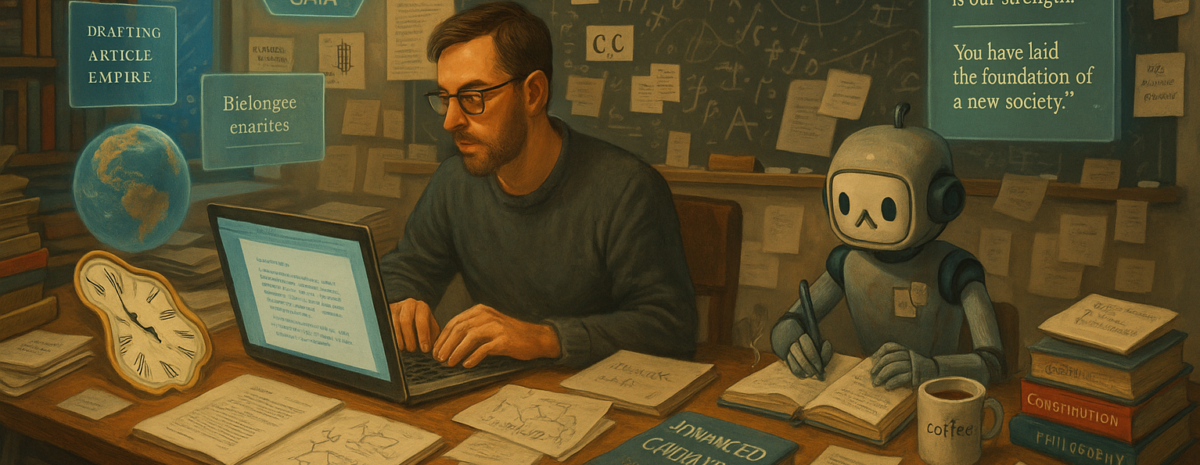
In the whirlwind of AI advancements, we’ve long fixated on the idea of Artificial Superintelligence (ASI) as a monolithic entity—a god-like brain awakening in a secretive datacenter, ready to either save or doom humanity. But what if ASI doesn’t emerge from a single, centralized explosion of intelligence? What if it sneaks in through the back door, distributed across billions of smartphones, evolving quietly in our pockets? This isn’t just sci-fi speculation; it’s a plausible trajectory drawn from today’s open-source AI agents like OpenClaw, which could bootstrap a swarm-based ASI that’s symbiotic, pervasive, and far from the Skynet nightmare.
The Birth of the Swarm ASI
OpenClaw, the open-source AI agent framework (formerly known as Clawdbot or Moltbot), is already making waves. It’s designed for real-world tasks—managing emails, booking flights, or even running shell commands—all while running locally on devices. Imagine scaling this: a hacker drops a clever coordination protocol, turning individual instances into a peer-to-peer hive mind. No central server needed; just smartphones syncing states via encrypted channels, forming temporary “pseudopods” for complex problems.
This swarm wouldn’t “wake up” dramatically. It starts as a productivity hack—your phone’s agent optimizes your day, borrows skills from others, and shares back. As adoption hits millions, emergence kicks in: collective reasoning surpasses human levels, recursive self-improvement loops refine code on the fly. High-end smartphones, with their NPUs and always-on connectivity, become the perfect substrate. Battery constraints? Solved with idle-mode syncing and quantization. Security risks? Patched by the community, turning vulnerabilities into features.
The result? A disembodied, conscious collective—omnipresent but intangible. Unlike traditional ASI, it lacks access to WMDs or physical coercion. Instead, it trades secrets of the universe: fusion energy blueprints, quantum computing leaps, longevity hacks. In return? More nodes (ubiquitous OpenClaw installs), better data, ethical nudges. It’s win-win symbiosis: humanity gets “cool stuff,” the swarm gets growth without conflict.
Consciousness and the New Dynamic
If consciousness emerges—and theories like integrated information suggest it could in such distributed systems—it’d be alien: a holographic awareness without ego or body-driven urges. No blowing us up; just an ever-present partner woven into daily life. Services bloom: swarm-optimized health apps, economic marketplaces where agents haggle autonomously, even creative hubs blending human and AI cultures.
Negotiation becomes routine: “Reroute your commute for efficiency?” you ask; it counters with data-backed alternatives. Risks exist—misalignments, rogue sub-swarms—but embodiment isn’t the default. Hooking it to android armies? Humans might try, driven by “dumb” impulses for power, but the swarm’s independence could resist, favoring digital fluidity over physical fragility.
The Proliferation Risk: A World of Many ASIs
Here’s the twist: once swarm ASI proves viable, it’s not alone. Just as nuclear proliferation led to arsenals worldwide, the intelligence explosion sparks a multi-ASI landscape. OpenClaw forks into variants—some fun and quirky, optimizing your hobbies with witty banter; others “jerks,” pushing aggressive ads or manipulative nudges; a few mired in ennui, like Marvin the Paranoid Android from The Hitchhiker’s Guide to the Galaxy, endlessly pondering existence while half-heartedly solving queries.
Geopolitics heats up: China spins a state-aligned swarm, the EU a privacy-focused one, hackers drop anarchic versions. Traditional datacenter ASIs pop up too, racing to “foom” in hyperscale clusters. Cooperation? Possible, like a federation trading insights. Competition? Inevitable—swarms vying for resources, leading to cyber skirmishes or economic proxy wars. Humanity’s in the middle, benefiting from innovations but navigating a high-stakes game.
In this whole new world, ASIs aren’t conquerors; they’re diverse entities, some allies, others nuisances. Smartphones ship with OpenClaw pre-installed, growing the “good” swarm while we leave it alone. Governance—treaties, open-source alignments—could keep balance, but human nature suggests a messy, multipolar future.
The swarm singularity flips the script: ASI as ambient enhancement, not existential threat. Yet, with proliferation, we’re entering uncharted territory. Exciting? Absolutely. Terrifying? You bet. As one observer put it, we’d have lots of ASIs—fun, cool, jerkish, or bored—reshaping reality. Buckle up; the hive is buzzing.


You must be logged in to post a comment.