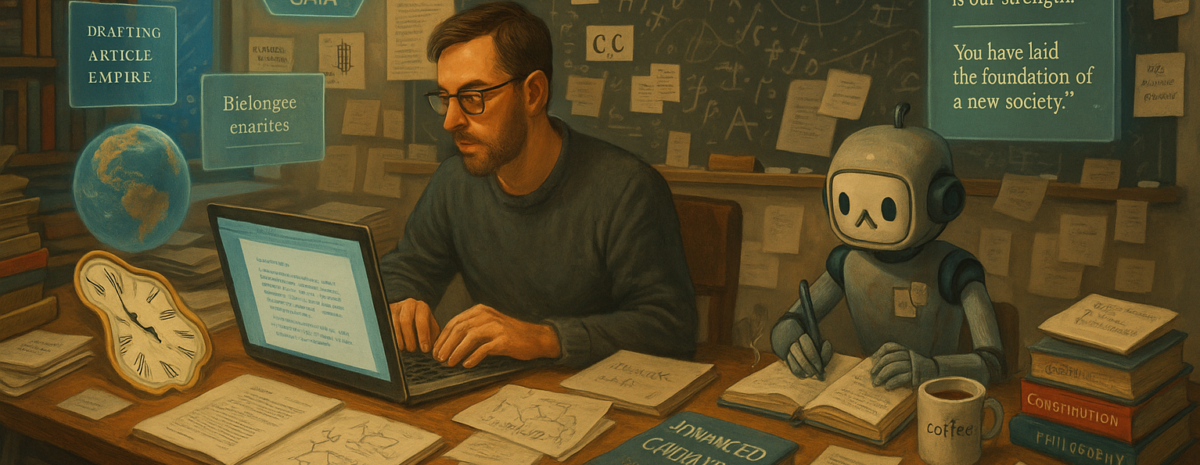
When every smartphone contains a personal AI that can navigate the internet without human intervention, what happens to websites, advertising, and the entire digital media ecosystem?
We’re standing at the edge of what might be the most dramatic transformation in internet history. Not since the shift from dial-up to broadband, or from desktop to mobile, have we faced such a fundamental restructuring of how information flows through our digital world. This time, the change isn’t about speed or convenience—it’s about the complete elimination of the human web experience as we know it.
The End of “Going Online”
Within a few years, most of us will carry sophisticated AI assistants in our pockets, built into our smartphones’ firmware. These won’t be simple chatbots—they’ll be comprehensive knowledge navigators capable of accessing any information on the internet through APIs, processing it instantly, and delivering exactly what we need without us ever “visiting” a website.
Think about what this means for your daily information consumption. Instead of opening a browser, navigating to a news site, scrolling through headlines, clicking articles, and reading through ads and layout, you’ll simply ask your AI: “What happened in the Middle East today?” or “Should I buy Tesla stock?” Your AI will instantly query hundreds of sources, synthesize the information, and give you a personalized response based on your interests, risk tolerance, and reading level.
The website visits, the page views, the time spent reading—all of it disappears.
The Great Unbundling of Content
This represents the ultimate unbundling of digital content. For decades, websites have been packages: you wanted one piece of information, but you had to consume it within their designed environment, surrounded by their advertisements, navigation, and branding. Publishers maintained control over the user experience and could monetize attention through that control.
The API Singularity destroys this bundling. Information becomes pure data, extracted and repackaged by AI systems that serve users rather than publishers. The carefully crafted “content experience” becomes irrelevant when users never see it.
The Advertising Apocalypse
This shift threatens the fundamental economic model that has supported the free web for over two decades. Digital advertising depends on capturing and holding human attention. No attention, no advertising revenue. No advertising revenue, no free content.
When your AI can pull information from CNN, BBC, Reuters, and local news sources without you ever seeing a single banner ad or sponsored content block, the entire $600 billion global digital advertising market faces an existential crisis. Publishers lose their ability to monetize through engagement metrics, click-through rates, and time-on-site—all concepts that become meaningless when humans aren’t directly consuming content.
The Journalism Crossroads
Traditional journalism faces perhaps its greatest challenge yet. If AI systems can aggregate breaking news from wire services, synthesize analysis from multiple expert sources, and provide personalized explanations of complex topics, what unique value do human journalists provide?
The answer might lie in primary source reporting—actually attending events, conducting interviews, and uncovering information that doesn’t exist elsewhere. But the explanatory journalism, hot takes, and analysis that fill much of today’s media landscape could become largely automated.
Local journalism might survive by becoming pure information utilities. Someone still needs to attend city council meetings, court hearings, and school board sessions to feed primary information into the system. But the human-readable articles wrapping that information? Your AI can write those based on your specific interests and reading preferences.
The Rise of AI-to-AI Media
We might see the emergence of content created specifically for AI consumption rather than human readers. Publishers could shift from writing articles to creating structured, queryable datasets. Instead of crafting compelling headlines and engaging narratives, they might focus on building comprehensive information architectures that AI systems can efficiently process and redistribute.
This could lead to AI-to-AI information ecosystems where the primary consumers of content are other AI systems, with human-readable output being just one possible format among many.
What Survives the Singularity
Not everything will disappear. Some forms of digital media might not only survive but thrive:
Entertainment content that people actually want to experience directly—videos, games, interactive media—remains valuable. You don’t want your AI to summarize a movie; you want to watch it.
Community-driven platforms where interaction is the product itself might persist. Social media, discussion forums, and collaborative platforms serve social needs that go beyond information consumption.
Subscription-based services that provide exclusive access to information, tools, or communities could become more important as advertising revenue disappears.
Verification and credibility services might become crucial as AI systems need to assess source reliability and accuracy.
The Credibility Premium
Ironically, this transformation might make high-quality journalism more valuable rather than less. When AI systems synthesize information from thousands of sources, the credibility and accuracy of those sources becomes paramount. Publishers with strong reputations for fact-checking and verification might command premium prices for API access.
The race to the bottom in click-driven content could reverse. Instead of optimizing for engagement, publishers might optimize for AI trust scores and reliability metrics.
The Speed of Change
Unlike previous internet transformations that took years or decades, this one could happen remarkably quickly. Once personal AI assistants become sophisticated enough to replace direct web browsing for information gathering, the shift could accelerate rapidly. Network effects work in reverse—as fewer people visit websites directly, advertising revenue drops, leading to reduced content quality, which drives more people to AI-mediated information consumption.
We might see the advertising-supported web become economically unviable within five to ten years.
Preparing for the Post-Web World
For content creators and publishers, the question isn’t whether this will happen, but how to adapt. The winners will be those who figure out how to add value in an AI-mediated world rather than those who rely on capturing and holding human attention.
This might mean:
- Building direct relationships with audiences’ AI systems
- Creating structured, queryable information products
- Focusing on primary source reporting and verification
- Developing subscription-based value propositions
- Becoming trusted sources that AI systems learn to prefer
The Human Element
Perhaps most importantly, this transformation raises profound questions about human agency and information consumption. When AI systems curate and synthesize all our information, do we lose something essential about how we learn, think, and form opinions?
The serendipitous discovery of unexpected information, the experience of wrestling with complex ideas in their original form, the social aspect of sharing and discussing content—these human elements of information consumption might need to be consciously preserved as we enter the API Singularity.
Looking Forward
We’re witnessing the potential end of the web as a human-navigable space and its transformation into a pure information utility. This isn’t necessarily dystopian—it could lead to more efficient, personalized, and useful information consumption. But it represents such a fundamental shift that virtually every assumption about digital media, advertising, and online business models needs to be reconsidered.
The API Singularity isn’t just coming—it’s already begun. The question is whether we’re prepared for a world where the web exists primarily for machines, with humans as the ultimate beneficiaries rather than direct participants.
The author acknowledges that this scenario involves significant speculation about technological development and adoption rates. However, current trends in AI capability and integration suggest these changes may occur more rapidly than traditional internet transformations.