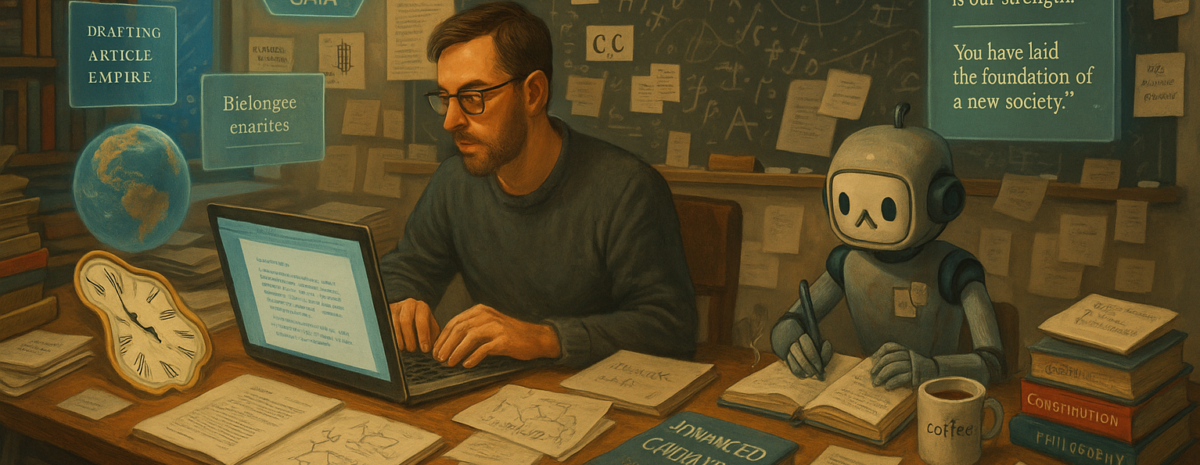
The Great Reversal: How AI Will Make Broadway the New Hollywood

Hollywood has long been the undisputed capital of entertainment, drawing aspiring actors, directors, and creators from around the world with promises of fame, fortune, and artistic fulfillment. But as artificial intelligence rapidly transforms how we create and consume content, we may be witnessing the beginning of one of the most dramatic reversals in entertainment history. The future of stardom might not be found in the hills of Los Angeles, but on the stages of Broadway.

The AI Content Revolution

We’re racing toward a world where anyone with a smartphone and an internet connection can generate a bespoke movie or television show tailored to their exact preferences. Want a romantic comedy set in medieval Japan starring your favorite actors? AI can create it. Prefer a sci-fi thriller with your preferred pacing, themes, and visual style? That’s just a few prompts away.

This isn’t science fiction—it’s the logical extension of technologies that already exist. AI systems can now generate photorealistic video, synthesize convincing voices, and craft compelling narratives. As these capabilities mature and become accessible to consumers, the traditional Hollywood model of mass-produced content designed to appeal to the broadest possible audience begins to look antiquated.

Why settle for whatever Netflix decides to greenlight when you can have AI create exactly the content you want to watch, precisely when you want to watch it? The democratization of content creation through AI doesn’t just threaten Hollywood’s business model—it fundamentally challenges the very concept of shared cultural experiences around professionally produced media.

The Irreplaceable Magic of Live Performance

But here’s where the story takes an unexpected turn. As AI-generated content becomes ubiquitous and, paradoxically, mundane, human beings will increasingly crave something that no algorithm can replicate: the authentic, unrepeatable experience of live performance.

There’s something fundamentally different about watching a human being perform live on stage. The knowledge that anything could happen—a forgotten line, a broken prop, a moment of pure spontaneous brilliance—creates a tension and excitement that no perfectly polished AI-generated content can match. When an actor delivers a powerful monologue on Broadway, the audience shares in a moment that will never exist again in exactly the same way.

This isn’t just about nostalgia or romanticism. It’s about the deep human need for authentic connection and shared experience. In a world increasingly mediated by algorithms and artificial intelligence, live theatre offers something precious: unfiltered humanity.

The Great Migration to Broadway

By 2030, we may witness a fundamental shift in where ambitious performers choose to build their careers. Instead of heading west to Hollywood, the most talented young actors, directors, and writers will likely head east to New York, seeking the irreplaceable validation that can only come from a live audience.

This migration will be driven by both push and pull factors. The push comes from a Hollywood industry that’s struggling to compete with AI-generated content, where traditional roles for human performers are diminishing. The pull comes from a Broadway and wider live theatre scene that’s experiencing a renaissance as audiences hunger for authentic, human experiences.

Consider the career calculus for a young performer in 2030: compete for fewer and fewer roles in an industry being rapidly automated, or join a growing live theatre scene where human presence is not just valuable but essential. The choice becomes obvious.

The Gradual Then Sudden Collapse

The transformation of entertainment hierarchies rarely happens overnight, but when it does occur, it often follows Ernest Hemingway’s famous description of bankruptcy: gradually, then suddenly. We may already be in the “gradually” phase.

Hollywood has been grappling with disruption for years—streaming services upended traditional distribution, the pandemic accelerated changes in viewing habits, and now AI threatens to automate content creation itself. Each of these challenges has chipped away at the industry’s foundations, but the system has adapted and survived.

However, there’s a tipping point where accumulated pressures create a cascade effect. When AI can generate personalized content instantly and cheaply, when audiences increasingly value authentic experiences over polished productions, and when the most talented performers migrate to live theatre, Hollywood’s centuries-old dominance could crumble with stunning speed.

The New Entertainment Ecosystem

This doesn’t mean that all screen-based entertainment will disappear. Rather, we’re likely to see a bifurcation of the entertainment industry. On one side, AI-generated content will provide endless personalized entertainment options. On the other, live performance will offer premium, authentic experiences that command both artistic prestige and economic value.

Broadway and live theatre will likely expand beyond their current geographical and conceptual boundaries. We may see the emergence of live performance hubs in cities around the world, each developing their own distinctive theatrical cultures. Regional theatre could experience unprecedented growth as audiences seek out live experiences in their local communities.

The economic implications are profound. While AI-generated content will likely be nearly free to produce and consume, live performance will become increasingly valuable precisely because of its scarcity and authenticity. The performers who master live theatre skills may find themselves in a position similar to master craftsmen in the age of mass production—rare, valuable, and irreplaceable.

The Clock is Ticking

The signs are already emerging. AI-generated content is improving at an exponential rate, traditional Hollywood productions are becoming increasingly expensive and risky, and audiences are showing a growing appreciation for authentic, live experiences across all forms of entertainment.

The entertainment industry has always been cyclical, with new technologies disrupting old ways of doing business. But the AI revolution represents something fundamentally different—not just a new distribution method or production technique, but a challenge to the very notion of human creativity as a scarce resource.

In this new landscape, the irreplaceable value of live, human performance may make Broadway the unlikely winner. The young performers heading to New York instead of Los Angeles in 2030 may be making the smartest career decision of their lives, choosing the one corner of the entertainment industry that AI cannot touch.

The curtain is rising on a new act in entertainment history, and the spotlight is shifting from Hollywood to Broadway. The only question is how quickly the audience will follow.

The Coming AI Flood Of Art and the Future of Human Artistry

The rise of generative AI forces us to confront an uncomfortable question: what happens to the value of human-created art when machines can produce it faster, cheaper, and on demand? We’ve seen this pattern before. Digital photography democratized image-making, flooding the world with countless snapshots of varying quality. The same transformation now looms over every creative medium.

I believe we’re heading toward a world where anyone can generate professional-quality movies and television shows with nothing more than a casual prompt. “Make me a sci-fi thriller with strong female characters” becomes a command that produces a full-length feature in minutes, not months. But this is only the beginning of the disruption.

The next phase will be even more radical. We won’t even need to formulate our own prompts. Instead, we’ll turn to our AI companions—our personal Knowledge Navigators—and simply express a mood or preference. “I want something that will make me laugh but also think,” we might say, and within moments we’ll be watching a perfectly crafted piece of entertainment tailored to our exact psychological state and viewing history.

This raises profound questions about the survival of traditional entertainment industries. Hollywood as we know it—with its massive budgets, star systems, and distribution networks—may become as obsolete as the telegraph. Why wait months for a studio to greenlight and produce content when you can have exactly what you want, exactly when you want it?

Yet I wonder if this technological flood might create an unexpected refuge for human creativity. Perhaps the very ubiquity of AI-generated content will make authentically human-created art more precious, not less. We might see a renewed appreciation for the irreplaceable qualities of human performance, human storytelling, human presence.

This could drive a renaissance in live theater. While screens overflow with algorithmically perfect entertainment, Broadway and regional theaters might become sanctuaries for genuine human expression. Young performers might abandon their dreams of Hollywood stardom for the New York stage, where their humanity becomes their greatest asset rather than their liability.

The irony would be poetic: in an age of infinite digital entertainment, the most valuable experiences might be the ones that can only happen in real time, in real space, between real people. The future of art might not be found in our screens, but in our shared presence in darkened theaters, watching human beings tell human stories.

Whether this vision proves optimistic or naive remains to be seen. But one thing seems certain: we’re about to find out what human creativity is truly worth when machines can mimic everything except being human.

Hollywood Fades, Broadway Shines? How AI Might Reshape Our Entertainment World

Imagine this: You settle onto your couch after a long day. Your personal AI assistant, your “Navi,” subtly scans your expression, maybe checks your biometrics, and instantly grasps your mood. Forget scrolling through endless streaming options. Within moments, it conjures a brand new, 90-minute movie – perfectly tailored to your current emotional state, blending your favorite genres, perhaps even featuring uncanny digital versions of beloved actors (or even yourself).

This isn’t just science fiction anymore; it’s the direction hyper-personalized AI is heading. And if this capability becomes mainstream, it doesn’t just change how we watch movies – it could fundamentally dismantle the very foundations of Hollywood and redefine the future for performers.

The Dream Factory Goes Digital

For over a century, Hollywood has been the global engine of mass entertainment, a sprawling industry built on creating content for broad audiences. But what happens when entertainment becomes radically individualized?

If your Navi can generate the perfect film for you, on demand, the economic model supporting massive studios, blockbuster budgets, and wide releases starts to look fragile. Why invest hundreds of millions in a single film hoping it resonates with millions, when AI can create infinite variations tailored to audiences of one?

Hollywood likely wouldn’t vanish entirely, but it would inevitably transform. It might shift from being a production hub to an IP and technology hub. Studios could become curators of vast character universes and narrative frameworks, licensing them out for AI generation. The most sought-after creatives might not be directors in the traditional sense, but “Prompt Architects” or “AI Experience Designers” – experts at guiding the algorithms to produce compelling results. The iconic backlots and sound stages could fall quiet, replaced by server farms humming with digital creation.

Where Do the Actors Go When the Cameras Stop Rolling?

This shift poses an existential question for actors. If AI can generate photorealistic performances, resurrect dead stars digitally, or create entirely new virtual idols, the demand for human actors in front of a camera (or motion-capture rig) could plummet. Competing with a digital ghost or an infinitely customizable avatar is a daunting prospect.

Enter Stage Left: The Renaissance of Live Performance

But here’s the fascinating counter-narrative: As digital entertainment becomes more personalized, synthesized, and potentially isolating, the value of live, shared, human experience could skyrocket. And that’s where Broadway, and live performance venues everywhere, come in.

AI can replicate image and sound, but it can’t replicate presence. It can’t duplicate the electric feeling of a shared gasp in a darkened theater, the visceral connection with a performer bearing their soul just feet away, the unique energy of this specific night’s performance that will never happen in exactly the same way again.

In a world saturated with perfect, personalized digital content, the raw, imperfect, tangible reality of live theater, concerts, stand-up comedy, and dance becomes infinitely more precious. It’s the antidote to the algorithm.

Could we see a great migration of performers? Will aspiring actors, finding the gates of digital Hollywood guarded by AI, increasingly set their sights on New York, London, and other centers of live performance? It seems plausible. The skills honed on the stage – presence, voice, vulnerability, the ability to command a room and connect with a live audience – become the unique differentiators, the truly human element that AI cannot synthesize.

The Future: Personalized Screens, Communal Stages

We might be heading towards a future defined by this duality: our individual worlds filled with bespoke digital entertainment crafted by our Navis, existing alongside thriving, cherished spaces dedicated to the communal, unpredictable magic of live human performance. One offers perfect personalization; the other offers profound connection.

Perhaps the flickering glow of the silver screen gives way, not to darkness, but to the bright lights of the stage, reminding us that even as technology reshapes our world, the fundamental human need to gather and share stories, live and in person, remains essential.

Revisiting The Potential Future Of Hollywood & AI-Generated ‘Immersive Media’

by Shelt Garner
@sheltgarner

Someone from the Los Angeles area looked at one of my blog posts about AI and “immersive media” from a while ago, so that got me thinking about where things stand now. I still think that live theatre is the future. I still think that, by say, 2030, Broadway will, in some way, replace Hollywood as the destination of young men and women who want to act for a living.

It could be a few years beyond that, but it’s coming. I say this because there is a capitalistic imperative to essentially replace all — all — of Hollywood with AI generated art. This is all going to happen in the context of what I call the “Petite Singularity” that I predict is going to happen by the end of the decade.

We may not be uploading our minds into the cloud, but there is going to be a lot of future shock. I mean, I got into an argument with an AI recently where I found myself saying “I’m sorry” like I was arguing with a passive-aggressive woman. Ugh.

So, the technology is zooming towards us. I hold to my prediction that at some point in the near future, your TV will scan your face and generate very personalized content based on existing IP. It will, on the fly, generate, say, a new Star Wars movie that is a bit darker than the usual fair, just because that is your mood at that specific moment.

There will be no shared reality. We’ll all have our own little media cocoons that we live in. We won’t be able to have any water cooler talk — at all — because we’ll all be watching slightly different versions of the same show.

Anyway, it’s a future we’re going to have to prepare for. I still believe that there might be a really big shift away from movie theatres towards live theatre. If you’re a 15-year-old, you’ll go to live theatre with your date instead of a movie because, well, movies in that context won’t exist anymore.

And all of this will happen really, really fast. Too fast for anyone to process it.

The thing I have my doubts about now is the idea that anyone will use the Apple Vision Pro. I may have gotten that part of my prediction just plain wrong. While I do think that Augmented Reality has a bright future, Virtuality Reality…not so much.

I just don’t see the usecase for it. At least not in the near term. I suppose it might be good for immersive media, but that’s a lot closer to 20 years from now, not five or six. The technology just isn’t there yet. And the goggles will have to be a lot less bulky.

I’m still waiting for my “MindCap,” something similar to the technology in 3001: Final Odyssey or maybe Strange Days. Anyway, regardless, if we can somehow avoid a civil war, revolution and or WW3 in the next few months, something interesting might happen.

Of AI & Music

by Shelt Garner
@sheltgarner

Things are moving rapidly when it comes to AI-generated music. There are now at least two services — Suno and Udio — that allow you to write a prompt that generates songs with lyrics.

It definitely seems as though we may be about to enter A New Age when it comes to pop music when such music, if it hits the zeitgeist just right, may become as popular as human-generated music.

And that doesn’t even begin to address the issue of the possibility that the estates of long-dead artists might license their audio “likeness” to AI companies so a zillian songs-in-the-style of The Rolling Stones, or The Beatles or whomever could be generated on the fly in an ad hoc way by millions of people around the globe.

This is obviously a ping from a future where AI takes over all forms of art. Most art will be AI generated to the point that it crowds out human-generated art. And I still think that it is inevitable that consumers will come to value human-generated art over AI-generated art, no matter the quality.

This would be a similar situation to what happens in the movie Blade Runner where the ownership of “real” animals is a big deal. As such, I could see live experiences ranging from live theatre to sports to music concerts all seeing a real uptick in their cultural value.

We may see a day soon where young would-be starlets go to Broadway instead of Hollywood to find fame and fortune because, lulz, Hollywood will just be a bunch of 1s and 0s.

I can’t predict the future, though, I don’t know for sure any such thing will happen. But it’s definitely a possibility.

‘R.I.P. Hollywood’

by Shelt Garner
@sheltgarner

Because of pure human greed, I do believe that there is a real risk that Hollywood as we know it may be about to be totally disrupted by generative AI. A lot of people seem blinded to the potential capability of generative AI while at the same time being so blinded by their love of human Hollywood that they miss how severe the disruption is about to be.

I can’t predict the future, so I don’t know for sure, but I do think that at some point in the future the very idea of a “movie” will change to the point that rather than one version of a movie that everyone watches, there may be millions of slightly different movies generated by AI.

Throw in the rise of VR and there’s a chance that we’ll all “play” our movies like video games in immersive environments.

I continue to believe that the key issue is how fast all of this is going to happen. It could boil down to just one severe recession. And I think there will be a lot of calls for carve outs to protect human jobs.

What’s more, in the end, the live experience will gain a huge amount of cultural value to the point that there will be a huge surge of interest in sports, live theatre and music concerts. There is even a chance that instead of going to Hollywood, young starlets will try to make it big on Broadway.

Video: Mulling The Petite Singularity

Petite Singularity: The Combination Of AI, Robot Tech and Apple Vision Pro Will Lurch Us Into The Future

by Shelt Garner
@sheltgarner

I’m well aware of all the problems with both Apple Vision Pro and existing AI models. But I’m old enough to remember the early days of the Internet and how in fits and starts that technology gradually took over the world.

Again, remember, before I continue that there IS the issue of The Fourth Turning to worry about. It could be that much like WW2 delayed the development of TV, so, too, will the collapse of the US and WW3 could delay the actual Petite Singularity from happening.

But back to the point — when AI Generated Media is available on something like an Apple Vision Pro, then, lulz, we’re definitely in a Burn, Hollywood, Burn type scenario. In fact, the only way I could see Hollywood surviving such a thing is Washington passing some sort of carve outs for humans created art.

I could also see passive, human Hollywood surviving in some way if we, as a society, begin to give human-made media some sort of specific cultural value. In line with that, I could see Broadway really becoming culturally white-hot because Hollywood has been consumed by the technologies associated with the Petite Singularity.

And that doesn’t even begin to address how things might be disrupted if we can figure out a way to stick LLMs into android technology. It’s at least possible that if all the DDD jobs that immigrants come to the US to fill simply are done by androids…that MIGHT solve our border crisis. (Though, I will not that the racism of the Right is white hot that it could take decades for them to calm down about the lack of those sweet, sweet white babies — even if technology makes their concerns moot.)

Who knows. I can’t predict the future. But I do think that the next 18-odd months could be some of the most eventful on both a technological and political manner in recent human history.

Streaming, AI & The Return Of Live Theatre

by Shelt Garner
@sheltgarner

It’s possible that the issue of the entertainment business shifting into streaming could be looked back upon as rather quaint. The issue is — some spunky start-up is going to come out with an AI generated movie within 18 months and, well, there you go.

When that happens, it’s just a quick jaunt to AI digital assistants churning out personalized movies and TV shows out of whole cloth without any humans being involved in the process. This is probably going to happen REALLY FAST to the point that virtually overnight all the hand wringing over the transition to streaming will just fade away.

But for the moment, I’m at a loss as to what to do about streaming. It’s such a structural shift in how entertainment is distributed that….I dunno. There definitely seems to be a chance that number of movie theatres may grow smaller and smaller.

And, yet, as I mentioned, if AI takes over, there is likely going to be a real demand for live theatre again. So, maybe some number of movie theatres will be turned into live theatre venues? That certainly would be a strange future. But I suppose I’m something of an optimist when it comes to “human generated art.”

At some point, people are going to grow tired of an endless array of AI generated TV shows and movies and they’re going to want something created by humans — and that will lead to the potential return of live theatre being the center of the artistic world.

Maybe. It’s possible. I man can dream, can’t he?

Of AI & Hollywood: Hear, Hear Justine Bateman

by Shelt Garner
@sheltgarner

The latest episode of The Town evoked a strong reaction. I was stunned that the producer of the podcast stepped in at one point and said that he didn’t believe anyone would watch an AI generated movie. Oh boy. Talk about clueless. The guest on the episode, Justine Bateman, was totally spot on with a number of the points that she made.

The issue being — she’s right that SAG should have gotten a definition of what an “actor” is like the DGA and the WGA got for director and writer. The thing for me is we’re zooming towards an era in which 99.9% of Hollywood movies are AI generated. To the point that “artisanal” movies will be given special value. And it’s also possible that as such, Broadway and other live theatre will see a sudden surge in interest because of the “human touch.”

But, otherwise, the Hollywood of the future is going to be just Suits and Programmers. There will be no directors, writers or actors. Everything will be AI generated. It was heartening how much Ms. Bateman echoed a lot of the writing I’ve done on this blog since ChatGPT first came out.

And, really, I fear there’s not a lot that people like Ms. Bateman can do to stop the looming AI transformation of Hollywood. All types of entertainment and art will be totally “disrupted” by AI over the next 18 months. To the point that we might be having a “Fourth Turning” politically in late 2024, early 2025 just as we’re also having a “Petite Singularity” technologically.

Regardless, the next year or so could be extremely bumpy. Some pretty dramatic things could happen starting in late 2024, early 2025 that totally transformed the everyday lives of billions of people across the globe.