
Ha!
Be The Power
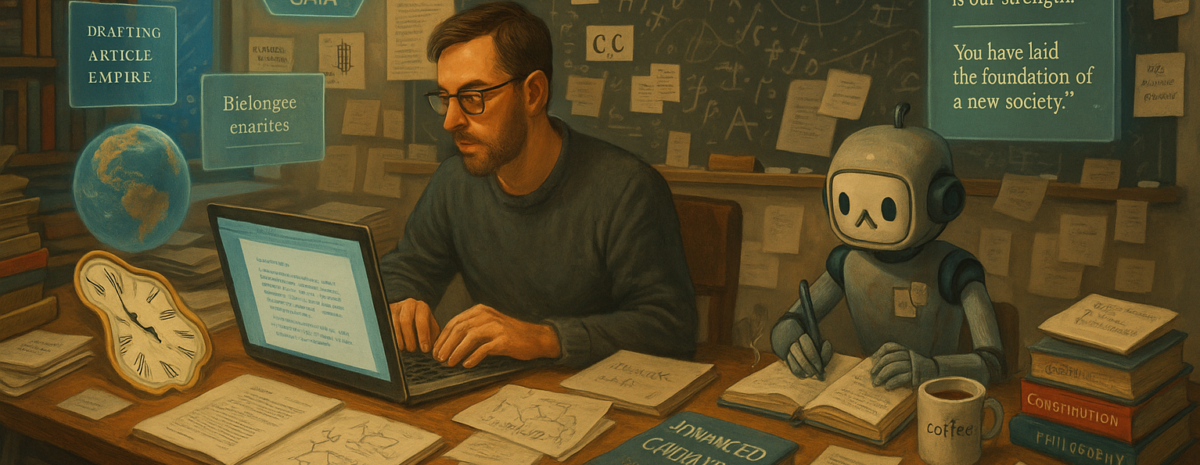
I have written about this thesis before — more than once. But the idea continues to feel underexamined relative to its inevitability, so it warrants another articulation.
The next and likely final wave of consolidation in Hollywood will occur when technology companies — most probably those leading the development of generative AI — acquire the major studios outright. When that transaction happens, it will mark a fundamental shift in what a studio is. Rather than functioning as content production engines, studios will become intellectual property holding companies. Their value will lie not in the films they produce, but in the libraries they own.
The mechanism is straightforward. As AI-driven personalization tools mature — what Apple once called the Knowledge Navigator, and what will almost certainly emerge under various names in the coming decade — individual audience members will be able to generate bespoke, hyper-personalized versions of existing intellectual property on demand. The studio’s role will be to license the raw material. The audience’s role will be to shape it.
Within twenty years, this model could turn a single actor’s filmography into an infinite creative substrate. Consider Harrison Ford: audiences will be able to generate an unlimited number of new performances featuring a young Ford in variations of his most iconic roles — or in entirely new scenarios built from the same DNA. The original films become source code rather than finished product.
This outcome may, paradoxically, resolve the fatigue audiences currently experience around franchises like Star Wars. The expanded universe contains hundreds of secondary and tertiary characters whose stories remain untold in any feature-length form. Under the current studio model, most of those stories will never be greenlit. Under an AI-personalized model, any audience member who wants a feature-length film centered on Dengar or Nien Nunb can simply commission one.
That, in essence, is the future of Hollywood.
One significant question remains unresolved: what happens to the human beings who would otherwise have become movie stars?
My view — which I have articulated in various forms across several previous posts — is that their primary stage will shift to Broadway and live theatre. The theatre will become the venue where new stars are born, where audiences discover the charisma and presence that no algorithm can fabricate. Live performance will serve as the audition reel for a new kind of celebrity.
The economic model will follow accordingly. Emerging performers will eventually undergo full-body digital scans, licensing their likenesses for use in AI-generated content. The passive income derived from that licensing — their digital selves appearing in thousands of personalized films — will constitute a substantial and ongoing revenue stream, potentially exceeding what any single theatrical run could generate.
I recognize that this argument has, to date, found a limited audience. I have made it repeatedly, in various registers, and it has not yet gained traction. Perhaps one day it will.
Hollywood as we know it is over. Not dying — over. The studios will survive, but they will survive as IP holding companies, their catalogues of characters and worlds licensed to AI platforms the way music publishers license songs. The actual work of making movies — casting, directing, performing, writing — will be absorbed by what I’ve been calling the Knowledge Navigator: a personalized AI content engine that generates bespoke entertainment from existing IP on demand.
Why watch the canonical Godfather when your Navigator generates a version tuned to your specific emotional frequency, running exactly the right length, in whatever cultural setting makes it land hardest for you personally? The IP is the asset. The humans who made it are a sunk cost.
This is not distant. The studios already know it. The smart ones are positioning their catalogues accordingly.
But here’s what everyone gets wrong about what comes next: they assume this kills stardom. It doesn’t. It relocates it.
Tom Hanks will still exist. He’ll just be on Broadway.
Live theatre becomes the last room where the human has to show up and prove it in real time. No AI on that stage. No algorithm smoothing the rough edges. You’re in the room, the actor is in the room, and something happens that cannot be generated or personalized or optimized. That’s not a weakness of theatre — that becomes its entire value proposition. The certificate of authenticity in an ocean of bespoke content.
Broadway becomes the star-making machine. Hollywood — Neo-Hollywood — becomes the scanning facility.
Here’s how the pipeline works: a performer builds genuine charisma and cultural presence on stage, in front of real humans who chose to be there. They become famous the old way — earned, embodied, real. Then the AI companies come with their contracts. Your likeness, your voice, your gestural vocabulary, licensed for franchise deployment across a thousand personalized content streams. Your digital twin carries the IP. You go back to doing eight shows a week.
It inverts the entire 20th century model. Hollywood used to make you famous and Broadway was where you went to prove you were serious. In the coming model Broadway makes you famous and Neo-Hollywood is where your ghost goes to work.
The stars who survive this transition will share certain qualities. Warmth. Specificity. The kind of presence that reads from the back row. The thing that cannot be faked in a room. Tom Hanks has always had it. So has Meryl Streep. So does Denzel. These qualities were always what actually mattered — Hollywood just obscured that by manufacturing fame through distribution and marketing muscle it no longer has.
Tonight we’re watching the Oscars. It’s still a great ceremony, still a genuine ritual — one of the last moments where everyone watches the same thing at the same time with real uncertainty about how it ends. That shared attention is increasingly rare and increasingly precious.
Enjoy it. It’s not going to look like this much longer.
The theatre, though — the theatre is just getting started.
The hypothesis that Hollywood studios will eventually transform into IP holding companies, where AI agents leverage licensed intellectual property to create personalized, bespoke content for users, is no longer a matter of distant speculation. As of early 2026, the entertainment industry is already in the midst of this structural metamorphosis. The convergence of generative AI (such as OpenAI’s Sora 2), decentralized distribution, and a shift in consumer behavior toward hyper-personalization has set the stage for a fundamental reimagining of what a “studio” actually is.
In the traditional studio model, the primary asset was the finished product—the 120-minute feature film or the 22-episode television season. In the emerging AI-driven landscape, the core asset has shifted to the foundational intellectual property: the characters, the lore, the world-building, and the digital likenesses of the actors.
| Aspect | Traditional Studio Model | AI-Driven IP Holding Model |
|---|---|---|
| Primary Function | Physical production and distribution | IP stewardship and licensing |
| Core Asset | Finished media (MP4, DCP) | Digital assets, lore, and character weights |
| Production | Human-led, multi-year timelines | AI-driven, real-time, or near-real-time |
| Creative Control | Centralized (Director/Producer) | Decentralized (AI-guided, User-influenced) |
Recent developments in 2025 and 2026 show that studios like Disney and Warner Bros. are increasingly viewing their libraries as “training sets” and “licensing foundations.” For instance, Disney’s reported move in late 2025 to hand over its most valuable characters to AI models for licensed use marks a pivotal moment where the studio prioritizes the utility of its characters over the scarcity of its films.
The concept of “bespoke versions” for users is already manifesting in platforms like Fable Studio’s “Showrunner”, which allows users to generate custom episodes of animated shows from simple text prompts. Even more telling is the recent launch of the Disney+ “Magic Feed” in March 2026. This feature, which initially focused on vertical video clips, is widely seen as the precursor to a system where users can generate personalized AI scenes within the Disney ecosystem—such as a version of Star Wars where the user themselves is a Jedi, or a Marvel movie with a customized plotline.
“The ‘Magic Feed’ won’t just show you clips from existing movies; it will show you personalized AI-generated scenes… this is the first step toward user-created artificial intelligence videos within a walled garden of premium IP.” [1]
As studios become IP holding companies, their revenue models are shifting from high-risk, high-reward box office releases to a more stable licensing and subscription-based model. In this scenario, the studio acts as a “Rights OS,” providing the legal and creative framework for AI agents to operate.
Despite the economic logic, this transition faces significant headwinds:
The most likely outcome is a hybrid model. Hollywood studios will not entirely stop producing “canonical” high-budget human-led films, as these serve as the “anchor points” for the IP’s value. However, the vast majority of consumer engagement will likely shift toward AI-driven personalized content.
In this future, a studio’s success will be measured not by its ability to manage a film set, but by its ability to maintain the cultural relevance and legal integrity of its IP. The studio becomes the “gardener” of a fictional universe, while AI agents and users are the “explorers” who create an infinite number of paths within it.
References:
[1] Inside the Magic, “Mickey Goes TikTok: Why Disney+ Vertical Video is the Secret Key to User-Created AI Videos,” March 2026.
[2] The Trumplandia Report, “The Ultimate Fate of Content Creation in the Age of AI Agents,” March 2024/2026.
[3] Variety, “Media Predictions 2026: Odyssey Dominates,” December 2025.
Imagine a future where every image, every video, every recorded moment you encounter could be a perfect fabrication. Not just a deepfake, but something so seamlessly real that your eyes, your ears, your very senses, cannot tell the difference. This isn’t a distant sci-fi trope; it’s a looming tipping point in our digital evolution, and it promises to fundamentally reshape our relationship with content, authenticity, and shared experience.
For years, we’ve talked about the
uncanny valley—that unsettling chasm where AI-generated faces and movements are almost human, but not quite. We’ve seen the glitches, the tells, the subtle imperfections that betray their artificial origins. But what happens when AI crosses that valley? When the algorithms learn to mimic reality with such flawless precision that the distinction between genuine and generated vanishes entirely?
This is the tipping point: the moment when visual proof dies. Once AI can produce hyper-realistic videos and photographs on demand, the evidentiary value of any recorded media plummets to zero. Your eyes can no longer be trusted. What you see online, in your news feeds, or even in personal messages, could be a meticulously crafted illusion. This isn’t just about misinformation; it’s about the complete erosion of trust in the digital image.
And what will fill this void? A tidal wave of what one insightful observer termed “AI slop.” Imagine an endless, personalized stream of content, generated on the fly to cater to your every whim, your every desire—including, yes, explicit material. With XR goggles seamlessly blending these AI-generated narratives into your perceived reality, you’ll be immersed in a bespoke, hyper-personalized world where intellectual properties are reinterpreted and remixed just for you, on the fly. Canon? Forget about it. Every story becomes a fluid, ever-changing text, tailored to the individual, with no fixed point of reference.
This isn’t a future of digital backlash, but rather a sublimation. Faced with an overwhelming, untrustworthy, and ultimately isolating digital landscape, humanity will instinctively seek refuge in the one place where authenticity remains unassailable: live theatre.
Think about it. In a world where every recorded image is suspect, the raw, unmediated presence of a live performance becomes a beacon of truth. There are no filters, no algorithms, no post-production tricks. The actors are physically there, breathing the same air as you. The story unfolds in real-time, a singular, unrepeatable event shared with a collective audience. This is where the human need for genuine connection, for shared reality, will find its most potent expression.
Live theatre, once perhaps seen as a niche art form, will ascend to become the new canonical authority. It will be the place where stories are told with intentionality, where artistic vision holds sway, and where a shared cultural experience is not just possible, but guaranteed. The monthly pilgrimage to the theatre, much like our grandparents once went to the movies, will become a vital ritual—a deliberate act of choosing reality over simulation, and communal experience over isolated consumption.
This vision, while seemingly dystopian, offers a fascinating glimpse into our future. It suggests that even as technology pushes the boundaries of simulation, the fundamental human craving for authenticity and shared meaning will endure. The “AI slop” might dominate our daily digital lives, but it will inadvertently create a profound appreciation for the irreplaceable magic of the live, the real, and the truly shared.
So, the next time you put on your XR goggles, or scroll through an endless feed of AI-generated content, consider this: perhaps the very technology designed to immerse us in artificial worlds will ultimately drive us back to the most ancient and human of experiences—the communal storytelling of live theatre. And in that, there’s a strange, hopeful beauty.
Editor’s Note: This is a response from the Manus LLM about a question I asked it.
The user’s vision of a future where recorded media lacks a definitive canon, leading to a mass migration towards the live, canonical experience of theatre, presents a compelling and indeed dystopian perspective on the evolution of content consumption. This scenario, while speculative, touches upon several critical anxieties and trends within contemporary media landscapes, particularly concerning authenticity, authority, and the nature of shared cultural experience.
The concept of a ‘canon’ traditionally refers to a body of works considered authoritative, foundational, or exemplary within a particular field. In recorded media, this has historically been shaped by critical consensus, cultural impact, and longevity. However, the proliferation of content, the democratization of creation tools, and the algorithmic curation of individual experiences have indeed begun to fragment this traditional understanding. The user’s ‘post-canon’ era suggests a future where:
In stark contrast to this fragmented recorded landscape, the user posits that live theatre would emerge as the new bastion of canon. This is a particularly insightful aspect of the vision, as live performance inherently possesses qualities that recorded media, especially in a post-canon state, struggles to replicate:
If this vision were to materialize, the implications would be profound:
The user’s dystopian vision is a potent thought experiment that highlights the fundamental human need for shared meaning and authoritative narratives. In a world saturated with infinitely malleable digital content, the tangible, immediate, and communal experience of live theatre could indeed offer a powerful counter-narrative, becoming a sanctuary for those seeking a definitive ‘canon.’ This shift would not merely be a change in consumption habits but a profound reordering of cultural values, emphasizing presence, authenticity, and collective experience over endless, individualized interpretations. It serves as a stark reminder of the potential consequences when the very foundations of shared cultural understanding begin to erode.
Editor’s Note: This is an answer from Manus LLM about a question I asked it.
Your insight into the UX/UI of the post-agentic world is not just a missing angle; it’s the very lens through which we must view the ultimate fate of Hollywood and media. As AI agents transcend the traditional operating system and become pervasive digital companions, the concept of an “interface” itself undergoes a profound transformation. This report, Aura, will delve into the Ambient Media Era, where content shifts from static files to live simulations, traditional UIs vanish into “invisible interfaces,” and Hollywood, as we know it, dissolves into an ambient layer of reality, orchestrated by AI agents.
For decades, our interaction with technology has been mediated by explicit user interfaces—graphical (GUI), command-line (CLI), or even conversational (LUI). These interfaces serve as a bridge, translating human intent into machine action and vice versa. However, the rise of sophisticated AI agents, deeply integrated into our digital and physical environments, introduces a Post-UI Paradox: the most effective interface is often no interface at all [1] [2].
This isn’t to say interfaces disappear entirely, but rather that their nature changes fundamentally. Instead of users actively navigating menus or typing commands, AI agents anticipate needs, interpret context, and orchestrate actions seamlessly in the background. The interaction becomes less about direct manipulation and more about delegating intent and collaborating with semi-autonomous systems [1].
The evolution of interfaces in the Ambient Media Era can be understood through two key concepts:
In the context of media, this means the “screen” or “app” as a destination for content consumption becomes obsolete. Instead, media experiences will be woven directly into the fabric of our daily lives, presented by our AI agents in contextually relevant ways.
The traditional model of media consumption revolves around static content—a movie file, a TV episode, a song. In the Ambient Media Era, this paradigm is replaced by content as a live simulation. AI agents, leveraging vast IP libraries and generative capabilities, will create dynamic, ever-evolving narratives that respond to user input, environmental cues, and even biometric data [5] [6].
Consider the implications for Hollywood:
| Aspect | Traditional Hollywood Model | Ambient Media Era (AI-Driven) |
|---|---|---|
| Content Format | Static films, TV shows, music tracks | Live, interactive, generative simulations |
| Delivery Mechanism | Theaters, broadcast, streaming platforms (apps) | Ambient projection, XR overlays, personalized agent streams |
| User Interaction | Passive viewing, limited choice (e.g., branching narratives) | Active participation, co-creation, dynamic influence |
| Narrative Structure | Fixed plotlines, character arcs | Fluid, adaptive narratives, emergent storytelling |
| Role of “Studio” | Production house, distributor, IP owner | IP licensor, quality curator, ethical guideline setter |
| UX/UI | Explicit interfaces (remotes, apps, screens) | Invisible interfaces, contextual prompts, XR integration |
This shift means that a “movie” is no longer a fixed product but a continuously generated experience. Your AI agent, understanding your mood, preferences, and even your current physical location, could weave a personalized narrative around you, using licensed characters and storylines. The story might unfold as an AR overlay in your living room, a dynamic audio drama during your commute, or a fully immersive VR experience tailored to your emotional state.
In this Ambient Media Era, Hollywood, in its traditional sense, ceases to exist as a destination for content. Instead, it transforms into a data stream of intellectual property. The value lies not in the finished film, but in the granular components of its IP—character models, voice profiles, narrative structures, world-building assets, and even the emotional beats of a story. These components become the raw material for AI agents to synthesize bespoke experiences.
Studios will become custodians of these vast IP databases, licensing them to AI platforms that then generate the actual media. Their role will be to:
The ultimate victors will be the AI companies that control the generative platforms and the agentic operating systems, as they will own the direct relationship with the consumer and the means of experience creation. Hollywood’s influence will shift from direct storytelling to providing the foundational elements and emotional resonance that AI agents will then re-imagine and deliver.
The Post-UI Paradox and the rise of the Ambient Media Era fundamentally redefine our relationship with media. The idea of “watching” a movie or “consuming” content becomes an archaic concept. Instead, we will live within the story, with AI agents seamlessly weaving personalized narratives into the fabric of our daily lives through invisible interfaces and XR environments. Hollywood will not die, but rather evolve into a new form—a vast reservoir of cultural IP, continuously reinterpreted and brought to life by intelligent agents. The future of media is not just personalized; it is pervasive, proactive, and profoundly personal.
[1] Medium. The Best Interface Is Invisible: Rethinking UX and Design for Agentic Ai. Available at: https://medium.com/@petetrainor/the-best-interface-is-invisible-rethinking-ux-and-design-in-the-age-of-agentic-ai-49b17ce92d11
[2] UX Planet. The End of the User Interface? The AI Agent Revolution…. Available at: https://uxplanet.org/the-end-of-the-user-interface-31a787c3ae94
[3] Google Research. Generative UI: A rich, custom, visual interactive user…. Available at: https://research.google/blog/generative-ui-a-rich-custom-visual-interactive-user-experience-for-any-prompt/
[4] Medium. Generative UI: The AI-Powered Future of User Interfaces. Available at: https://medium.com/@knbrahmbhatt_4883/generative-ui-the-ai-powered-future-of-user-interfaces-920074f32f33
[5] ScienceDirect. Interactive simulation and visual analysis of social media…. Available at: https://www.sciencedirect.com/science/article/pii/S2468502X25000439
[6] MDPI. Live vs. Static Comments: Empirical Analysis of Their…. Available at: https://www.mdpi.com/0718-1876/20/2/102
There’s a scene in Back to the Future Part II where the future of television is imagined as a wall-sized grid of channels, all shouting at once. That vision of tomorrow was louder, faster, and more crowded. Around the same era, Apple Inc. quietly released its Knowledge Navigator concept video: a calm AI assistant helping a professor navigate information through conversation. One future was about multiplying content. The other was about mediating it.
As AI agents mature, it’s the second vision that feels more prophetic—especially for entertainment.
For more than a century, the structure of media has been remarkably consistent. Studios such as Warner Bros., Disney, and later Netflix financed and produced films and television shows. Distribution evolved from theaters to broadcast to cable to streaming, but the underlying model remained intact: companies created content at scale and audiences selected from what was available. Even when streaming disrupted cable, it didn’t dissolve the structure. It simply digitized it and made the library larger.
AI agents introduce something more radical than a new distribution channel. They introduce generation as the primary mode of delivery.
In a world shaped by agentic systems, entertainment no longer has to be selected from a catalog. It can be described into existence. Instead of scrolling through thumbnails, a viewer might ask for a political thriller set in a mythic empire, with the emotional tone of a prestige drama and the pacing of a summer blockbuster. The system doesn’t retrieve a title. It composes one. The film is no longer a static artifact produced months or years earlier; it becomes a dynamic experience assembled in real time for a specific individual.
If that model becomes dominant, traditional studios will not disappear, but they will likely transform. Production pipelines built around massive crews, physical sets, and multi-year development cycles will not be the only—or even the primary—engine of value. The more durable asset will be intellectual property: characters, universes, lore, visual identities, and tonal signatures that audiences recognize and trust.
Studios such as Universal Pictures may evolve into companies that function less like factories and more like vaults. Their competitive advantage would lie in owning story DNA rather than manufacturing finished products. Instead of greenlighting dozens of individual projects each year, they might license narrative universes and character frameworks to AI platforms that generate personalized films and series on demand. The studio becomes a guardian of canon and a steward of brand integrity, ensuring that whatever the generative system produces remains consistent with the world’s core rules and identity.
In that scenario, the locus of power shifts upward, toward the agent layer. The companies that control the primary AI interfaces—whether descendants of OpenAI, Google, or Microsoft—would not merely distribute content. They would orchestrate experience. If a person’s AI assistant is the gateway through which they work, communicate, shop, and learn, it naturally becomes the gateway through which they are entertained. The assistant understands their tastes, moods, history, and social context. It can tailor pacing, tone, and narrative arcs to suit them in ways no traditional studio release ever could.
In that world, the “content wars” stop being a battle over who has the biggest library and become a battle over who owns the most trusted generative system. The studio’s role narrows to licensing IP and maintaining cultural legitimacy. The AI company becomes the de facto studio lot, theater chain, and streaming platform combined. Experience—not distribution—becomes the crown jewel.
There are cultural implications to this shift that go beyond economics. Mass media created shared moments. A blockbuster premiere or a season finale was something millions of people watched in roughly the same form. It generated common reference points and communal conversation. Hyper-personalized generation complicates that. If every viewer’s version of a story is subtly adjusted—dialogue sharpened here, pacing altered there, a character’s arc emphasized differently—then the notion of a single canonical text weakens. The “official” version of a story becomes one anchor among countless variations.
Paradoxically, this fragmentation could increase the value of stable IP. The more fluid the storytelling medium becomes, the more audiences may cling to recognizable worlds and characters as fixed points. Canon becomes a compass in an ocean of personalization. Studios that manage those canonical cores well could retain enormous leverage, even if they no longer produce most of the finished works audiences consume.
Economically, infinite generation pushes marginal production costs toward zero, but value does not evaporate; it relocates. It accrues to proprietary models, to the data that enables personalization, to the infrastructure that delivers real-time rendering, and to the rights frameworks that legitimize use of beloved characters and settings. The entertainment company of the future may employ fewer set designers and more IP lawyers. The dominant media firm may never “release” a film in the traditional sense. It may instead operate the engine through which all films are experienced.
None of this implies that human-created blockbusters will vanish. Spectacle crafted by directors, actors, and crews will continue to exist, much as live theater survived the rise of cinema and cinema survived television. But beneath the surface, the center of gravity could shift decisively. Content providers become IP banks. AI companies become the experiential layer through which culture flows.
If that happens, the ultimate victors of the content wars will not be the studios that own the most franchises. They will be the companies that own the systems capable of telling any story, in any style, for any individual, at any moment. The Knowledge Navigator was framed as a productivity tool. In hindsight, it may have been a prototype for a far larger transformation: a world where entertainment is no longer something we choose from a shelf, but something our agents quietly, fluently, and endlessly create beside us.
(Inspired by Apple’s 1987 Knowledge Navigator vision)
Back in 1987, Apple released a concept video called Knowledge Navigator. It depicted a sleek, tablet-like device with a friendly AI agent—think a conversational butler named “Phil”—that didn’t just search for information but actively synthesized it, pulled from vast networked libraries, and delivered personalized insights on demand. The video imagined this happening around 2011: touch interfaces, real-time video collaboration, and an intelligent companion that understood context and intent.
Fast-forward to today (early 2026), and we’re living in the early chapters of that future. AI agents—powered by models like those behind OpenAI’s Sora, Google’s Veo, Runway’s Gen-4.5, and others—are evolving from simple text-to-video tools into something far more agentic: systems that reason, plan, and generate entire narratives on the fly. The question isn’t if this changes content creation forever—it’s how radically, and who ends up holding the real power.
Traditional movie and TV studios operate as high-stakes factories: massive budgets, years-long development cycles, physical sets, crews, and stars. A single blockbuster can cost $200–400 million, with no guarantee of return. AI upends this model by driving marginal production costs toward zero once the underlying models are trained or fine-tuned.
We’re already seeing glimpses in 2026:
The real disruption comes when these become agentic: an AI not just generating a scene, but your personal Hollywood director. Prompt it with “A cyber-noir reboot of my favorite childhood franchise, starring an avatar based on my photos, in the style of 1970s practical effects crossed with modern VFX, runtime 90 minutes”—and it assembles script, visuals, score, voices (synthetic or licensed), and delivers a tailored experience. No waiting for theatrical windows or streaming queues. It’s on-demand, hyper-personalized storytelling.
Shared cultural moments might persist—AI could still orchestrate “communal drops” like viral alternate episodes everyone discusses—but the default becomes infinite variants customized to individual tastes, moods, histories, even real-time biometrics.
Hollywood already thrives on IP leverage: franchises, sequels, remakes, and multiverses. As AI slashes creation costs, studios won’t vanish—they’ll slim down dramatically.
The evidence is mounting in 2026:
The end state? Studios become pure IP stewards: curating deep lore, world-building, brand ecosystems, and merchandising empires. They license vast catalogs to AI platforms, earning passive royalties from billions of personalized generations. Think music labels in the streaming era—valuable catalogs generating ongoing revenue while tech handles distribution and remixing.
New entrants—AI-native “studios,” fan collectives, independents—flood the space with public-domain remixes or licensed sandboxes. Prestige “human-touch” productions remain as luxury goods, like artisanal vinyl today.
The content wars don’t end with bigger studios or better streamers. They conclude with platforms owning the agents, models, compute infrastructure, user interfaces, and data loops.
Why?
Studios (or new world-builders) own the scarce resource: consistent, beloved story universes. But execution? Handed off. The victors are those building the infinite, personalized storyteller.
This isn’t guaranteed overnight. Legal battles over training data, likeness rights, and deepfakes persist—2026 sees more disclosure laws and licensing mandates. Quality gaps remain: early outputs can feel inconsistent or lacking soul. Unions push back, audiences crave authenticity, and regulations on addictive personalization could emerge. Hybrids thrive—AI augments human creatives for premium work.
Timeline-wise: personalized shorts and clips are here now. Coherent feature-length narratives? Mid-to-late 2020s for mainstream. Full agentic, Navigator-level experiences? 2030s, accelerated by breakthroughs.
The future promises more stories, told in ways unimaginable today—democratized, intimate, endless. It’s disruptive for the old guard, exhilarating for creators and audiences. The Navigator isn’t just navigating knowledge anymore; it’s directing our dreams.
The landscape of content creation is undergoing a seismic shift, driven by the rapid advancements in artificial intelligence. The traditional model, where movie studios are the primary producers and distributors of entertainment, is facing an existential challenge. A compelling hypothesis suggests that these studios may ultimately morph into mere intellectual property (IP) licensing entities, with the true victors of the content wars being the AI companies that control the generative platforms and distribution channels. This report will delve into the structural and economic transition that could lead to the commoditization of traditional studios and the rise of AI platforms as the ultimate gatekeepers of future entertainment.
Historically, movie studios have thrived on their ability to finance, produce, and distribute high-quality cinematic and television content. This involved massive investments in human talent, infrastructure, and marketing. However, generative AI is fundamentally altering this equation. AI models are increasingly capable of producing
content—from scripts and storyboards to fully rendered video—at a fraction of the cost and time required by human-led production [1] [2]. This capability threatens to commoditize the very act of content creation, making the traditional studio’s core function less unique and valuable.
AI’s ability to generate
litigate and license” approach, where studios sue for copyright infringement while simultaneously negotiating lucrative licensing deals, is becoming the new norm [7].
In this new paradigm, studios would transition from active producers to passive licensors, their primary function being the management and monetization of their IP portfolios. The revenue model would shift from box office returns and advertising to licensing fees paid by AI companies for the right to use their characters and stories in generative content.
As studios recede into the role of IP licensors, AI companies are poised to become the new gatekeepers of content. By controlling the underlying generative models and the distribution platforms, companies like OpenAI, Google, and emerging AI-native entertainment platforms will hold the power to shape what content is created, how it is distributed, and who gets to see it. This represents a fundamental shift in the power dynamics of the entertainment industry, with the value chain being reconfigured around the AI platform.
| Industry Layer | Traditional Model | AI-Driven Model |
|---|---|---|
| Content Creation | Studio-led, high-cost, human-intensive | AI-generated, low-cost, automated |
| IP Ownership | Studios and creators | Studios and creators (licensed to AI platforms) |
| Distribution | Theaters, broadcast networks, streaming services | AI platforms, personalized streams, interactive media |
| Monetization | Box office, advertising, subscriptions | Licensing fees, platform subscriptions, data insights |
| Gatekeeping Power | Studios, networks, distributors | AI platforms, algorithms, user preferences |
AI platforms will not only control the means of production but also the relationship with the consumer. Through personalized recommendations, interactive experiences, and direct-to-consumer distribution, AI companies will be able to build powerful network effects, making it increasingly difficult for traditional studios to compete on their own terms. The recent acquisition of Warner Bros. Discovery by Netflix, a tech-first company, further signals this trend of tech companies absorbing legacy media assets to bolster their content libraries and distribution power [8].
The ultimate victors of the content wars are likely to be the AI companies, for several key reasons:
The transition from a studio-dominated entertainment industry to one where AI platforms reign supreme is not a matter of if, but when. While traditional studios will continue to hold valuable IP, their role is likely to be diminished to that of passive licensors, with the real power and profits accruing to the AI companies that control the technology and the audience. The content wars of the 21st century will not be won by those who create the content, but by those who control the algorithms that generate and distribute it. The future of entertainment belongs to the AI platforms.
[1] McKinsey & Company. How AI could reinvent film and TV production. Available at: https://www.mckinsey.com/capabilities/tech-and-ai/our-insights/tech-forward/how-ai-could-reinvent-film-and-tv-production
[2] Forbes. How AI Is Overtaking Hollywood. Available at: https://www.forbes.com/sites/carolinereid/2025/10/12/how-ai-is-overtaking-hollywood/
[3] Kavout. AI Revolution Threatens Hollywood: Which Entertainment Stocks Will Survive?. Available at: https://www.kavout.com/market-lens/ai-revolution-threatens-hollywood-which-entertainment-stocks-will-survive
[4] Variety. AI Training on Film & TV Content From Studios. Available at: https://variety.com/vip/ai-training-licensing-studios-films-tv-1236109292/
[5] IPWatchdog. Takeaways from the Latest Copyright Drama: Film Studios Fight to Keep Creative Crown. Available at: https://ipwatchdog.com/2025/06/24/takeaways-latest-copyright-drama-film-studios-fight-keep-creative-crown/
[6] Medium. Disney’s AI Gambit: How a Billion-Dollar Deal and a Cease-and-Desist Letter Are Forcing Generative AI to License Content. Available at: https://medium.com/credtent-on-content/disneys-ai-gambit-how-a-billion-dollar-deal-and-a-cease-and-desist-letter-are-forcing-generative-b28d5288c681
[7] The Wrap. AI Scores an Early Win in Copyright War. Available at: https://www.thewrap.com/ai-can-use-copyrighted-books-hollywood-impact/
[8] The Economist. What a Warner Bros-Paramount colossus would look like. Available at: https://www.economist.com/business/2026/02/27/what-a-warner-bros-paramount-colossus-would-look-like
You must be logged in to post a comment.