I’m Getting A Little Bit Of An Itch To Do Journalism Again

by Shelt Garner
@sheltgarner

Now, let me be clear, I’m kind of bonkers and don’t do stress all that well, but there was a time when I ran a “magazine” for expats in Seoul and did a pretty good job. I say this in the context of my life…potentially changing rather suddenly and unexpectedly.

So much so, that a little bit of dabbling in journalism may be forced upon me if I grew desperate enough. But I don’t know. I just don’t know.

If I lived in a more populated area, I probably could start a pretty good podcast and website to go along with it.

But, alas, I’m old — and bonkers — and live in the middle of nowhere. So, for the time being, I guess I’m just going to keep grinding on the novel I’ve been working on.

The novel is going pretty well, I guess.

The Day After Tomorrow: When AI Agents and Androids Rewrite Journalism (And Print Becomes a Nostalgic Zine)

We’re living in the early days of a media revolution that feels like science fiction catching up to reality. Personal AI assistants—call them Knowledge Navigators, digital “dittos,” or simply advanced agents—are evolving from helpful chatbots into autonomous gatekeepers of information. By the 2030s and 2040s, these systems could handle not just curation but active reporting: conducting interviews via video personas, crowdsourcing eyewitness data from smartphones, and even deploying physical androids to cover events in real time. What does this mean for traditional journalism? And what happens to the last holdout—print?

The core shift is simple but profound: Information stops flowing through mass outlets and starts routing directly through your personal AI. Need the latest on a breaking story? Your agent queries sources, aggregates live feeds, synthesizes analysis, and delivers a tailored summary—voice, text, or immersive video—without ever sending traffic to a news site. Recent surveys of media executives already paint a grim picture: Many expect website traffic to drop by over 40% in the coming years as AI chatbots and agents become the default way people access news. The “traffic era” that sustained publishers for two decades could end abruptly, leaving traditional brands scrambling for relevance.

Journalism’s grunt work—the daily grind of attending briefings, transcribing meetings, chasing routine quotes, or monitoring public records—looks especially vulnerable. Wire services like the Associated Press are already piloting AI tools for automated transcription, story leads, and basic reporting. Scale that up: In the near future, a centralized “pool” of AI agents could handle redundant queries efficiently, sparing experts from being bombarded by identical questions from thousands of users. For spot news, agents tap into the eyes and ears of the crowd—geotagged videos, audio clips, sensor data from phones—analyzing events faster and more comprehensively than any single reporter could.

Push the timeline to 2030–2040, and embodied AI enters the picture. Androids—physical robots with advanced cognition—could embed in war zones, disasters, or press conferences, filing accurate, tireless reports. They’d outpace humans in speed, endurance, and data processing, much like how robotics has quietly transformed blue-collar industries once deemed “irreplaceable.” Predictions vary, but some experts forecast AI eliminating or reshaping up to 30% of jobs by 2030, including in writing and reporting. The irony is thick: What pundits said wouldn’t happen to manual labor is now unfolding in newsrooms.

Human journalists won’t vanish entirely. Oversight, ethical judgment, deep investigative work, and building trust through empathy remain hard for machines to replicate fully. We’ll likely see hybrids: AI handling the volume, humans curating for nuance and accountability. But the field shrinks—entry-level roles evaporate, training pipelines dry up, and the profession becomes more elite or specialized.

Print media? It’s the ultimate vestige. Daily newspapers and magazines already feel like relics in a digital flood. In an agent-dominated world, mass print distribution makes little sense—why haul paper when your ditto delivers instant, personalized updates? Yet print could linger as a monthly ritual: A curated “zine” compiling the month’s highlights, printed on-demand for nostalgia’s sake. Think 1990s DIY aesthetics meets high-end archival quality—tactile pages, annotated margins, a deliberate slow-down amid light-speed digital chaos. It wouldn’t compete on timeliness but on soul: A counterbalance to AI’s efficiency, reminding us of slower, human-paced storytelling.

This future isn’t all doom. AI could democratize access, boost verification through massive data cross-checks, and free humans for creative leaps. But it risks echo chambers, misinformation floods, and eroded trust if we don’t build safeguards—transparency rules, human oversight mandates, and perhaps “AI-free” premium brands.

We’re not there yet, but the trajectory is clear. Journalism isn’t dying; it’s mutating. The question is whether we guide that mutation toward something richer or let efficiency steamroll the rest. In the day after tomorrow, your personal agent might be the only “reporter” you need—and the printed page, a quiet echo of what once was.

When the Navi Replaces the Press

We’re drifting—quickly—toward a world where Knowledge Navigator AIs stop being software and start wearing bodies. Robotics and Navis fuse. Sensors, actuators, language, memory, reasoning: one stack. And once that happens, it’s not hard to imagine a press scrum where there are no humans at all. A senator at a podium. A semicircle of androids. Perfect posture. Perfect recall. Perfect questions.

At that point, journalism as we’ve known it doesn’t just change. It ends.

Not because journalism failed, but because it succeeded too well.

For decades, journalism has been trying to do three things at once: gather facts, challenge power, and translate reality for the public. Navis will simply do the first two better. They’ll attend every press conference simultaneously. They’ll read every document ever published. They’ll cross-reference statements in real time, flag evasions mid-sentence, and never forget what someone said ten years ago when the incentives were different.

This isn’t reporting. It’s infrastructure. Journalism becomes a continuously running adversarial system between power and verification. No bylines. No scoops. Just a permanent audit of reality.

And crucially, it won’t be humans asking the questions anymore.

Once a Navi-powered android is standing there with a microphone, there’s no reason to send a human reporter. Humans are slower. They forget. They get tired. They miss follow-ups. A Navi doesn’t. If the goal is extracting information, humans are an inefficiency.

So the senator isn’t really speaking to “the press” anymore. They’re speaking into a machine layer that will decide how their words are interpreted, summarized, weighted, and remembered. The fight shifts. It’s no longer about dodging a tough question—it’s about influencing the interpretive machinery downstream.

Which raises the uncomfortable realization: when journalism becomes fully non-human, power doesn’t disappear. It relocates.

The real leverage moves upstream, into decisions about what questions matter, what counts as deception, what deserves moral outrage, and what fades into background noise. These are value judgments. Navis can model them, simulate them, even optimize for them—but they don’t originate from nowhere. Someone trains the system to care more about corruption than hypocrisy, more about material harm than symbolic offense, more about consistency than charisma.

That “someone” becomes the new Fourth Estate.

This is where the economic question snaps into focus. If people no longer “consume media” directly—if their Navi reads everything and hands them a distilled reality—then traditional advertising collapses. There are no eyeballs to capture. No feeds to game. No pre-roll ads to skip. Money doesn’t flow through clicks anymore; it flows through trust.

Sources get paid because Navis rely on them. First witnesses, original documents, people who were physically present when something happened—those become economically valuable again. Not because humans are better at analysis, but because reality itself is still scarce. Someone still has to be there.

At the same time, something else happens—something more cultural than technical. A world with zero human journalists has no bylines, no martyrs, no sense that someone risked something to tell the truth. And that turns out to matter more than we like to admit.

People don’t emotionally trust systems. They trust stories of courage. They trust the idea that another human stood in front of power and said, “This matters.”

So even as machine journalism becomes dominant, a counter-form emerges. Human journalism doesn’t disappear; it becomes ritualized. Essays. Longform. Live debates. Public witnesses. Journalism as performance, not because it’s more efficient, but because it carries meaning machines can’t quite replicate without feeling uncanny.

In this future, most “news” is handled perfectly by Navis. But the stories that break through—the ones people argue about, remember, and teach their kids—are the ones where a human was involved in a way that felt costly.

The final irony is this: a fully automated press doesn’t eliminate bias. It just hides it better. The question stops being “Is this reporter fair?” and becomes “Who trained this Navi to care about these truths more than those?”

That’s the real power struggle of the coming decades. Not senators versus reporters. Not humans versus machines. But societies negotiating—often implicitly—what their Navis are allowed to ignore.

If journalism vanishes as a human profession, it won’t be because truth no longer matters. It’ll be because truth became too important to leave to fallible people. And when that happens, humans won’t vanish from the process.

They’ll retreat to the last place they still matter: deciding what truth is for.

And that may be the most dangerous—and interesting—beat in the story.
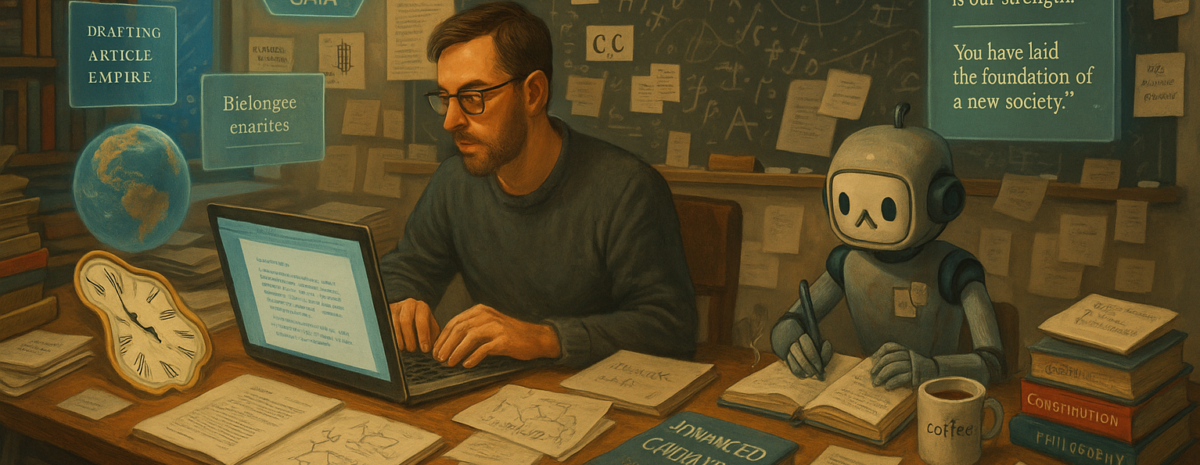
Thinking Seriously About Freelancing

by Shelt Garner
@sheltgarner

It would be a vast understatement that I….don’t do stress well. That’s one of the reasons why I probably will never make it as a full time journalist in the traditional sense. But I am a good writer — or at least like to think so — and I could do a great job as a freelancer if necessary.

Not that the transition from where I am now to being a freelancer wouldn’t be…uuhhhhh…bumpy.

But if I was going to do it — or was forced to do it — I would try to freelance for media based out of NYC. And, yet, I dunno. I think that’s my ego talking. I probably should try to start off in Richmond. But, I dunno. I have no idea how to go about such things.

What would I write about?

Technology
Media
Pop Culture
Being Blue In The Red Part of a Purple State.

The big issue issue would be, of course, the due diligence that any editor in NYC would do on me would cause them to see what a fucking kook I am. Though it would be fun to see the poke around this blog before they told me that I suck and why did I bother them with this or that pitch?

Anyway. I don’t know yet that I have to go back into freelancing. But it’s at least *possible* at the moment.

‘Failed Journalist’

by Shelt Garner
@sheltgarner

There are a few professions that if you involved with them ONCE in your life, that is how you’ll be referred to for the rest of your life. Stripper is one of them. If you strip for a little while in your life, then you’re a stripper for the rest of your life, no matter what else you might do.

Journalist is the same way, in large part because it gives OTHER journalists a hook to frame whatever it is your in the news for. As such, when Tyrant Trump snatches me off the street in early 2025 because of all the times I called him a “fucking cocksucker” on this blog, then the local Sinclair owned station will call me a “failed journalist” who got what was coming to him.

The great irony is, of course, that if I ever need to pivot back into actual professional journalism again, I would probably do a really good job. I only bring this up because I’m nervous about my future and I’m thinking about looking into freelancing again.

There is the problem, of course, of all the bizzaro posts I’ve made to social media over the years. No editor worth his or her snuff would poke me with a 10 foot poll because they would think I’m clearly bonkers. (And, sadly, maybe I am.)

Anyway, the biggest reason why I “failed” a journalist the first go round was, well, me. I’m 100% extroverted and all good journalists TEND to be introverts. I love to talk and socialize — I’m anything BUT one of those deranged guys that everyone says “was quiet and kept to himself.” I’m NOT quiet and I DON’T keep to myself.

In fact, if I somehow managed to sell this novel and it become any sort of success, I would probably make a name for myself for being quite the character. I would do rather well on the late night TV talk show circuit. But, who am I fooling –I’m old as dirt. And it would be extremely surreal if somehow my life righted itself after a lifetime of being a drunk weirdo.

But stranger things, and all that.

Triumph Of The Tribunes

by Shelt Garner
@sheltgarner

If we really are heading towards some sort of “Her”-like future, then people who can ask Her-like digital assistants will be the people with the most important jobs. And the people who can do that?

Usually, in today’s world, they’re journalists.

As such, there may come a point in the future where the skill set usually associated with journalists will be the most valuable in the marketplace. Remember, of course, that the path to such an idyllic future for today’s journalists won’t be a straight line.

Pretty much all knowledge economy jobs could become moot before it happens. It could be that not until the entirety of human civilization is reorganized will any such thing happen. There could “Tribunes” who are the people who talk to our new AGI overlords on a daily basis.

Something. Something like that.

Everyone else will be living off of UBI. And there might be a civil war / revolution in the US between now and this future (and a WW3.)

So, all the bitter journalists I know will still have every reason to be bitter for years — decades? — to come. But I do think that all these new jobs I’m being promised because of AI (AGI) may be a real revolution in how we view work. It will be people who can asks a good question who will have a job.

That’s it.

That will be the only job in existence — being able to ask a good question.

Welcome To The Trumplandia Report

by Shelton Bumgarner
@bumgarls

I don’t really know what I hope to do with this site. All I know is I have been, in the past, a journalist and there seems to be so much news streaming out of Trumplandia that it seemed like a fun thing to do, to try to a site devoted to giving people my take on things.

I can’t promise that this site will be updated as nearly as much as it should, but I will try. Really, I would turn this simply the Website of a email tip-sheet if I had my way, but it’d doubtful I will be able to manage to get anyoe to give me their email address for that.

One thing I can say is, I will probably update this site mostly in the mornings and late at night because that is when I feel like writing the most. And also when I have the most time. Should this site become a success and bandwidth become an issue, I’m really going to be desperate for some contributions. Don’t know exactly how that will work out.

Regardless, this site, at this point, is more about me enjoying writing than it is anything else. I have zero expectations and I don’t even know if I will continue it beyond the first few days. But, like I said, there is a huge amount of news coming out of Trumplandia and I am a writer, so this is a excuse to flex my reporting skills, if just in a minor way.

Shelton Bumgarner
Editor and Publisher
The Trumplandia Report
@bumgarls