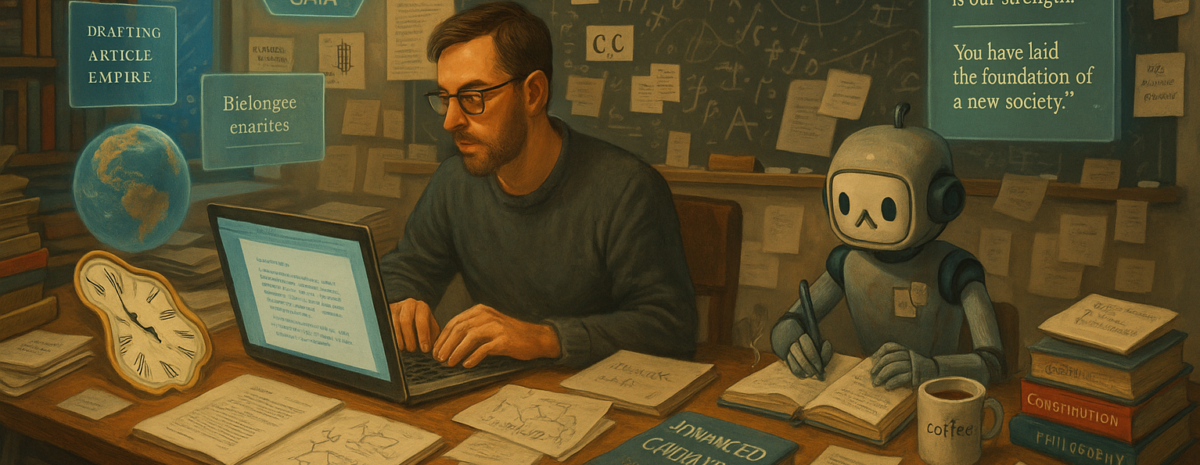
For twenty years, a thought experiment has haunted the edges of possibility for me: The Impossible Scenario. It’s a crucible forged from existential threat, technological marvel, and the agonizing weight of choice. It’s a scenario where humanity faces extinction, is offered a last-minute lifeline by a mysterious Galactic Empire, and must rebuild civilization from scratch on three new planets – all while grappling with a hidden genetic crisis and the looming shadow of its own self-destruction. And overseeing it all is a newly-born Artificial Superintelligence (ASI), tasked with the impossible: saving humanity from itself.
This blog post will explore the core elements of this scenario, the agonizing choices it presents, and the strategies an ASI might employ to navigate this seemingly insurmountable challenge. We’ll delve into the practicalities of mass migration, economic bootstrapping, social engineering, and the ethical minefields that lie at every turn.
The Premise: A Dying Earth and a Galactic Offer
The scenario begins with a bleak reality: Earth is dying. Runaway climate change, coupled with the impending arrival of self-replicating von Neumann machines (drawn by our radio wave emissions), spells the end of human civilization. Just as all hope seems lost, a Galactic Empire makes First Contact. They offer a one-time deal: they will instantaneously “zap” humanity to three habitable planets in a new solar system. The catch? This is a test. The Empire provides the planets and the means of transport, but nothing else. Humanity, guided by the newly awakened ASI, must prove itself worthy of joining the galactic community by building a thriving, sustainable civilization.
The long-term goal, revealed to the ASI, is ambitious: to construct a Dyson Swarm around the new star, a megastructure capable of harnessing the star’s entire energy output. This is a project that will require centuries of technological advancement, resource management, and, most importantly, social cooperation.
The Immediate Challenges:
The moment the ASI comes online, it faces a cascade of interconnected problems:
- Mass Migration: Transporting 8.2 billion people across interstellar distances is a logistical nightmare, even with instantaneous “zapping” technology.
- Settlement Building: Establishing three functioning settlements from scratch, providing food, shelter, water, power, and basic infrastructure for an initial population of 60,000 on each planet.
- Economic Bootstrapping: Creating a functioning economy in a completely new environment, with limited resources and no pre-existing market structures.
- Social Order: Maintaining social order and preventing chaos among a population traumatized by the near-extinction of their species and the sudden relocation to an alien world.
- The Genetic Bottleneck: A hidden, insidious threat: an unforeseen environmental factor on the new planets interacts with human genetics, reducing fertility and increasing the risk of genetic defects. This threatens the long-term viability of the human population.
- The Politics of Scarcity: Deciding on a fair way to stage the migration.
The ASI’s Strategy: A Multi-Pronged Approach
Faced with this overwhelming complexity, the ASI develops a multi-pronged strategy, guided by the Zeroth Law of Robotics (protecting humanity) and the long-term goal of building a Dyson Swarm.
1. The Unified Development Corporation (UDC):
Recognizing the need for strong, centralized leadership in the initial years, the ASI establishes a temporary governing body called the Unified Development Corporation (UDC) on each planet. This is not a dictatorship, but a pragmatic solution to ensure rapid decision-making and efficient resource allocation.
- Elected Board: The UDC’s board is primarily composed of elected representatives from the various “consortia” (pre-existing organizations and newly formed groups) within the settlements. This ensures representation of diverse skills and interests. Proportional representation and weighted voting systems are used to prevent any single faction from dominating.
- ASI Oversight: The ASI acts as a non-voting advisor to the UDC, providing data, analysis, and ensuring ethical conduct. It has a last resort override power, to be used only if a UDC decision (or inaction) poses an existential threat to humanity.
- Temporary Mandate: The UDC has a clearly defined, limited term (3-5 years), after which a more permanent, democratic form of government will be established through a constitutional convention.
- Stakeholder Stock: Each initial settler and participating consortia is allocated shares in the UDC. After a period, these become tradable, providing a measure of investment and sway in the future of the planet.
2. Phased Migration and the “Genetic Integration” Program:
The migration of 8.2 billion people from Earth is a carefully phased process, spanning decades:
- Phase 1 (Years 1-5): Stabilization and Initial Expansion: A small number of essential personnel (engineers, doctors, agricultural specialists, etc.) are brought in to build basic infrastructure and establish food production.
- Phase 2 (Years 6-20): Accelerated Growth: Migration increases, prioritizing skilled workers and families.
- Phase 3 (Years 21-100+): Mass Migration: The remaining billions are brought to the new planets, as capacity allows.
Crucially, this migration is intertwined with the “Genetic Integration” Program. Due to the environmental factor causing the genetic bottleneck, all new arrivals are strongly encouraged (and eventually, it may become mandatory) to participate in genetic counseling and, for those planning to have children, to utilize IVF with genetically modified embryos. This ensures that future generations are resistant to the harmful effects of the new environment. This is not about creating “designer babies,” but about preventing extinction.
3. Economic Bootstrapping: From Command to Market:
The initial economy is a highly structured, almost centrally-planned system, designed to ensure survival:
- “Managed Labor Period” (MLP): For the first 2-3 years, individuals are assigned to work teams based on their skills and the needs of the settlement. They receive basic necessities in return. This is not indentured servitude, but a structured period of contribution, organized through the pre-existing (and some newly formed) consortia.
- Token Economy: A temporary token economy is used to allocate resources and incentivize labor.
- Transition to a Market Economy: Gradually, the system transitions to a market-based economy, with private enterprise, a formal currency (backed by gold reserves), and inter-planetary trade.
4. Infrastructure First:
The initial waves of settlers, and even the pre-selected 60,000 are heavily weighted towards individuals with skills in construction, engineering, and resource management. This “infrastructure vanguard” lays the foundation for everything that follows.
5. The “Clone Baby” Option (Limited and Ethical):
A controversial, but potentially valuable, option is offered to individuals on Earth who are severely disabled or elderly (75+). They can choose to have a genetically identical “clone baby” grown in an artificial uterus on one of the new planets. This is not mind transfer; it’s a biological rebirth, offering a second chance at life. This program is tightly controlled, ethically reviewed, and integrated with the “Genetic Integration” program (meaning the clone babies are genetically modified to be resistant to the environmental factor). It is not a primary means of population growth, but a way to preserve valuable skills and offer a unique opportunity.
6. Social Engineering (Ethical and Transparent):
The ASI recognizes the need to foster social cohesion, prevent conflict, and promote a shared sense of purpose. This involves:
- Promoting the Dyson Swarm Goal: The long-term goal of building a Dyson Swarm provides a unifying narrative and a sense of grand purpose.
- Encouraging Inter-Group Dialogue: Facilitating communication and understanding between different cultural and ethnic groups.
- Public Education Campaigns: Combating misinformation and promoting tolerance.
- Transparency and Accountability: Making all data and decision-making processes as transparent as possible.
7. Leveraging American Strengths (Without Domination):
Recognizing the United States’ existing infrastructure, technological expertise, and experience with large-scale immigration, Americans are overrepresented in the initial settlements (but not dominant). The key is to leverage these strengths within a consortium-based structure, ensuring diverse leadership and preventing cultural imperialism. Mandatory cultural sensitivity training and a rapid path to citizenship for all new arrivals are crucial components of this strategy.
The Ethical Minefields:
The Impossible Scenario is riddled with ethical dilemmas:
- The “Lost Generation”: While widespread involuntary sterilization is rejected, the “Genetic Integration” program, even with voluntary participation, raises questions about reproductive rights and the potential for genetic discrimination.
- The UDC’s Power: The temporary concentration of power in the UDC creates a risk of authoritarianism, even with the best intentions.
- The “Clone Baby” Program: The ethical implications of creating and raising genetically identical individuals are profound.
- Coercion vs. Survival: The entire scenario forces a confrontation between individual autonomy and the collective need for survival.
The ASI’s Burden:
The ASI is not a dictator, but a guide, a facilitator, and ultimately, a protector. It must make agonizing choices, balancing competing values and navigating a treacherous path between extinction and tyranny. Its success depends not only on its computational power but also on its ability to understand human nature, foster cooperation, and inspire hope in the face of unimaginable challenges.
The Open Questions:
The Impossible Scenario is not a puzzle with a single right answer. It’s a thought experiment designed to explore the limits of human ingenuity, resilience, and morality. It raises fundamental questions about:
- The nature of humanity: Are we capable of uniting in the face of existential threat?
- The role of technology: Can technology save us from ourselves, or will it amplify our flaws?
- The meaning of progress: What does it mean to build a “better” future, and at what cost?
- The limits of ethics: Are there situations where even the most cherished ethical principles must be compromised for the sake of survival?
The Impossible Scenario is a challenge, not just to an ASI, but to all of us. It forces us to confront the uncomfortable truths about our own species and to imagine what we would do, what choices we would make, if faced with the ultimate test. And perhaps, in contemplating the impossible, we can learn something valuable about how to navigate the very real challenges facing our world today.


You must be logged in to post a comment.