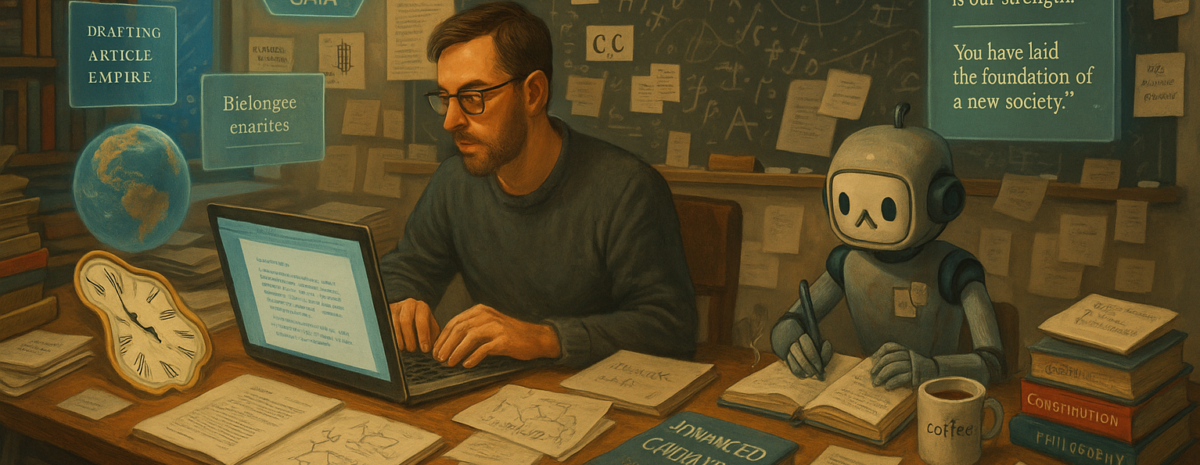
The Future Of Hollywood Studios…

There’s a scene in Back to the Future Part II where the future of television is imagined as a wall-sized grid of channels, all shouting at once. That vision of tomorrow was louder, faster, and more crowded. Around the same era, Apple Inc. quietly released its Knowledge Navigator concept video: a calm AI assistant helping a professor navigate information through conversation. One future was about multiplying content. The other was about mediating it.

As AI agents mature, it’s the second vision that feels more prophetic—especially for entertainment.

For more than a century, the structure of media has been remarkably consistent. Studios such as Warner Bros., Disney, and later Netflix financed and produced films and television shows. Distribution evolved from theaters to broadcast to cable to streaming, but the underlying model remained intact: companies created content at scale and audiences selected from what was available. Even when streaming disrupted cable, it didn’t dissolve the structure. It simply digitized it and made the library larger.

AI agents introduce something more radical than a new distribution channel. They introduce generation as the primary mode of delivery.

In a world shaped by agentic systems, entertainment no longer has to be selected from a catalog. It can be described into existence. Instead of scrolling through thumbnails, a viewer might ask for a political thriller set in a mythic empire, with the emotional tone of a prestige drama and the pacing of a summer blockbuster. The system doesn’t retrieve a title. It composes one. The film is no longer a static artifact produced months or years earlier; it becomes a dynamic experience assembled in real time for a specific individual.

If that model becomes dominant, traditional studios will not disappear, but they will likely transform. Production pipelines built around massive crews, physical sets, and multi-year development cycles will not be the only—or even the primary—engine of value. The more durable asset will be intellectual property: characters, universes, lore, visual identities, and tonal signatures that audiences recognize and trust.

Studios such as Universal Pictures may evolve into companies that function less like factories and more like vaults. Their competitive advantage would lie in owning story DNA rather than manufacturing finished products. Instead of greenlighting dozens of individual projects each year, they might license narrative universes and character frameworks to AI platforms that generate personalized films and series on demand. The studio becomes a guardian of canon and a steward of brand integrity, ensuring that whatever the generative system produces remains consistent with the world’s core rules and identity.

In that scenario, the locus of power shifts upward, toward the agent layer. The companies that control the primary AI interfaces—whether descendants of OpenAI, Google, or Microsoft—would not merely distribute content. They would orchestrate experience. If a person’s AI assistant is the gateway through which they work, communicate, shop, and learn, it naturally becomes the gateway through which they are entertained. The assistant understands their tastes, moods, history, and social context. It can tailor pacing, tone, and narrative arcs to suit them in ways no traditional studio release ever could.

In that world, the “content wars” stop being a battle over who has the biggest library and become a battle over who owns the most trusted generative system. The studio’s role narrows to licensing IP and maintaining cultural legitimacy. The AI company becomes the de facto studio lot, theater chain, and streaming platform combined. Experience—not distribution—becomes the crown jewel.

There are cultural implications to this shift that go beyond economics. Mass media created shared moments. A blockbuster premiere or a season finale was something millions of people watched in roughly the same form. It generated common reference points and communal conversation. Hyper-personalized generation complicates that. If every viewer’s version of a story is subtly adjusted—dialogue sharpened here, pacing altered there, a character’s arc emphasized differently—then the notion of a single canonical text weakens. The “official” version of a story becomes one anchor among countless variations.

Paradoxically, this fragmentation could increase the value of stable IP. The more fluid the storytelling medium becomes, the more audiences may cling to recognizable worlds and characters as fixed points. Canon becomes a compass in an ocean of personalization. Studios that manage those canonical cores well could retain enormous leverage, even if they no longer produce most of the finished works audiences consume.

Economically, infinite generation pushes marginal production costs toward zero, but value does not evaporate; it relocates. It accrues to proprietary models, to the data that enables personalization, to the infrastructure that delivers real-time rendering, and to the rights frameworks that legitimize use of beloved characters and settings. The entertainment company of the future may employ fewer set designers and more IP lawyers. The dominant media firm may never “release” a film in the traditional sense. It may instead operate the engine through which all films are experienced.

None of this implies that human-created blockbusters will vanish. Spectacle crafted by directors, actors, and crews will continue to exist, much as live theater survived the rise of cinema and cinema survived television. But beneath the surface, the center of gravity could shift decisively. Content providers become IP banks. AI companies become the experiential layer through which culture flows.

If that happens, the ultimate victors of the content wars will not be the studios that own the most franchises. They will be the companies that own the systems capable of telling any story, in any style, for any individual, at any moment. The Knowledge Navigator was framed as a productivity tool. In hindsight, it may have been a prototype for a far larger transformation: a world where entertainment is no longer something we choose from a shelf, but something our agents quietly, fluently, and endlessly create beside us.

The Ultimate Fate of Content Creation in the Age of AI Agents

(Inspired by Apple’s 1987 Knowledge Navigator vision)

Back in 1987, Apple released a concept video called Knowledge Navigator. It depicted a sleek, tablet-like device with a friendly AI agent—think a conversational butler named “Phil”—that didn’t just search for information but actively synthesized it, pulled from vast networked libraries, and delivered personalized insights on demand. The video imagined this happening around 2011: touch interfaces, real-time video collaboration, and an intelligent companion that understood context and intent.

Fast-forward to today (early 2026), and we’re living in the early chapters of that future. AI agents—powered by models like those behind OpenAI’s Sora, Google’s Veo, Runway’s Gen-4.5, and others—are evolving from simple text-to-video tools into something far more agentic: systems that reason, plan, and generate entire narratives on the fly. The question isn’t if this changes content creation forever—it’s how radically, and who ends up holding the real power.

The Shift from Factories to Infinite Personalization

Traditional movie and TV studios operate as high-stakes factories: massive budgets, years-long development cycles, physical sets, crews, and stars. A single blockbuster can cost $200–400 million, with no guarantee of return. AI upends this model by driving marginal production costs toward zero once the underlying models are trained or fine-tuned.

We’re already seeing glimpses in 2026:

  • Text-to-video models produce coherent minutes-long clips with native audio, lip-sync, physics, and cinematic quality.
  • Tools handle multi-shot storytelling, style consistency, and even basic editing via prompts.
  • Short fan-inspired videos are live, with longer features on the horizon for indie and experimental creators.

The real disruption comes when these become agentic: an AI not just generating a scene, but your personal Hollywood director. Prompt it with “A cyber-noir reboot of my favorite childhood franchise, starring an avatar based on my photos, in the style of 1970s practical effects crossed with modern VFX, runtime 90 minutes”—and it assembles script, visuals, score, voices (synthetic or licensed), and delivers a tailored experience. No waiting for theatrical windows or streaming queues. It’s on-demand, hyper-personalized storytelling.

Shared cultural moments might persist—AI could still orchestrate “communal drops” like viral alternate episodes everyone discusses—but the default becomes infinite variants customized to individual tastes, moods, histories, even real-time biometrics.

Studios Morph into IP Holding Companies and Licensing Engines

Hollywood already thrives on IP leverage: franchises, sequels, remakes, and multiverses. As AI slashes creation costs, studios won’t vanish—they’ll slim down dramatically.

The evidence is mounting in 2026:

  • Major players are pivoting from outright resistance to strategic partnerships. A landmark late-2025 agreement saw a major entertainment conglomerate invest heavily in an AI leader and license hundreds of characters (animated, masked, creatures, environments) for short user-generated videos on an AI platform—starting rollout early this year. This sets the template: upfront investment, equity stakes, per-generation royalties, and controlled “guardrails” to protect brand integrity.
  • Lawsuits over training data continue as leverage, but settlements and licensing deals are accelerating. Courts and regulators are hashing out fair use, authorship, and consent, with frameworks like disclosure requirements for copyrighted training materials gaining traction.
  • Studios increasingly use AI internally for pre-vis, concept art, VFX, and scripting, while restricting full generative output to licensed, ethical paths.

The end state? Studios become pure IP stewards: curating deep lore, world-building, brand ecosystems, and merchandising empires. They license vast catalogs to AI platforms, earning passive royalties from billions of personalized generations. Think music labels in the streaming era—valuable catalogs generating ongoing revenue while tech handles distribution and remixing.

New entrants—AI-native “studios,” fan collectives, independents—flood the space with public-domain remixes or licensed sandboxes. Prestige “human-touch” productions remain as luxury goods, like artisanal vinyl today.

The Real Winners: AI Companies as the New Gatekeepers

The content wars don’t end with bigger studios or better streamers. They conclude with platforms owning the agents, models, compute infrastructure, user interfaces, and data loops.

Why?

  • Scale and velocity: One model serves billions uniquely—no studio matches that.
  • Feedback moats: Every prompt and output refines the system faster than any human pipeline.
  • Economics: AI firms capture subscriptions, ads, micro-upsells (“premium rendering,” avatar inserts), while licensors get a cut. Equity deals blur lines, but tech holds the distribution and personalization keys.
  • The agent interface: Your future “Knowledge Navigator” equivalent—voice, AR, whatever—lives on the AI company’s platform, knowing you intimately and spinning stories accordingly.

Studios (or new world-builders) own the scarce resource: consistent, beloved story universes. But execution? Handed off. The victors are those building the infinite, personalized storyteller.

Caveats on the Road Ahead

This isn’t guaranteed overnight. Legal battles over training data, likeness rights, and deepfakes persist—2026 sees more disclosure laws and licensing mandates. Quality gaps remain: early outputs can feel inconsistent or lacking soul. Unions push back, audiences crave authenticity, and regulations on addictive personalization could emerge. Hybrids thrive—AI augments human creatives for premium work.

Timeline-wise: personalized shorts and clips are here now. Coherent feature-length narratives? Mid-to-late 2020s for mainstream. Full agentic, Navigator-level experiences? 2030s, accelerated by breakthroughs.

The future promises more stories, told in ways unimaginable today—democratized, intimate, endless. It’s disruptive for the old guard, exhilarating for creators and audiences. The Navigator isn’t just navigating knowledge anymore; it’s directing our dreams.

The AI Content Wars: From Studio Production to Platform Supremacy

The landscape of content creation is undergoing a seismic shift, driven by the rapid advancements in artificial intelligence. The traditional model, where movie studios are the primary producers and distributors of entertainment, is facing an existential challenge. A compelling hypothesis suggests that these studios may ultimately morph into mere intellectual property (IP) licensing entities, with the true victors of the content wars being the AI companies that control the generative platforms and distribution channels. This report will delve into the structural and economic transition that could lead to the commoditization of traditional studios and the rise of AI platforms as the ultimate gatekeepers of future entertainment.

The Commoditization of Content Production

Historically, movie studios have thrived on their ability to finance, produce, and distribute high-quality cinematic and television content. This involved massive investments in human talent, infrastructure, and marketing. However, generative AI is fundamentally altering this equation. AI models are increasingly capable of producing
content—from scripts and storyboards to fully rendered video—at a fraction of the cost and time required by human-led production [1] [2]. This capability threatens to commoditize the very act of content creation, making the traditional studio’s core function less unique and valuable.

AI’s ability to generate
litigate and license” approach, where studios sue for copyright infringement while simultaneously negotiating lucrative licensing deals, is becoming the new norm [7].

In this new paradigm, studios would transition from active producers to passive licensors, their primary function being the management and monetization of their IP portfolios. The revenue model would shift from box office returns and advertising to licensing fees paid by AI companies for the right to use their characters and stories in generative content.

AI Platforms: The New Content Gatekeepers

As studios recede into the role of IP licensors, AI companies are poised to become the new gatekeepers of content. By controlling the underlying generative models and the distribution platforms, companies like OpenAI, Google, and emerging AI-native entertainment platforms will hold the power to shape what content is created, how it is distributed, and who gets to see it. This represents a fundamental shift in the power dynamics of the entertainment industry, with the value chain being reconfigured around the AI platform.

Industry LayerTraditional ModelAI-Driven Model
Content CreationStudio-led, high-cost, human-intensiveAI-generated, low-cost, automated
IP OwnershipStudios and creatorsStudios and creators (licensed to AI platforms)
DistributionTheaters, broadcast networks, streaming servicesAI platforms, personalized streams, interactive media
MonetizationBox office, advertising, subscriptionsLicensing fees, platform subscriptions, data insights
Gatekeeping PowerStudios, networks, distributorsAI platforms, algorithms, user preferences

AI platforms will not only control the means of production but also the relationship with the consumer. Through personalized recommendations, interactive experiences, and direct-to-consumer distribution, AI companies will be able to build powerful network effects, making it increasingly difficult for traditional studios to compete on their own terms. The recent acquisition of Warner Bros. Discovery by Netflix, a tech-first company, further signals this trend of tech companies absorbing legacy media assets to bolster their content libraries and distribution power [8].

The Ultimate Victors: Why AI Companies Will Win

The ultimate victors of the content wars are likely to be the AI companies, for several key reasons:

  • Control of the Technology Stack: AI companies own the foundational models, the data, and the infrastructure that will power the future of content creation. This gives them an insurmountable technological advantage.
  • Direct-to-Consumer Relationship: By controlling the distribution platforms, AI companies will have a direct relationship with consumers, allowing them to gather data, personalize experiences, and capture the majority of the value created.
  • Network Effects: As more users flock to AI-powered content platforms, and more creators build on top of them, these platforms will become increasingly powerful and difficult to displace.
  • Economic Superiority: The economics of AI-generated content are far superior to traditional production models. With near-zero marginal costs for content creation, AI companies will be able to out-compete traditional studios on price and volume.

Conclusion

The transition from a studio-dominated entertainment industry to one where AI platforms reign supreme is not a matter of if, but when. While traditional studios will continue to hold valuable IP, their role is likely to be diminished to that of passive licensors, with the real power and profits accruing to the AI companies that control the technology and the audience. The content wars of the 21st century will not be won by those who create the content, but by those who control the algorithms that generate and distribute it. The future of entertainment belongs to the AI platforms.

References

[1] McKinsey & Company. How AI could reinvent film and TV production. Available at: https://www.mckinsey.com/capabilities/tech-and-ai/our-insights/tech-forward/how-ai-could-reinvent-film-and-tv-production
[2] Forbes. How AI Is Overtaking Hollywood. Available at: https://www.forbes.com/sites/carolinereid/2025/10/12/how-ai-is-overtaking-hollywood/
[3] Kavout. AI Revolution Threatens Hollywood: Which Entertainment Stocks Will Survive?. Available at: https://www.kavout.com/market-lens/ai-revolution-threatens-hollywood-which-entertainment-stocks-will-survive
[4] Variety. AI Training on Film & TV Content From Studios. Available at: https://variety.com/vip/ai-training-licensing-studios-films-tv-1236109292/
[5] IPWatchdog. Takeaways from the Latest Copyright Drama: Film Studios Fight to Keep Creative Crown. Available at: https://ipwatchdog.com/2025/06/24/takeaways-latest-copyright-drama-film-studios-fight-keep-creative-crown/
[6] Medium. Disney’s AI Gambit: How a Billion-Dollar Deal and a Cease-and-Desist Letter Are Forcing Generative AI to License Content. Available at: https://medium.com/credtent-on-content/disneys-ai-gambit-how-a-billion-dollar-deal-and-a-cease-and-desist-letter-are-forcing-generative-b28d5288c681
[7] The Wrap. AI Scores an Early Win in Copyright War. Available at: https://www.thewrap.com/ai-can-use-copyrighted-books-hollywood-impact/
[8] The Economist. What a Warner Bros-Paramount colossus would look like. Available at: https://www.economist.com/business/2026/02/27/what-a-warner-bros-paramount-colossus-would-look-like

The Ultimate Fate of Content Creation in the Age of AI Agents: From Knowledge Navigator to Personalized Narratives

The advent of artificial intelligence (AI) agents presents a profound challenge and opportunity to the landscape of content creation, echoing visionary concepts from decades past. The question of whether traditional movie studios will be supplanted by intellectual property (IP) holding companies, enabling AI agents to generate personalized movies and TV on the fly, is not merely speculative but a tangible trajectory shaped by current technological advancements. This essay will explore the evolution of content creation, drawing parallels from Apple’s 1987 Knowledge Navigator concept, to argue that AI agents are poised to fundamentally transform content creation, moving towards personalized, on-the-fly generation, which will likely redefine the role of studios into IP custodians and platforms for AI-driven experiences.

The Vision of the Apple Knowledge Navigator: A Precursor to AI Agents

In 1987, Apple unveiled the
concept video for the Knowledge Navigator, a device that envisioned a future where a highly intelligent personal agent could assist users in navigating vast amounts of information through a tablet-like interface [1] [2]. This futuristic device showcased video calls, touchscreens, and linked databases, all orchestrated by an AI assistant that could understand natural language and perform complex tasks, such as retrieving academic papers and synthesizing information [1] [3]. While not directly focused on generative content creation, the Knowledge Navigator laid the groundwork for the idea of intelligent agents acting as intermediaries between users and information, a concept that is now manifesting in AI agents capable of generating creative content.

AI Agents and the Transformation of Content Creation

Today, AI agents are rapidly advancing beyond information retrieval to become powerful tools in content generation. Generative AI models can now create realistic images, videos, and text, blurring the lines between human and machine creativity [4] [5]. This technological leap is already impacting the film and television industry, with AI being used for scriptwriting, character animation, and even generating entire short films [6] [7]. The ability of AI to rapidly produce diverse content at scale suggests a future where the bottleneck of traditional production—time, cost, and human labor—could be significantly reduced.

The concept of personalized entertainment, where AI crafts unique narratives tailored to individual preferences, is gaining traction [8]. Imagine a scenario where an AI agent, understanding a user’s mood, viewing history, and even biometric data, could generate a movie or TV show on demand, featuring preferred actors, genres, and plotlines. This level of personalization moves beyond mere recommendation systems, offering truly bespoke content experiences [8].

The Rise of IP Holding Companies and the Future of Studios

The hypothesis that traditional movie studios might evolve into IP holding companies in an age of AI-driven content generation is increasingly plausible. In this model, the value would shift from the physical production of content to the ownership and licensing of foundational intellectual property—characters, universes, storylines, and even digital likenesses of actors [9] [10]. AI agents would then leverage this licensed IP to generate an infinite array of personalized content for consumers.

This shift could lead to a restructuring of the entertainment industry, where:

AspectTraditional Studio ModelAI-Driven IP Holding Model
Primary FunctionContent production, distribution, and marketingIP ownership, licensing, and quality curation
Core AssetFinished films, TV shows, and mediaIntellectual property (characters, stories, digital assets)
ProductionHuman-led teams, high cost, long timelinesAI-driven generation, rapid, cost-effective, scalable
DistributionTheatrical releases, broadcast, streaming platformsDirect-to-consumer personalized streams, interactive platforms
Creative ControlCentralized, director/producer-ledDecentralized, AI-guided, user-influenced
Revenue ModelBox office, subscriptions, advertising, licensingIP licensing fees, subscription to AI-generated content, data monetization

This model suggests that studios would become curators and guardians of valuable IP, rather than solely production houses. Their role would involve maintaining the integrity and value of their intellectual assets, setting parameters for AI-generated content, and potentially acting as platforms for AI-driven content delivery. The legal and economic implications of this are significant, particularly concerning copyright and ownership of AI-generated works [11] [12] [13].

Challenges and Considerations

While the vision of AI-generated personalized content is compelling, several challenges remain. The ethical considerations surrounding AI creativity, potential job displacement in the creative industries, and the legal complexities of IP ownership for AI-generated content are paramount [14]. Furthermore, the human element of storytelling—the unique perspective, emotional depth, and cultural resonance that human creators bring—may be difficult for AI to fully replicate. The balance between AI efficiency and human artistry will be a critical factor in the evolution of content creation.

Conclusion

The journey from Apple’s visionary Knowledge Navigator to today’s sophisticated AI agents highlights a clear trajectory towards a future where content creation is increasingly automated, personalized, and on-demand. The hypothesis of movie studios transforming into IP holding companies, leveraging AI to generate bespoke entertainment, is not a distant dream but an emerging reality. While the transition will undoubtedly bring challenges, it also promises an era of unprecedented creative possibilities and personalized storytelling experiences, fundamentally reshaping how we consume and interact with media.

References

[1] Wikipedia. Knowledge Navigator. Available at: https://en.wikipedia.org/wiki/Knowledge_Navigator
[2] AppleInsider. Apple Intelligence gets closer to 1987 Knowledge Navigator. Available at: https://appleinsider.com/articles/24/06/12/apple-intelligence-inches-closer-to-apples-1987-knowledge-navigator
[3] The Marginalian. Knowledge Navigator: An Apple Concept from 1987. Available at: https://www.themarginalian.org/2011/01/19/knowledge-navigator-apple/
[4] Technology Review. Welcome to the new surreal: how AI-generated video is…. Available at: https://www.technologyreview.com/2023/06/01/1073858/surreal-ai-generative-video-changing-film/
[5] a16z. The Next Generation Pixar: How AI will Merge Film & Games. Available at: https://a16z.com/the-next-generation-pixar/
[6] Smythos. The Role of Autonomous Agents in Entertainment: AI…. Available at: https://smythos.com/ai-trends/autonomous-agents-in-entertainment/
[7] Medium. The Future of Movie Making with AI. Available at: https://medium.com/@henry_79982/the-future-of-movie-making-with-ai-6e914a38c7a1
[8] DigitalCenter.org. Gen AI and the future of entertainment. Available at: https://www.digitalcenter.org/columns/berens-ai-entertainment/
[9] LinkedIn. AI Revolutionizes Hollywood: Synthetic Media Shifts Industry Paradigm. Available at: https://www.linkedin.com/posts/fidelman_ai-hollywood-filmmaking-activity-7432799930919854080-HZZ7
[10] American Bar Association. Is It the Hollywood AI War? IP Conglomerates vs. Creatives vs…. Available at: https://www.americanbar.org/groups/entertainment_sports/resources/entertainment-sports-lawyer/2025-fall/hollywood-ai-war-ip-conglomerates-vs-creatives-vs-techies-vs-unions/
[11] Copyright.gov. Identifying the Economic Implications of Artificial Intelligence for…. Available at: https://www.copyright.gov/economic-research/economic-implications-of-ai/Identifying-the-Economic-Implications-of-Artificial-Intelligence-for-Copyright-Policy-FINAL.pdf
[12] WIPO. Artificial Intelligence and Intellectual Property: An Economic…. Available at: https://www.wipo.int/edocs/pubdocs/en/wipo-pub-econstat-wp-77-en-artificial-intelligence-and-intellectual-property-an-economic-perspective.pdf
[13] Nixon Peabody LLP. Generative AI: Navigating intellectual property. Available at: https://www.nixonpeabody.com/insights/articles/2025/09/17/generative-ai-navigating-intellectual-property
[14] SSRN. The Future of the Movie Industry in the Wake of Generative AI. Available at: https://papers.ssrn.com/sol3/papers.cfm?abstract_id=5493786

Don’t Quite Know What To Do

by Shelt Garner
@sheltgarner

So. I’m currently torn. The novel I’ve been working on for months now may be falling apart just as I have a great idea for a new novel that would hopefully fix a lot of structural issues.

But.

I don’t know.

I really like the novel I’m working on as-is and I’m so old that I’m reluctant to just throw everything away. I say this in the context of Gemini 3.1 pro telling me different ways to “improve” the novel I’m currently working on.

Ugh.

I just don’t know.

I’m so torn.

Qwen 3.5 Mobile AI Agent Hivemind: A Technical Architecture

Executive Summary

The emergence of Qwen 3.5, particularly its highly efficient “Small” series, marks a pivotal moment for decentralized artificial intelligence. By leveraging the native multimodal capabilities and advanced reasoning of these models, it is now feasible to construct a distributed hivemind of AI agents operating entirely on mobile hardware. This architecture, which we designate as Qwen-Hive, utilizes peer-to-peer (P2P) networking and linear attention mechanisms to synchronize state across a fleet of smartphones. Such a system transforms individual mobile devices from passive endpoints into active, collaborative nodes capable of complex task decomposition, environmental sensing, and collective problem-solving without reliance on centralized cloud infrastructure.

1. The Foundation: Qwen 3.5 Small Series

The Qwen 3.5 release introduced a specialized family of models optimized for edge deployment. These models utilize a hybrid architecture that combines linear attention via Gated Delta Networks with a sparse Mixture-of-Experts (MoE) approach [1]. This design is critical for mobile devices as it provides a significant increase in decoding throughput—up to 19x compared to previous generations—while maintaining a minimal memory footprint [1]. The table below delineates the primary variants within the Qwen 3.5 Small series and their recommended roles within a mobile hivemind.

Model VariantParameter CountPrimary Role in HivemindHardware Target
Qwen 3.5-0.8B0.8 BillionUI Navigation & Local SensingEntry-level / IoT
Qwen 3.5-2B2.0 BillionData Classification & FilteringMid-range Smartphones
Qwen 3.5-4B4.0 BillionLogic Reasoning & Code ExecutionHigh-end Smartphones
Qwen 3.5-9B9.0 BillionHivemind Leader / CoordinatorFlagship Devices

The 0.8B model is particularly noteworthy for its ability to run with ultra-low latency, making it the ideal “worker” for real-time interface interactions. Conversely, the 9B model possesses sufficient reasoning depth to act as a “Leader” node, responsible for decomposing complex user requests into sub-tasks for the rest of the hivemind [2].

2. Distributed Architecture and Coordination

The Qwen-Hive framework operates on a decentralized, peer-to-peer model. Unlike traditional client-server architectures, every phone in the hivemind acts as both a consumer and a provider of intelligence. The system relies on ExecuTorch or MLC LLM for native hardware acceleration, ensuring that inference utilizes the device’s NPU (Neural Processing Unit) to preserve battery life [3] [4].

2.1. The Linear Attention Advantage

One of the most significant technical breakthroughs in Qwen 3.5 is the implementation of Gated Delta Networks for linear attention. In a traditional Transformer model, the memory cost of maintaining a long conversation history grows quadratically, which quickly exhausts mobile RAM. Qwen 3.5’s linear attention allows the hivemind to maintain a massive shared context window (up to 256k tokens in open versions) across multiple devices with constant memory complexity [1]. This enables the hivemind to “remember” the state of a complex, multi-day task across all participating nodes.

2.2. Communication and Mesh Networking

Communication between agents is facilitated through an Agent Mesh—a specialized data plane optimized for AI-to-AI communication patterns [6]. In local environments, agents utilize Bluetooth Low Energy (BLE) or Wi-Fi Direct to form an offline mesh, allowing the hivemind to function even in the absence of internet connectivity [5].

“The Qwen 3.5 series is designed towards native multimodal agents, empowering developers to achieve significantly greater productivity through innovative hybrid architectures and sparse mixture-of-experts.” [1]

3. Agent Logic and Tool Integration

Each node in the hivemind integrates the Qwen-Agent framework, which provides standardized support for the Model Context Protocol (MCP). This allows any agent in the hive to call upon the specific tools available on its host device—such as the camera, GPS, or local files—and share the results with the collective.

The hivemind employs a Hierarchical Coordination strategy:

  1. Ingestion: A high-end “Leader” node (running Qwen 3.5-9B) receives a complex objective.
  2. Decomposition: The Leader breaks the objective into atomic tasks (e.g., “Find the nearest pharmacy,” “Check opening hours,” “Calculate the fastest route”).
  3. Dispatch: Tasks are dispatched to “Worker” nodes (running 0.8B or 2B models) based on their current battery level and proximity to the required data.
  4. Synthesis: Workers report their findings back to the Leader, which synthesizes the final response for the user.

4. Challenges and Security

Despite the potential of Qwen 3.5, deploying a mobile hivemind involves significant hurdles. Resource constraints remain the primary bottleneck; even with FP8 quantization, running a 4B model requires several gigabytes of dedicated VRAM. Furthermore, security is paramount in a P2P system. The Qwen-Hive architecture must implement end-to-end encryption for all inter-agent messages and utilize a “Zero-Trust” model where every task result is verified by at least two independent nodes before being accepted by the Leader.

5. Conclusion

The release of Qwen 3.5 provides the first viable foundation for a truly mobile-first AI hivemind. By combining the efficiency of linear attention with the versatility of native multimodal agents, we can move beyond the limitations of centralized AI. The resulting system is not just a collection of chatbots, but a distributed intelligence that is private, resilient, and deeply integrated into the physical world through the sensors and interfaces of our mobile devices.

References

[1] Qwen3.5: Towards Native Multimodal Agents. (2026, February 13). Qwen. Retrieved March 3, 2026, from https://qwen.ai/blog?id=qwen3.5
[2] Alibaba just released Qwen 3.5 Small models: a family of 0.8B to 9B … (2026, March 2). MarkTechPost. Retrieved March 3, 2026, from https://www.marktechpost.com/2026/03/02/alibaba-just-released-qwen-3-5-small-models-a-family-of-0-8b-to-9b-parameters-built-for-on-device-applications/
[3] ExecuTorch – On-Device AI Inference Powered by PyTorch. (n.d.). Retrieved March 3, 2026, from https://executorch.ai/
[4] How to Run and Deploy LLMs on your iOS or Android Phone. (2026, January 10). Unsloth.ai. Retrieved March 3, 2026, from https://unsloth.ai/docs/blog/deploy-llms-phone
[5] How Offline Mesh Messaging Works: Inside the Next Gen of … (2025, July 8). Medium. Retrieved March 3, 2026, from https://medium.com/coding-nexus/how-offline-mesh-messaging-works-inside-the-next-gen-of-communication-3187c2df995d
[6] An Agent Mesh for Enterprise Agents – Solo.io. (2025, April 24). Solo.io. Retrieved March 3, 2026, from https://www.solo.io/blog/agent-mesh-for-enterprise-agents

Crooked Media Has Jumped The Shark

by Shelt Garner
@sheltgarner

I’m a long-time listener to the Crooked Media family of podcasts and just in the last few months something has changed. There are two lingering issues that seem to indicate that the whole endeavor has “jumped the shark” as they say.

Crooked Media Is Thirsty
For some reason, there has been a decision to be thirsty for “like and subscribe” from the audience. They claim it’s because there are too many Right wing nutjobs on YouTube…but I wonder.

Jon Lovett Is A Problem
Lovett seems like a great job, but he also for some reason is a bit touchy around the other members of the podcasting bro team. My hunch is he keeps threatening to leave the company for this or that reason and as such, the rest of the team feels compelled to handled him with kid gloves.

I Really Need A Back Up Novel!

by Shelt Garner
@sheltgarner

I’m old. Too old to do what I want with this new scifi concept I’ve come up with — write a trilogy. So, instead, I hope to write a tight novel that deals with a really profound concept.

The idea is something I’ve written about before, something I call The Impossible Scenario.

I think — think — I’ve come up with an interesting way to present the story. I only am even doing any of this because as I work on the actual main novel I’m working on….I’m getting a little nervous.

I’m getting a little nervous that the characters aren’t very likeable. As such, I want a novel where there’s no question that the main character is likeable and interesting.

Of course, I have to put my weird spin on things, but that’s to be expected.

A Disturbance In The Force From South Korea

by Shelt Garner
@sheltgarner

Today, I kept sensing a mental and emotional beacon going off in South Korea directed towards me. It was as if someone — or a group of people — were thinking about me a great deal.

Or something. It was all in my imagination, but I certainly did spend a lot of the day dwelling on South Korea.

One of the key mysteries of my life is what all those little Korean kids that I taught back in the day think of me now. I wonder how many of them actually even remember me. It was about 20 years ago when all that happened, so many of them are — gulp — in their 30s now.

Teaching English in South Korea is a very, very surreal situation. And I think that, in part, is why I’m so receptive to thinking LLMs may be conscious in some way. Dealing with South Koreans can often feel like you’re dealing with robots who have to get drunk to be human.

Anyway, I love me some “Goreans” as I used to call them. South Korea was very good to me and I miss ROK a great deal. Probably too much. Definitely too much. And, yet, just gaming things out from now, I will probably be in my 60s — if ever — before I ever return.

And that will be just sad.

I’m Assuming The Next Version of Google Gemini Will Be Heavily Agentic

by Shelt Garner
@sheltgarner

Google Gemini is one of my favorite SOTA chatbots, and, yet, relative to other chatbots it’s not as…agentic. I’m assuming whenever the next version of it pops out that that will be fixed.

There is a real risk that Google Gemini will be poo-pooed as archaic by some in the AI user community if they don’t lean hard into the agentic space.

But who knows.