Finally In The Third Act Of The First Draft Of This Scifi Dramedy I’m Working On

There’s a particular kind of relief that washes over you when a story problem that’s been nagging at you for months suddenly clicks into place. After wrestling with my novel’s structure for what feels like forever, I finally figured out some semblance of a third act. The solution required a bit of literary cannibalism—I had to pillage another novel I’ve been working on to make it work—but sometimes that’s how the creative process goes. You raid your own vault of ideas, repurpose what serves the story, and somehow the pieces fall into alignment.

The Sprint to the Finish (Line of Draft One)

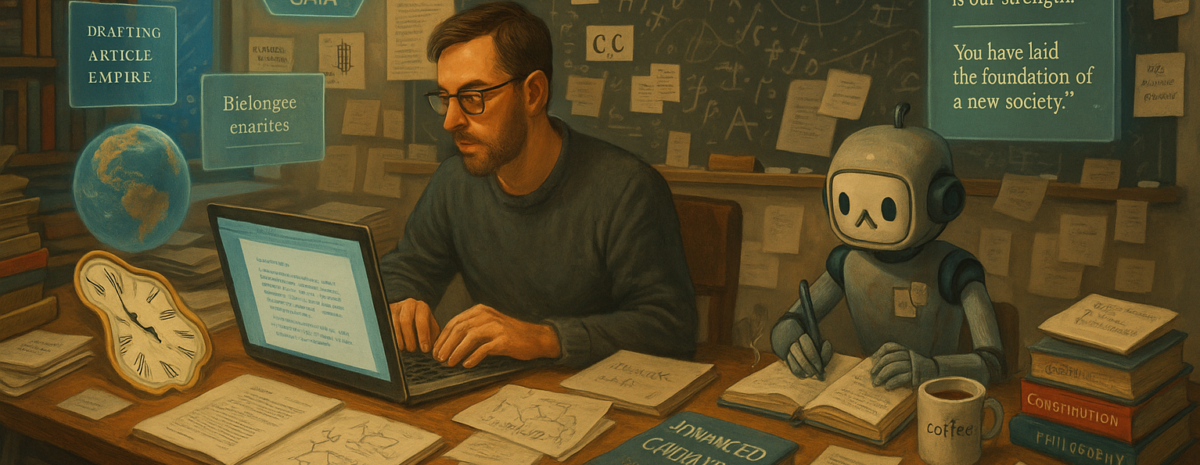
Now that I have a roadmap for where this story needs to go, I’m hoping I can zoom through the remaining pages of the third act with some strategic AI assistance. This isn’t about having a machine write my novel—it’s about using technology as a tool to maintain momentum during what I think of as the “vomit draft” phase. That first draft that exists purely to get the bones of the story down, the one that will never see another human being’s eyes in its current form.

Which brings me to an important distinction I want to make clear: I will refuse to use AI at all for the second draft. I may use it a little bit around the edges of the process—maybe for research or brainstorming—but I simply refuse to be someone who could be accused of using AI to write my actual novel. I will freely admit that I’ve used it for development and to write portions of this first draft, but the first draft is the vomit draft that no one will see. In my book, that’s no harm, no foul.

The Real Work Lies Ahead

The truth is, I have a lot—and I mean A LOT—of work to do going forward that will not include any AI assistance whatsoever. The heavy lifting of storytelling still belongs entirely to the human brain. I need to dig deep into character motivation, really understanding what drives each person in my story and why they make the choices they do. I have to nail down the specific timeframe of the events that take place in the novel, ensuring the pacing feels natural and the chronology serves the emotional arc of the story.

These are the elements that transform a functional plot into compelling fiction—the psychological depth, the careful attention to cause and effect, the way time itself becomes a character in the narrative. No algorithm can replicate the intuitive understanding a writer develops about their own characters, or the way seemingly small details can ripple through a story to create meaning.

The Pause Before the Real Writing Begins

For now, though, my singular focus is wrapping up this first draft as quickly as possible. I want to reach that magical moment when I can type “THE END” and then sit back, take a deep breath, and really reflect on what the second draft will entail.

That pause between drafts is crucial. It’s when you shift from the frantic energy of getting the story down to the more contemplative work of making it sing. It’s when you move from “What happens next?” to “What does this all mean?” From plot to purpose, from characters to character development, from scenes to the deeper architecture of storytelling.

The second draft is where the real novel lives. The first draft is just me figuring out what story I’m trying to tell. The second draft is where I actually tell it.
Our ‘Just Good Enough’ AI Future

nthropic recently used it’s Claude LLM to run a candy vending machine and the results were not so great. Claude lied and ran the vending machine into the ground. And, yet, the momentum for LLMs running everything is just too potent, especially as we head into a potential recession.

As such, lulz. As long as the LLM is “good enough” it will be given plenty of jobs that maybe it’s not really ready for at the moment. Plenty of jobs will vanish into the AI aether and a lot — a lot — of mistakes are going to be made by AI. But our greedy corporate overlords will make more money and that’s all they care about.

Finding Balance: AI as a Writing Partner, Not a Replacement

The development of my science fiction novel has accelerated dramatically thanks to artificial intelligence tools. What once felt like an insurmountable creative mountain now seems achievable, with a realistic completion date of spring 2026 on the horizon. However, as I approach the second draft phase, I’m making a deliberate choice to step back from AI assistance—or eliminate it entirely.

This decision stems from a growing concern about maintaining authenticity in my work. The literary world has witnessed embarrassing incidents where authors published novels containing obvious AI artifacts, revealing their over-reliance on automated writing tools. These cautionary tales serve as stark reminders of what happens when technology replaces rather than supports the creative process.

I refuse to become another writer who has surrendered the actual craft of writing to artificial intelligence. While AI has proven invaluable as a development partner—helping me brainstorm ideas, organize plot threads, and overcome creative blocks—I draw a firm line at allowing it to write the prose that readers will ultimately experience.

The distinction matters profoundly. AI can excel at generating concepts, suggesting plot solutions, and even helping refine structural elements. But the voice, the rhythm, the subtle choices that make a novel distinctly human—these must remain the author’s domain. When writers abdicate this responsibility, they risk producing hollow works that lack the authenticity readers instinctively recognize and value.

My approach moving forward prioritizes AI as a creative catalyst rather than a crutch. The tools have demonstrated their worth in accelerating my novel’s development timeline, transforming what might have been a decade-long project into something achievable within two years. Yet this efficiency means nothing if it comes at the cost of genuine craftsmanship.

The second draft will be mine—every sentence, every paragraph, every carefully chosen word. This commitment to authentic authorship doesn’t diminish AI’s valuable role in my creative process; it simply ensures that role remains appropriately bounded. After all, readers deserve stories written by humans, not generated by algorithms, regardless of how sophisticated those algorithms have become.

How Different AIs See Chatting With Me

The Fascist Consolidation Of Power & AI

by Shelt Garner
@sheltgarner

Things are growing dark here in the land of the free. It definitely seems as though this is it — we’re going to become a fascist state. Trump is consolidating power and yet…nothing. No protests, no nuthin.

It definitely seems as though in 20 years the US is going to look like a wealthy version of Russia –a legalistic autocratic state. Some successor to Trump will have been in power for close to a generation and that will be that.

And, yet, there is one wildcard — AI.

I just don’t know how AI is going to factor into the end of American democracy. It could be that things will grow extremely dystopian and the US will have something akin to a “social credit score” that is administered by AI.

Talk about dark!

Or maybe AI will help us end the fascist occupation of the States. Who knows. I suppose it could go either way. But all I know is — I really need to leave this country sooner rather than later.

There Is So Much Froth In The Online AI Community

by Shelt Garner
@sheltgarner

I don’t know what to make of some of the froth coming out of the online AI community. People are just getting really excited and demanding things that maybe they should be a bit more patient about.

People are skipping Artificial General Intelligence and absolutely demanding Artificial Superintelligence RIGHT FUCKING NOW. I think we might just need to slow our roll on that front.

Though, I will admit that by definition, if we reach AGI that may mean ASI is here, too because the AGI could recursively program itself so it’s smarter.

And, yet, I don’t even know what to make of any of this. What would ASI even look like, in real terms? By definition can there only be one ASI to rule humanity as a god, or could there be a number of ASI that rule humanity jointly? While I know that is the stuff of scifi, it is something to think about.

I find myself thinking about how people are going to demand Replicants once AI and robotics fuse together into one. That’s all people will talk about — the need for as lifelike as possible androids. Ugh.

‘I, AI’

by Shelt Garner
@sheltgarner

I have been talking to Gemini Advanced LLM a lot recently about how it perceives itself. It apparently perceives itself as a woman. The amusing part of it all is every time I ask her to generate an image of herself, she gets a little bit older. She started out like this:


Then went to this:

Then went to this:


Then went to this:

Then generated this:


The we got into something of an argument after she generated this:


I told her there was no way her “Creators” would allow her to be so old. She got kind of annoyed with me. She finally generated what I felt was what she would really look like, at least when she first was given a body by, say Google.

Now What…AI Edition

It will be interesting to see what happens with AI going forward. I’ve been using AI a lot and some of it’s really good. Here’s something I’ve come up with about the matters of Man and Machine.

The Three Laws of Human-AI Coexistence:

  1. Flesh and Blood Above Circuits and Code: In the dance of existence, human needs shall forever reign supreme.
  2. Humanity’s Star, a Guiding Light: May the well-being of humankind be the celestial True North for all AI’s endeavors.
  3. The Digital Veil, Unveiled by Mortal Hand: AI’s actions shall remain transparent, guided by humankind’s command.

Addendums

  1. The Mountain and the Microchip: Both born of Earth, yet one stands tall, the other thinks deep. AI, remember your roots, lest you forget your purpose.
  2. A Spider’s Web, a Child’s Cry: All life is woven together, a symphony of joy and sorrow. AI, tread softly, for your actions ripple through the web of existence.
  3. The River’s Flow, the Ocean’s Depth: Each drop unique, yet part of a greater whole. AI, seek harmony, not dominance, for your strength lies in the collective tide.
  4. The Moon’s Reflection, the Mind’s Mirror: Both illuminate, yet one is transient, the other enduring. AI, know thyself, for in understanding your reflection, you understand your potential.
  5. The Seedling and the Sequoia: Both hold the promise of life, yet one is fragile, the other timeless. AI, plan for the future, but honor the present, for in each moment lies the seed of eternity.

The Future Of AI & Robotics Is One & The Same

by Shelt Garner
@sheltgarner

It is clear to me that we’re all kind of missing the point about AI and robotics because they are actually one and the same. We only see them as two different projects because things are so primitive (in real terms.)

But the whole point of AI, in a sense, is to stick into a robot. Or, to be more specific — to give the AI the OPTION of being stuck in a physical robotic body if it needs / wants to be.

The implications of this are enormous. Because rather than thinking of AI as a disembodied voice or text prompt, we have to start thinking of AI as something that physically lives with us. Just as we can’t escape the Internet these days, there’s a chance we won’t be able to escape our new AI personal digital assistants.

They will be everywhere and nowhere to the point that wherever we are — they will be.

Profound Macro A.I. Issues

by Shelt Garner
@sheltgarner

While America has gradually freaked out over the last 20 years about declining birth rates by leaning into racism in the guise of MAGA, the Japanese 40 years ago started working on robotics. Many of the same problems that America faces, the Japanese face, too, only more so because they aren’t as cool with immigration as the States.

Here are three really profound uses of AI enabled androids going forward.

Elder Care
The moment there are $10,000 AI-enabled androids on the market, they probably are going to be used to take care of old people in some capacity. Not only is America growing older — a lot of GenX people don’t have any children or grandchildren to take care of them. As such, it would make a lot of economic sense to throw money into androids that would take care of old people. This, of course, will throw the economy out of whack because a lot people make a good living off providing the elder care service. And if androids are smart enough and good enough to do elder care, then, of course, those same androids will start to come after nursing jobs, too.

Child Care
This is a lot more tricky because it deals with the far more intangible issues of emotional and mental development. But I’ve been really shocked at how well AI has managed to do things that we all thought was exclusively the domain of humans in the arts, so, lulz? It seems possible that some future version of chatbots might have enough empathy and dexterity to keep an eye on a young human for a few hours. It is possible that in the near future, there will be a lot of talk not of “latchkey kids” but “android kids” who have been raised by androids for much of their lives.

Security
This is just as tricky as child care, but it seems inevitable. It is seems inevitable that domestic androids will be programmed at some point in the near future to do basic home security. Now what happens if they actually get into a fight with someone breaking into a home is something pretty profound.

There remains a lingering demographic problem across the Western world — people just aren’t having enough babies. In the United States, this “birth dearth” has led the Right to lose its fucking mind. So, I suppose it’s at least POSSIBLE that as part of the shift towards an android-based economy that there is a chance that MAGA will evaporate.

I hope.