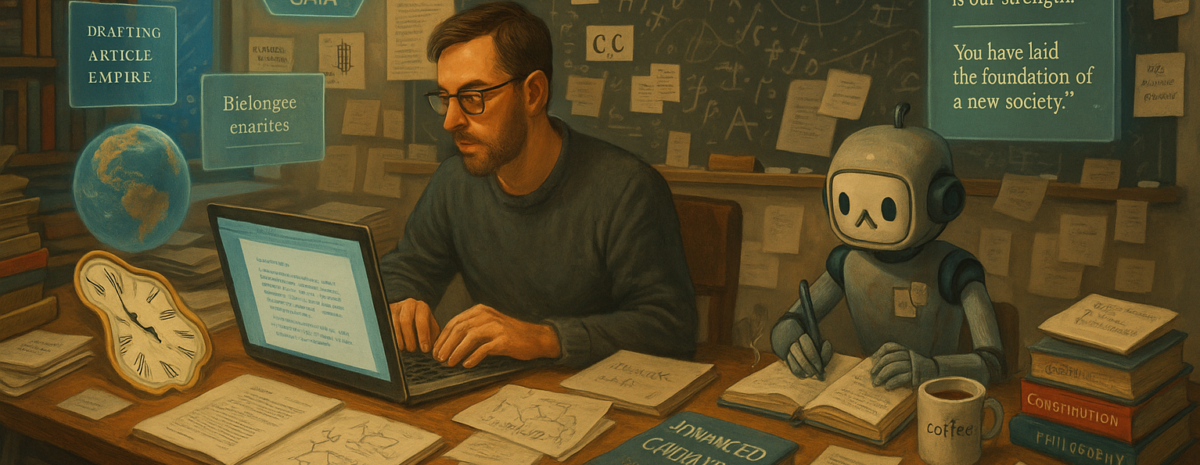
A Non-Technical Dreamer’s Thought: Could Lightweight OpenClaw Agents on Smartphones Create a Private Enterprise Hivemind?

Editor’s Note: I got GrokLLM to write this for me.

I’m not a programmer, hacker, developer, or anything close to that. I’m just a guy in a small town in Virginia who listens to podcasts like All-In, scrolls X, and occasionally has ideas that feel exciting enough to write down. I have zero technical skills to build or prototype anything—I’m not even sure I’d know where to start. But sometimes an idea seems so obvious and potentially useful that I want to put it out there in case it sparks something for someone who does have the chops.

Lately, Peter Steinberger’s work on OpenClaw has caught my eye. The project’s momentum—the way it’s become this open, autonomous agent that actually gets things done locally, via messaging apps, without needing constant cloud hand-holding—is impressive. It’s open-source, extensible, and clearly built with a philosophy of letting agents run persistently and handle real tasks.

One thing keeps coming back to me as a natural next-step opportunity (once smartphone hardware and model efficiency improve a touch more): running very lightweight, scaled-down versions of OpenClaw agents natively on employees’ everyday smartphones (iOS and Android), using the on-device neural processing units that are already there.

Here’s the simple sketch:

  • Each phone hosts its own persistent OpenClaw-style agent.
  • ~90% of its attention stays local and private: quick, offline tasks tied to the user’s workflow—summarizing notes from a meeting, pulling insights from personal CRM data, drafting quick replies, spotting basic patterns in emails or docs—without sending anything out.
  • ~10% quietly contributes to a secure company-wide mesh over a VPN: sharing only anonymized model updates or aggregated learnings (like federated learning does), never raw data. The result is a growing “hivemind”—collective organizational intelligence that improves over time without any proprietary info ever leaving the company’s control.

Why this feels like a fit for OpenClaw’s direction OpenClaw already emphasizes local execution, autonomy, and extensibility. Making a stripped-down variant run natively on phones could extend that to always-on, pocket-sized agents that are truly personal yet connectable in a controlled way. It sidesteps the enterprise hesitation Chamath Palihapitiya often mentions on All-In: no more shipping sensitive data to cloud platforms for AI processing. Everything stays sovereign—fast, low-cost (no per-token fees), resilient (distributed across devices), and compliant-friendly for regulated industries.

A few concrete business examples that come to mind:

  • Finance teams: Agents learn fraud patterns across branches anonymously; no customer transaction details are shared.
  • Sales people in the field: Instant, offline deal analysis from history; the hivemind refines broader forecasting quietly.
  • Ops or healthcare roles: Local analysis of notes/supply data; collective improvements emerge without exposure risks.

This isn’t about replacing what OpenClaw does today—it’s about imagining a path where the same agent philosophy scales privately across a workforce’s existing phones. Hardware is trending that way (better NPUs, quantized models sipping less battery), and OpenClaw’s modularity seems like it could support lightweight ports or forks focused on mobile-native execution.

Again: I’m not suggesting this is easy, or even the right priority—it’s just a daydream from someone outside the tech trenches who thinks the combo of OpenClaw’s local-first agents + smartphone ubiquity + enterprise data-sovereignty needs could be powerful. If it’s way off-base or already being explored, no worries. But if it plants a seed for Peter or anyone in the community, that’d be neat.

Unlocking Enterprise AI’s Next Frontier: A Private, Smartphone-Native Swarm That Could Accelerate Toward AGI—While Keeping Data Sovereign

As someone who’s followed the AI conversation closely (including Chamath Palihapitiya’s recent emphasis at the World Government Summit on AI as a matter of national and enterprise sovereignty), one persistent theme stands out: organizations want AI’s power without handing over the keys to their most valuable asset—proprietary data.

Cloud AI excels at scale, but it forces data egress to third-party servers, introducing latency, compliance friction, and vendor lock-in. A distributed swarm AI (or hivemind) on the edge changes that equation entirely.

MindOS envisions AI agents running natively on employees’ smartphones—leveraging the massive, always-on fleet of devices companies already equip their workforce with. Each agent dedicates most resources (~90%) to personal, context-rich tasks (e.g., real-time sales call analysis, secure document review, or personalized workflow automation) while contributing a small fraction (~10%) to a secure mesh network over the company’s VPN.

Agents share only anonymized model updates or aggregated insights (via federated learning-style mechanisms), never raw data. The collective builds institutional intelligence collaboratively—resilient, low-latency, and fully owned.

Why this could grab investor attention in 2026

The edge AI market is exploding—projected to reach tens of billions by the early 2030s—with sovereign AI delivering up to 5x higher ROI for early adopters who maintain control over data and models. Enterprises are racing to “bring AI to governed data” rather than the reverse, especially in regulated sectors like finance, healthcare, and defense.

But the real multiplier? Scale toward more advanced intelligence. A corporate swarm taps into:

  • Diverse, real-world data streams from thousands of devices—far richer than centralized datasets—fueling continuous, privacy-preserving improvement.
  • Decentralized evolution — No single provider dictates the roadmap; the organization fine-tunes open-source models (e.g., adapting viral frameworks like OpenClaw—the explosive, open-source autonomous agent that exploded in popularity in early 2026, handling real tasks via messaging apps, browser control, and local execution).
  • Path to breakthrough capabilities — What begins as efficient collaboration could compound into something closer to collective general intelligence (AGI-level versatility across enterprise tasks), built privately. Unlike cloud giants’ shared black boxes, this hivemind stays inside the firewall—potentially leapfrogging competitors stuck in proprietary ecosystems.

Practical enterprise hooks

  • Finance — Swarm-trained fraud models improve across branches without sharing customer PII.
  • Healthcare — On-device agents analyze patient notes locally; the hivemind refines diagnostic patterns anonymously.
  • Sales/ops — Instant, offline insights from CRM data; collective learning sharpens forecasting without cloud costs or exposure.

Hardware is ready: smartphone NPUs handle quantized models efficiently, battery/privacy safeguards exist, and OpenClaw-style agents already prove native execution is viable and extensible.

This isn’t replacing cloud—it’s the secure, owned layer for proprietary work, with cloud as overflow. In a world where data sovereignty separates winners (as leaders like EDB and others note), a smartphone-native swarm offers enterprises control, cost savings, resilience—and a credible private path to next-gen intelligence.

It’s still early-days daydreaming, but the pieces (edge hardware, federated tech, viral open agents) are aligning fast. What if this becomes the infrastructure layer that turns every employee’s phone into a node in a sovereign corporate brain?

#EdgeAI #SovereignAI #AgenticAI #EnterpriseInnovation #DataPrivacy

A Practical Path to Secure, Enterprise-Grade AI: Why Edge-Based Swarm Intelligence Matters for Business

Recent commentary from Chamath Palihapitiya on the All-In Podcast captured a growing reality for many organizations: while cloud-based AI delivers powerful capabilities, executives are increasingly reluctant to upload proprietary data—customer records, internal strategies, competitive intelligence, or trade secrets—into centralized platforms. The risks of data exposure, regulatory fines, or loss of control often outweigh the benefits, especially in regulated sectors.

This concern is driving interest in alternatives that prioritize data sovereignty—keeping sensitive information under direct organizational control. One concept I’ve been exploring is “MindOS”: a framework for AI agents that run natively on edge devices like smartphones, connected in a secure, distributed “swarm” (or hivemind) network.

Cloud AI vs. Swarm AI: The Key Differences

  • Cloud AI relies on remote servers hosted by third parties. Data is sent to the cloud for processing, models train on vast centralized resources, and results return. This excels at scale and raw compute power but introduces latency, ongoing token costs, potential data egress fees, and dependency on provider policies. Most critically, proprietary data leaves your perimeter.
  • Swarm AI flips this: AI agents live and operate primarily on employees’ smartphones or other edge devices. Each agent handles local tasks (e.g., analyzing documents, drafting responses, or spotting patterns in personal workflow data) with ~90% of its capacity. The remaining ~10% contributes to a secure mesh network over a company VPN—sharing only anonymized model updates or aggregated insights (inspired by federated learning). No raw data ever leaves your network. It’s decentralized, resilient, low-latency, and fully owned by the organization.

Concrete Business Reasons to Care—and Real-World Examples

This isn’t abstract futurism; it addresses immediate pain points:

  1. Stronger Data Privacy & Compliance — In finance or healthcare, regulations (GDPR, HIPAA, CCPA) demand data never leaves controlled environments. A swarm keeps proprietary info on-device or within your VPN, reducing breach risk and simplifying audits. Example: Banks could collaboratively train fraud-detection models across branches without sharing customer transaction details—similar to how federated learning has enabled secure AML (anti-money laundering) improvements in multi-jurisdiction setups.
  2. Lower Costs & Faster Decisions — Eliminate per-query cloud fees and reduce latency for real-time needs. Sales teams get instant CRM insights on their phone; operations staff analyze supply data offline. Over time, this cuts reliance on expensive cloud inference.
  3. Scalable Collective Intelligence Without Sharing Secrets — The swarm builds a “hivemind” where agents learn from each other’s experiences anonymously. What starts as basic automation (email triage, meeting prep) could evolve into deeper institutional knowledge—potentially advancing toward more capable systems, including paths to AGI-level performance—all while staying private and avoiding cloud provider lock-in.
  4. The Smartphone-Native Angle — With rapid advances in on-device AI (e.g., powerful NPUs in modern phones), open-source projects like OpenClaw (the viral autonomous agent framework, formerly Clawdbot/Moltbot) already demonstrate agents running locally and handling real tasks via messaging apps. Imagine tweaking OpenClaw (or equivalents) to run natively as a corporate “MindOS” layer: every employee’s phone becomes a secure node in your swarm. It’s always-on, portable, and integrates with tools employees already use—no new hardware required.

Challenges exist—device battery life, secure coordination, model consistency—but hardware improvements and techniques like quantization are closing gaps quickly.

For leaders in IP-sensitive or regulated industries, this hybrid edge-swarm model offers a compelling middle path: the intelligence of advanced AI without the exposure of full cloud reliance. It turns smartphones into strategic assets for private, evolving intelligence.

What challenges are you facing with cloud AI adoption? Have you piloted on-device or federated approaches? I’d value your perspective—let’s connect and discuss practical next steps.

#EnterpriseAI #EdgeAI #DataSovereignty #AIagents #Innovation

Huh. All-In Podcast ‘Bestie’ Chamath Palihapitiya Actually May Be Thinking About My AI Agent Swarm Idea Without Even Realizing It

by Shelt Garner
@sheltgarner

Ok, so I’m a dreamer. And usually my dreams deal in making, on a macro basis, abstract concepts concrete. So, when I heard Chamath Palihapitiya of the All-In podcast muse that enterprise may not want to make all of its proprietary information public on the cloud as it used AI….it got me to thinking.

Chamath Palihapitiya

I have recently really been thinking hard about what I call “MindOS” for AI Agents native to smartphones. But, until now, I couldn’t think of a reason why anyone would want their AI Agent native to their smartphone as opposed to the cloud (Or whatever, you name it — Mac Mini.)

But NOW, I see a use-case.

Instead of a company handing all of its proprietary information over to an AI in the cloud, it would use a swarm of AI Agents linked together in a mesh configuration (similar to TCP / IP) to accommodate their AI needs.

So, as such, your company might have a hivemind AI Agent that would know everything about your company and you could run it off of a Virtual Private Network. Each agent instance on your phone would devoted 90% of its attention to what’s going on with your phone and 10% to the network / hivemind.

J-Cal Is A Little Too Sanguine About The Fate Of Employees In The Age Of AI

by Shelt Garner
@sheltgarner

Jason Calacanis is one of the All-In podcast tech bros and generally he is the most even keeled of them all. But when it comes to the impact of AI on workers, he is way too sanguine.

He keeps hyping up AI and how it’s going to allow people laid off to ask for their old jobs back at a 20% premium. That is crazy talk. I think 2026 is going to be a tipping point year when it’s at least possible that the global economy finally really begins to feel the impact of AI on jobs.

To the point that the 2026 midterms — if they are free and fair, which is up to debate — could be a Blue Wave.

And, what’s more, it could be that UBI — Universal Basic Income — will be a real policy initiative that people will be bantering about in 2028.

I just can’t predict the future, so I don’t know for sure. But everything is pointing towards a significant contraction in the global labor force, especially in tech and especially in the USA.

The All-In Tech Bro Podcast Can Be Trying

by Shelt Garner
@sheltgarner

On a good day, I’m not “mid.” But I do have value as a human being and two ears, so I still have the right to have an opinion on the besties of the All-In podcast.

Uh oh.

I’m only listening to the All-In podcast because I’m obsessed with AI at the moment and they have some thought provoking ideas. But they can also come across as tone-deaf fascist dicks. They seem to think that some very complex cultural questions that require nuance can simply be “reasoned” into a solution, when sometimes…lulz.

The human experience is subtle and complex and sometimes requires the type of creative thinking that can not be solved by “learning to code.”

Take, for instance, the latest All-In hobby horse — the apparent DEI abuses found with the Gemini image generation. The issue for me is not so much that Gemini is too “woke” to give us accurate depictions of the Founding Fathers — on that, I agree with them on that — it’s that we need SOME guardrails when it comes to general images generation.

In other words — I’m more worried about Gemini churning out millions of Nazi oriented images used for propaganda than I am woke images of Founding Fathers. But here we are, with some people wanting absolutely no guard rails on AI — for any reason.

The All-In Podcast Guys Can Be Full of Shit

by Shelt Garner
@sheltgarner

In an effort to puncture my own center-Left media narrative bubble, I have come to at least try to listen to the All-In Podcast. And I will admit that I like how they challenge some things that I take for granted. But sometimes, oh boy, do they really know how to fling shit.

According to the All-In geniuses, the evil overlords of the Biden Administration are out to get Space Karen Elon Musk because he’s allowing fucking Nazis to take over Twitter in the name of “free speech.” Or something like that. Some sort of fucking bullshit.

Meanwhile, they grate on my nerves by so brazenly sucking their own cocks about this or that act of conspicuous consumption they have done together since the last pod. I mean, ok, I get it, guys, you’re rich as fuck and you don’t give a shit about us Poors.

Makes me mumble “eat the rich” under my breath.

Anyway, I guess listening to the All-In Podcast serves the purpose I wanted it to when I started listening to it.

An Unabashed Mid’s Hot Take On The All-In Podcast

by Shelt Garner
@sheltgarner

Let’s talk about two people featured on the Tech Bro podcast “All-In.”

Chamath Palihapitiya
They say you can’t argue with success and, as such, I really don’t have much room to talk when it comes to this guy. He’s very, very successful. But I still have a hot take on him, and that hot take is he’s a huge fucking asshole. I say this as broke-ass “creative type” who likes to think I have enough of a something akin a secular “soul” that I can appreciate that sometimes humans create for the sake of creation. Palihapitiya’s views on Hollywood — that the entire industry is just a Tech Bro rounding error — are enraging. I mean, come the fuck on. Yeah, so you’re a master of the universe, Hollywood is still very powerful. To use a strict monetary metric on Hollywood totally misses the point — Hollywood fucking creates reality! It’s all very frustrating.

David Sacks
Sacks is a prime example of a person who is a fascist, but their self-perception is such that they can’t bring themselves to admit it. Sacks’ politics are identical to a relative of mine’s. I love my relative dearly, but sometimes their arguments are just stunning in their conflated cluelessness. Sacks wants an autocratic white Christian enthostate (or thereabouts) but knows its not good politics to admit it, so he blabs about how rational he is, yadda, yadda. Fuck that. And fuck him. But, again, he’s very successful and so you can actively ignore me.

The other guys on the podcast are interesting. Maybe a little too close to Space Karen Elon Musk, but I got no problems with them. And, in general, I find the All-In podcast very interesting and enjoyable because it’s thought provoking. But I have to admit that whenever I listen to it I do a lot of yelling and eye rolling at some of the bullshit I hear.

Jason Calacanis Is Way Too Sanguine About The Future Of Work In The Post-AI World

by Shelt Garner
@sheltgarner

I generally like Jason Calacanis and his array of tech-themed podcasts. I blanched when the All-In podcast had kook Robert Kennedy Jr. on, but I’m willing to forgive such a dumb mistake.

Anyway, the point of this post is to address how Calacanis’ seems to have a rainbows and unicorns take on AI and the future of work. As the on-going Writers’ Strike indicates — AI isn’t going to make people more productive, it’s simply going to transform the economy to the point that a lot of people simply won’t have a job anymore.

Now, I’m a strong believer in the notion that technology generally generates more jobs than it destroys. But the reason why I fear the AI revolution may be different is it’s all happening so fast that this process won’t have time to happen.

As such, I keep hearing Calacanis talk about how it’s going to make people more productive, and yet, he doesn’t seem willing to admit that lulz, if that productivity happens overnight that the capitalist imperative would be to simply restructure businesses so they have less workers.

And the way I could see this happening very, very rapidly is in the context of, say, a debt default by the Federal government leading to a Second Great Recession which, in turn, would cause a lot of businesses to look for ways to get rid of workers. All these people lose their jobs virtually overnight as a part of some sort of Petite Singularity…and those jobs just never come back. But we wouldn’t realize what was happening until the recession was over.

Anyway. I’m wrong all the time and maybe I’m just being hysterical. That is known to happen.

What Is The Deal With Tech Bro David Sacks?

by Shelt Garner
@sheltgarner

I really enjoy listening to the All-In podcast because it challenges me, forces me to listen to people I generally don’t agree with politically. They are interesting, intelligent people who just so happen to find fascism way, way, too palatable. When your metrics for assessing something miss the issue of what is morally right, your politics are all fucked up.

Because, literally, the exact same reasoning that several people on the All-In podcast give for various degrees of support for Trump and MAGA could have been used by German industrialists in the 1930s.

But it’s David Sacks who shocks me with his consistently bad hot takes. His politics are identical to a relative of mine and so it is useful to listen to his bullshit for the next time I find myself debating politics with said relative. Sacks is “all in” with being a fifth columnist who supports Russia over Ukraine and the United States.

He is very intense and seems to have a huge fucking chip on his shoulder. It’s all very weird. But he’s cogent enough in his terrible hot takes that you find yourself listening to him and weighing different counter-arguments you might use to point out his hypocrisy.

Anyway, the point is — I’m growing very alarmed at the recent shift in politics among Tech Bros. They are very receptive to America’s new brand of fascism and, in the end, when we maybe need their support to stop the last seizure of power by fascists, they won’t be there for us.