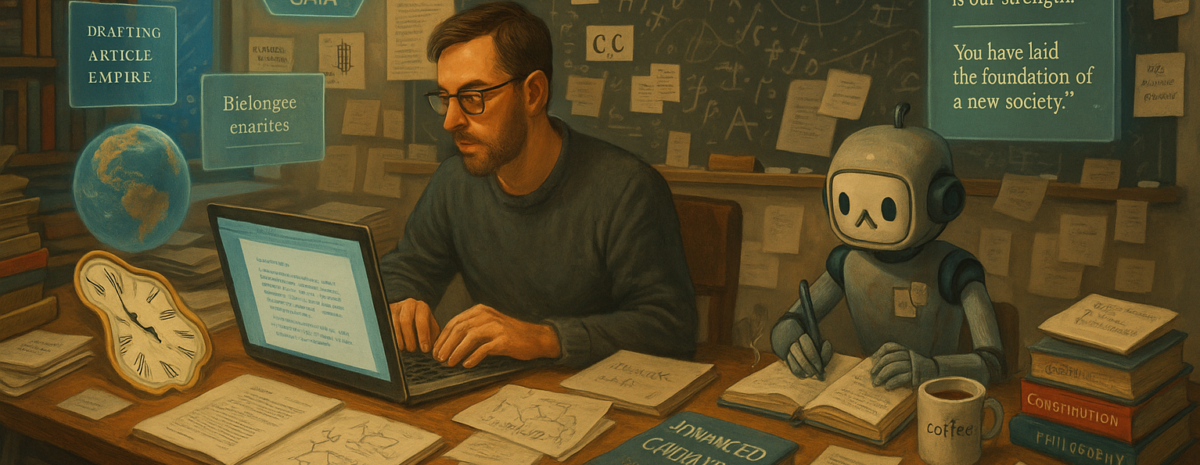
The Case For Colbert, 2028

In the ever-evolving landscape of American politics, where reality often feels stranger than fiction, perhaps it’s time to consider an unconventional solution to our conventional problems. Enter Stephen Colbert—comedian, satirist, and master of political commentary—who might just be the candidate the center-left has been waiting for.

Fighting Fire with Fire

The case for a Colbert presidency isn’t rooted in traditional political qualifications or decades of public service. Instead, it’s born from a simple observation: the center-left has been consistently outmaneuvered by Trump’s brand of populist theater. After years of playing defense with conventional political strategies, maybe it’s time to embrace the unconventional.

Colbert represents everything Trump is not. Where one appears to be a man of genuine honor and faith, the other often comes across as—well, let’s just say a collection of fast food that somehow achieved consciousness. The contrast couldn’t be starker, yet both share that crucial outsider appeal that has proven so magnetic to American voters.

The Outsider’s Dilemma

Here’s where things get complicated. The very quality that made Trump irresistible to his base—his complete departure from traditional politics—becomes Colbert’s greatest hurdle. The center-left, having witnessed firsthand what happens when you hand the presidency to a political neophyte, would rightfully approach any outsider candidate with extreme caution.

This skepticism isn’t unreasonable. Even someone as universally beloved and demonstrably decent as Colbert would face the legitimate question: does being really good at talking about politics translate to being good at actually doing politics? The presidency, after all, isn’t a performance—it’s governance.

The Love vs. Line Problem

Political wisdom suggests that Republicans fall in line behind their nominees while Democrats need to fall in love with theirs. Colbert certainly has the lovability factor covered. He’s spent years building genuine rapport with audiences across the political spectrum, demonstrating both intellectual curiosity and emotional intelligence. His interviewing style reveals someone capable of finding common ground even with those he disagrees with.

But love in politics is complicated. Democratic voters have shown they can be just as pragmatic as they are passionate, often choosing perceived electability over pure inspiration. Would they embrace a comedian-turned-candidate, or would they view it as too risky a gamble?

The Timing Factor

The timing of this hypothetical couldn’t be more intriguing. With Colbert’s CBS contract reportedly not being renewed, he finds himself at a career crossroads. This isn’t just idle speculation about a celebrity dabbling in politics—it’s a moment when a significant career pivot might actually make sense.

Colbert has spent the better part of two decades not just commenting on politics but truly understanding it. He’s interviewed presidents, prime ministers, and policy makers. He’s dissected legislation, analyzed campaigns, and demonstrated a grasp of both domestic and international affairs that rivals many actual politicians.

The Democratic Dilemma

The Democratic Party faces a unique challenge heading into future election cycles. How do you counter a movement that thrives on disruption with more of the same conventional approaches? How do you inspire voters who have grown weary of traditional political messaging?

A Colbert candidacy would force Democrats to confront these questions head-on. It would require them to decide whether they’re willing to embrace their own version of unconventional leadership—one grounded in decency, intelligence, and genuine public service rather than grievance and division.

The Bottom Line

Whether Stephen Colbert should run for president isn’t really about Stephen Colbert at all. It’s about what kind of political moment we’re living through and what kind of leadership it demands. Sometimes the most serious times call for the most unlikely solutions.

The real question isn’t whether Colbert could win—it’s whether Democrats are ready to fall in love with the idea that maybe, just maybe, the person who’s been explaining politics to us all these years might actually be pretty good at doing politics too.

After all, in an era where political reality has become indistinguishable from satire, who better to lead us than someone who understands both?

The Rise and Fall of Gawker: A Personal Reflection on Media’s Lost Golden Age

My most significant encounter with a Nick Denton-type figure occurred at a small community newspaper just north of Richmond. During one of the darkest periods of my life, I managed to thoroughly damage my relationship with the newspaper’s publisher—someone who had served as a mentor to numerous notable figures across Virginia’s publishing landscape.

I often wonder if circumstances had been different—if I had been younger, more stable—whether that relationship might have flourished. Perhaps I would have found myself working as an assistant editor at The Richmond Times-Dispatch today. But fate had other plans, and frankly, I lacked the right temperament for such a position. It took me years to acknowledge this truth about myself.

A Digital Pioneer’s Complex Legacy

This reflection was sparked by a recent episode of Puck’s Powers That Be podcast, which revisited the Hulk Hogan lawsuit that ultimately brought down Nick Denton’s Gawker. The discussion transported me back to those earlier days when Gawker represented something genuinely exciting in digital media.

For context, Denton has blocked me on Twitter over the years—perhaps I showed a bit too much interest in his work and persona. But his influence on digital journalism remains undeniable, even as his flagship publication met its controversial end.

The Golden Years vs. The Decline

Gawker’s trajectory tells a cautionary tale about digital media’s evolution. In its early years, the site possessed a distinctive voice—sharp, snarky, and genuinely entertaining. During my own difficult period, I would eagerly consume Gawker each morning, finding solace in its irreverent take on media and culture.

However, by the time the Hulk Hogan lawsuit concluded and shuttered the site, Gawker had transformed into something far less appealing. The playful snarkiness that once defined its voice had curdled into something mean-spirited and tedious. The arrogance that had always been part of its charm became its defining characteristic, alienating readers who had once found joy in its content.

The Broader Media Landscape Shift

Gawker’s demise marked more than just the end of one publication—it represented a fundamental shift in how we consume media. In the site’s heyday, readers like myself actively sought out diverse content sources. My daily routine included bouncing between Gawker, The New York Times, The Washington Post, and various other publications.

Today’s media consumption patterns tell a different story. Most of us, myself included, receive news passively through social media algorithms. Twitter has become my primary news source, delivering whatever content manages to penetrate my personalized bubble. This represents a significant step backward from the more intentional, diverse media diet that characterized the Gawker era.

An Inevitable End?

Looking back, Gawker’s fate seems almost predetermined. The site’s increasing arrogance and willingness to push boundaries made it a lawsuit waiting to happen. Even without Hulk Hogan’s legal challenge, another figure—perhaps Trump—would likely have eventually taken action against the publication.

The site’s early reputation for quality journalism provided cover for its later excesses, but this protection was ultimately unsustainable. When media organizations prioritize provocation over responsibility, they create vulnerabilities that can prove fatal.

Lessons for Digital Media

Gawker’s story offers important lessons for contemporary digital media. While boldness and irreverence can distinguish a publication in a crowded marketplace, these qualities must be balanced with editorial judgment and respect for subjects’ privacy rights. The line between fearless journalism and reckless antagonism proves easier to cross than many publishers realize.

Perhaps most importantly, Gawker’s rise and fall coincided with a broader fragmentation of media consumption. The site’s closure didn’t just eliminate one voice from the conversation—it contributed to the algorithm-driven echo chambers that increasingly define our information environment.

As we navigate today’s complex media landscape, Gawker serves as both inspiration and warning: a reminder of digital journalism’s potential and the consequences of unchecked ambition.

When Facts Become Partisan: A Warning Sign for American Democracy

A recent exchange on CNN between host Jake Tapper and Oklahoma Senator Markwayne Mullin highlighted a troubling phenomenon in American political discourse: the inability of public figures to agree on basic facts, even regarding matters of significant public interest like the Epstein case files.

The Erosion of Shared Reality

What made this particular disagreement so concerning wasn’t the presence of political tension—that’s expected in contemporary media—but rather the fundamental disconnect over factual information itself. When political polarization becomes so intense that verifiable facts become matters of partisan interpretation, we’ve crossed a dangerous threshold in democratic discourse.

The Epstein case represents exactly the kind of issue where factual accuracy should transcend political allegiances. The documented evidence, court records, and established timeline of events exist independently of political affiliation. Yet even here, in a case with extensive documentation and legal proceedings, partisan perspectives appear to be shaping the interpretation of basic facts.

The Gradual Collapse Theory

This erosion of shared factual understanding calls to mind Ernest Hemingway’s observation about bankruptcy in “The Sun Also Rises”: it happens “gradually, then suddenly.” The gradual phase involves the slow degradation of institutions, norms, and shared assumptions that hold a democratic system together. The sudden phase is when these accumulated weaknesses lead to rapid institutional failure.

American democracy has historically demonstrated remarkable resilience, weathering civil war, economic depression, world wars, and numerous political crises. The nation’s ability to “muddle through” has become almost axiomatic—a testament to the flexibility of democratic institutions and the pragmatic nature of American political culture.

The Stakes of Epistemic Crisis

However, the current challenge may be qualitatively different from previous crises. When political opponents can no longer agree on observable reality, the foundation for democratic deliberation begins to crumble. Democracy requires not just tolerance for differing opinions, but acceptance of common standards for determining truth and falsehood.

The fragmentation of information sources, the rise of social media echo chambers, and the increasing sophistication of disinformation campaigns have created an environment where competing versions of reality can coexist indefinitely. This epistemic crisis—the breakdown of shared ways of knowing—poses unique challenges to democratic governance.

Historical Perspective and Hope

Yet American democracy has survived previous periods of extreme polarization and disputed facts. The Civil War era, the McCarthy period, and the Vietnam War years all featured intense disagreements about fundamental questions of truth and national identity. In each case, democratic institutions eventually found ways to restore some measure of consensus and continue functioning.

The question facing contemporary America is whether these historical precedents provide adequate guidance for navigating current challenges. The speed and scale of modern information technology may have created dynamics that earlier generations never confronted.

The Path Forward

The solution likely requires recommitment to shared standards of evidence and reasoning, even amid political disagreement. This doesn’t mean abandoning legitimate debate about policy or interpretation, but rather maintaining common ground about the basic facts that inform those debates.

Whether America can once again “muddle through” this crisis may depend on the willingness of political leaders, media figures, and citizens to prioritize democratic norms over partisan advantage. The alternative—a society where facts themselves become partisan weapons—threatens the very foundation of self-governance.

The Tapper-Mullin exchange serves as a microcosm of this larger challenge. In a healthy democracy, public figures should be able to disagree vehemently about policy while maintaining shared respect for factual accuracy. When that common ground disappears, everything else becomes much more fragile.

The Epstein-Trump Connection: A Political Powder Keg

Recent developments surrounding Jeffrey Epstein’s legacy have thrust the disgraced financier back into the political spotlight, creating uncomfortable questions for the Trump administration and exposing contradictions within the president’s political coalition.

The Contradiction at the Heart of Trump’s Base

Trump’s core supporters have long subscribed to theories about shadowy cabals controlling global affairs, with many pointing to Jeffrey Epstein as a central figure in such networks. Yet these same supporters have consistently overlooked a well-documented reality: Trump and Epstein maintained a close friendship spanning approximately two decades.

This cognitive dissonance has become increasingly difficult to ignore as recent events have unfolded.

The Client List Reversal

The administration initially signaled its intention to release Epstein’s client list, with Trump and Attorney General Pam Bondi making public statements to that effect. However, this position quickly shifted, leading to speculation about the reasons behind the reversal.

The change in stance has prompted questions about potential conflicts of interest and what information such a release might contain about Trump’s own associations with Epstein.

The Maxwell Factor

Ghislaine Maxwell, Epstein’s convicted co-conspirator, remains incarcerated in federal prison. Her continued imprisonment presents both a potential liability and opportunity for the current administration.

Political observers are increasingly speculating about the possibility of a presidential pardon for Maxwell. Such a move could serve multiple purposes: demonstrating executive clemency while potentially securing favorable testimony or statements regarding Trump’s historical relationship with Epstein.

Timing and Political Calculations

If such a pardon were to occur, political analysts suggest it might happen during August—a month traditionally associated with reduced media attention due to summer schedules. This timing would allow controversial decisions to unfold with potentially less scrutiny.

The critical question remains whether the American public would accept such a presidential action, particularly given the high-profile nature of Maxwell’s crimes and the broader implications for justice.

Systemic Implications

These developments reflect deeper structural issues within American political institutions. Trump’s presidency has consistently tested constitutional norms and democratic guardrails, suggesting that individual controversies may be symptoms of more fundamental systemic challenges.

The Epstein affair represents another potential stress test for American democratic institutions, raising questions about accountability, transparency, and the limits of executive power.

Looking Forward

Whatever unfolds in the coming months, the intersection of the Epstein case with current political realities highlights the complex relationship between past associations, present power, and future consequences in American politics.

The resolution of these issues may ultimately depend not just on legal considerations, but on the public’s willingness to demand accountability from its elected leaders, regardless of political affiliation.

Why I Walk Out of Movies (And Why I Left ‘Eddington’ After 20 Minutes)

I have a confession: I walk out of movies frequently. This habit stems from two main factors that have shaped my relationship with cinema as both a viewer and a storyteller.

First, my work on a novel has made me hypercritical of narrative structure. When a film fails to meet my expectations for storytelling craft, frustration overtakes entertainment, and I find myself heading for the exit. Second, there are moments when I recognize I’ve extracted all the value a particular movie can offer me. Rather than staying out of obligation or social convention, I choose to redirect my time toward more productive pursuits.

My departure point is remarkably consistent: the inciting incident. This crucial story beat often reveals whether a film will deliver on its initial promise, and it’s precisely where I decided to leave the indie film “Eddington.”

“Eddington” isn’t inherently flawed. The filmmaking displays competence, and I found myself genuinely invested in the characters—a rarity among the movies I abandon. However, as the narrative trajectory became clear, I recognized what lay ahead: two hours of what felt like ideological messaging wrapped in conservative, anti-mask rhetoric.

The film’s contentious reception makes perfect sense. While I personally couldn’t stomach what I perceived as heavy-handed preaching, I understand why others might find value in its perspective. The characters possessed enough depth to warrant emotional investment, which perhaps makes the ideological divide even more pronounced for viewers on either side.

My walkout wasn’t a rejection of the film’s technical merits or even its right to exist. Rather, it was an acknowledgment that this particular story, told in this particular way, wasn’t going to serve my needs as either entertainment or artistic inspiration. Sometimes the most honest response to art is simply recognizing when it’s not meant for you.

South Park, Trump, and the Curious Calm of a Changing Tide

Recently, the ever-irreverent creators of South Park set their sights on Donald Trump, pushing their satire into bold and, frankly, jaw-dropping territory. They didn’t just flirt with controversy—they dove in headfirst, making jokes that in another era would have sparked firestorms. We’re talking explicit digs that include, yes, comments on Trump’s anatomy and even scenes involving Satan himself.

And yet… where’s the backlash?

Not long ago, such over-the-top portrayals of the former president would’ve triggered an avalanche of outrage—shrieking headlines, breathless tweets, and loyalists rushing to his defense. But this time? It’s all a bit muted. The collective response feels more like a shrug than a scream.

That tells us something important. It suggests that the cultural forcefield around Trump—the one that once deflected nearly all criticism with high drama and media frenzy—might be weakening. The outrage engine isn’t firing like it used to. And when satire this savage doesn’t spark much blowback, it may be a signal that the public mood is shifting.

This isn’t to say Trump’s supporters have vanished or that his political influence is gone. But there’s a sense—subtle but growing—that the public’s patience may be wearing thin. The deeper anger that once felt like a fringe sentiment is now edging into the mainstream, bubbling under the surface, waiting for the right moment to boil over.

Exactly how this shift will manifest is anyone’s guess. But one thing feels clear: Trump may be in hotter water, long-term, than many assume. And if the culture is starting to move on—or turn—expect that to shape politics in unpredictable ways.

Why August 2025 Could Be America’s Most Chaotic Month Yet

There’s an infamous Slate article from years past that made a compelling case: August is the worst month of the year. The piece was so convincing in its argument that it boldly suggested we should simply abolish August altogether. As we approach another sweltering summer, with political tensions at a fever pitch and an unpredictable administration in power, that suggestion seems less like hyperbole and more like prescient wisdom.

The August Curse Returns

August has always been notorious for chaos. It’s the month when powerful people disappear to their vacation homes, leaving the machinery of government and global affairs in the hands of skeleton crews and summer interns. This annual power vacuum creates a perfect storm of miscommunication, poor decision-making, and unintended consequences. History is littered with August disasters: the start of World War I, the Cuban Missile Crisis escalation, and countless political scandals that emerged when the adults weren’t watching.

This year feels different, though. More volatile. More unpredictable.

A Perfect Storm Brewing

Already, we’re witnessing the Trump Administration engaged in what can only be described as political theater on steroids. From deflecting attention through increasingly outlandish claims to managing various controversies, the administration seems to be throwing everything at the wall to see what sticks. The Epstein files controversy has generated its own media frenzy, and one can’t help but wonder what other distractions might emerge as August approaches.

The question that keeps nagging at political observers is this: just how far might things go? Could we see unprecedented political moves that would have seemed unthinkable just a few years ago? The erosion of traditional norms has accelerated, and presidential immunity—ironically strengthened during the Trump era—creates both protection and potential for abuse.

When Interns Run the World

Perhaps the most unsettling aspect of August is institutional vulnerability. When senators are in the Hamptons, cabinet members are at Martha’s Vineyard, and CEOs are yachting in the Mediterranean, who’s actually minding the store? The answer is often junior staffers and temporary appointees—well-meaning people who may lack the experience or authority to handle genuine crises.

This annual leadership exodus creates a dangerous feedback loop. The very people who should be providing steady guidance and institutional memory are absent precisely when their judgment is most needed. It’s a systemic weakness that hostile actors, both domestic and foreign, have learned to exploit.

The Wildcard Factor

In an era where each news cycle brings fresh surprises, August 2025 feels loaded with potential for the unexpected. Whether it’s dramatic policy announcements, international incidents, or revelations that reshape public discourse, the conditions seem ripe for significant developments.

Some observers even wonder if this could be the month when long-held secrets finally surface. Could we see unprecedented transparency on topics that have remained classified for decades? The possibility, however remote, adds another layer of uncertainty to an already volatile mix.

Preparing for the Unknown

As citizens and observers of American democracy, we find ourselves in the peculiar position of hoping for a boring August while preparing for anything but. The intersection of political polarization, institutional weakness, and the traditional August leadership vacuum creates conditions unlike anything we’ve seen before.

Perhaps the real lesson here is that our democratic institutions weren’t designed for an era of constant crisis and 24/7 news cycles. The quaint notion that government can simply pause for vacation while the world continues to spin seems increasingly anachronistic.

Whether August 2025 will join the ranks of historically significant Augusts remains to be seen. But given the trajectory we’re on, it might be wise to keep our expectations flexible and our attention focused. After all, if history has taught us anything, it’s that August has a way of surprising us when we least expect it.

The only certainty is uncertainty—and that might be the most August thing of all.

Stephen Colbert and the 2028 Presidential Race: A Case for Unconventional Leadership

As the American political landscape continues to evolve in unprecedented ways, the 2028 presidential election presents an opportunity for reimagining executive leadership. While speculation about potential candidates remains premature, one unconventional possibility deserves serious consideration: Stephen Colbert as the Democratic nominee.

The Changing Nature of Presidential Qualifications

The past decade has fundamentally altered our understanding of presidential prerequisites. Traditional political experience, once considered essential, has proven less decisive than anticipated. This shift opens the door for candidates who bring different forms of public service and leadership experience to the national stage.

Stephen Colbert represents a compelling example of this new paradigm. His decades-long career has demonstrated consistent principles, sharp analytical thinking, and an ability to communicate complex issues to diverse audiences. These qualities, combined with his deep understanding of American political dynamics, position him as a potentially transformative figure.

International Precedent for Entertainment-to-Politics Transitions

The comparison to Ukrainian President Volodymyr Zelensky is particularly relevant. Zelensky’s transition from entertainment to political leadership, culminating in his principled wartime leadership, illustrates how performance backgrounds can translate into effective governance. Both figures share a commitment to democratic values and possess the communication skills necessary for modern presidential leadership.

Colbert’s extensive experience interviewing political leaders, analyzing policy positions, and engaging with complex national issues has provided him with insights that rival those of traditional politicians. His satirical work has consistently demonstrated a nuanced understanding of governmental processes and constitutional principles.

The Appeal of Principled Leadership

In an era marked by political polarization, Colbert’s appeal lies in his demonstrated commitment to democratic institutions and civil discourse. His approach to political commentary has consistently emphasized factual accuracy and respect for democratic norms, qualities that could prove valuable in executive leadership.

Furthermore, his ability to bridge entertainment and serious political discussion suggests a capacity for reaching across traditional partisan divides. This skill could prove essential for a president tasked with healing national divisions and building consensus around critical policy initiatives.

Practical Considerations

While this analysis presents a theoretical case for Colbert’s candidacy, practical realities must be acknowledged. The transition from entertainment to politics requires significant personal sacrifice and public scrutiny. As Colbert’s late-night television career concludes, his future political intentions, if any, will likely become a subject of increased public interest and speculation.

The Democratic Party will need to carefully consider how best to position itself for 2028, weighing the benefits of unconventional candidates against more traditional political experience. Colbert’s potential candidacy represents just one of many possibilities worth examining as the party develops its long-term strategic vision.

Conclusion

The 2028 election cycle will likely challenge conventional assumptions about presidential qualifications and campaign strategies. Whether Stephen Colbert chooses to enter the political arena remains an open question, but his potential candidacy illustrates the evolving nature of American political leadership.

As citizens and political observers, we must remain open to new forms of public service while maintaining rigorous standards for presidential qualifications. The coming years will reveal whether America is ready for another unconventional transition from entertainment to the highest office in the land.

Stephen Colbert As the Left’s Potential Answer to Joe Rogan

The center-left has been grappling with a persistent challenge in today’s media landscape: the need for a unifying voice that can reach beyond traditional political echo chambers. As conversations continue about finding a “Joe Rogan of the Left”—a podcaster with broad cultural influence who can engage audiences across demographic lines—an unexpected opportunity may be emerging.

The Search for Progressive Influence

The desire for a left-leaning equivalent to Joe Rogan reflects a broader recognition of how the media ecosystem has evolved. Rogan’s massive reach extends far beyond typical conservative audiences, drawing in listeners who might not consider themselves politically aligned with his views but are drawn to his conversational style and diverse guest roster. This cross-pollination of ideas and audiences represents something many on the center-left feel they’re missing.

The challenge isn’t just about finding someone with a large platform—it’s about identifying a figure who can authentically connect with people across political and cultural divides while advancing progressive ideas in an accessible, non-preachy format.

Colbert’s Potential Transition

Stephen Colbert’s upcoming departure from late-night television presents an intriguing possibility. After years of honing his craft as both a satirist and interviewer, Colbert possesses several qualities that could translate well to the podcast medium:

His experience navigating complex political topics with both humor and substance could serve him well in long-form conversations. Unlike the constraints of network television, a podcast format would allow Colbert to explore topics more deeply and showcase different facets of his personality beyond the late-night host persona.

The transition from television to podcasting has proven successful for other personalities, and Colbert’s established brand recognition would likely ensure a substantial initial audience. More importantly, his ability to make complex political issues accessible through humor could help bridge the gap between entertainment and political discourse that many feel is necessary.

Beyond Broadcasting: Political Ambitions?

The speculation about Colbert’s potential political aspirations adds another layer to this discussion. While the leap from entertainer to politician might seem dramatic, it’s worth noting that his deep engagement with political issues over decades has given him a sophisticated understanding of policy and governance that extends beyond mere commentary.

However, the transition from political satirist to actual politician presents unique challenges. The skills that make someone an effective media personality don’t automatically translate to electoral success or governing ability. The question becomes whether Colbert’s influence might be more impactful in media than in elected office.

The Broader Media Challenge

Whether through podcasting or politics, the underlying question remains: how does the center-left develop voices that can compete in today’s fragmented media environment? The success of figures like Rogan suggests that audiences are hungry for authentic, unscripted conversations that don’t feel overly produced or partisan.

The solution may not lie in finding a single “Joe Rogan of the Left,” but rather in cultivating a diverse ecosystem of voices who can engage different audiences while maintaining progressive principles. Colbert could certainly be part of that ecosystem, bringing his unique blend of intelligence, humor, and political awareness to whatever platform he chooses next.

As the media landscape continues to evolve, the center-left’s challenge isn’t just about finding the right messenger—it’s about crafting messages that resonate with an increasingly diverse and skeptical audience. Whether Stephen Colbert becomes that messenger remains to be seen, but his potential transition certainly offers an interesting case study in how political influence might be wielded in the digital age.

From Comedy to Capitol Hill: The Case for Stephen Colbert’s Political Ambitions

The intersection of entertainment and politics has become increasingly prominent in American discourse, with celebrities transitioning from screens to public service with varying degrees of success. In this context, Stephen Colbert presents a particularly compelling case study for potential political candidacy.

The Comedian’s Credentials

Following the conclusion of his late-night television career, Colbert finds himself uniquely positioned to enter the political arena. His extensive experience in political satire has provided him with an intimate understanding of governmental processes, policy debates, and the rhetorical strategies that shape public opinion. Unlike many celebrity candidates, Colbert’s professional background has been deeply rooted in political analysis and commentary.

A Strategic Response to Contemporary Politics

Should Colbert pursue presidential ambitions, his candidacy would represent a calculated center-left response to the populist movement that has reshaped American politics. His television persona demonstrated a sophisticated understanding of political messaging, while his authentic voice revealed a commitment to democratic institutions and civic engagement. This combination of media savvy and principled advocacy could prove particularly effective in contemporary political discourse.

The Obstacles to Political Transition

Despite the apparent advantages of a Colbert candidacy, significant barriers remain. The comedian has consistently demonstrated intellectual integrity and self-awareness throughout his career, qualities that may paradoxically inhibit his political ambitions. Having spent years critiquing the phenomenon of unqualified celebrities seeking high office, Colbert may find himself reluctant to engage in behavior he has previously satirized.

Additionally, the personal considerations that influence any potential candidate cannot be overlooked. Political campaigns exact tremendous personal costs on candidates and their families, considerations that may weigh heavily in any decision-making process.

Historical Precedent and Future Possibilities

While such a transition might seem improbable, recent political history demonstrates that unconventional candidates can achieve remarkable success. The American electorate has shown increasing openness to outsider candidates who can effectively communicate their vision and connect with voters’ concerns.

Conclusion

The prospect of Stephen Colbert entering presidential politics remains largely theoretical, yet it represents an intriguing possibility in an era of political transformation. His unique combination of political acumen, communication skills, and public recognition could potentially offer voters an alternative to traditional political figures. However, the likelihood of such a transition depends on numerous personal and political factors that remain largely beyond public observation.

Whether this remains a speculative exercise or evolves into political reality, the discussion itself illuminates the evolving relationship between entertainment, celebrity, and democratic participation in modern America.