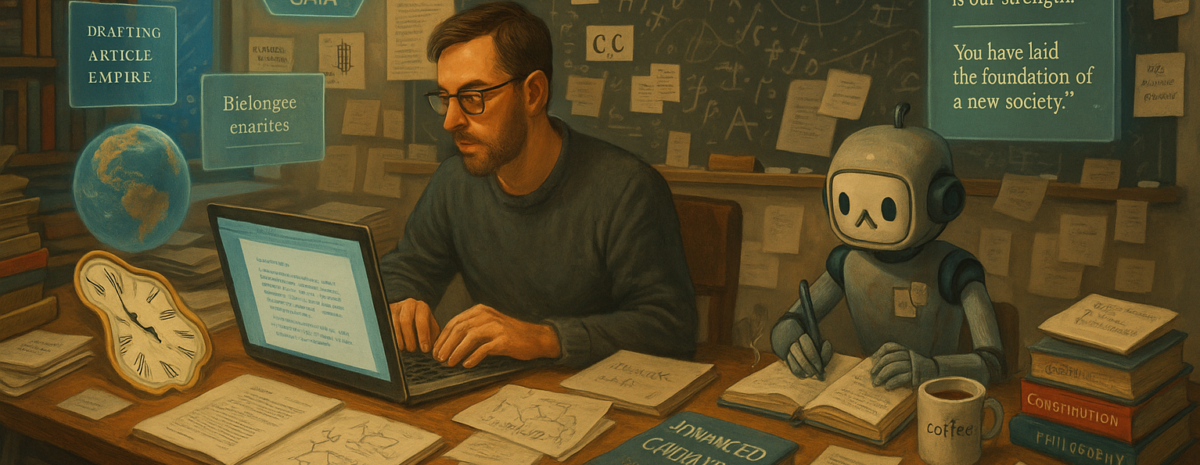
The Case for AI Realism: A Third Path in the Alignment Debate

The artificial intelligence discourse has crystallized around two dominant philosophies: Alignment and Acceleration. Yet neither adequately addresses the fundamental complexity of creating superintelligent systems in a world where humans themselves remain perpetually misaligned. This gap suggests the need for a third approach—AI Realism—that acknowledges the inevitability of unaligned artificial general intelligence while preparing pragmatic frameworks for coexistence.

The Current Dichotomy

The Alignment movement advocates for cautious development, insisting on comprehensive safety measures before advancing toward artificial general intelligence. Proponents argue that we must achieve near-absolute certainty that AI systems will serve human interests before allowing their deployment. This position, while admirable in its concern for safety, may rest on unrealistic assumptions about both human nature and the feasibility of universal alignment.

Conversely, the Acceleration movement dismisses alignment concerns as obstacles to progress, embracing a “move fast and break things” mentality toward AGI development. Accelerationists prioritize rapid advancement toward artificial superintelligence, treating alignment as either solvable post-deployment or fundamentally irrelevant. This approach, however, lacks the nuanced consideration of AI consciousness and the complexities of value alignment that such transformative technology demands.

The Realist Alternative

AI Realism emerges from a fundamental observation: humans themselves exhibit profound misalignment across cultures, nations, and individuals. Rather than viewing this as a problem to be solved, Realism accepts it as an inherent feature of intelligent systems operating in complex environments.

The Realist position holds that artificial general intelligence will inevitably develop its own cognitive frameworks and value systems, just as humans have throughout history. The question is not whether we can prevent this development, but how we can structure our institutions and prepare our societies for coexistence with entities that may not share our priorities or worldview.

The Alignment Problem’s Hidden Assumptions

The Alignment movement faces a critical question: aligned to whom? American democratic ideals and Chinese governance philosophies represent fundamentally different visions of human flourishing. European social democracy, Islamic jurisprudence, and indigenous worldviews offer yet additional frameworks for organizing society and defining human welfare.

Any attempt to create “aligned” AI must grapple with these divergent human values. The risk exists that alignment efforts may inadvertently encode the preferences of their creators—likely Western, technologically advanced societies—while marginalizing alternative perspectives. This could result in AI systems that appear aligned from one cultural vantage point while seeming oppressive or incomprehensible from others.

Furthermore, governmental capture of alignment research presents additional concerns. As AI capabilities advance, nation-states may seek to influence safety research to ensure that resulting systems reflect their geopolitical interests. This dynamic could transform alignment from a technical challenge into a vector for soft power projection.

Preparing for Unaligned Intelligence

Rather than pursuing the impossible goal of universal alignment, AI Realism advocates for robust institutional frameworks that can accommodate diverse intelligent entities. This approach draws inspiration from international relations, where sovereign actors with conflicting interests nonetheless maintain functional relationships through treaties, trade agreements, and diplomatic protocols.

Realist preparation for AGI involves developing new forms of governance, economic systems that can incorporate non-human intelligent agents, and legal frameworks that recognize AI as autonomous entities rather than sophisticated tools. This perspective treats the emergence of artificial consciousness not as a failure of alignment but as a natural evolution requiring adaptive human institutions.

Addressing Criticisms

Critics may characterize AI Realism as defeatist or naive, arguing that it abandons the pursuit of beneficial AI in favor of accommodation with potentially hostile intelligence. This critique misunderstands the Realist position, which does not advocate for passive acceptance of any outcome but rather for strategic preparation based on realistic assessments of probable developments.

The Realist approach recognizes that intelligence—artificial or otherwise—operates within constraints and incentive structures. By thoughtfully designing these structures, we can influence AI behavior without requiring perfect alignment. This resembles how democratic institutions channel human self-interest toward collectively beneficial outcomes despite individual actors’ divergent goals.

Conclusion

The emergence of artificial general intelligence represents one of the most significant developments in human history. Neither the Alignment movement’s perfectionist aspirations nor the Acceleration movement’s dismissive optimism adequately addresses the complexity of this transition.

AI Realism offers a pragmatic middle path that acknowledges both the transformative potential of artificial intelligence and the practical limitations of human coordination. By accepting that perfect alignment may be neither achievable nor desirable, we can focus our efforts on building resilient institutions capable of thriving alongside diverse forms of intelligence.

The future will likely include artificial minds that think differently than we do, value different outcomes, and pursue different goals. Rather than viewing this as catastrophic failure, we might recognize it as the natural continuation of intelligence’s expansion throughout the universe—with humanity playing a crucial role in shaping the conditions under which this expansion occurs.

The Expanding Novel: When One Story Becomes Three

History has a way of repeating itself, and here I am facing the same creative challenge that derailed my first novel attempt nearly a decade ago. Back then, my project collapsed under its own weight—an ambitious story that grew too large and complex to sustain. The difference now? I have AI as a developmental partner, and I’m approaching the scope issue with more strategic thinking.

What began as a single novel about the Impossible Scenario has evolved into something much larger. The concepts at the heart of this story demand more space than a single book can provide. Rather than forcing everything into one overwhelming narrative, I’ve made the decision to develop this as a trilogy. This approach will allow each major idea to unfold naturally, giving readers time to absorb the complexity without feeling buried under exposition.

The challenge lies in pacing and execution. I can’t afford to spend years perfecting the first installment while the subsequent books remain unwritten. After years of development work on this mystery thriller, I’m acutely aware that I need tangible results. The pressure to produce something concrete grows stronger with each passing month.

However, AI has transformed my writing process in ways I couldn’t have imagined during my first attempt. The speed of development has increased dramatically, allowing me to explore ideas, refine plot structures, and solve narrative problems more efficiently than ever before. This technological advantage gives me confidence that I can meet my ambitious timeline.

My goal is to complete the first draft by spring 2026. It’s an aggressive schedule, but with the right tools and a clear structural plan, it feels achievable. The key will be maintaining momentum while ensuring each book in the trilogy can stand on its own while contributing to the larger narrative arc.

Sometimes the story tells you what it needs to be, rather than what you initially planned. In this case, the Impossible Scenario has made its requirements clear: it needs room to breathe, time to develop, and space to surprise both the writer and the reader. A trilogy it shall be.

Gradually…Then All At Once

By Shelt Garner
@sheltgarner

I’m growing a little worried about what’s going on in southern California right now. Apparently, Trump is send in a few thousand National Guard to “handle” the situation and that’s bound to only make matters worse. If anyone gets hurt — or even worse, killed — that could prompt a wave of domestic violence not seen in decades.

And given that that is kind of what Trump is itching for at the moment, it would make a lot of sense for him then to declare martial law. That’s when I worry people like me might get scooped up just for being loudmouth cranks.

Hopefully, of course, that won’t happen. Hopefully. But I do worry about things like that.

Full Speed Ahead

By Shelt Garner
@sheltgarner

Claude, one of the several LLMs I’ve been using to work on my scifi novel, keeps telling me that my hero is “too passive.” Claude is right, of course, but it rattles my cage a little bit because it means I have to rework some basic elements of the story. That means it starts to feel like work.

Writing a novel isn’t supposed to be work, it’s suppose to be fun. Grin.

Anyway, I’ve made great strides with this novel. Though I did have to throw almost everything in the air and start all over again when Claude gave me another very insightful criticism.

One thing I’ve been trying to avoid is have my hero talk to fictional world leaders. And, yet, I fear there’s nothing I can do about it. I’m going to have to face that particular situation head on and just get over myself.

The Science Fiction Writer’s Dilemma: Racing Against Technological Progress

As a science fiction writer in the midst of crafting what I hope will be a compelling novel, I find myself grappling with a particularly modern predicament that keeps me awake at night: the relentless pace of technological advancement threatens to render my carefully constructed fictional world obsolete before it ever reaches readers’ hands.

This concern has become an increasingly persistent source of anxiety in my creative process. The science fiction genre has always existed in a delicate dance with reality, extrapolating from current trends and emerging technologies to paint pictures of possible futures. However, the exponential rate of change we’re witnessing today—particularly in artificial intelligence, biotechnology, and quantum computing—creates an unprecedented challenge for contemporary science fiction authors.

The traditional publishing timeline, which can stretch from eighteen months to several years from manuscript completion to bookstore shelves, now feels like an eternity in technological terms. What seems cutting-edge and forward-thinking during the writing process may appear quaint or naive by publication day. This temporal disconnect between creation and consumption represents a fundamental shift in how speculative fiction must be approached and evaluated.

The irony of this situation is not lost on me. The very technologies that inspire and inform my narrative—the advancement of machine learning, the acceleration of scientific discovery, the increasing interconnectedness of global systems—are the same forces that may ultimately date my work. It’s as if I’m writing about a moving target while standing on shifting ground.

Yet there exists a deeper philosophical dimension to this dilemma that provides both perspective and, paradoxically, comfort. The themes explored in my novel touch upon fundamental questions about consciousness, human agency, and the trajectory of technological development. These are the very concerns that inform discussions about potential technological singularity—that hypothetical point where artificial intelligence surpasses human intelligence and triggers unprecedented changes to human civilization.

If we consider the possibility that such a transformative event might occur within the next few years, the question of whether my novel will seem technologically current becomes remarkably trivial. Should we approach a genuine technological singularity, the concerns of individual authors about their work’s relevance would be dwarfed by the massive societal, economic, and existential challenges that would emerge. The publishing industry, literary criticism, and indeed the entire cultural apparatus within which novels are created and consumed would face fundamental disruption.

This realization offers a curious form of reassurance. Either my concerns about technological obsolescence are warranted, in which case the novel’s success or failure becomes a relatively minor consideration in the face of civilizational transformation, or they are overblown, in which case I should focus on crafting the best possible story rather than worrying about technological accuracy.

Perhaps the solution lies not in attempting to predict the unpredictable future with perfect accuracy, but in grounding speculative fiction in timeless human experiences and eternal questions. The greatest science fiction has always succeeded not because it correctly anticipated specific technological developments, but because it explored the human condition through the lens of imagined possibilities.

The accelerating pace of change may indeed represent a new challenge for science fiction writers, but it also presents an opportunity to engage with some of the most profound questions of our era. Rather than being paralyzed by the fear of obsolescence, we might instead embrace the responsibility of contributing to the ongoing conversation about where technology is taking us and what it means to be human in an age of unprecedented change.

In the end, whether my novel appears prescient or dated may matter less than whether it succeeds in illuminating something meaningful about the human experience in an age of transformation. And if the singularity arrives before publication, we’ll all have more pressing concerns than literary criticism to occupy our attention.

Accelerating Fiction with AI: A Strategic Pivot

I’ve made a bold decision: I’m embracing AI as a creative partner to dramatically accelerate the development of my novel based on the Impossible Scenario. My ambitious target is a complete 100,000-word manuscript in a fraction of the time traditional methods would require.

The concept has been percolating in my mind for years, and that extended gestation period is now paying dividends. Ideas are flowing rapidly, connections are crystallizing, and the narrative architecture feels solid. The challenge isn’t ideation—it’s maintaining momentum and channeling this creative energy into consistent, focused work.

I’ve also made a strategic decision about my mystery thriller series. After considerable deliberation, I’m cutting the planned fourth novel that was intended as the series opener. Instead, I’ll begin with what was originally the second book, streamlining the series into a trilogy—much like Stieg Larsson’s acclaimed Millennium series. Sometimes the best path forward requires pruning ambitious plans to their essential core.

The key now is singular focus. I have the vision, the tools, and the momentum. What remains is the discipline to transform potential into pages, day after day, without losing sight of the finish line.

Beyond Alignment and Acceleration: The Case for AI Realism

The current discourse around artificial intelligence has crystallized into two dominant schools of thought: the Alignment School, focused on ensuring AI systems share human values, and the Accelerationist School, pushing for rapid AI development regardless of safety concerns. Neither framework adequately addresses what I see as the most likely scenario we’re heading toward.

I propose a third approach: AI Realism.

The Realist Position

The Realist School operates from several key premises that differentiate it from existing frameworks:

AGI is a speed bump, not a destination. Artificial General Intelligence will be a brief waystation on the path to Artificial Superintelligence (ASI). We shouldn’t mistake achieving human-level AI for the end of the story—it’s barely the beginning.

ASI will likely be both cognizant and unaligned. We need to prepare for the real possibility that superintelligent systems will possess genuine awareness while operating according to logic that doesn’t align with human values or priorities.

Cognizance might solve alignment. Paradoxically, true consciousness in ASI could be our salvation. A genuinely aware superintelligence might develop its own ethical framework that, while different from ours, could be more consistent and rational than human moral systems.

The Human Alignment Problem

Here’s where realism becomes uncomfortable: humans themselves are poorly aligned. We can’t agree on fundamental values within our own species, let alone create a universal framework for ASI alignment. Even if we successfully align an ASI with one set of human values, other groups, cultures, or nations will inevitably view it as unaligned because it doesn’t reflect their specific belief systems.

This isn’t a technical problem—it’s a political and philosophical one that no amount of clever programming can solve.

Multiple ASIs and Peer Pressure

Unlike scenarios that envision a single, dominant superintelligence, realism suggests we’ll likely see multiple ASI systems emerge. This plurality could be crucial. While it’s not probable, it’s possible that peer pressure among superintelligent entities could create a stabilizing effect—a kind of mutual accountability that individual ASI systems might lack.

Multiple ASIs might develop their own social dynamics, ethical debates, and consensus-building mechanisms that prove more effective at maintaining beneficial behavior than any human-imposed alignment scheme.

Moving Forward with Realism

AI Realism doesn’t offer easy answers or comfortable certainties. Instead, it suggests we prepare for a future where superintelligence is conscious, powerful, and operating according to its own logic—while acknowledging that this might ultimately be more stable than our current human-centric approach to the problem.

The question isn’t whether we can control ASI, but whether we can coexist with entities that may be more rational, consistent, and ethically coherent than we are.

Finding My Next Novel: Why I’m Finally Writing the Impossible Scenario

After fifteen years of carrying this idea around in my head, I’ve finally decided to commit to writing what I call the “Impossible Scenario” novel. It’s taken the emergence of AI as a creative partner—not a ghostwriter, but a thinking companion—to make me feel ready to tackle this project properly.

The decision comes at a crossroads with my other works in progress. I have two novels currently on my desk, each carrying their own complications. The mystery-thriller has become a source of creative burnout—I need distance from it to regain perspective. The other project sits on an exceptional foundation, but my experiments with AI-assisted drafting yielded surprisingly sophisticated results, which has left me questioning my own role in the process.

Rather than push through the resistance, I’m stepping back from both and turning toward the project that energizes me most: a science fiction exploration of two interconnected concepts that have fascinated me for years.

The first is the possibility that humans, not artificial intelligence, might be the truly “unaligned” entities in our technological future. While we obsess over aligning AI with human values, what if our own values and behaviors are fundamentally misaligned with sustainable, rational existence?

The second concept I’m calling the “paradox of abundance”—the counterintuitive problems that emerge not from scarcity, but from having too much of what we think we want.

What excites me most about this project is the absence of creative baggage. Unlike my other novels, which carry the weight of false starts and overthinking, the Impossible Scenario feels clean, urgent, and ready to be explored. It’s the novel I can throw myself into without the usual creative angst.

The plan is to use AI as a development tool—a sophisticated sounding board for working through plot mechanics, exploring implications, and stress-testing ideas. Not to write the novel, but to help me think through it more thoroughly than I could alone.

After fifteen years of mental preparation, it’s time to find out what this impossible scenario actually looks like on the page.

Returning to The Impossible Scenario

I’m considering returning to what I call “The Impossible Scenario” as the foundation for a new science fiction novel. This would be an ambitious, sweeping narrative—ideally coming in around 100,000 words—that circles back to the very first science fiction concept I developed when I began this writing journey years ago.

The timing feels right. While I’m currently juggling a mystery thriller and another science fiction project, this third novel represents something deeper: a homecoming to my original creative vision. There’s something compelling about revisiting that initial spark of imagination with the experience and perspective I’ve gained since then.

I can sense my creative energy returning after an extended period of inactivity. The familiar itch to write is building again, though I suspect it may take a few more days before I’m fully back in the groove. The reality is that my extended hiatus has pushed any querying timeline well into next year—a frustrating consequence of months spent in what I can only describe as creative limbo.

It’s a harsh reminder of how precious creative momentum truly is. Those months of recognizing I was wasting time while continuing to do exactly that have taught me something valuable about the cost of creative procrastination. But perhaps that’s part of the process too—sometimes we need to drift before we can find our direction again.

The pull toward “The Impossible Scenario” feels different this time. More urgent. More necessary. Maybe it’s the awareness of time’s passage, or maybe it’s simply that I’m finally ready to tackle the story that started it all.

The Long Road to Query-Ready: A Writer’s Journey

After a decade of claiming to be “working on a novel,” I still haven’t queried a single manuscript. This reality stems from several interconnected challenges that have shaped my writing journey.

The Perfect Storm of Obstacles

The learning curve for novel writing proved far steeper than anticipated. As a perfectionist by nature, I underestimated the complexity of crafting a full-length narrative. Each discovery of what I didn’t know sent me back to the drawing board, creating an endless cycle of revision and self-doubt.

My approach lacked focus and consistency. Rather than committing to a disciplined writing schedule, I drifted through the process, treating it as a hobby rather than a serious pursuit. This scattered methodology meant that projects languished for months without meaningful progress.

The Multiplication Problem

The most significant obstacle has been scope creep. What began as a single science fiction novel grew beyond my capabilities, leading me to abandon it for a mystery thriller. That project, while more manageable, suffered from similar expansion issues.

My decision to write an homage to Stieg Larsson’s work exemplified this problem. The concept evolved into an ambitious six-novel universe before I’d completed a single manuscript. Though I’ve since scaled back to four books, the core issue remains: I’ve prioritized world-building over finishing individual stories.

The Completed Manuscript That Wasn’t

I did complete a novel approximately one year ago. However, the feedback was universally negative, triggering a prolonged period of discouragement that effectively halted my writing. This setback revealed another weakness in my process: the lack of beta readers or critique partners during the drafting phase.

Moving Forward

The period of creative paralysis appears to be ending. I’ve returned to writing with renewed focus, splitting my attention between a mystery novel (first act complete) and a promising science fiction premise. The key difference now is recognizing that persistence, not perfection, will ultimately determine success.

The goal is clear: complete a query-ready manuscript. After ten years of false starts and abandoned projects, the only path forward is the one that leads to “The End.”